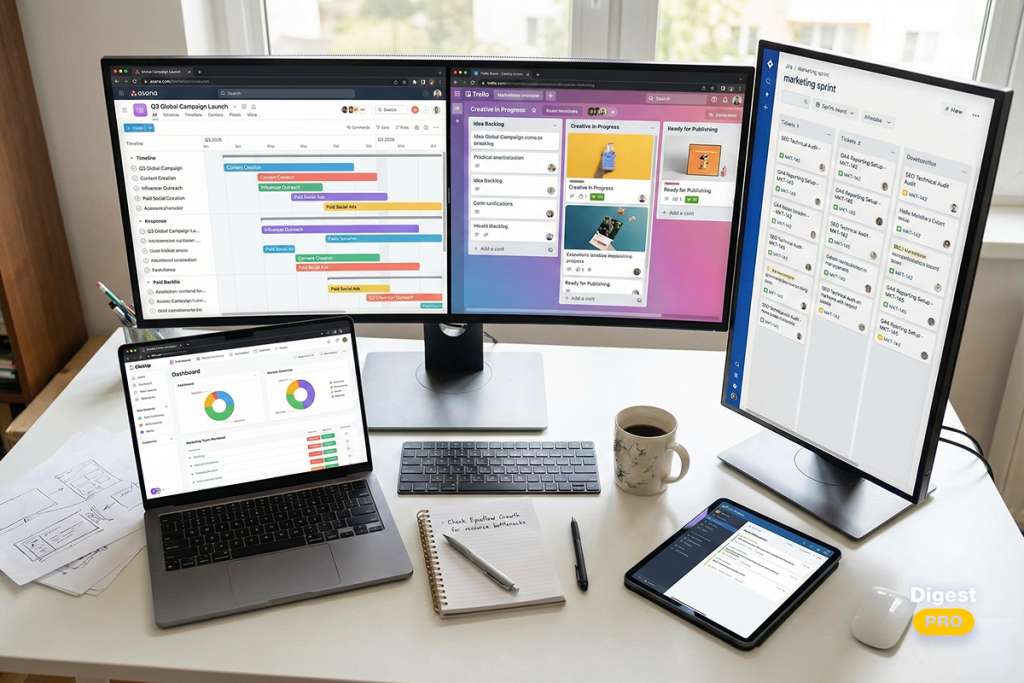
Different marketing companies have absolutely different approaches to manage their projects. Some use complex hybrid methodologies and need highly scalable tools to manage various campaigns simultaneously, while others rely just on simple Kanban boards. The diversity of systems that help organizations deliver the best results in marketing project management is extremely huge. So, here we face a difficult question: how to select a tool specifically for my situation?
In this guide we’ll present to you the top 10 best project management tools for marketing in 2026 and give some recommendations on how to choose the right one for your organization.
So, let’s get started.
What Are The Marketing Project Management Tools?
Marketing project management tools are a software designed specifically for marketing project management. They help teams to plan marketing campaigns, organize and execute them effectively to deliver the best outcomes. Most often marketing project management tools combine the traditional project management software features, like task tracking and scheduling, with special ones that address directly the complexities of modern marketing, such as changing priorities, performance tracking, dependency management, resource allocation, and so on.
How exactly do they solve these problems? Project management tools for marketing teams create the single source of truth for all team members, helping you collaborate better to invent new ideas for campaigns and track efficiency and possible bottlenecks in real-time.
Now, when we know more about marketing project management tools, let’s dive deeper into the key features that will drive your business to success.
Key Features of Marketing Project Management Tools
When you will select marketing project management software it is important to pay your attention to the features that increase the team’s productivity and deliver measurable results. You should look for the following ones:
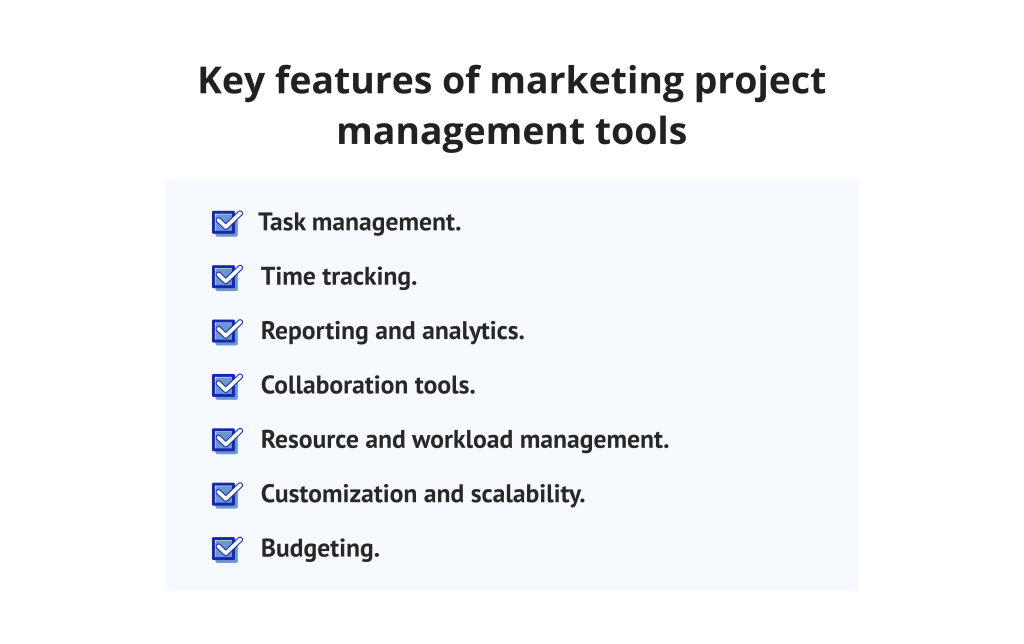
- Task management: it allows for assigning and managing tasks within the team to ensure that each team member knows their responsibilities and project deadlines.
- Time tracking: it helps to monitor the amount of time spent on different tasks and processes. You can detect bottlenecks or blocks that slow processes down and manage them to increase productivity.
- Reporting and analytics: this feature in marketing project management tools helps to identify and highlight potential risks and mitigate them in advance to speed the growth and increase revenue.
- Collaboration tools: they remove messaging through emails and make communication within the team faster and clearer.
- Resource and workload management: it allows organizations to allocate and monitor their resources, ensuring timely campaign delivery without overloads.
- Customization and scalability: this point is about the ability to add more advanced features to the tool or upgrade the plan without losing the current project data. It is an essential feature especially for growing businesses.
- Budgeting: this feature helps to monitor the project costs and prevent overspending in less impactful initiatives. It’s extremely important while dealing with a limited budget to spread the money efficiently.
Read More: Best Change Management Tools: Features, Use Cases & How to Choose the Right Software
Benefits of Marketing Project Management Tools
As we already discussed, tools for marketing project management offer a wide range of advantages that directly impact the project’s productivity and success rates. Want you to know what else they can offer?
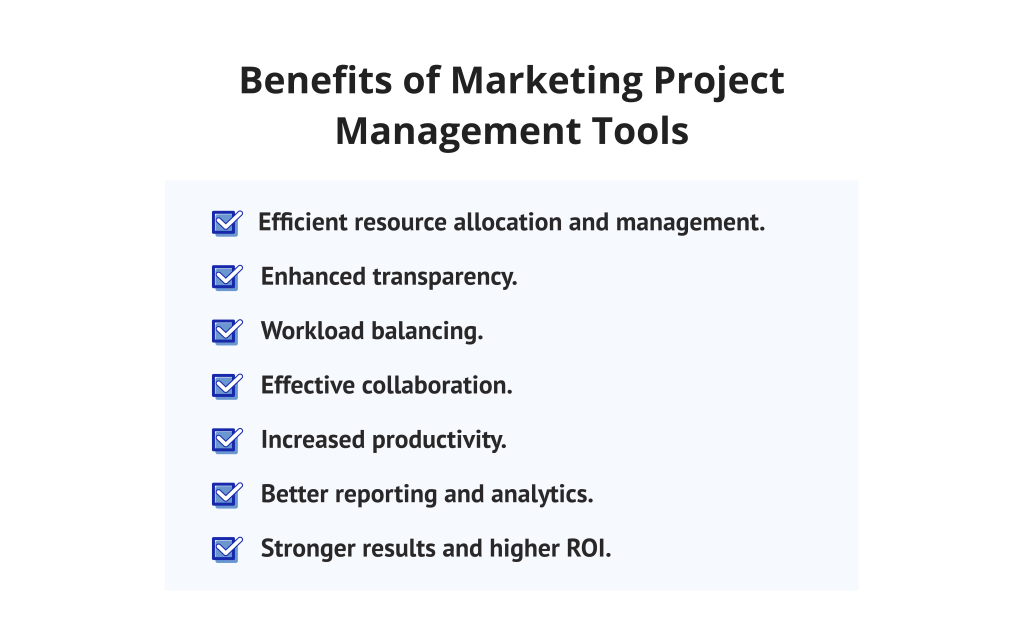
1. Efficient resource allocation and management.
Tools for marketing project management allows companies to allocate the right resources to the right processes and tasks at the right time. This, in turn, helps to:
- Reduce cost spending and eliminate waste.
- Track if the projects have enough time or human resources to meet the demand.
- Forecast and prevent potential bottlenecks.
- Ensure team members with the right skills handle tasks that match their expertise.
2. Enhanced transparency.
Modern marketing campaigns require a unified system that will help to manage task dependencies, priorities, deadlines, and responsibilities within the team. Marketing project management tools give you a full visibility of all ongoing processes through:
- Centralizing all tasks, deadlines, and dependencies.
- Allowing every team member to see real-time project status.
- Giving managers an overview of current workloads and progress.
- Reducing the number of meetings to save time for more important tasks.
3. Workload balancing.
Another major problem that many marketing teams face is unbalanced workloads. To be more precise, it is a situation when teams fall into one of two traps:
- Overbooking: when teams are overwhelmed with too many tasks and having not enough time. It is the most common cause of burnouts and delays.
- Underutilization: employee’s time and potential isn’t used fully and workers have a lot of free time, while others are struggling with overload.
Marketing project management tools helps companies avoid this problem by providing a cohesive dashboards and workload charts that:
- Show how many tasks each team member is currently handling.
- Help managers to analyze resource group output vs. capacity to drive efficiency.
- Prevent team burnout and set realistic tasks.
- Predict future workload for upcoming months with more advanced features.
All of these makes teams stronger and healthier, delivering better results.
4. Effective collaboration.
Marketing relies on constant communication between team members. So, really often teams need marketing project management tools to bridge the gap between employees by removing fragmented communication through emails, chats and spreadsheets, so everyone can be on the safe side. They provide:
- Shared workspaces for tasks, comments, and reports.
- Real-time updates when tasks are completed or changed.
- Centralized source for every team member.
5. Increased productivity.
From points described above, we can conclude that collaboration, structured workflows, automation, and visibility contributes to significant productivity boost across the entire team. In terms of productivity, tools for marketing project management help teams:
- Automate repetitive and time-wasting processes such as approvals, status updates, and so on.
- Simplify task tracking.
- Avoid delays and missed deadlines.
Here productivity increases naturally just because teams work faster and without obstacles, so they can deliver more in the same or even less amount of time.
6. Better reporting and analytics.
Some marketing project management software provide advanced reporting tools that help experts to see results and measure the success of their marketing campaigns. Thus, businesses don’t waste time on waiting and see results in real-time. These analytics shows:
- Campaign timelines and progress over time.
- Project KPIs and milestones.
- Analysis of load and bottlenecks to meet problems in advance and tackle them hands-on.
7. Stronger results and higher ROI.
Ultimately, all the benefits described above lead to one core outcome: better results. Thus, marketing teams who use digital marketing project management tools often ended up being:
- Faster in campaign delivery with fewer missed deadlines.
- Tighter in alignment with business goals.
- More flexible and scalable.
- Better in resource usage.
- More productive in operational output and gained revenue.
These benefits look promising, don’t they? However, each marketing project management tool is unique and brings its own standout bonuses. Epicflow Growth system helps companies to streamline complex processes and ensure smooth campaign delivery, so, don’t hesitate to book a demo version to see all of its capabilities.
Now, when we’re aware of all the advantages that tools for marketing project management can bring, we can move further to the criteria that will help you to evaluate tools.
Read More: 10 n8n Alternatives: Best Workflow Automation Tools
How Did We Evaluate the Marketing Project Management Tools
We’ve discovered over 20 marketing project management tools and came up with the ideal selection criteria. It combines essentials with nice-to-have additions, directly addressing buyers’ pain points.
It is a common framework for evaluating the necessity of different features and areas. In the beginning we had 100% and should’ve spread them across the most impactful requirements to marketing project management software.
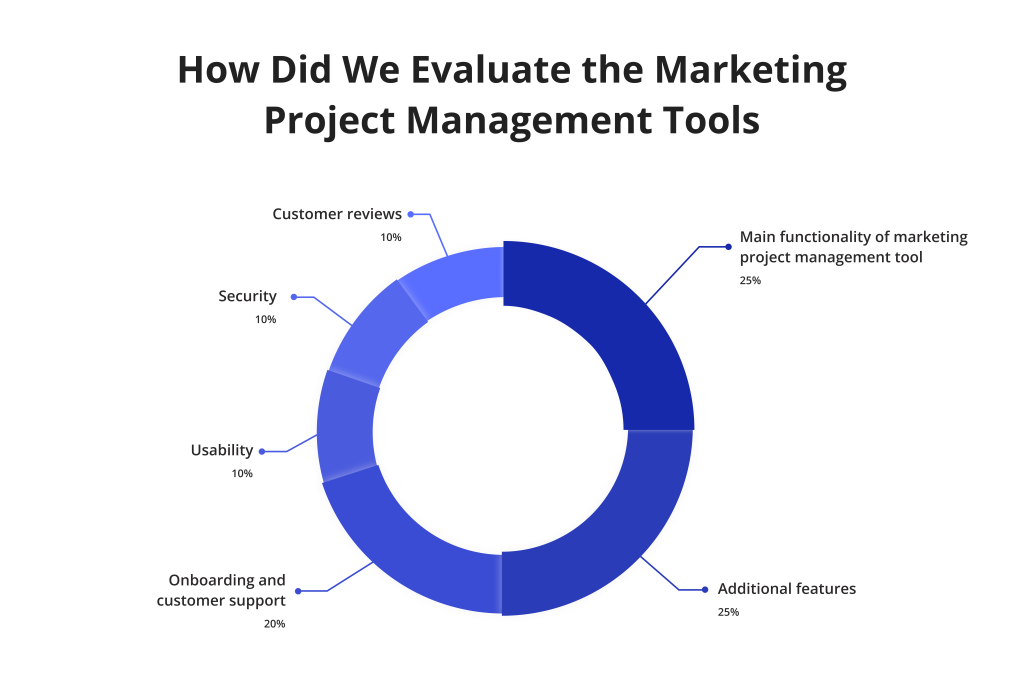
Main functionality of marketing project management tool: 25% of total score.
- Collaboration features to ensure quick communication through the chats and shared workspaces.
- Task management for structured work assignment and delegation.
- Workload and resource management to use limited resources properly without overloads and underutilization.
- Reporting and analytics to get full visibility about teams productivity and efficiency of processes.
- Scalability for further growth and expanding.
Additional features: 25%
- Automatic project planning and control to automate routine tasks and have more free time for strategic planning.
- Bottleneck detection to mitigate or prevent risks as early as possible.
- Deadlines prediction based on different metrics within the system.
- Customizable dashboards and reports to fit your company’s specific needs.
- Smart resource capacity planning to optimize workloads and ensure timely project delivery.
Onboarding and customer support: 20%
- Support channels, such as live chats or email support.
- Guides and training materials to simplify onboarding and adoption.
Usability: 10%
- Intuitive user interface that ensures quick adaptation, especially for non-technical users.
- Drag-and-drop charts and workflow pipelines for full visibility across multiple processes.
- Clear navigation that minimizes the learning curve and simplifies adoption.
Security: 10%
- Anonymization protocols, GDPR compliance, and security of personal data.
- User access rights for proper access control.
Customer reviews: 10%
- Satisfaction ratings from users about using experience, features quality, etc.
- Practical use cases and stories of success.
- Expectations vs reality.
- Value for money.
I know, it might be overwhelming, so let’s briefly summarize the points above. While selecting the tool for marketing project management evaluate such points as:
- main must-have functions;
- additional features;
- whether the tool provides onboarding guides and customer support;
- how easy it is to use;
- customer’s opinions about the tool;
- how secure it is.
By considering these factors you’ll find the system that improves all work processes and drives your business to success.
And finally, we’ve reached the most important section of the article – an overview of marketing project management tools. The list below describes different tools that are best aligned with the latest industry trends and help businesses to increase their efficiency. So, let’s kick off.
10 Best Marketing Project Management Tools in 2025
Here is our review of top marketing project management tools with their pros and cons, features, and who it suits the most.
1. Epicflow Growth
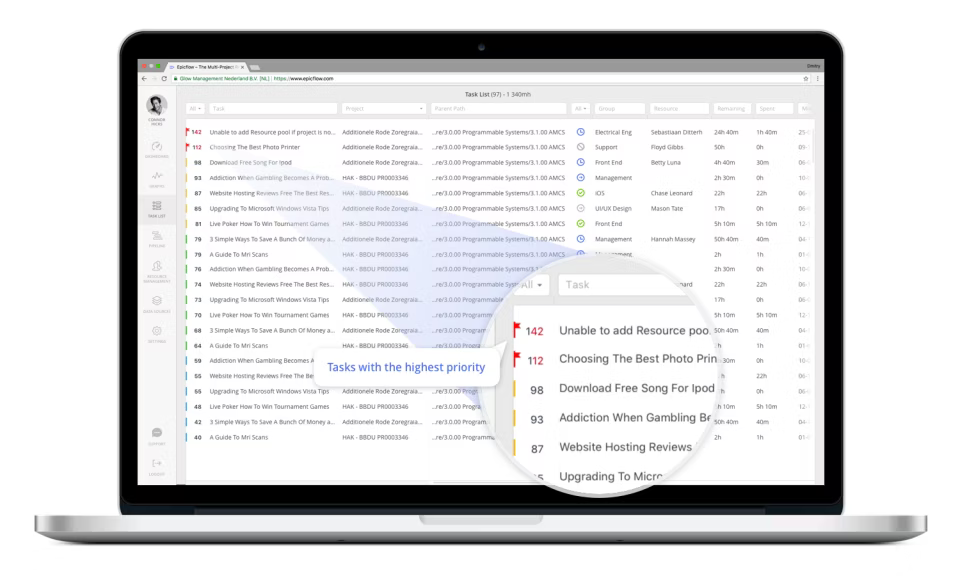
Epicflow Growth is the best marketing project management software designed for teams that operate multiple projects simultaneously and want to scale from just basic project management features to more advanced ones. It helps companies to detect bottlenecks that lower productivity and address them effectively to deliver campaigns on time. Therefore, organizations can improve their performance and be confident that resources will be allocated in a most efficient way to meet the demand.
Best for:
Epicflow Growth suits the best for growing companies or ones that operate multiple concurrent projects but don’t need enterprise-grade features yet.
Key features:
1. Automatic real-time project planning and control.
Epicflow’s Gantt chart is a timeline that helps teams understand project sequencing, deadlines, and dependencies. But unlike other traditional charts Epiclow’s version is dynamic and updates automatically based on real-time resource availability and workload changes. Futhermore, the system recalculates timelines when resources become overloaded and highlights risks.
2. Resource and progress analytics.
Epicflow Growth includes Burnup graph that allows you to monitor the team’s progress by showing how much work has been done compared to the total scope. Additionally, it also automatically updates due to changes and adjusts to them.
3. Personal and group task management.
The system provides an overview across both personal and group tasks. The personal task list consists of all assignments of a particular team member and automatically prioritizes tasks based on different metrics. At the same time, a group task list shows the workload of a whole team and tasks spreading among the team members.
4. Resource capacity planning.
This feature gives marketing teams predictive insights about resource capacity. Therefore, companies can estimate the amount of work their employees can handle and whether they have enough resources for it.
5. Workload management.
Gives an understanding of how responsibilities are spread across all team members, helping to prevent overload and underutilization.
6. Bottleneck analysis.
Allows to quickly identify where the work is getting stuck and which resources are slowing down the overall progress. Moreover, it helps to focus on the biggest challenges first and improve the project flow.
7. Introducing Epica AI assistant.
Epica is a virtual AI assistant that acts like an experienced project manager and helps teams in decision-making. Ask her any question about your projects and get a confident data-driven answer. She also can alert about bottlenecks and give suggestions for your next actions.
Also, it’s worth admitting that some more advanced features such as What-if scenario planning, AI resource-allocation advisor, or full project portfolio management are available in the Enterprise plan.
Thus, if you want to scale and grow further with Epicflow, contact our experts to get more information about its impact on your business processes.
Pricing
Epicflow Growth offers 30-days free trial, while paid period is available at price for 25€ per person/month or 22.5€ monthly/billed annually.
Pros:
- Predictive and workload-based features help to avoid overload and missed deadlines.
- Has excellent scalability when your marketing operations become more complex.
- Has a big variety of advanced features helpful in marketing project management.
- Provides ability to scale to the enterprise version to get full access to the system.
- Enables more strategic resource usage rather than just simple task tracking.
- Has an AI virtual assistant.
- All the features, even advanced, are suitable not only for technical specialists but also for no-code users.
- Has an intuitive user interface so that teams can quickly get used to the tool.
Cons:
- Access to some advanced features you can gain only with an Enterprise plan.
- May have a learning curve.
- Cost can be higher compared to smaller tools but it pays off with growing.
2. Trello
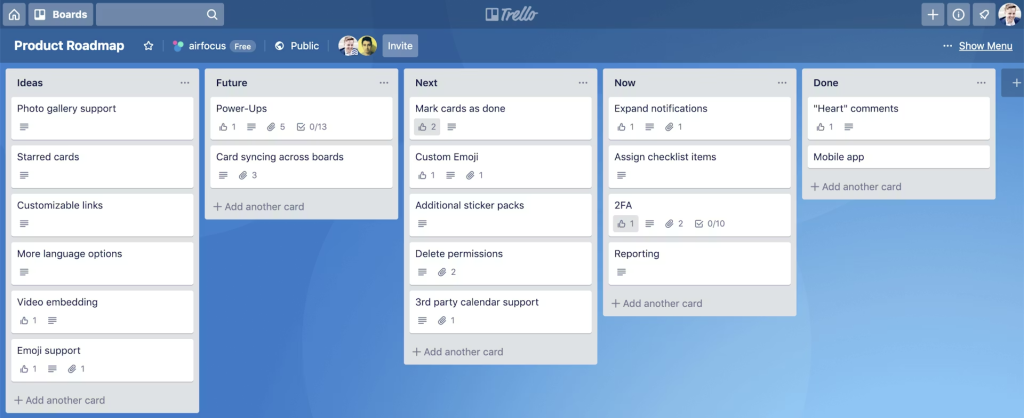
Trello is one of the most well-known tools for marketing project management. It is famous for its simplicity and provides customizable and flexible solutions for small teams and enterprises.
Best for:
Small teams, freelancers, or individuals who need an easy-to-use marketing project management tool.
Key features:
- Kanban-style visual board for task management.
- Butler automation for common actions.
- Additional integrations for extra features.
Pricing
Has a free plan, paid starts from $5 user/month.
Pros:
- Has an intuitive interface, so team members can quickly get used to the tool.
- Has a free plan, but a paid one is also affordable.
- A plenty of templates to get started with.
Cons:
- May be too simple for larger teams or agencies who need more advanced collaboration features.
- Lacks advanced functionality for managing reports, project schedules, resources, and so on.
3. Asana
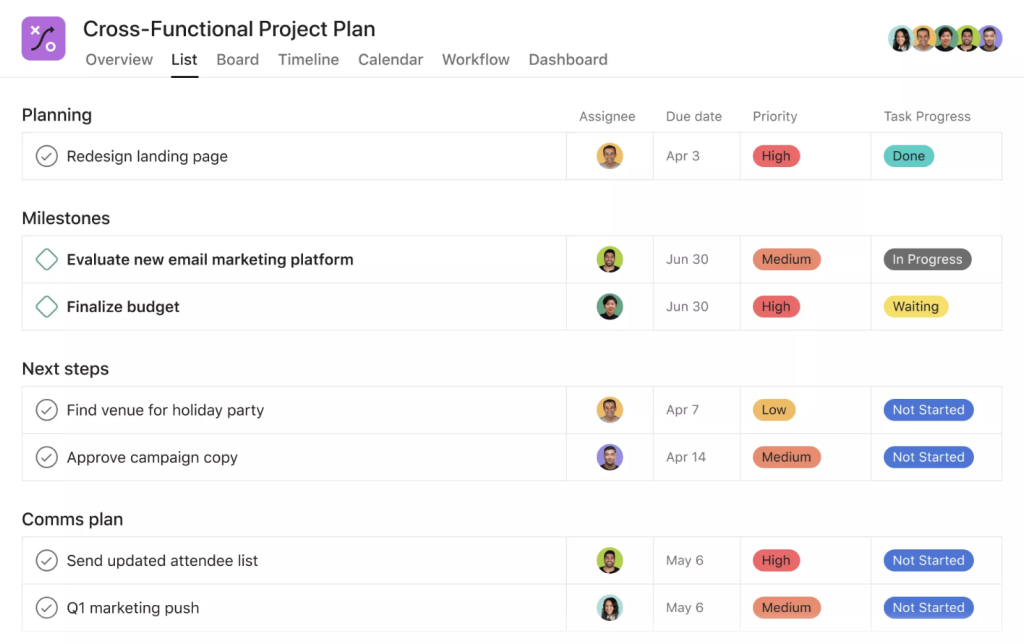
Asana is one of the best project management tools for marketing. It helps teams organize and execute their projects more efficiently. It provides various tools for tracking deadlines, managing projects and tasks as well as collaborating features to deliver better results.
Best for:
Organizations that are struggling to find a solution for effective team collaboration.
Key features:
- Real-time communication and collaboration tools.
- Robust project planning and tracking.
- Workflow automation.
- Task management.
- Goal tracking.
- Insights and recommendations.
Pricing
Has a free plan, paid starts from $10.99 user/month.
Pros:
- Aligning team members around strategic business goals.
- Diverse integrations with external tools.
- Strong security features.
Cons:
- Limited customization capabilities.
- It may be hard to get used to the tool.
- Can require latrine and onboarding.
- Has no time-tracking features.
4. Zoho Projects
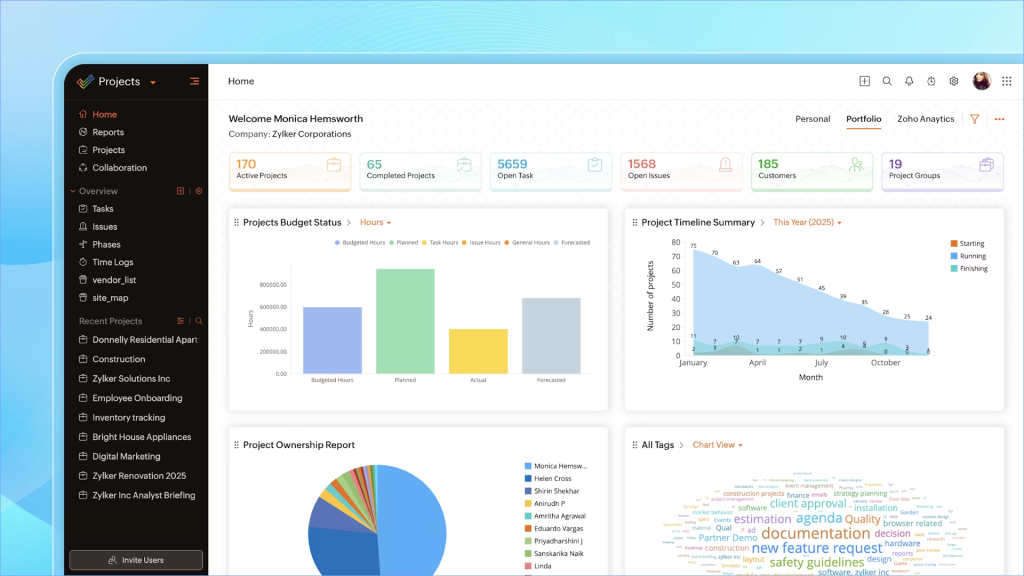
Zoho Projects is another strong player among marketing project management tools. It offers a platform that allows teams to decompose their projects into small sequential tasks for more efficiency and faster campaign delivery. Also, another beneficial feature is tracking of milestones and project goals to ensure aligning of all processes with business strategy.
Best for:
Companies that are already using other tools from the Zoho ecosystem.
Key features:
- Milestones and tasks tracking.
- Visual Gantt charts and kanban boards.
- Project planning and scheduling.
- Strong reporting and integration capabilities.
Pricing
Has a free plan, paid starts from €4 user/month.
Pros:
- As it’s a part of the Zoho ecosystem, it seamlessly integrates with other Zoho tools.
- Price is affordable even for individuals.
- Has a free plan to get started.
- Allows to monitor costs to avoid budget overruns.
Cons:
- The user interface can feel outdated.
- Lacks advanced features and analytics.
5. ClickUp
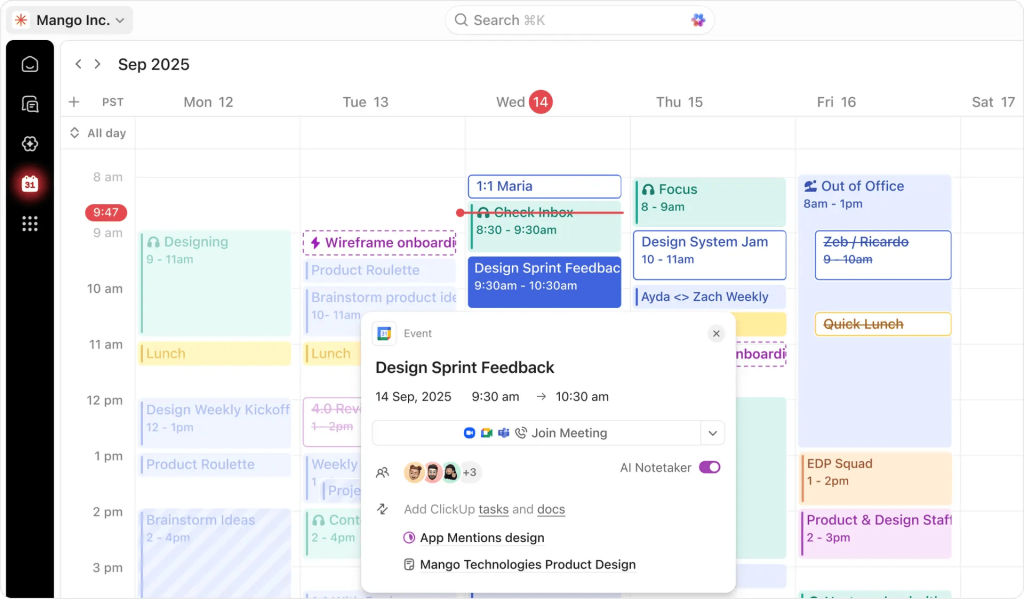
From the list of best project management tools for marketing teams, ClickUp offers a robust all-in-one solution with flexible pricing and customization. It provides a plenty of essential features for effective collaboration, allowing teams to consolidate their workflows and gain reports about productivity, thanks to AI-powered automation.
Best for:
Companies that are struggling to unite collaboration and productivity features in a single marketing project management solution.
Key features:
- Automated project summaries and updates.
- Easy task prioritization.
- Setting and tracking marketing goals and aligning them with strategic objectives.
- Tracking the time spent on various tasks.
- Pre-built templates for marketing projects.
Pricing
Has a free plan, paid starts from $7 user/month.
Pros:
- Powerful customization.
- Diverse integration opportunities.
- Strong flexibility and scalability.
Cons:
- Can be overwhelming for new users.
- Complexity of workflows grows fast.
6. Jira
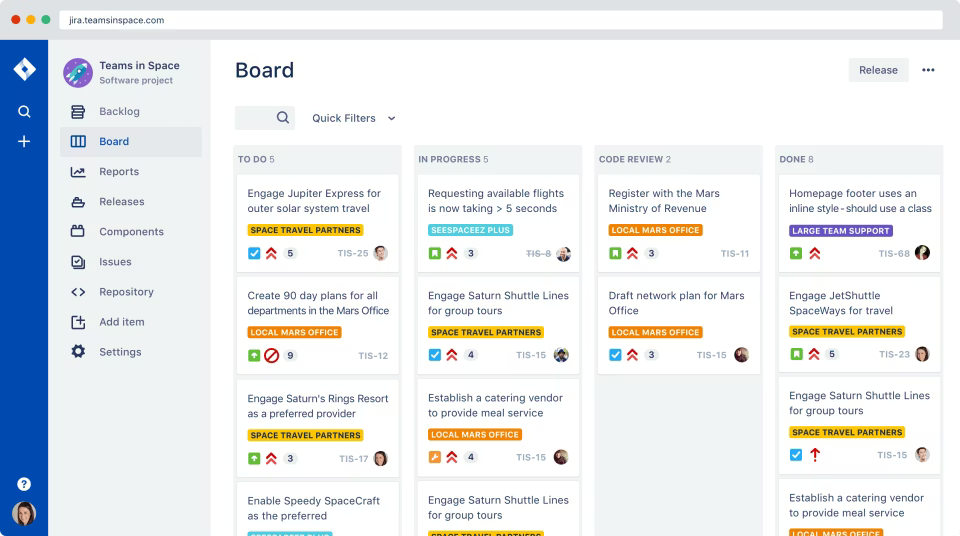
Jira is the next popular solution from the list of marketing project management tools. It is highly oriented on agile methods like Scrum and Kanban, which help to visualize and simplify workflows within the marketing team and organize their schedules, tasks, and reports.
Best for:
Managing agile teams and projects effectively.
Key features:
- Timelines help teams visualize project dependencies.
- Agile boards help teams visualize and manage their work.
- Provides various reports.
- Has advanced AI features for reporting and analytics.
Pricing
Has a free plan, paid starts from $7.91 user/month.
Pros:
- Effective issue and bug tracking.
- Customizable workflows.
- Strong scalability and effective collaboration.
- Effective backlog management.
Cons:
- It may not be flexible enough for cross-team use.
- Compared to other tools, it has weak communication capabilities through in-built chats.
- No resource and budget management.
7. Teamwork.com
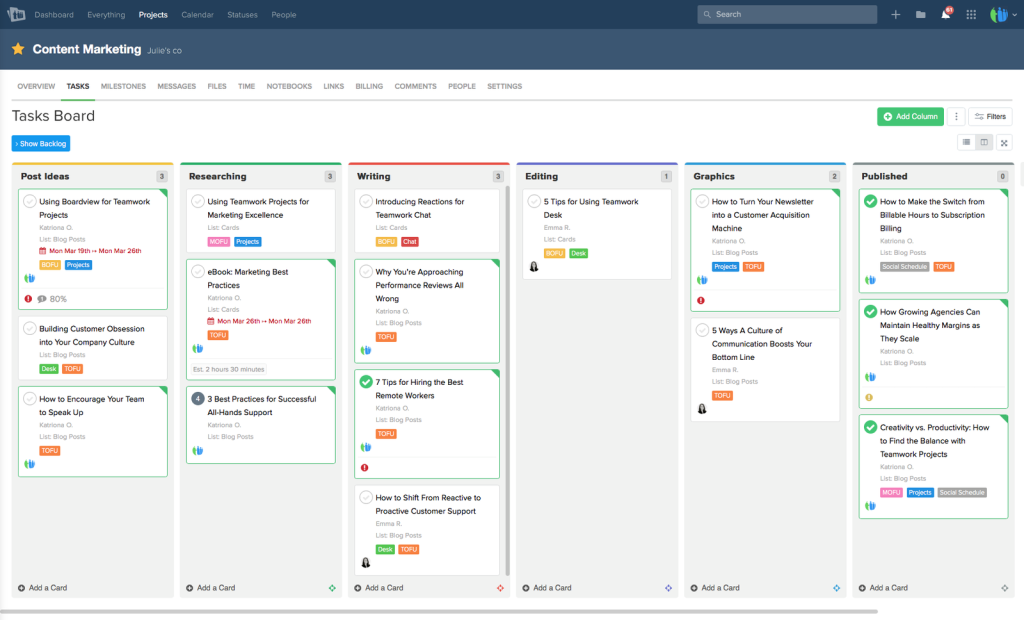
Teamwork.com is a work and project management platform perfectly suitable for marketing project management. It allows users to track tasks and their progress and stands out for its advanced data hosting options that is extremely important for marketing teams that work with big amounts of sensitive user data.
Best for:
Marketing teams that need client visibility and project tracking combined with strong security and compliance.
Key features:
- Resource and project management, milestones and workflows.
- Time and cost tracking.
- Customizable templates.
- User access rights so you can add freelancers or other external specialists.
- Client feedback tools.
Pricing
Has a free plan, paid starts from $10.99 user/month.
Pros:
- Team workload visibility across multiple projects.
- Strong customer support.
- Focus on security with strong reliable protocols and certifications.
Cons:
- Customization of notifications and reporting can be limited.
- Can slow down with the growing number of projects.
8. Wrike
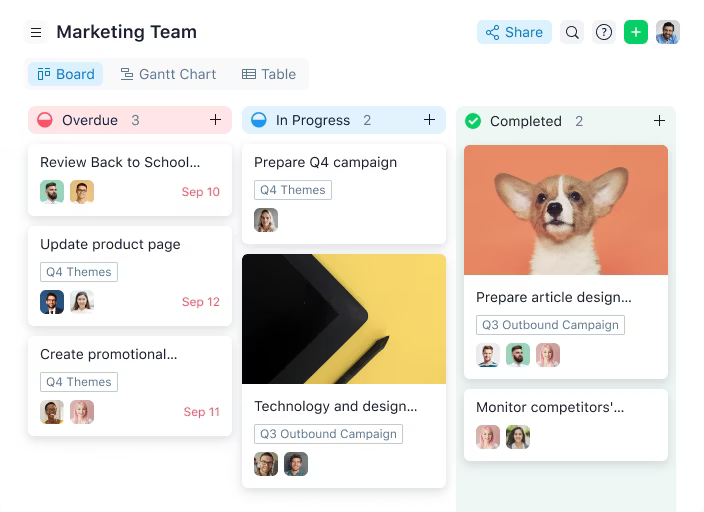
Wrike is another popular solution for marketing project management. It helps different teams to improve processes as well as plan and execute projects more effectively to drive better outcomes. It also helps to improve communication and visibility across projects and tasks.
Best for:
Managing and collaboration within the marketing teams with shared resources.
Key features:
- Time and budget tracking.
- Pre-built marketing templates.
- Workload management.
- Resource management.
Pricing
Has a free plan, paid starts from $10 user/month.
Pros:
- Has AI features available in all plans.
- The interface is user-friendly and intuitive.
- Can handle complex workflows.
Cons:
- It may be overwhelming for the small teams.
- Some functions require an additional cost.
- Advanced capabilities are not suitable for non-technical teams.
9. Basecamp
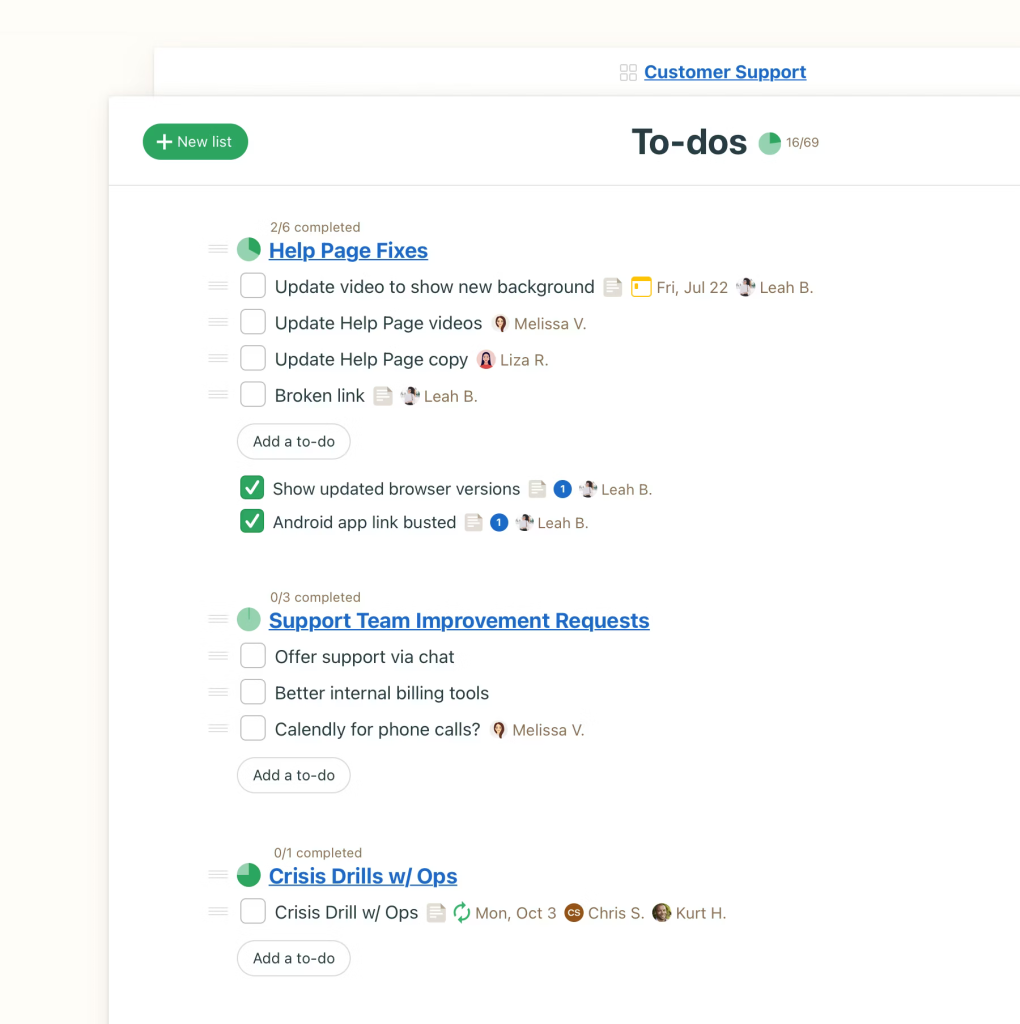
Basecamp is an all-in-one solution for marketing project management that creates a single source of truth for the whole team or a company. It simplifies collaboration and increases work efficiency by providing tools for task management, messaging, and scheduling.
Best for:
Perfectly suits small and mid-sized teams and companies that want to easily organize and manage their projects.
Key features:
- Task management and project templates.
- Messaging and group chats for team discussions.
- Centralized documents, schedules, and file storage.
- Client access feature.
- To-do lists.
Pricing
Has a free plan, paid starts from $15 user/month.
Pros:
- Various integration opportunities.
- Client access control for secure collaboration.
- Hill charts simplify data visualising, making it more intuitive.
- Centralized place for project data and communication.
Cons:
- Can be not so affordable for small teams or individuals.
- May require adaptation and onboarding.
- Limited customization options.
10. monday.com
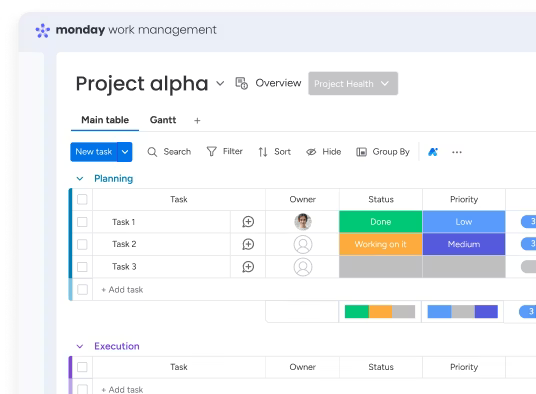
This is the final boss from the list of marketing project management tools. Monday.com is one of the most widely known systems for project management overall but also perfectly suitable for marketing project management as it offers visual project tracking alongside extensive integration support. The platform has proven its effectiveness in many industries not only in marketing.
Best for:
Marketing teams and agencies due to its CRM, workflow automation, and collaboration capabilities.
Key features:
- Time tracking and invoicing.
- Strong collaboration tools where you can attach files, make comments, and so on.
- Shared documents and boards.
- File versioning.
- Integrations with various marketing tools.
Pricing
Has a free plan, paid starts from €12 user/month.
Pros:
- Has a user-friendly interface and great usability.
- AI can alert about risks and bottlenecks.
- Has a wide range of integrations.
- Automation and customizable workflows.
Cons:
- Users need to learn how to use a platform at first.
- Complexity may grow with scale.
- AI recommendations may need checking and analysis.
This list doesn’t contain completely free marketing project management tools, but the vast majority has free plans, making these tools affordable for companies and teams of different sizes.
Table of Comparison of Marketing Project Management Tools
|
Tool |
Best for |
Standout benefit |
Pricing |
|
Epicflow Growth |
Growing companies / multi-project organizations that don’t need enterprise subscription |
Highly customizable, all-in-one solution, developed directly for multi-project management |
Offers 30-day free trial, paid options starts from €22.5 monthly/billed annually |
|
Trello |
Small teams, freelancers, or individuals who need an easy-to-use project management tool |
Easy-to-use Kanban boards to categorize and prioritize tasks |
Has a free plan, paid starts from $5 user/month |
|
Asana |
Organizations that are struggling to find a solution for effective team collaboration |
Structured task and goal management across teams |
Has a free plan, paid starts from $10.99 user/month |
|
Zoho Projects |
Companies that are already using other tools from the Zoho ecosystem |
Tracking of milestones and project goals |
Has a free plan, paid starts from €4 user/month |
|
ClickUp |
Companies that are struggling to unite collaboration and productivity features |
Highly customizable all-in-one platform |
Has a free plan, paid starts from $7 user/month |
|
Jira |
Managing agile teams and projects effectively |
Agile-oriented, supports backlog and sprint management |
Has a free plan, paid starts from $7.91 user/month |
|
Teamwork.com |
Marketing teams that need client visibility and project tracking combined with strong security |
Real-time tracking progress of tasks and changes in milestones |
Has a free plan, paid starts from $10.99 user/month |
|
Wrike |
Managing and collaboration within the marketing teams with shared resources |
Scalable complex workflow automation |
Has a free plan, paid starts from $10 user/month |
|
Basecamp |
Small and mid-sized teams/companies that want to easily organize and manage projects |
A wide range of communication capabilities |
Has a free plan, paid starts from $15 user/month |
|
monday.com |
Marketing teams and agencies due to its CRM, workflow automation, and collaboration capabilities |
Visual project tracking combined with a huge variety of integrations |
Has a free plan, paid starts from €12 user/month |
How to Choose a Perfect Marketing Project Management Tool
Okay, now you already know some of the best marketing project management software tools. But there are a lot of characteristics. What should you pay your attention to while choosing the right one for your company? Don’t worry, we’ve prepared a short list of criteria to simplify this process.
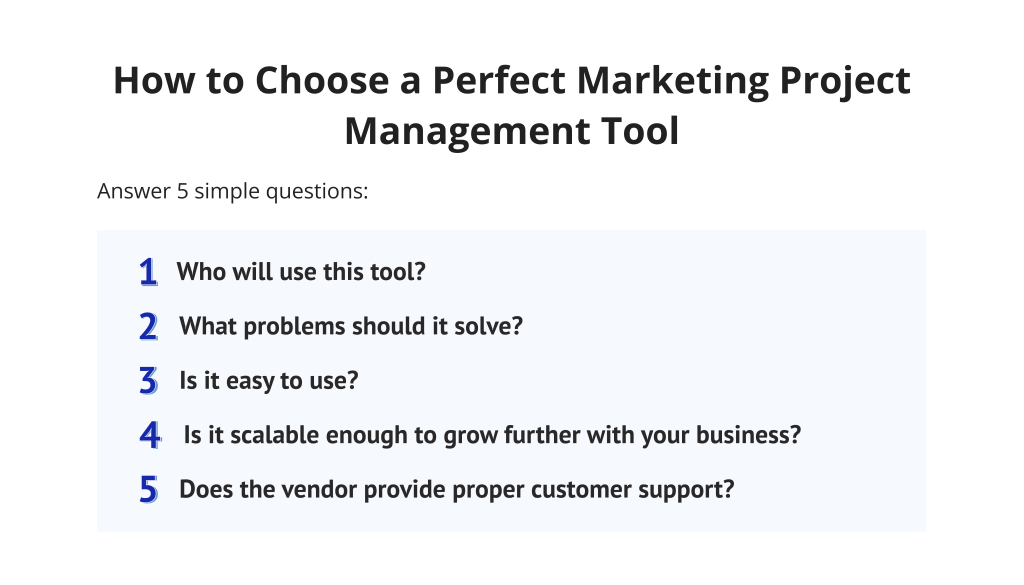
1. Who will use this tool?
In a nutshell, who is a day-to-day user of this marketing project management software?
- Creative teams: need visual workflows and fast communication across the team.
- Marketing managers: need dashboards and reporting.
- Analysts and performance teams: need KPI tracking and structured workflows. In some more complex situations integrations with third-party tools will be a great bonus.
- Executives: struggle with high-level visibility and progress tracking.
While selecting the tool, consider all these roles and not only these – gather requirements from all user roles. One mistake – and the tool won’t be relevant enough to cover all your business needs.
2. What problems should it solve?
In other words, why do you need this marketing project management tool? What areas of the business do you need to improve? Of course, the answer will be different in various companies, but the main points may be similar:
- Task management;
- Resource allocation;
- Capacity planning;
- Decision-making;
Also, it is important to consider the complexity of projects that you are handling. These points are critical for making an informed decision.
3. Is it easy to use?
To make processes more efficient, you should always follow the rule: simplify as much as possible to succeed. If a tool is complicated and requires weeks for training, it will slow you down instead of helping to move faster. However, marketing project management tools with a user-friendly interface and minimal onboarding requirements will shorten the learning curve for your team members.
4. Is it scalable enough to grow further with your business?
As the business grows and campaigns become more complex, demand for more advanced features, like scenario planning or predictive analysis, will grow as well. The marketing project management software you choose today must serve not only your current needs but also consider:
- More users.
- More campaigns.
- More advanced workflows.
- Automation.
- Integrations with new tools.
And all of it should be done without losing the performance. So, pay extra attention to scalability and flexibility.
5. Does the vendor provide proper customer support?
Customer support is extremely important, because no matter how intuitive a tool is, your team will eventually need support, whether it’s during the setup or while further maintaining. Thus, it is better to choose marketing project management tools that have diverse support channels, for instance, live chat, documentation, community forums, etc. The more channels they offer, the better and easier the usage will be.
If you want to see in practice how a marketing project management tool can transform specifically your workflows, don’t hesitate to book a call with our experts from Epicflow.
Trends in Marketing Project Management Tools
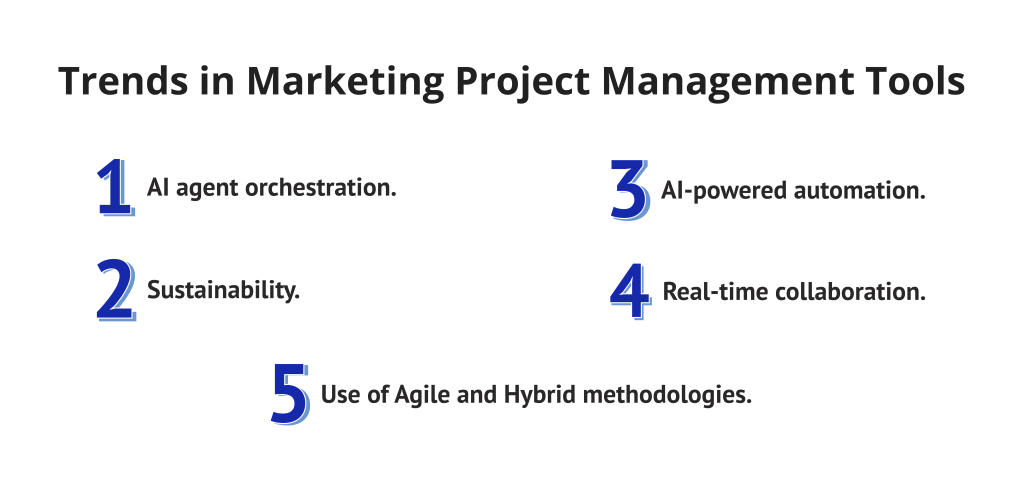
1. AI agent orchestration.
In 2026, you could hear about AI agents from every corner of the Internet. Well, this trend in marketing project management software is quite explainable: organizations can create their own virtual employees and assign different roles and tasks to them. These agents can collaborate with each other as real team members, for instance, analyze competitors, their strategy, suggest ideas for campaigns, gather statistics, and make reports, while the human specialists would pay more attention to the more valuable strategic processes.
2. Sustainability.
As the threat of global warming and environment pollution increases faster than ever, most of the companies are beginning to reflect this shift and tools for marketing project management are not the exception. They help to track resource usage, reduce carbon footprint, and sometimes even measure environmental impact of the campaigns, which is especially important for global brands and enterprises with ESG commitments.
3. AI-powered automation.
Automation in 2026 isn’t a nice-to-have feature, it has become a necessity. Companies now have not only automatized workflows, but bottleneck detection and alerts, predictive analysis, recommendations, and automatic resource allocation. For marketing teams running multiple campaigns, such features help to prevent team burnouts and reduce manual work, eliminating human factor errors.
4. Real-time collaboration.
Staying competitive in marketing requires fast communication to make decisions and solve problems effectively. That is why teams need tools that support live chats and editing as well as synchronized project updates. Moreover, it is extremely important for remote or shared teams, where people responsible for different processes need fast answers to deliver their fair share of work on time.
5. Use of Agile and Hybrid methodologies.
Marketing project management tools follow the latest trends not only in technologies and AI adoption but also in approaches to managing projects. Agile is still one of the fundamental methodologies that allows organizations to break down large campaigns into consequential sprints, allowing companies to deliver campaigns on time within the budget.
In turn, hybrid methodologies combine the most effective parts from different approaches to reach maximum efficiency. For example, it can combine flexibility of Agile and strict structure of traditional project management, giving the teams ability to manage long-term projects while staying responsive to changes.
Conclusion
Let’s briefly conclude the main points of the article:
- Marketing project management tools are software, designed specifically to help teams to plan marketing campaigns and organize them to deliver the best outcomes.
- Key features of marketing project management tools should include ability to track tasks, costs and time spent on the work, provide detailed reporting and analytics, enhance team collaboration. Also such advanced features as resource management and AI features will be a great bonus for the further scalability.
- The benefits of marketing project management tools are improved transparency across projects and tasks, resource and workload balancing to prevent both overloads and underutilization as well as escape wasted resources, improve communication and productivity. All these points lead to the most important one – stronger results and higher ROI.
- To choose the proper marketing project management software for your project, you need to answer a few simple questions:
- Who will use this tool?
- What problems should it solve?
- Is it easy to use?
- Is it scalable enough to grow further with your business?
- Does the vendor provide proper customer support?
Epicflow Growth is ready to help marketing teams grow and develop more effective campaigns. Thus, schedule a call with our experts to discover all its capabilities and see how it can elevate your team’s performance from day one.
FAQ
What is marketing project management?
Marketing project management is a process of planning, organizing, analyzing and controlling marketing campaigns. It allows teams to work more efficiently and avoid bottlenecks thanks to structured planning.
What is the best marketing project management tool?
The best tool for marketing project management is Epicflow Growth. It allows companies to address the most critical problem – resource availability, by detecting bottlenecks that lower productivity. Therefore, project performance will only grow and adjust to constant changes effectively.
Which key features marketing project management tools should include?
A reliable tool for marketing project management should cover as many of your requirements as possible. Here is the short list of possible features:
- Task management: to create, assign and manage tasks within the team.
- Time tracking: to monitor the amount of time spent on different tasks and processes.
- Reporting and analytics: to have a full picture of the ongoing processes within the organization.
- Collaboration tools: to improve the internal communication, make it faster and clearer.
- Resource and workload management: to allocate and monitor their resources.
- Customization and scalability: to grow and expand into new markets and adjust to the changes quickly.
- Budgeting: to monitor the project costs and prevent overspending.
How to choose the best marketing project management tool?
To select the right tool for marketing project management you need to answer 5 simple questions, listed below:
- Who will use this tool? Ensure the tool supports the needs of all potential users within the company.
- What problems should it solve? Identify your biggest pain points and search for the tool that will cover them.
- Is it easy to use? The tool should simplify processes, not complicate them.
- Is it scalable enough to grow further with your business? Choose the tool that offers scalability and additional more advanced features.
- Does the vendor provide proper customer support? The proper onboarding and assistance ensures successful adoption.
What are the trends in the marketing project management tools?
There are a few trends that gain popularity in a field of marketing project management tools:
- AI agent orchestration: ability to create a virtual staff and assign different roles and tasks to them.
- Sustainability: a complex of technologies and approaches that help to track impact of projects on the environment.
- AI-powered automation: automation of different tasks to reduce manual work and increase efficiency.
- Real-time collaboration: tools that support live chats and editing as well as synchronized project updates.
- Use of Agile and Hybrid methodologies: approaches that combine flexibility of Agile and strict structure of traditional project management.
How marketing project management tools benefit businesses?
- Efficient resource allocation and management: tools for marketing project management help to track resources availability and allocate them properly.
- Enhanced transparency: they give you a full visibility of all ongoing processes.
- Workload balancing: also, they help to avoid overbooking or underutilization.
- Effective collaboration: allow to remove fragmented communication and work more efficiently.
- Increased productivity: help to eliminate or automate repetitive manual tasks.
- Better reporting and analytics: help to see results and measure the success of marketing campaigns.
- Stronger results and higher ROI: organizations see higher return on their marketing investments, campaigns become more focused on strategic goals.
How to evaluate marketing project management tools before choosing?
We’ve used a common framework for evaluating the necessity of different features. At the beginning we had 100% and should’ve spread them across the most impactful requirements to marketing project management software. So, the evaluation criteria looks like:
- Main functionality of marketing project management tool: 25% of total score.
- Additional features: 25%.
- Onboarding and customer support: 20%.
- Usability: 10%.
- Security: 10%.
- Customer reviews: 10%.
How to score: rate from 1-10 on how closely it fits your needs, then multiply by 0.25, 0.2 or 0.1 according to percentage.