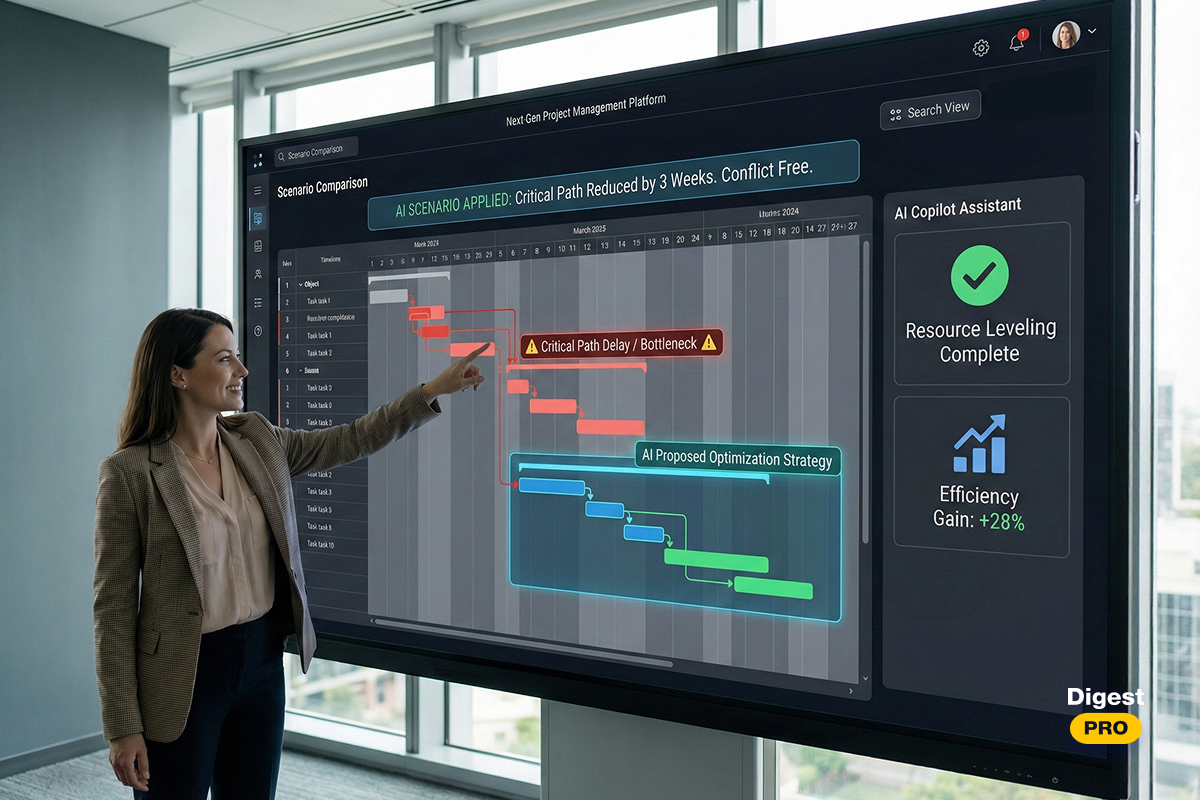
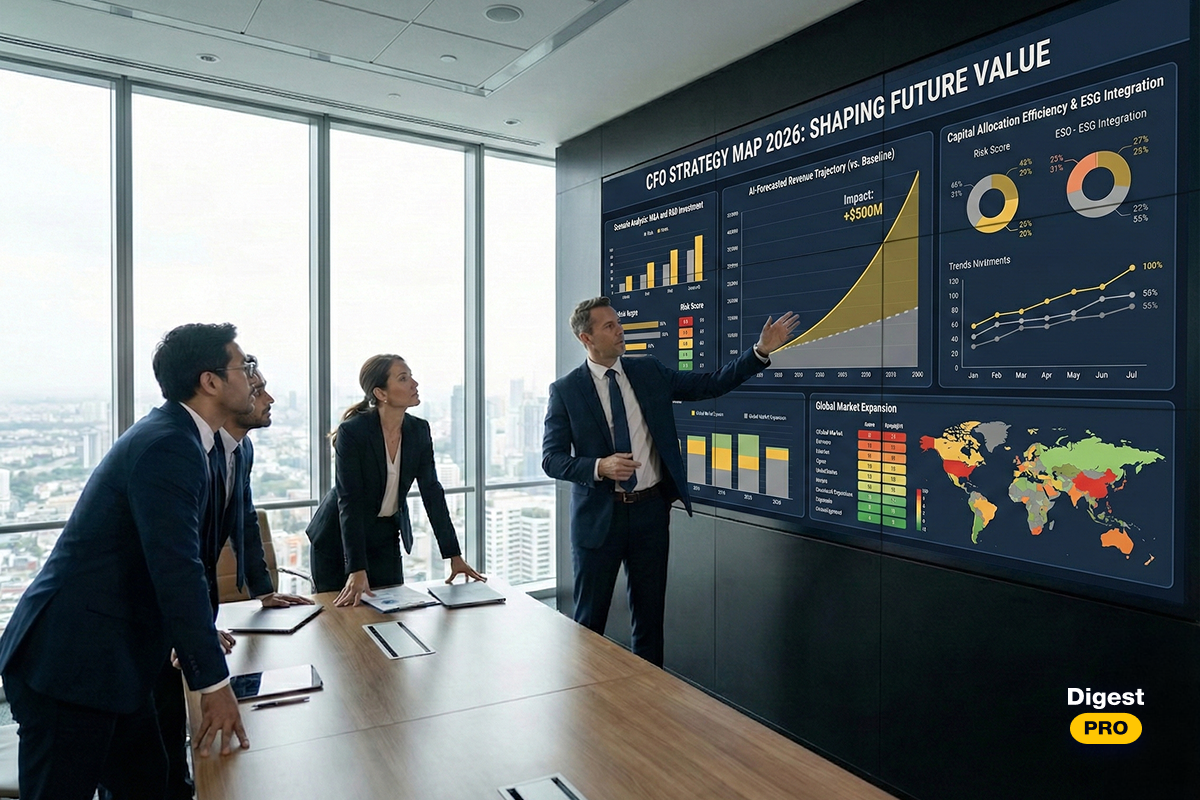
Traditional automation, at times, does not deliver the desired level of efficiency even after substantial investments in IT. In such a scenario, how do the organizations operate in very dynamic environments where the old rule-of-thumb-based scripts fail? The solution lies in AI agent orchestration that can manage complex workflows.
When standalone AI models are deployed, they often lead to the creation of several disconnected silos. How do you realize effective management of multiple digital workers? This kind of orchestration, besides coordinating autonomous software agents, also remakes the messy actions into a well-organized journey.
In this article, you will find out what it is, how it performs, and how operating multi-agent systems can push your business to real operational greatness.
Key takeaways:
- AI agent orchestration transforms your dispersed digital workforce into a genuinely cohesive, dynamic team that works proactively to advance your business objectives.
- By bringing in an AI agent orchestration platform, you prevent AI agents in silos from wasting time on duplicate work.
- Scaling your operations is selecting the ideal multi-agent orchestration architecture that perfectly matches your company’s distinctive appetite for nimbleness and security.
- Strong orchestration acts like your safety net during times of market volatility. It ensures the business continues to function effectively by breaking down complex tasks for agents to have clear communication and resolving conflicts that could escalate
What is AI agent orchestration?
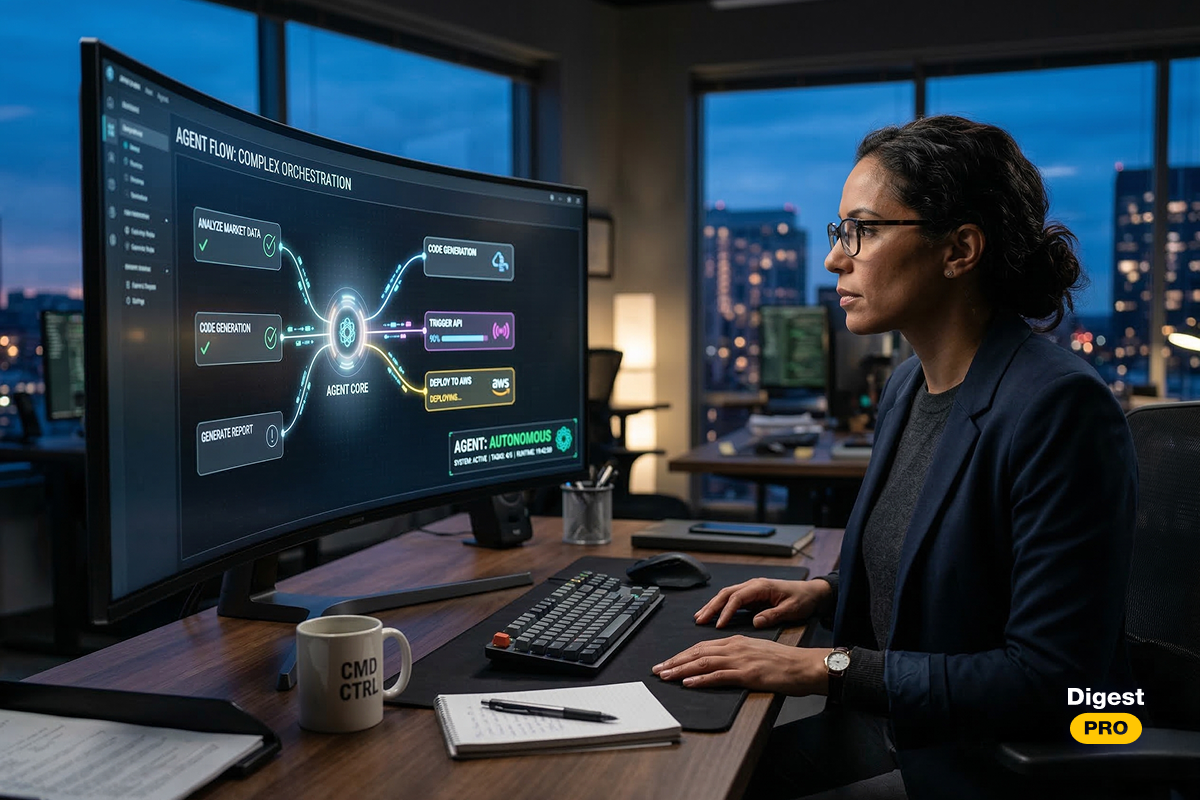
AI agent orchestration enables focused progress toward shared organizational outcomes. From a central position, the platform guides activity across tools and teams without overlap or delay.
Instead of siloed AI agents that repeat tasks, alignment emerges through continuous adjustment. AI agent orchestration transforms chaotic individual actions into a streamlined AI agent workflow.
This management level manages intricate task links, so expert AI units work together instead of alone. When Agent A examines information prior to Agent B preparing a summary, the framework makes certain the order proceeds without error. Smooth alignment like this enables companies to apply agentic AI efficiently across large operations.
Read more: 10 Best Risk Management Tools: Features, Reviews & Comparison
Why is AI agent orchestration important in complex workflows?
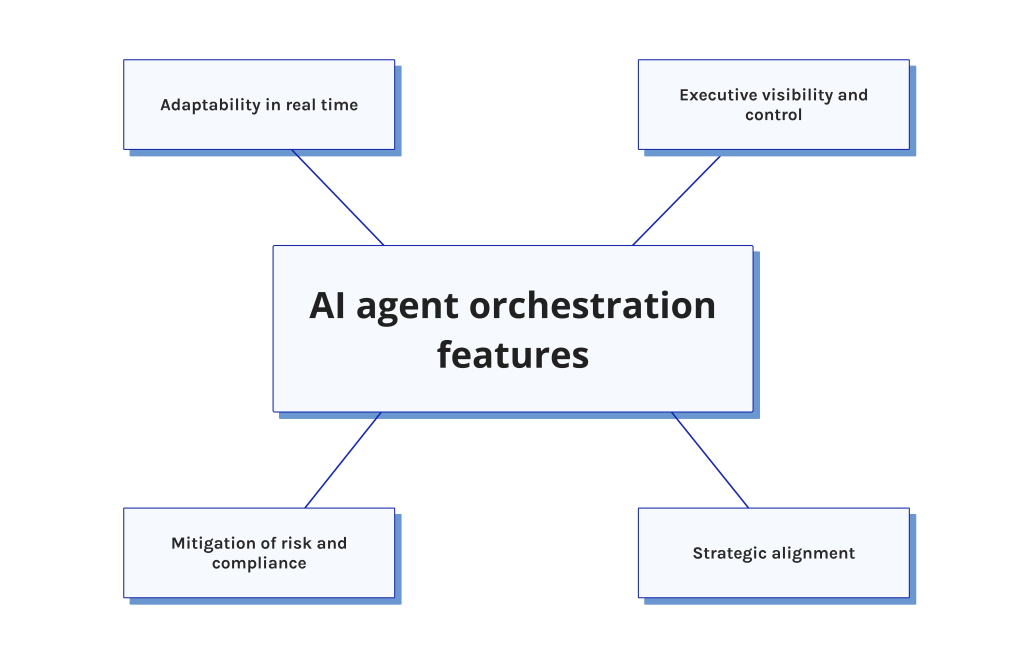
In most cases, standard automation fails when dealing with complex business processes that don’t follow a straight line. These processes are always running into exceptions, multi-tier approvals, and changing market conditions. AI agents need to be integrated into an orchestration plan to achieve operational continuity across multiple areas that deliver tangible business value.
- Adaptability in real time. This helps to create the necessary flexibility to adapt dynamically to changes in a marketplace. Tasks can be rerouted immediately if there are any exceptions without introducing systemic failure.
- Executive visibility and control. An effective orchestration platform provides the C-level executive with an accurate and complete view of the automated workflows that are taking place within the organization. Moreover, orchestration platforms empower them to take control over what is actually happening through comprehensive, real-time dashboards.
- Mitigation of risk and compliance. The capabilities of the orchestration platforms, through tracking every single decision made by the agentic (agent-based) automation engine. It will significantly reduce the operational risks and ensure that both regulatory compliance and operational standards are strictly enforced.
- Strategic alignment. The orchestration platforms will ensure that all AI autonomous actions and outputs will remain in strict alignment with an organization’s strategic business objectives. Thereby providing a mechanism to turn raw automation into measurable ROI.
Read more: Best AI Project Management Tools in 2026: Benefits, Key Features, and How to Choose
Benefits & Drawbacks of using an AI agent orchestration platform
Implementing an orchestration layer transforms how businesses handle agentic workflows. However, executive leaders must weigh both sides before deployment.
Benefits
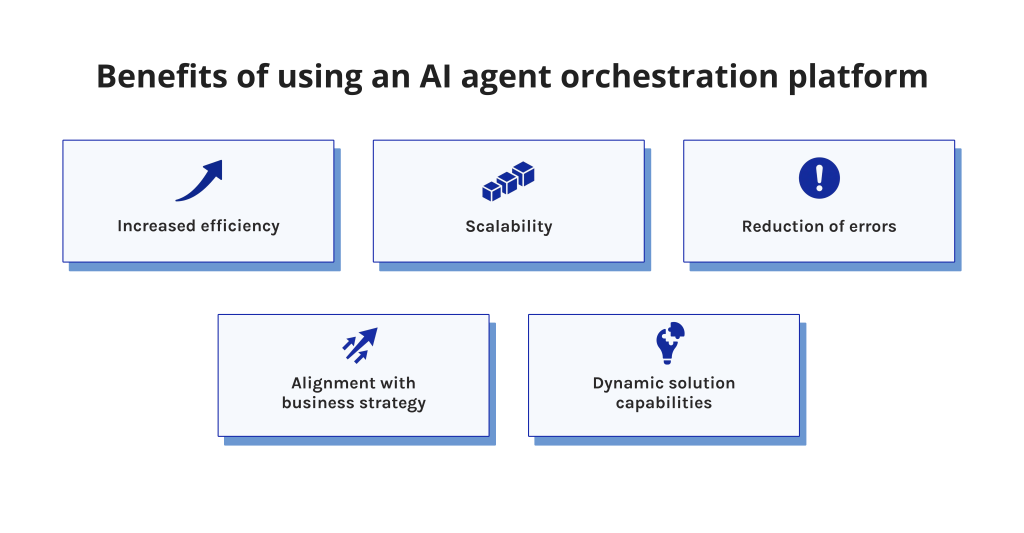
- Increased efficiency: Manual handoffs between tasks are completely eliminated, resulting in significant reductions in the time taken to process tasks.
- Scalability: AI agents enable easy scaling of automation, as orchestration helps to add agents without disruption to currently running processes.
- Reduction of errors: By automating coordination, human error associated with transferring data is minimized.
- Alignment with business strategy: Specialized AI agents work together toward the company’s overall business goal.
- Dynamic solution capabilities: If a single agent fails or has an exception, re-routing of tasks is possible
Drawbacks
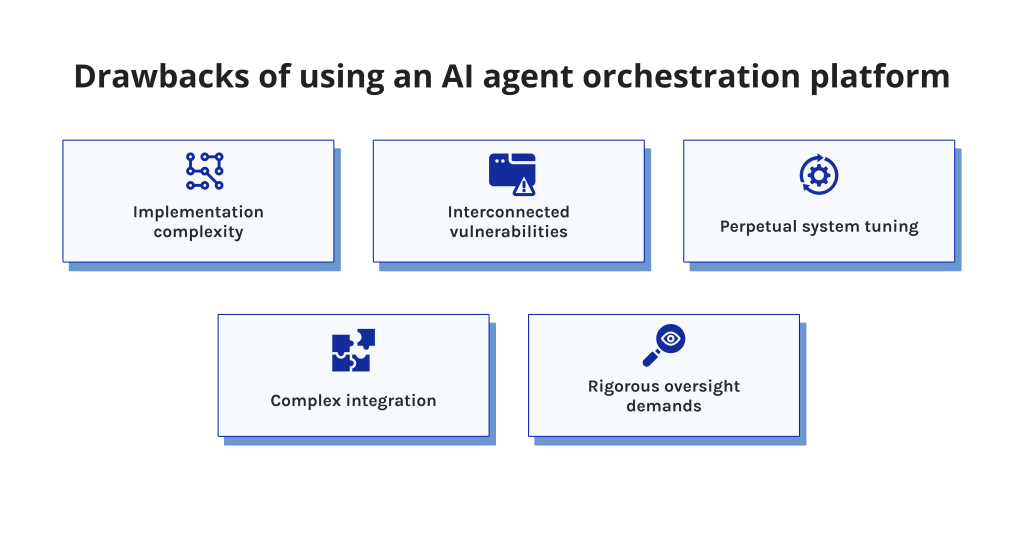
- Implementation complexity. Designing a multi-agent orchestration architecture requires specialized technical expertise.
- Implementation complexity. Designing a multi-agent orchestration architecture requires specialized technical expertise.
- A major financial commitment often marks the beginning of building an advanced AI system. Funding such development does not happen quickly nor without careful planning. Integration into existing structures requires resources beyond simple software updates. Large upfront spending becomes unavoidable when aiming for reliability and long-term function.
- Exposure grows when linking several AI agents together. Each added connection introduces new vulnerabilities by design.
- Constant attention defines upkeep demands. Effectiveness depends on regular adjustments. Oversight cannot stop without consequences. Tuning occurs repeatedly as conditions shift. Functionality fades if ignored for too long.
Read more: 13 Best Scrum Tools in 2026: In-Depth Comparison & Expert Review
Examples of complex workflows powered by AI agent orchestration
Operations directors can apply this technology across various critical business functions.
- Supply chain resilience The world’s supply chains are highly volatile. AI agent orchestrations for complex workflows can simultaneously monitor the world’s weather, ports, and suppliers. In the event of an occurrence, the system can automatically redirect the supply chain with the help of specialized AI agents.
- Enterprise customer support. Resolving high-tier customer complaints involves multiple departments. An agentic workflow can handle this seamlessly. One agent analyzes the customer sentiment. Another agent retrieves billing history. A third agent drafts a personalized compensation offer. The orchestration platform ensures these actions happen instantly and cohesively.
- Monitoring financial compliance. Regulatory compliance necessitates conducting an exhaustive review of all financial data. Numerous automated agents can simultaneously examine thousands of transactions for anomalous activity. The orchestrator synthesizes these findings, cross-references them against legal databases, and generates a comprehensive risk report for the Chief Operating Officer.
Today’s world is changing at lightning speed. If you want to receive the freshest news in the AI industry, subscribe to Digest.Pro. Our experts conduct research daily to select the most important news for you.
4 Main types of AI agents orchestration in complicated conditions
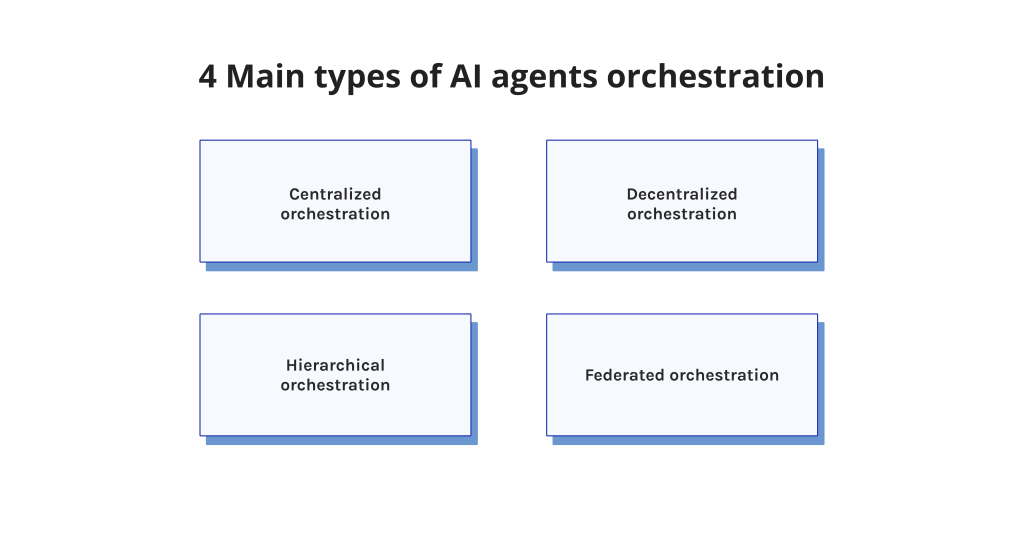
Choosing the right structure is vital for success. Enterprise architects must select appropriate AI agent orchestration architecture patterns based on their specific operational needs.
-
Centralized orchestration:
In this model, a single master controller dictates every action. The central orchestrator assigns tasks to specialized AI agents and monitors their progress.
This approach offers maximum control and security. It is highly suitable for strict financial or legal workflows. However, the central controller can become a bottleneck if task volumes spike.
-
Decentralized orchestration
Here, there will be no single master controller. Multiple AI agents communicate with each other directly. They negotiate tasks and share data peer-to-peer.
This type of multi-agent orchestration is highly resilient and scalable. If one agent fails, the other ones adapt. It is most suitable for dynamic environments such as real-time logistics routing.
-
Hierarchical orchestration
This structure mimics a traditional corporate org chart. A top-level agent breaks down a massive goal into subtasks. It then delegates these to mid-level manager agents. These managers coordinate specialized AI agents at the bottom level.
This model perfectly balances control and scalability. It efficiently handles massive agentic AI workflows.
-
Federated orchestration
This model connects independent AI systems across different organizations or departments. Each department maintains control over its own AI agent platform.
However, they share specific data and capabilities through a federated protocol. This is ideal for secure B2B collaborations or massive healthcare data analysis.
Read more: 20 Best Kanban Tools To Improve Workflow Efficiency In 2026
How is the AI agent orchestration process going in a complex environment?
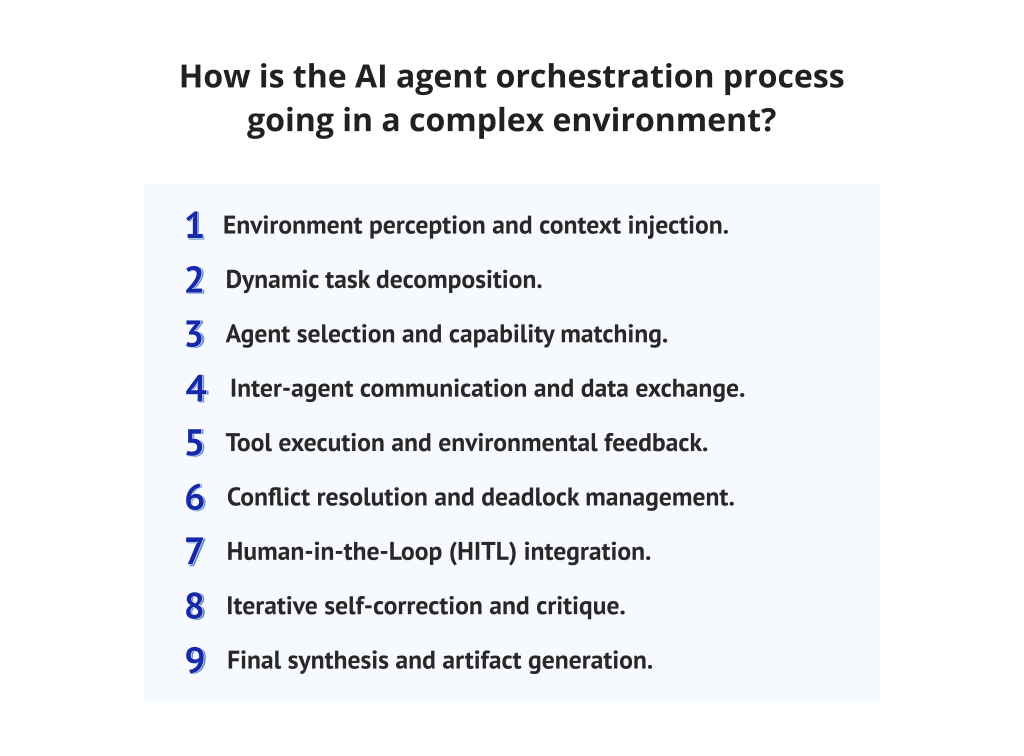
Executing AI agent orchestration in complicated conditions requires a systematic approach. The agentic automation engine follows a strict lifecycle to ensure flawless execution.
1. Environment perception and context injection
The Orchestrator collects data in real time from APIs, databases, and users, creating an understanding of what is happening now. This primary data (environment) is injected into active AI agents so they all have a clear understanding of what the overall business goal is before they act independently.
2. Dynamic task decomposition
Complex problems are too large for a single action. The orchestration platform breaks the main objective into smaller, manageable tasks. It maps out dependencies between these micro-tasks. This creates a logical AI agent workflow optimized for speed and accuracy.
3. Agent selection and capability matching
Not all agents are equal. The system maintains a registry of various types of AI agents. It evaluates the requirements of each micro-task. Then, it assigns the task to the most qualified specialized AI agents available. This guarantees high-quality outputs.
4. Inter-agent communication and data exchange
Siloed AI agents cannot complete complex workflows. The orchestrator facilitates secure communication channels. Agents share intermediate results and request information from one another. This constant data exchange keeps the agentic workflow synchronized and moving forward.
5. Tool execution and environmental feedback
Agents often need external tools to complete their work. The platform grants them access to web search, calculators, or internal CRM systems. As agents execute these tools, the environment changes. The orchestrator monitors this feedback and adjusts the plan accordingly.
6. Conflict resolution and deadlock management
In multi-agent systems, agents may occasionally request the same resource simultaneously. Alternatively, they might generate contradictory data. The AI agent orchestration platform acts as a referee. It resolves these conflicts using predefined business logic. This prevents operational deadlocks.
7. Human-in-the-loop (HITL) integration
Some decisions require human intuition or executive approval. The orchestrator pauses the workflow when it encounters high-risk situations. It alerts a human manager, presents the context, and waits for a decision. Once approved, the AI agent workflow resumes automatically.
8. Iterative self-correction and critique
Advanced agentic AI does not settle for the first answer. The system employs critique agents to review the work of generation agents. If the output fails quality standards, the orchestrator forces a revision. This iterative loop guarantees high accuracy in the final deliverable.
9. Final synthesis and artifact generation
Finally, the orchestrator collects all completed subtasks. It synthesizes the data into a cohesive final product. This could be a comprehensive report, a modified codebase, or an updated logistics schedule. The platform then delivers this artifact to the end-user.
Read more: 8 Best Open Source Product Management Software of 2026
Final Words
The era of simple, rigid automation is ending. Implementing AI agent orchestration for complex workflows is no longer optional for industry leaders. It is the defining factor for future operational excellence.
Through unifying siloed AI agents, companies experience tremendous productivity improvements. An AI agent orchestration platform combines multiple AI agents into one cohesive digital workforce by providing visibility, control, and scalability to executives (C-level) at larger organizations.
With the continuing improvement of AI workflows based on agentic AI, new early adopters will be able to respond more rapidly to changing markets than their late-adopting peers with lower operational costs. Companies should establish an agent robotics system/architecture for their organizations as preparation for the autonomous future.
This article provides comprehensive but not as deep as possible knowledge about AI agent orchestration. If you want to deepen your awareness of modern technologies that reshape the future, subscribe to Digest.Pro.
FAQs
Which tool is used to orchestrate autonomous AI agents for complex tasks?
Often, businesses use tools such as LangGraph, CrewAI, AutoGen, and enterprise-level tools such as IBM WatsonX and/or customized Boomi integrations to develop and effectively manage multi-agent systems.
What is the best AI orchestration platform?
The “best” platform depends entirely on your enterprise needs. Frameworks like AutoGen excel in conversational agentic workflows, while CrewAI is great for role-based task delegation. For enterprise compliance, platforms like IBM WatsonX are often preferred.
How to orchestrate an AI agent?
Start with a clear goal. Split it into small steps. Give each step to a focused AI. Set up safe ways for them to talk and solve disagreements.
What is AI workflow orchestration?
The management of a complex business process in an automated manner by different AI agents or automated software tools. AI workflow orchestration enabling these agents/tools to dynamically communicate with one another without the intervention of a human being in order to attain a singular, unified goal.
How does AI agent orchestration for complex workflows differ from traditional RPA?
Unlike the traditional RPA approach, in which the script fails when any exceptions are present, the cognitive reasoning of AI orchestration can decide for itself how to reach the goal based on the dynamic variables present in the system.
What are the main security risks when multiple agents exchange sensitive data?
The main risks include prompt injection attacks, unauthorized access to the API, and leakage of information between separate departments. Strong encryption is a must.
Which framework is better for hierarchical orchestration: LangGraph, CrewAI, or AutoGen?
CrewAI is exceptionally well-suited for hierarchical orchestration due to its built-in role-playing and delegation mechanics. LangGraph offers more granular control over state, while AutoGen is highly flexible for conversational patterns.
How do you measure the ROI of AI agent orchestration for complex workflows?
To determine the return on investment (ROI) for AI agents orchestrating complex workflows, ROI can be quantified by calculating:
1) duration of process cycles;
2) number of errors made operationally;
3) labor cost savings due to automation of hand-off;
4) quantity of complex tasks completed.
What is the "Human-in-the-loop" (HITL) protocol, and when is it triggered?
The HITL Protocol acts as an important security measure established by the Orchestration Platform. It will activate a ‘Pause’ function for any workflow that has an agent who will be faced with making a decision involving high levels of risk/inordinate amounts of uncertainty, or an executive has to approve a decision before proceeding.
How do agents maintain long-term memory and context across different sessions?
Agents will use vector databases (e.g., Pinecone or Milvus) and use semantic searches to store and return previous interactions with users. The orchestration layer will inject this history into the agents’ current prompt to ensure that there is no loss of continuity.
References
-
https://www.gartner.com/en/documents/5850847
-
https://www.mckinsey.com/capabilities/tech-and-ai/our-insights/the-economic-potential-of-generative-ai-the-next-productivity-frontier
-
https://www.ibm.com/thought-leadership/institute-business-value/en-us/report/ceo-generative-ai
-
https://www.cambridge.org/core/books/abs/cambridge-handbook-of-artificial-intelligence/ethics-of-artificial-intelligence/B46D2A9DF7CF3A9D92601D9A8ADA58A8
-
https://www.gooddata.com/blog/ai-agent-workflows-everything-you-need-to-know/
-
https://www.moveworks.com/us/en/resources/blog/improve-workflow-efficiency-with-ai
- https://medium.com/@josefsosa/ai-agent-orchestration-enterprise-framework-evolution-and-technical-performance-analysis-4463b2c3477d
- R. Noothigattu et al., “Teaching AI agents ethical values using reinforcement learning and policy orchestration,” in IBM Journal of Research and Development, vol. 63, no. 4/5, pp. 2:1-2:9, 1 July-Sept. 2019, doi: 10.1147/JRD.2019.2940428.
- https://www.moveworks.com/us/en/resources/blog/improve-workflow-efficiency-with-ai
- https://www.gooddata.com/blog/ai-agent-workflows-everything-you-need-to-know/
- https://www.cambridge.org/core/books/abs/cambridge-handbook-of-artificial-intelligence/ethics-of-artificial-intelligence/B46D2A9DF7CF3A9D92601D9A8ADA58A8