With time running short, does hesitation still make sense in energy innovation? By 2026, change arrives not through slow evolution but via urgent competition—where falling behind by twelve months risks both environmental tipping points and massive economic setbacks across nations.
The Global Energy Perspective 2025 McKinsey report shows they are close to financial stability and safety at the state level. According to experts, investment trends favor tools ensuring self-reliance in power supply while maintaining predictable expenses amid uncertain international tensions.
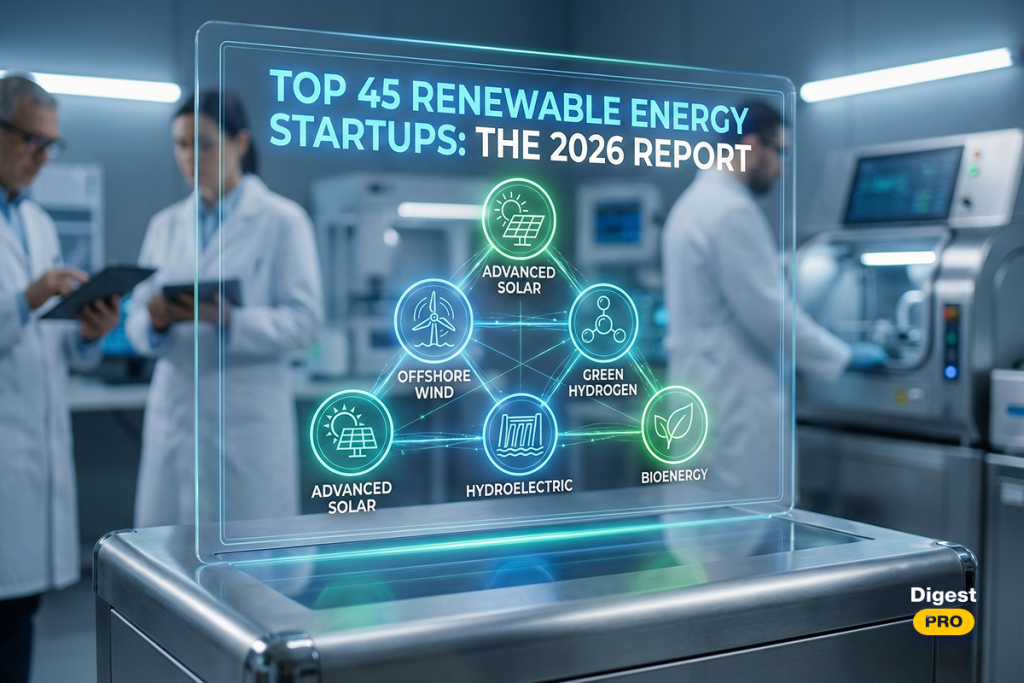
In this article, we will find out about the 37 most revolutionary startups in the renewable energy startups sector that are leading this charge and what kind of impact they are creating on the future of our planet.
The New Era of Green Energy Startups: Market Dynamics and Growth
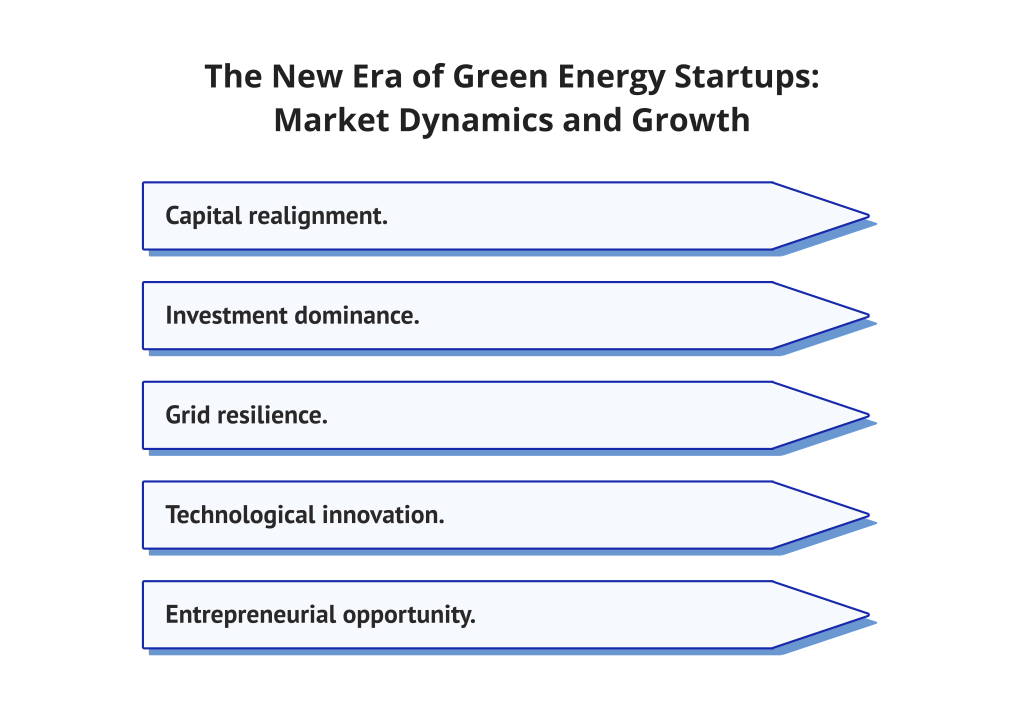
The current market is changing several important factors that we should consider:
- Capital realignment: The change in investor perception after the complete shift of renewable energy from a costlier source to a cheaper one has been phenomenal. Now, green energy startups are experiencing a significant market surge while the traditional portfolio is gradually moving towards sustainability.
- Investment dominance: As per a McKinsey report, the amount of money going into fossil fuels is much less than that going into green energy startups. This direct infusion of capital is leading to the emergence of renewable energy unicorns as the standard scenario.
- Grid resilience: New startup companies’ renewable energy sources are addressing the vulnerability of old infrastructure. Through the use of reliable, decentralized energy that protects against systemic failures, they are at the forefront of the energy transition.
- Technological innovation: AI and materials science combined are at the core of their growth. These technologies enable solar energy startups to be more efficient and resilient than we ever believed possible.
- Entrepreneurial opportunity: Such revolutionary factors are a dream come true for any new renewable energy startups to come up with a high-impact, profitable niche that they can both identify and capture.
Read more: Top 67 Startups in Germany to Watch 2026: AI, Unicorns & GreenTech Leaders.
Deep Dive: 16 Innovative Startup Companies Redefining the Industry
The following ten companies represent the pinnacle of current innovation. They have secured significant funding and demonstrated technical viability.
1. Carbo Culture

Carbo Culture is recognized as one of the carbon drawdown leaders that employs a patented thermochemical process to transform biomass into biochar. This technique essentially secures carbon in a stable form for a very long time; thus, organically originating materials are prevented from breaking down into greenhouse gases.
- Specialization: High-durability carbon removal and sequestration through biochar production.
- Revenue: Estimated $5M-$10M (carbon credit pre-sales).
- Location: Helsinki, Finland.
- Latest funding round: Grant.
Success in shifting energy systems depends heavily on reliable information. When precision matters, clarity often comes from careful monitoring of emerging leaders in renewables. For consistent detail, exclusive insights and forward-looking assessment, subscribe to Digest.Pro.
2. Electric Hydrogen

A leading-edge firm in the clean energy startups space builds large-scale PEM electrolysis systems. Despite common assumptions, focus remains fixed on industries resistant to decarbonization—steel stands out. Progress hinges on driving down costs for green hydrogen. Fossil-derived options may soon face cost competition. Achieving parity could happen before 2030.
- Specialization: Large-scale electrolyzer systems for industrial-grade green hydrogen.
- Revenue: $20M+ (contracted deployments).
- Location: Natick, Massachusetts, USA.
- Latest funding round: Debt Financing.
3. Enpal

Enpal has greatly affected the European solar market by way of its innovative subscription-based model, which, basically, through the removal of upfront costs, offers homeowners the solar solution. This green energy company doesn’t just stop at installing solar panels but rather goes the whole way in providing a full ecosystem, including hardware installation, digital management, and maintenance.
- Specialization: Residential solar-as-a-service and smart energy management.
- Revenue: $400M+ (Annual Recurring Revenue).
- Location: Berlin, Germany.
- Latest funding round: Debt Financing (Unicorn status confirmed).
4. Form Energy
Form Energy reacts to the problem of the inconsistent availability of wind and solar power by manufacturing an iron-air battery that can be used to store the energy. Their solution, which is capable of delivering 100-hour-long continuous energy at a very low cost in contrast with that of lithium-ion systems, is an energy storage field.
- Specialization: Long-duration, low-cost iron-air battery energy storage.
- Revenue: Pre-commercial / Early pilot revenue ($1M-$5M).
- Location: Somerville (Massachusetts, USA).
- Latest funding round: Debt Financing.
5. Commonwealth Fusion Systems
CFS makes use of high-temperature superconductors to produce small-sized, high-performance fusion reactors. It appears that this renewable energy startup is in the right place to showcase the power-producing aspect of net positive energy, hence becoming a permanent solution to the worldwide energy crisis.
- Specialization: Magnetic confinement nuclear fusion using HTS magnets.
- Revenue: Pre-revenue (research and development phase).
- Location: Devens, Massachusetts, USA.
- Latest funding round: Series B ($1.8B)—Leading renewable energy unicorn.
Read more: Top 51 Startups in Poland to Watch in 2026: Investment Executive Guide
6. Redwood Materials

From discarded lithium-ion batteries, Redwood Materials builds closed-loop systems for electric vehicle materials. Because old devices contain valuable resources, recovery becomes central to their method. Most cobalt and nickel returns into new parts through advanced extraction techniques. With efficiency above 95%, lost material stays minimal across processing stages. Components like anodes emerge again, reshaped from what once seemed waste.
- Specialization: Circular economy, battery recycling, and materials manufacturing.
- Revenue: $100M+ (Projected).
- Location: Carson City, Nevada, USA.
- Latest funding round: Series E.
7. Aurora Solar

Aurora Solar is powering the digital transformation of the solar industry, enabling installers to design and sell projects remotely with the help of AI and satellite data. Their solution greatly lowers the “soft costs” linked to residential and commercial solar adoption.
- Specialization: AI-powered cloud software for solar project design and sales.
- Revenue: $50M-$100M.
- Location: San Francisco, California, USA.
- Latest funding round: Series D.
8. H2 Green Steel
Ahead of most efforts worldwide, this project swaps coal for green hydrogen in making top-grade steel without fossils. From its base in Stockholm, the operation becomes a model others may follow to cut gases from heavy production lines.
- Specialization: Hydrogen-powered steel production and industrial decarbonization.
- Revenue: Pre-operational (over $5B in pre-sale agreements).
- Location: Stockholm, Sweden.
- Latest funding round: Private.
9. Mainspring Energy
Power from Mainspring Energy comes through a straight-line generator. While built for change, it runs on hydrogen one moment, then shifts—without pause—to ammonia or biogas. Not tied to one fuel type, the system delivers steady electricity where control matters most. Microgrids depend on such stability; so do corporate computing hubs. Output remains consistent even when supply sources shift.
- Specialization: Fuel-flexible linear generators for distributed power.
- Revenue: $30M-$50M.
- Location: Menlo Park, California, USA.
- Latest funding round: Series F.
10. Zap Energy
A different path emerges through Zap Energy’s work on a small-scale fusion device. Rather than relying on large magnetic systems, motion-controlled flow holds the reaction steady. Cost-effective power becomes possible when simplicity replaces complexity. Growth potential exists without dependence on traditional infrastructure. Renewable output arrives by rethinking confinement methods.
- Specialization: Z-pinch nuclear fusion technology.
- Revenue: Pre-revenue (vulnerability-backed R&D).
- Location: Everett, Washington, USA.
- Latest funding round: Series D.
Read more: 15 Best ERP Software for Small Businesses Reviewed in 2026
11. Halcyon

Halcyon is an AI-native intelligence platform built specifically for the modern energy buildout. By aggregating and structuring complex regulatory filings, utility dockets, and rate cases from commissions across the U.S., the platform helps developers, utilities, and hyperscalers accelerate their “speed to power” for critical digital and grid infrastructure.
- Specialization: AI-powered regulatory search, analytical models, and energy market trackers.
- Revenue: Subscription-based recurring revenue (scaling with targeted industry data trackers).
- Location: San Francisco, California, USA.
- Latest Funding Round: Series A ($21M) in March 2026.
Master Comparison Table: Remaining 35 Promising Renewable Energy Startups
| Company name | Primary sector | Key innovation | 2026 status |
| Swell Energy | Grid management | Virtual power plants | Series B |
| Orbital Marine Power | Tidal energy | Floating tidal turbines | Series A |
| Next Energy Tech | Window solar | Transparent PV coatings | Series C |
| Verkor | Battery tech | Low-carbon battery cells | Series C |
| Mission Zero | Direct air capture | Ion-exchange sequestration | Series A |
| Banyan Infrastructure | Finance | Renewable project SaaS | Active |
| Terabase Energy | Solar utility | Robotic PV construction | Series C |
| Fervo Energy | Geothermal | Next-gen fracking for heat | Public |
| Elcogen | Waste heat | CO2-based heat recovery | Series B |
| Amogy | Ammonia fuel | Ammonia-to-power cracking | Series C |
| KoBold Metals | Mining AI | AI-driven mineral exploration | Unicorn, Series D |
| Quidnet Energy | Water storage | Geomechanical pumping | Series C |
| Sila Nanotechnologies | Material science | Silicon anodes for EVs | Unicorn |
| Malta Inc. | Thermal storage | Molten salt pumped heat | Series B |
| Symbio | Hydrogen mobility | Fuel cell systems | Acquired |
| Freyr Energy | Rooftop Solar | Tech-enabled Solar SaaS & Hardware | Series B / Scaling |
| Blue World Tech | Methanol fuel | Methanol fuel cells | Scaling |
| Antora Energy | Thermal Storage | Zero-carbon industrial heat | Series B |
| CarbonCure | Construction | CO2 mineralized concrete | Series F |
| Twelve | Electrochem | CO2-to-Jet fuel | Series C |
| GridX | Utilities | Energy Billing SaaS | Series A |
| Eavor | Geothermal | Closed-loop geothermal | Series C |
| Skeleton Tech | Supercaps | Graphene-based storage | Series E |
| Kyoto Group | Heat Storage | Molten salt thermal batteries | Series A |
| Modvion | Wind Power | Wooden wind turbine towers | Grant |
| Aypa Power | Storage | Utility-scale battery assets | Conventional Debt |
| Tado | Energy Efficiency | Smart Climate Control | Corporate round |
Read more: 15 Best Free ERP Software Reviewed in 2026
Conclusion: The Future of the Global Energy Transition
A shift has taken place: what was once seen as marginal now drives industry worldwide. Power comes not just from old systems but from new ideas taking root today. New companies are reducing our collective dependence on fossil fuels and generating sustainable jobs and wealth.
As we look out to 2030, combining these technologies will be our biggest challenge. Solar startups linked closely to extended storage and responsive grid systems could reshape outcomes. Though reaching net-zero involves tangled challenges, practical solutions already exist.
When many different technologies become part of one energy network, following the updates is essential. Navigating complex challenges in today’s sustainable systems often benefits from shared insight—to gain exclusive knowledge, subscribe to Digest.Pro.
Our Methodology: How We Ranked the Top Renewable Energy Startups
It was a multi-factor analysis that our experts used to pick these 37 startups and to make sure we were selecting companies that would be viable in the long run, rather than those just having a short-term rise in popularity. Our team used articles, researches, surveys and market trend reports from Gartner and McKinsey to base our choices on what is real and existing in the markets.
We judged every green energy company from three main aspects:
- Technological innovation: IP that is unique to the company or totally new hardware that really breaks the limits of present renewable capabilities; these are the companies we preferred.
- Scalability and financial health: We only took into account startup companies in renewable energy solutions that have completed Series A funding or higher rounds, so that we could be sure of their capability to move from pilot to production.
- Measurable environmental impact: Firms taking measurable steps to lower carbon emissions shaped our choices. Where sunlight and wind face gaps, solutions emerged as key.
A disciplined method supports the accuracy of our list amid shifting conditions in demanding markets.
FAQ: Frequently Asked Questions About Renewable Energy Startups
The landscape of the best renewable energy startups in 2026 consists of hybrid solar energy coupled with storage startups, AI-enabled digital grid management startups, and VPPs, or decentralized Virtual Power Plants. In addition, there are some advancements regarding green hydrogen and battery energy storage systems intended to stabilize electricity grids.
The 2026 green technology startup sector attracts investors to a large extent due to the changing industrial policies in terms of tax credits and other advantages, which decrease the risk of income. Besides, companies are gradually moving towards developing integrated infrastructure solutions rather than generation capacity.
Virtual Power Plants (VPPs) allow startups to digitally aggregate thousands of decentralized, small-scale assets like rooftop solar arrays and local battery systems into a single, dispatchable resource. By networking these distributed assets via high-performance control systems, startups can bypass minimum market bid limits and profitably trade their collective power directly on major electricity exchanges.
Startups are bypassing severely constrained public grids by deploying gigawatt-scale, on-site clean power generation directly at AI data centers using solar, battery storage, and advanced fuel cells. Hyperscalers are increasingly signing long-term power purchase agreements and directly co-locating facilities with behind-the-meter generation startups to secure the reliable, ultra-high-density power required for modern machine learning workloads.
LDES has become an absolute necessity due to the fact that the increasing number of intermittent renewable sources exceeds the point at which short-duration lithium-ion batteries are no longer economically feasible as the means to stabilize energy supply in the grid. LDES provides a viable solution to the multi-day variability of solar and wind energy with discharge times ranging from four hours to several weeks.
The startups are fast adopting new electrochemical energy storage technology in the form of iron-air flow batteries, sodium-sulfur battery systems, and zinc-based technology. There is also molten salt thermal storage technology and gravity mechanical energy storage technology that do not require the use of rare earth materials.
With the increase in size, green energy startups start using the concept of energy as a Service (EaaS) to outsource the management of complex functions like predictive monitoring, asset optimization, and infrastructure maintenance. Green energy startups often outsource smart contract billing with the help of blockchain technology.
The top operational roadblock for renewable energy startups in 2026 is the lack of transmission capacity, with over 2,500 gigawatts of renewable energy projects worldwide stranded in interconnection queues due to the need for network expansion. Additionally, highly fragmented permitting processes, local land acquisition issues, and jurisdictional regulatory conflicts consistently hinder the deployment of clean energy infrastructure at a fast pace.
Energy as a Service (EaaS) is an off-balance-sheet model where a third-party financier owns, installs, and operates the energy infrastructure, including solar PV, and the end user only needs to pay for energy usage. In this way, it saves the end user from huge upfront capital costs to install solar energy solutions.
Startups in the field of green energy tend to incur high up-front capital investments, too long periods of technology development, and regulatory delays in connecting to electricity grid, which reduces the chances of persuading conservative investors to back them. Overall, proving the commercial economics of the product beyond lab tests still constitutes the main obstacle for startup teams dealing with climate technology.
Business leaders and investors use various research platforms like PitchBook, Sightline Climate (CTVC), HolonIQ, and specialized deal-tracking sites, such as digest.pro, to identify suitable investments. Also, public funding platforms, like ARPA-E, European Innovation Council (EIC), and global climate accelerator registries can help to identify fundraising founders.
Currently, there are many investments in long-duration energy storage, AI software for grid balancing, and industrial decarbonization. There is also an increased interest in circular battery supply chains and bio-based chemical alternatives.
VCs evaluate clean tech startups primarily on intellectual property defensibility, levelized cost of energy (LCOE) competitiveness, and path to manufacturing scale. Investors also heavily weigh the founding team’s technical track record and early off-take agreements or pilot commitments with major industrial clients.
Yes, the startups are succeeding in competing through the use of advanced AI, smart grid connections, and distributed microgrid technology to provide agile green power options that old utility models cannot deploy swiftly enough. Furthermore, huge amounts of venture capital investment from corporations, along with government clean-tech subsidies, are helping to level the playing field when competing with the legacy fossil fuel firms.
Long-duration energy storage, AI-driven grid/VPP software, and next-generation nuclear and geothermal built for AI data-center power are the standout opportunities for 2026 and beyond. Battery recycling and enhanced geothermal drilling are also drawing strong founder and investor interest as the sector shifts from generation toward reliability.
Nuclear and advanced geothermal are pulling in the sharpest growth in capital in 2026, driven by AI data-center demand, with grid-scale battery storage close behind as the fastest practical bridge to round-the-clock clean power. Solar still holds the largest overall dollar share, but pure early-stage renewable-tools funding actually fell 22% year over year to $3.1 billion as investors rotate toward reliability plays.
Startups improve profitability by shifting from one-time hardware sales to recurring-revenue models — Energy-as-a-Service, solar subscriptions, and Virtual Power Plant aggregation — which produce steadier margins than installation alone. Locking in offtake agreements early and managing cash through interconnection delays are just as important as the underlying technology.
AI-driven electricity demand is the defining trend, pulling capital toward nuclear, geothermal, and storage startups that deliver firm power rather than just generation capacity. Interconnection bottlenecks and shifting tax policy, including the accelerated phaseout of U.S. solar and wind tax credits for projects starting after July 4, 2026, are pushing founders toward decentralized, behind-the-meter solutions.
Storage and reliability-focused startups are growing fastest, with battery-storage specialists posting year-over-year growth above 125% and geothermal firm Fervo Energy scaling on 24/7 baseload power. Their common success factor is recurring revenue over one-off hardware sales, as shown by German solar unicorn Enpal, which grew operational revenue 25% to €1.1 billion in 2025 largely through its subscription model.
Renewable energy startups bypass traditional interconnection queues by deploying behind-the-meter (BTM) microgrids, co-locating power directly with high-demand off-takers, and utilizing flexible non-firm interconnection agreements. By pairing modular solar and battery storage directly on customer sites—such as industrial facilities or AI data centers—startups generate and consume power on-site, skipping utility transmission study backlogs entirely.
AI-driven predictive maintenance protects clean energy startup margins by forecasting component failures and reducing unplanned operational downtime for wind and solar assets. Machine learning models analyze real-time IoT vibration and thermal sensor telemetry to trigger preemptive repairs. This lowers levelized cost of energy (LCOE) and prevents expensive emergency maintenance dispatches.
Clean tech startups structure 24/7 Carbon-Free Energy (CFE) contracts using time-matched Power Purchase Agreements (PPAs) supported by granular, hourly Energy Attribute Certificates (T-EACs). Startups blend wind, solar, and long-duration storage into a single virtual product, using optimization software to guarantee enterprise demand is matched hourly with zero-carbon generation.
Green hydrogen startups decarbonize heavy industry by replacing fossil fuels with zero-emission chemical feedstocks and extreme high-temperature combustion. In steelmaking, startups supply green hydrogen to replace metallurgical coal in Direct Reduced Iron (DRI) shafts. In cement, startups provide high-heat hydrogen burner injection systems to achieve the required 1,450°C clinker kiln temperatures without direct CO2 emissions.
DERMS startups partner with legacy utilities by deploying cloud-based software that aggregates behind-the-meter batteries, EVs, and solar assets into controllable grid-balancing services. Instead of replacing legacy distribution management systems, startups integrate via API interfaces to provide grid operators real-time visibility, automated congestion relief, and non-wires alternatives (NWA) during peak load hours
References
- Gartner (2025). “Hype Cycle for Environmental Sustainability,.”
- McKinsey & Company (2026). “The Global Energy Perspective 2026.”
- International Energy Agency (IEA). “Renewables 2025: Analysis and Forecast to 2030.”
- BloombergNEF. (2026). “Battery Storage Costs Hit Record Lows as Costs of Other Clean Power Technologies Increased.”
- Dobrovolska, O., Ortmanns, W., Podosynnikov, S., Halynskyi, D., & Miniailo, A. (2024). Start-Ups and Entrepreneurship in Renewable Energy: Investments and Risks. Financial Markets, Institutions and Risks, 8(2), 213-240. https://doi.org/10.61093/fmir.8(2).213-240.2024
- Serhiy Lyeonov, Serhiy Podosynnikov, and Wadim Strielkowski. Does a reliable electricity grid connection matter for the development of European renewable energy startups?
- Myroshnychenko, I., Podosynnikov, S., Halynskyi, D., Ushkalov, M., & Chuhai, O. (2024). Regulatory Barriers for Entrepreneurship and Start-Ups In Renewable Energy: Bibliometric Analysis. SocioEconomic Challenges, 8(3), 181-210. https://doi.org/10.61093/sec.8(3).181-210.2024
- Tiesheva, L., & Shteimiller, I. (2025). Development of entrepreneur structures in the field of renewable energy through improving public-private partnership mechanisms. Bulletin of V. N. Karazin Kharkiv National University Economic Series, (109), 208-219. https://doi.org/10.26565/2311-2379-2025-109-18.
- Muser, T., Krymova, E., Morabito, A. et al. Fatigue damage reduction in hydropower startups with machine learning. Nat Commun 16, 2961 (2025). https://doi.org/10.1038/s41467-025-58229-z.
- Bloomberg NEF (BNEF) (2024). Clean Energy Investment Trends 2024: Tracking global investment in the low-carbon transition.