
Gartner projects that task-specific AI agents will reach 40% of enterprise applications by the end of 2026, up from under 5% in 2025. Yet Gartner’s 2026 CIO survey found only 17% of organizations had actually deployed an agent as of early 2026, even though over 60% planned to within two years. That gap between ambition and execution is why this guide exists.
Knowing how to build AI agents is now a core skill for product leaders, not a research niche. The technology has outrun the standard playbook most teams use to ship it. This guide closes that gap with a repeatable process for how to build an AI agent, how to create an AI agent that survives real users, and how to choose a framework without locking yourself into the wrong one.
Our guide will help you understand what separates an agent from a chatbot, decide whether your use case needs autonomy at all, and walk through the eight-step build sequence — from objective-setting through governance — that production teams use in 2026. This is how to build AI agents that reach production, not just a demo.
Building an agent roadmap for your team? Follow Digest.Pro on LinkedIn for weekly, no-hype breakdowns of what is actually working in enterprise AI.
What an AI Agent Actually Is
A software program that utilizes planning, invokes tools, examines outcomes, and makes its own decisions, without requiring manual pre-programming of every option, is called an AI agent. According to Anthropic, workflows consist of LLMs and tools that work together following predetermined programming and paths, while real agents steer their own processes and tools.
A chatbot answers a question. An agent completes a task. Ask a chatbot why an invoice bounced, and it lists common reasons. Give an agent the same instruction, and it queries the billing API, reads the transaction log, and returns a specific answer, or escalates when it cannot find one.
The agent layer does the reasoning loop, not just the model. The underlying model supplies judgment. The agent layer supplies memory, tool access, and the loop that turns one model call into finished work. Most AI agent development effort belongs here.
Do You Actually Need an Agent?
Not every automation problem needs autonomy. A fixed, five-step approval process with no real ambiguity is cheaper and more predictable as plain code than as an agent.
Agents earn their cost when three conditions hold at once.
- The number of steps varies and cannot be known in advance.
- The correct action depends on information the system can only get by calling a tool.
- And a human would normally use judgment to decide the next step, not just follow a script.
These conditions define most realistic ai agent use cases, from support triage to research synthesis.
Developer forums raise the same complaint constantly: teams build an agent for a task a simple script could handle, then spend months debugging non-determinism they created themselves. A simple test: could a checklist do this job? If yes, automate it as a fixed workflow. If a competent employee would need to investigate and adapt mid-task, that is where agentic AI adds real value.
The Building Blocks Every Agent Needs
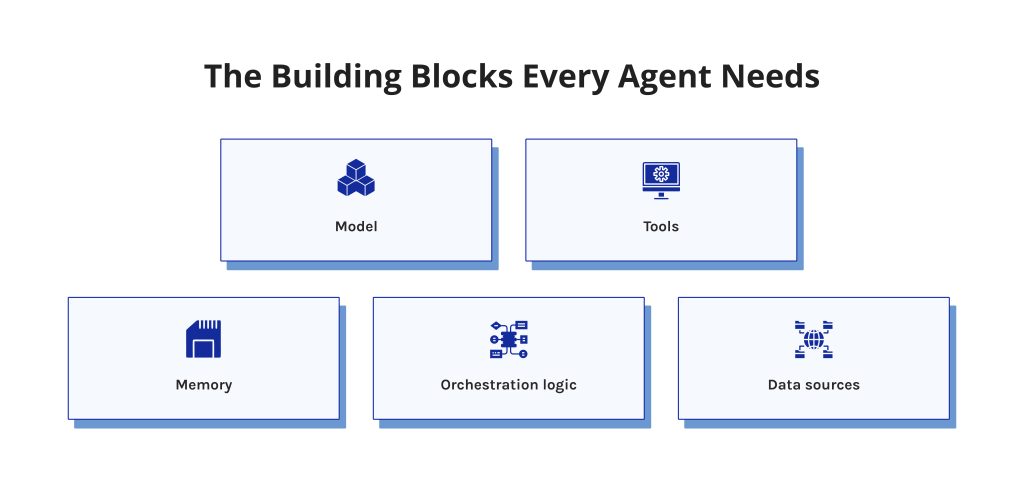
Every production agent, regardless of framework, is built from the same five components.
- Model: the reasoning engine that plans steps and interprets tool output.
- Tools: functions, APIs, or MCP servers the agent calls to act on the world.
- Data sources: the knowledge the agent draws on, from a vector database of past tickets to a live CRM connection. Most agent failures trace back to stale data sources, not a weak model.
- Memory: short-term context for the current task, and often, longer-term storage of past decisions.
- Orchestration logic: the loop that governs workflow execution — call a tool, ask the model again, or stop.
Data quality determines agent quality more than model choice does. Before writing orchestration code, keep an external tools data map of every API, database, and MCP server the agent can reach, and confirm each source is trustworthy enough to act on. That audit is the technical core of how to build AI agents, whether from scratch in Python or inside a no-code AI agent platform.
Read more: The 9 Best AI Agent Frameworks in 2026 (Compared)
How to Build an AI Agent: An Eight-Step Process
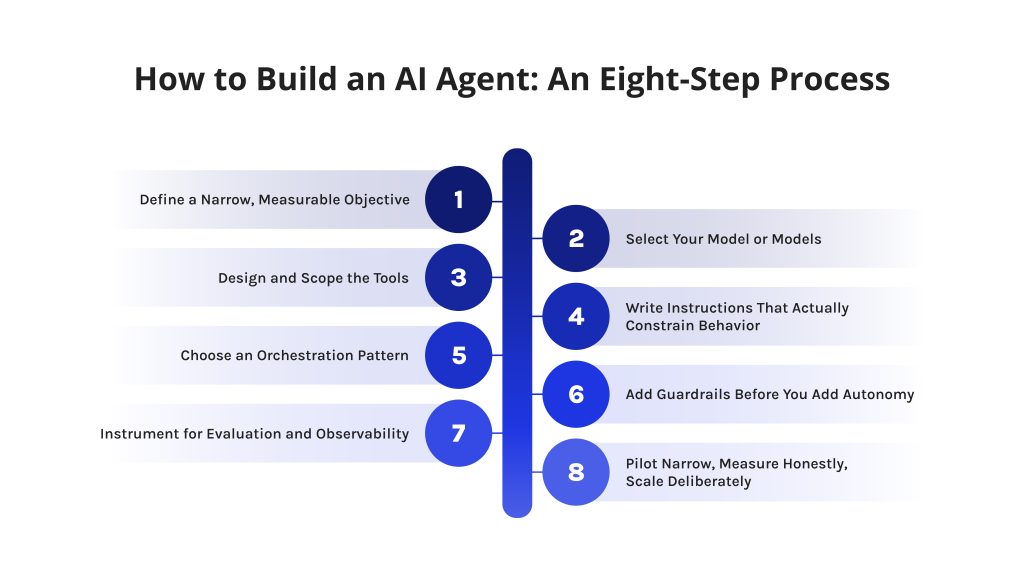
How to build AI agents well comes down to sequence, not tool choice. The steps below reflect how production teams sequence a build, drawing on Anthropic’s own agent-development guidance and patterns seen across dozens of deployments. Jumping to orchestration before defining a measurable objective is the most common reason agent projects stall.
Step 1: Define a Narrow, Measurable Objective
Building AI agents starts narrower than feels comfortable. “Handle customer service” is not an objective; “resolve order-status questions without human involvement, escalate everything else” is.
Write the objective with a measurable outcome attached: percentage resolved without escalation, handling time, or error rate. Gartner’s data shows why this matters: more than 40% of agentic AI projects will be canceled by 2027 due to unclear business value, not technical failure.
A vague goal produces an agent nobody can evaluate. Anyone researching how to create an AI agent should start exactly here, with the objective, not the tool.
Step 2: Select Your Model or Models
Model choice comes after the objective, never before it. Match capability to task difficulty: a fast, lightweight model handles routing and lookups, while a stronger reasoning model handles multi-step planning. Many teams run two models inside one agent — cheap for volume, strong for the one step that genuinely needs judgment.
Teams that build AI agents with Python get the widest choice among AI agent frameworks: the OpenAI Agents SDK, Google’s ADK, and Anthropic’s Claude Agent SDK all expose the same core primitives in a few dozen lines of code. Python remains the default language for AI agent development, with TypeScript a close second. Test the model against your actual task, not a public benchmark.
Step 3: Design and Scope the Tools
Every tool an agent can call is also a risk surface. Scope each tool narrowly: “look up order status” is safer than an unrestricted “query the database” tool.
Expose tools through the Model Context Protocol where possible. MCP has crossed 97 million monthly SDK downloads and is now supported by every major AI provider, so tools built as MCP servers stay reusable across AI agent frameworks. Learning core ai agent protocols early, MCP included, prevents costly vendor lock-in.
Scope permissions to the smallest set of actions the task requires. An agent that only reads order status should never hold write access to billing. List every external tool and data source the agent will touch; this becomes your security review checklist later.
Halfway through the build? Digest.Pro’s LinkedIn page breaks down real agent architecture decisions from teams shipping in production.
Step 4: Write Instructions That Actually Constrain Behavior
Instructions are not a personality description. They are the operational contract the agent runs against, and vague instructions produce vague behavior.
Effective instructions specify three things: what the agent must do, what it must never do, and what it should do when uncertain. “Never process a refund above $200 without approval” constrains behavior; “be helpful and cautious” does not.
Write instructions like an onboarding document for a new hire with zero context, and spell out the escalation path explicitly. Test instructions against edge cases, not the happy path, since production breaks on the account nobody anticipated.
Step 5: Choose an Orchestration Pattern
Orchestration is the layer that governs workflow execution, deciding what an agent does next. Anthropic’s research names five patterns for AI agent workflow design: prompt chaining, routing, parallelization, orchestrator-worker, and evaluator-optimizer. Start with the simplest pattern that solves the problem; prompt chaining handles more tasks than teams expect, and orchestrator-worker fits when one coordinator needs to delegate subtasks to specialists.
Multi agent systems solve coordination problems, not capability problems. Adding more agents does not make any single agent smarter; it adds overhead and more places for a workflow to break. Reserve multi-agent systems for cases where distinct roles genuinely need separate context. The Agent2Agent protocol — one of the core AI agent protocols alongside MCP, now backed by more than 150 organizations under the Linux Foundation — standardizes how agents from different vendors hand off tasks once your architecture needs more than one.
Step 6: Add Guardrails Before You Add Autonomy
Guardrails are not a polish step; they are what makes autonomy safe to grant in the first place. Three matter most: hard limits on which actions require human approval, spend caps that stop runaway tool calls, and input validation before a request reaches a tool.
Deloitte’s enterprise AI research found only one in five companies has a mature model for agent governance, even as agentic AI usage rises sharply. Autonomy without guardrails is unmanaged risk, not efficiency. Build guardrail logic into the orchestration layer, not the prompt — a confused agent can talk itself past a soft instruction, but not past a hard-coded permission check.
Step 7: Instrument for Evaluation and Observability
You cannot improve what you cannot see. Log every tool call, decision, and escalation, starting with the first internal test. Build an evaluation set from real examples: twenty to fifty representative tasks with a known correct outcome, run against every new version before release. Track task success rate, escalation rate, and cost per completed task.
Observability catches drift before customers do. A model update or a subtle prompt edit can quietly shift agent behavior. Treat each change as a new version of the AI agent workflow, not a silent patch; teams that log decisions catch drift within days, while teams that only monitor uptime miss it entirely.
Step 8: Pilot Narrow, Measure Honestly, Scale Deliberately
Launch to a small, real slice of traffic first — five percent of tickets, or one product line. Real usage surfaces failure modes no test set predicts. Set a go or no-go threshold before the pilot starts, not after seeing favorable results.
McKinsey’s global AI survey found 88% of organizations report regular AI use in at least one business function, up from 78% a year earlier, yet far fewer have scaled agents specifically. Scaling too early is the most expensive mistake in agent development. Expand scope only once the pilot proves the Step 1 objective is genuinely being met.
Read more: Quick Guide to Agentic Workflow: What It Is, Why Use It, and How to Build
Choosing Your Framework and Protocol Stack
Once you know how to build AI agents at a technical level, the framework question is mostly about fit. By 2026, choosing among AI agent frameworks has settled into a handful of well-documented options, each suited to a different team and its AI agent use cases.
| Framework | Best For | Learning Curve | Notable Strength |
| LangGraph | Complex, stateful workflows with approval steps | Steep | Graph-based control over workflow execution |
| CrewAI | Fast, role-based multi-agent prototypes | Gentle | Readable, declarative Python API |
| Microsoft Agent Framework | Enterprise .NET and Azure environments | Moderate | Merges AutoGen and Semantic Kernel |
| Google ADK | Teams already on Google Cloud and Gemini | Moderate | Native Vertex AI integration |
| OpenAI Agents SDK | Simple agent chains, OpenAI-native stacks | Gentle | Minimalist, four core primitives |
Editorial note: Our team spent two weeks running the same triage workflow across five of these AI agent platforms before writing this guide. LangGraph took roughly a day longer than CrewAI to get running, but gave the clearest audit trail once the agent hit edge cases the demo never covered. CrewAI produced a working prototype in under two hours, though we hit friction adding a custom approval step outside its built-in patterns.
Treat MCP and A2A as complementary layers of your AI agent protocols stack, not competing standards. MCP standardizes how a single agent connects to external tools and data sources; revisit your external tools data map whenever you swap frameworks.
A2A standardizes how separate agents, built on different frameworks, discover each other and hand off tasks. A complete stack in 2026 uses MCP for tool access and adds A2A only once the architecture needs multiple cooperating agents.
For teams that prefer a no-code AI agent platform over a full framework, n8n, Google’s Workspace Studio, and Microsoft Copilot Studio offer visual builders that trade some control for a faster path to a first working AI agent workflow. Whether you build an AI agent with Python or assemble one visually, the same five building blocks apply, and most AI agent frameworks now support both patterns out of the box. Enterprise AI agent platforms increasingly bundle governance tooling too, though it is rarely switched on by default.
Common Pitfalls That Sink Agent Projects
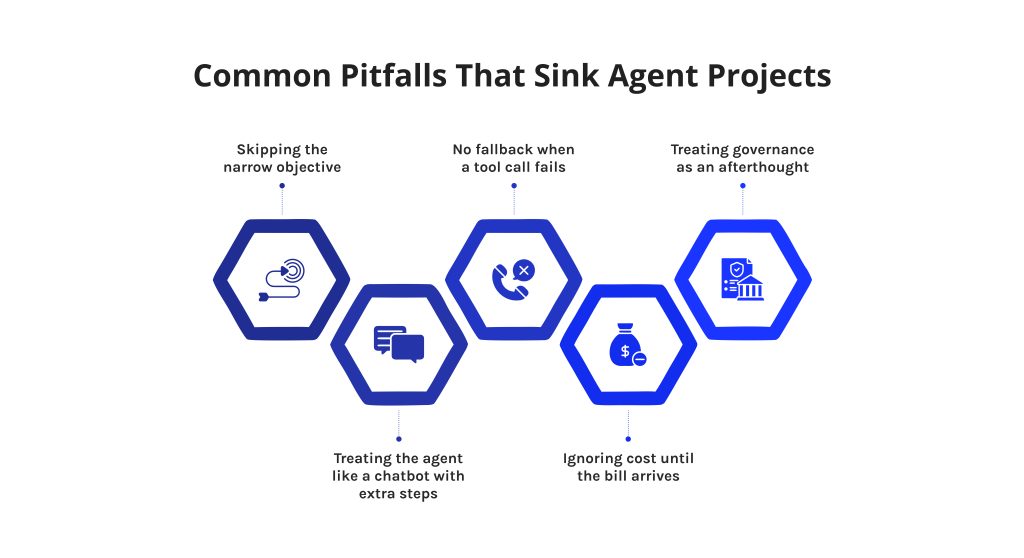
Most teams learning how to build AI agents repeat the same handful of mistakes, regardless of industry.
- Skipping the narrow objective. Teams that start with “let’s add an agent” build something impressive in a demo and unusable in production.
- Treating the agent like a chatbot with extra steps. This produces a bloated prompt instead of proper tool design and orchestration logic.
- No fallback when a tool call fails. An agent with no defined fallback either guesses at an answer or stalls completely.
- Ignoring cost until the bill arrives. Reasoning loops multiply token usage fast, especially inside multi agent systems where agents exchange messages repeatedly.
- Treating governance as an afterthought. Deloitte’s research shows most companies planning an AI agent deployment still lack a mature governance model.
Gartner’s Anushree Verma, Senior Director Analyst, put it bluntly: “Most agentic AI projects right now are early stage experiments or proof of concepts that are mostly driven by hype and are often misapplied.” Building AI agents that survive contact with real users means fixing these patterns before scale, not after. Discipline in scoping, not model sophistication, separates projects that survive production.
A Governance Checklist Before You Scale
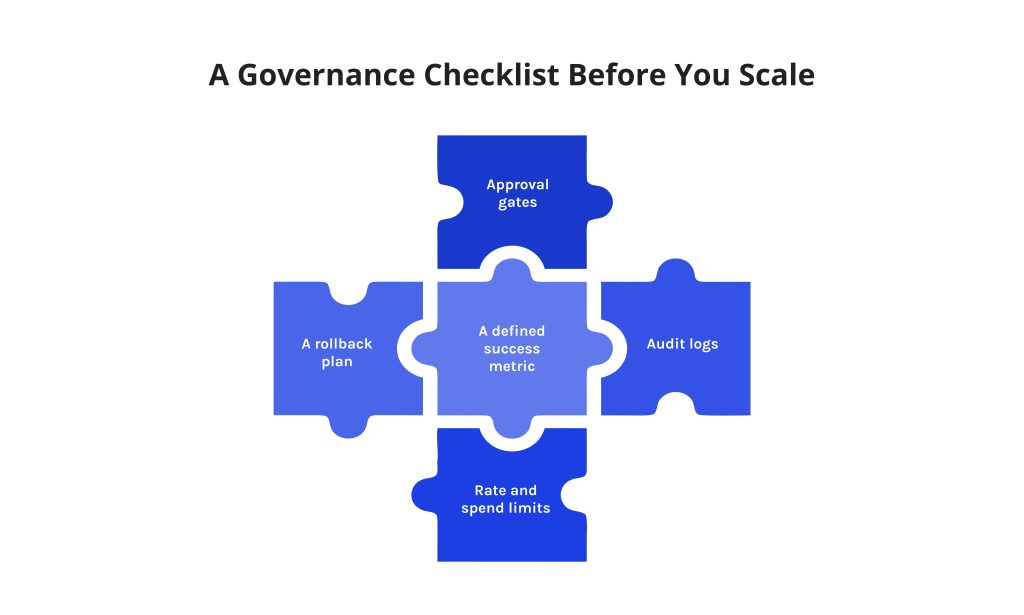
Governance is the last mile of how to build AI agents responsibly. Before expanding any agent beyond a pilot, confirm the following are genuinely in place, not just documented in a slide.
- Approval gates for every irreversible or costly action, with a named owner for exceptions.
- Audit logs covering every tool call, decision, and escalation, retained long enough for a real incident review.
- Rate and spend limits enforced at the point of workflow execution, not only monitored after the fact.
- A rollback plan that reverts to the previous version or a human-only process within minutes.
- A defined success metric tied to the Step 1 objective, reviewed on a fixed schedule.
Deloitte’s research frames the stakes plainly: AI agent adoption is poised to rise sharply over the next two years, but oversight is lagging, with only one in five organizations governance-ready. Treat this checklist as a gate, not a suggestion, before any agent touches real customers or money at scale.
Conclusion
How to build AI agents is no longer a research problem. It is an engineering and governance discipline with a known, repeatable process: define a narrow objective, select the right model and tools, write instructions that constrain behavior, choose an orchestration pattern, add guardrails, instrument everything, and pilot before you scale.
The organizations pulling ahead in 2026 do not necessarily have the most sophisticated model. They treat agent building as a discipline, with narrow scope and governance built in from day one instead of bolted on after an incident. As Andrew Ng, founder of DeepLearning.AI, wrote when the current wave of interest began, “I think AI agent workflows will drive massive AI progress this year — perhaps even more than the next generation of foundation models.”, a claim 2026’s adoption data has largely confirmed.
Start with one workflow, one measurable objective, and one well-scoped agent. That is how to build AI agents that reach production and stay there.
Want more practical AI agent development coverage? Follow Digest.Pro on LinkedIn for weekly, grounded analysis of what enterprise AI teams are actually building.
Read more: AI Agent Assist: What It Is and Why You Need It in 2026?
FAQs
Your use case needs an agent when the number of steps varies, the correct action depends on live data, and a human would normally use judgment mid-task. If the process always follows fixed steps, a simpler script is more reliable and cheaper to run.
An LLM generates text from a prompt; a chatbot wraps that LLM in a conversational interface; an AI agent adds tools, memory, and an orchestration loop on top. That loop lets an agent plan multiple steps and complete a task rather than simply answer a question.
Start with a single agent, and move to multi agent systems only when distinct roles genuinely need separate context and tools. A research agent handing findings to a writing agent is a good example; each added agent brings coordination overhead.
Pick LangGraph for complex, stateful workflows that need explicit control and approval steps. Choose CrewAI for fast, role-based prototypes, Microsoft Agent Framework for enterprise Azure environments, and Google ADK for Google Cloud stacks; all four are solid AI agent platforms for production use.
Require explicit human approval for any expensive, irreversible, or customer-facing action, enforced in the orchestration layer rather than in a prompt. Add hard rate and spend limits, validate every input, and log each decision for later review.
Customer service, IT support, software engineering, and knowledge management. Finance and supply chain follow closely as AI agent adoption expands beyond early pilots.
AI agents let businesses complete multi-step work across common AI agent use cases, such as research, triage, and reconciliation, without a human handling every step manually. Deloitte found that 64% of service leaders report higher agent productivity after deploying agentic AI, with 39% reporting lower cost per contact.
Every AI agent needs a model for reasoning, tools to act on external systems, data sources to draw on, memory for context, and an orchestration layer. A weakness in any one component, especially the data sources, undermines the whole system.
Python is the default language for AI agent development, since LangGraph, CrewAI, the OpenAI Agents SDK, and Google ADK all ship Python-first. Teams that build AI agents with Python get the broadest framework choice; TypeScript is the strongest alternative for JavaScript-native teams.
Build an evaluation set of twenty to fifty real tasks with known outcomes, and run it against every agent version before release. Pilot on a small slice of real traffic with a predefined go or no-go threshold, then scale once the objective is met with measured data.
References
Anthropic. (2024). Building effective agents. https://www.anthropic.com/research/building-effective-agents
Deloitte. (2026). The state of AI in the enterprise (2026 AI report). https://www.deloitte.com/us/en/what-we-do/capabilities/applied-artificial-intelligence/content/state-of-ai-in-the-enterprise.html
Deloitte. (2026, February 16). The future of service [Press release]. Deloitte US. https://www.deloitte.com/us/en/about/press-room/the-future-of-service.html
Forasoft. (2026, June 3). Manus AI, Claude Agent SDK, OpenAI Swarm, Google ADK, n8n — The 2026 framework deep-dive. https://www.forasoft.com/learn/ai-for-video-engineering/articles-ai/manus-ai-claude-agent-sdk-openai-swarm-google-adk-n8n-2026
Gartner. (2025, August 26). Gartner predicts 40% of enterprise apps will feature task-specific AI agents by 2026, up from less than 5% in 2025 [Press release]. https://www.gartner.com/en/newsroom/press-releases/2025-08-26-gartner-predicts-40-percent-of-enterprise-apps-will-feature-task-specific-ai-agents-by-2026-up-from-less-than-5-percent-in-2025
Gartner. (2026). 2026 hype cycle for agentic AI. https://www.gartner.com/en/articles/hype-cycle-for-agentic-ai
Harvard Business Review. (2025, October 21). Why agentic AI projects fail—and how to set yours up for success. HBR Store. https://store.hbr.org/product/why-agentic-ai-projects-fail-and-how-to-set-yours-up-for-success/H08Y6F
McKinsey & Company. (2025, November). The state of AI in 2025: Agents, innovation, and transformation. https://www.mckinsey.com/capabilities/quantumblack/our-insights/the-state-of-ai