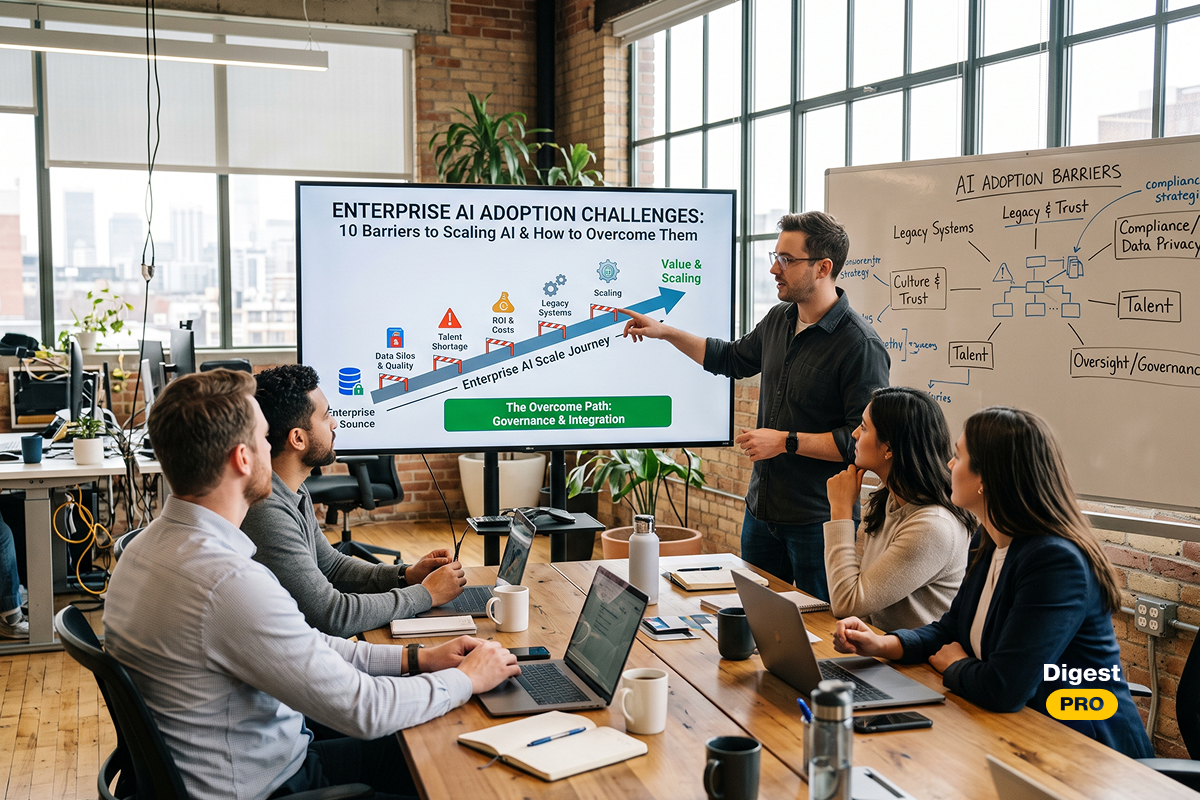

The biggest FP&A challenges come down to one imbalance: finance teams spend more time preparing numbers than using them. In the 2025 FP&A Trends Survey, 46% of FP&A time went to collecting and validating data, and only 31% to the high-value work of generating insight and driving action. The rest went to formatting and basic reporting. That leaves little room for fast scenarios, reliable forecasts and clear advice. Below are the 10 most common FP&A challenges in corporate financial planning, why each one persists, and practical ways to fix them, starting with the data and process problems that make every other challenge harder.
Executive Summary
- FP&A teams spend nearly half their time on data collection and validation; value-adding work has not exceeded one-third since 2019 (FP&A Trends Survey, 2025).
- Only 14% of finance teams formally track forecast accuracy, according to the 2026 AFP FP&A Benchmarking Survey.
- Only 38% use structured scenario planning, yet those teams budget 11% faster (AFP, 2026).
- Gartner rates forecasting and insight generation among the lowest-impact finance AI use cases (2026).
- The challenges are linked. Fix data and process first, then add tools and AI.
What Is FP&A and Why Is It Getting Harder?
Financial planning and analysis (FP&A) is the corporate finance function that builds budgets, forecasts and scenarios, and explains performance against plan so leaders can allocate capital. It is getting harder because planning horizons are shrinking, data volumes are growing, and executives now expect finance to answer “what if” questions within days, not weeks.
In the 2025 FP&A Trends Survey, 61% of respondents said they can only predict their business environment up to six months ahead, and just 10% believe they can plan beyond 12 months. Yet the classic model still assumes a 12-month annual budget.
Expectations have moved faster than capability. CFOs want FP&A to partner with the business, run scenarios on demand and adopt AI, while most teams are still reconciling spreadsheets.
A note on scope: this article covers corporate financial planning challenges inside companies, not personal or household financial planning.
10 FP&A Challenges and How to Fix Them
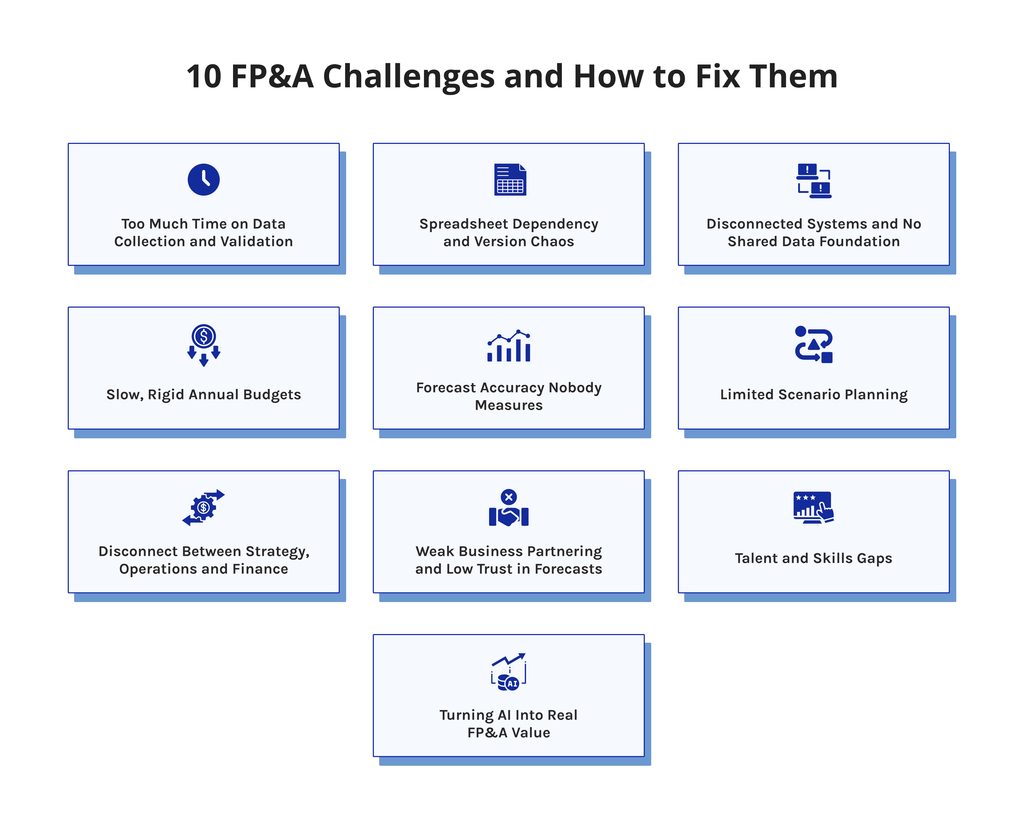
The 10 most common problems are excessive data preparation, spreadsheet dependency, disconnected systems, slow annual budgets, unmeasured forecast accuracy, limited scenario planning, misaligned strategic and operational plans, weak business partnering, skills gaps and slow AI value. Each follows the same format: warning signs, why it happens, how to fix it.
1. Too Much Time on Data Collection and Validation
Warning signs: Analysts spend the first week of every cycle pulling exports and reconciling totals. Commentary is written the night before the deadline.
Why it happens: FP&A time allocation has barely moved in seven years. The 2025 FP&A Trends Survey (459 finance professionals) found 46% of time goes to data collection and validation, down only from 53% in 2019. High-value work fell to 31% from 35% in 2024; formatting and basic reporting took 23%. Since 2019, value-adding work has never exceeded one-third. Data quality drives much of it: teams with poor data spend 59% of their time collecting and validating, against 35% with best-in-class data.
How to fix it: Measure where analyst hours go for one full cycle. Automate the three most repetitive data pulls, assign an owner to each source and protect the freed hours for analysis. Data preparation is also where AI agents in finance are most practical today.
2. Spreadsheet Dependency and Version Chaos
Warning signs: Files named “Budget_v14_FINAL_revised”. Links break when someone inserts a row. Nobody is sure which version went to the board.
Why it happens: Spreadsheets are flexible, cheap and familiar. FP&A Trends (2025) found 45% of organizations still rely primarily on spreadsheets for planning, down from 60% in 2022. Those teams spend just 28% of their time on insight and 50% on manual data work. Every handoff adds a copy and more reconciliation risk.
How to fix it: Keep spreadsheets for ad hoc analysis, but move the core model (actuals, drivers, consolidation) into one governed planning environment with version control and an audit trail. Separate inputs from calculations and stop emailing plan files.
3. Disconnected Systems and No Shared Data Foundation
Warning signs: CRM revenue never matches ERP revenue, HR headcount differs from planned headcount, and every review opens with an argument about whose number is right.
Why it happens: ERP, CRM, HR and operational systems were bought separately and define the same entities differently. FP&A Trends (2025) reports that 84% of organizations still operate with multiple data sources that vary in taxonomy and require manual reconciliation. Only 17% rate their planning data as best-in-class or advanced.
How to fix it: Start with master data, not technology: agree definitions for customers, products, cost centers and headcount, then name a system of record for each metric and connect planning to it. If the ERP is the weak link, our guides to ERP software for small businesses and manufacturing ERP software compare options.
4. Slow, Rigid Annual Budgets
Warning signs: The budget takes a quarter to build and is outdated on approval. Mid-year, nobody refers to it.
Why it happens: These budgeting challenges are structural. The 2026 AFP FP&A Benchmarking Survey (332 practitioners, fielded August to September 2025) found the average budget takes 8.7 weeks, unchanged from three years ago despite new technology. FP&A Trends (2025) adds that 28% of companies need three to six months, 38% still rely on “last year plus x%”, and only 5% run a rolling or continuously adaptive budget.
How to fix it: Reduce the annual budget to a small set of targets and move detail into a 12- to 18-month rolling forecast built on a few operational drivers (volume, price, headcount, capacity). More detail in budgeting and forecasting challenges.
5. Forecast Accuracy Nobody Measures
Warning signs: Forecasts are reissued monthly, but nobody can say whether they are improving. Business units sandbag, and finance cannot prove it.
Why it happens: Accuracy is rarely treated as a performance metric. According to the 2026 AFP FP&A Benchmarking Survey, as cited by AFP, only 14% of finance teams formally track forecast accuracy. The payoff from better modeling is large: in FP&A Trends (2025), 77% of teams with fully driver-based models rate their forecasts good or great, against 27% of those with basic models.
How to fix it: Publish two metrics every cycle: absolute percentage error against actuals for key lines (revenue, EBITDA, cash) and bias, meaning whether errors skew consistently high or low. Track both by business unit and horizon. Bias usually signals incentive problems; large errors signal model or data problems.
6. Limited Scenario Planning
Warning signs: When the board asks “what if demand drops 15%?”, the answer takes two weeks.
Why it happens: Scenarios need a driver-based model and clean data, which most teams lack. The AFP 2026 survey found only 38% of organizations use structured scenario planning. Those that do report 14% higher strategic alignment and build budgets in 8.1 weeks versus 9.2 weeks for peers. FP&A Trends (2025) found 19% of teams still cannot run scenarios at all, with lack of tools as the top barrier (39%).
“Finance’s response to an unpredictable future must be to maintain multiple points of view of what can happen. Inflexible budgets break. The findings of AFP’s survey show that structured scenario planning is a key difference between organizations that can pivot quickly and those that get stuck in disconnected execution,” said Bryan Lapidus, FPAC, Director of FP&A Practice, AFP.
How to fix it: Model the five to seven drivers that move most of the P&L and cash, and pre-build scenarios around real risks: demand, pricing, input costs, rates, capacity. Our review of scenario planning tools compares platforms, and the guide to digital twins for planning and forecasting shows the operational end of the spectrum.
7. Disconnect Between Strategy, Operations and Finance
Warning signs: The sales plan, the project or production plan and the financial plan are built separately and never reconcile. Finance learns about a delayed delivery when revenue misses.
Why it happens: These strategic planning challenges are organizational before they are technical. FP&A Trends (2025) found only 11% of companies have fully integrated strategic, financial and operational planning, and 42% cite departmental fragmentation as the top barrier. In project-based businesses the gap is sharpest: cash arrives at payment milestones such as design sign-off or customer acceptance, so a slip that pushes one milestone into the next quarter moves cash even when the end date looks safe.
How to fix it: Adopt integrated business planning, sometimes called extended planning and analysis (xP&A), with shared drivers and one planning calendar across functions. Link operational plans to cost and cash at the milestone level, not just the project total. Project portfolio tools such as Epicflow, Planview or Planisware now tie resource plans to project cost and cash flow forecasts. More on this shift in FP&A trends.
8. Weak Business Partnering and Low Trust in Forecasts
Warning signs: Operational leaders keep their own numbers. Finance is invited to present results, not to shape decisions.
Why it happens: Trust follows usefulness. FP&A Trends (2025) shows 45% of FP&A functions are now recognized or endorsed by senior management as business partners, yet only 9% act as strategic advisors. When most time goes to data preparation, little is left for the conversations that build credibility.
How to fix it: Cut the reporting pack in half and replace pages with decisions and their financial consequences. Judge business partners on decisions influenced, not reports delivered. The broader shift in the finance leader’s role is covered in our CFO trends analysis.
9. Talent and Skills Gaps
Warning signs: Strong accountants struggle with data modeling, data specialists do not understand the P&L, and senior analyst vacancies stay open for months.
Why it happens: Modern FP&A needs people fluent in both finance and data. In Deloitte’s Finance Trends 2026 (1,326 finance leaders, surveyed spring 2025), 47% of companies at an advanced stage of AI implementation cite limited expertise as a barrier. Yet skills development as a transformation priority fell from 19% in 2022 to 4% in 2025 (FP&A Trends).
How to fix it: Fix challenge 1 first, because training only happens when analysts have free hours. Pair finance professionals with data engineers, define a skills matrix (modeling, data, storytelling) and hire from adjacent functions.
10. Turning AI Into Real FP&A Value
Warning signs: Several AI pilots, no change in cycle time or forecast quality.
Why it happens: AI amplifies the data and process it sits on. In a March 2026 Gartner survey of 204 finance leaders, 63% said AI implementation was slower than expected in 2025, and financial forecasting and insight generation were among the lowest-rated use cases. An earlier Gartner survey of 183 CFOs (June 2025) found 84% had implemented or planned AI, but only 7% reported high impact.
“They must not mistake activity for impact. Counts of pilots, tools rolled out or use cases in production show that finance is moving, but they do not prove that AI is delivering the value boards now expect,” said Marco Steecker, Director Analyst, Gartner Finance practice.
Deloitte (2026) reports data security as the leading barrier, cited by 57% of advanced adopters.
How to fix it: Start where AI already works: data preparation, reconciliation and variance commentary. Move to forecasting only once accuracy is measured (challenge 5), so you can prove AI beats the baseline.
“Finance does not need to prove that it can use AI anymore. It needs to prove that AI can change how finance supports better business decisions,” said Marco Steecker, Director Analyst, Gartner Finance practice.
Why FP&A Challenges Matter to the CFO
Planning problems escalate to the CFO because the CFO signs off on the forecast, the capital plan and the guidance built on them. Slow cycles, unmeasured accuracy and disconnected plans become late decisions, misallocated capital and lost credibility with the board and investors, which makes planning capability a board-level issue.
Most CFO challenges, from volatile demand to AI investment pressure, land on the planning team as a request for faster, more reliable answers. A team spending nearly half its time preparing data cannot respond at that speed. Our analysis of CFO trends looks at how finance leaders are reshaping their role and what that demands from the planning function.
An FP&A Maturity Model: Where Does Your Team Stand?
Most challenges of financial planning map to a maturity stage. Reactive teams fight data, structured teams fight process, integrated teams fight alignment, and predictive teams fight model trust. Knowing your stage tells you which fix to prioritize next, rather than buying technology that your data and process cannot yet support.
Use the four-stage view below as a diagnostic, not a scorecard.
| Level | Typical signs | Next step |
|---|---|---|
| 1. Reactive | Spreadsheet-led; more than half of time on data collection; annual budget only; accuracy not tracked | Agree data owners and definitions; automate the main data pulls |
| 2. Structured | Governed planning tool; standard calendar; monthly or quarterly reforecasts; basic variance analysis | Introduce driver-based models and measure forecast accuracy and bias |
| 3. Integrated | Rolling forecast; sales, operations and finance plans share drivers; regular scenario runs | Link operational plans to cost and cash at milestone level; pre-build risk scenarios |
| 4. Predictive | Scenarios in days or hours; accuracy tracked by horizon; AI in data preparation and forecasting with human review | Scale AI use cases with measured baselines; shift analyst time to decision support |
Few teams sit cleanly at one level. FP&A Trends (2025) found only 2% describe their function as fully optimized, while 54% say they are coping with a long journey ahead.
How to Overcome FP&A Challenges: A Practical Order of Fixes
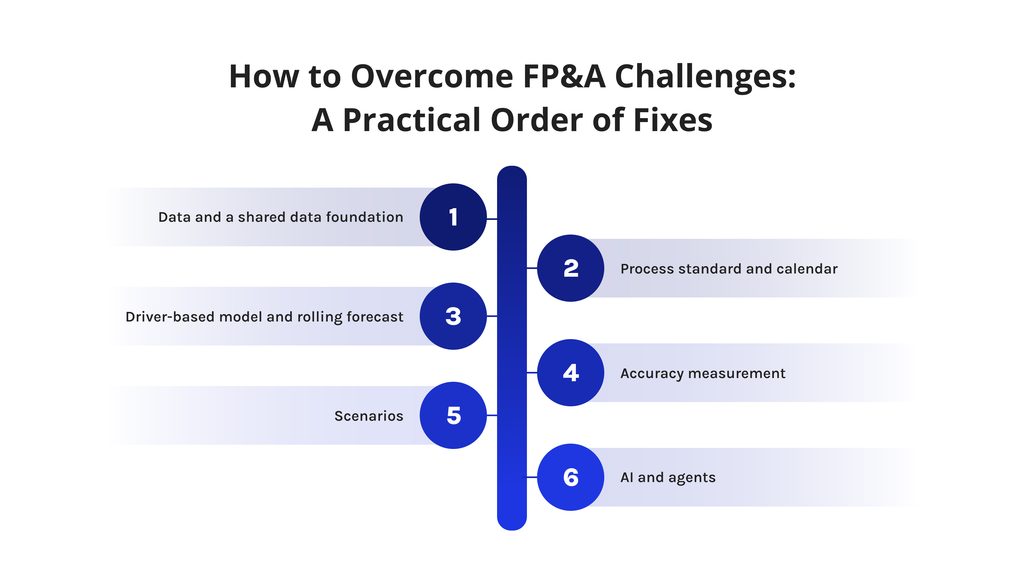
The most reliable way to overcome FP&A challenges is to fix them in sequence: data first, then process, models, measurement and scenarios, and only then AI. Each step creates the conditions for the next. Skipping ahead, especially to AI, usually automates existing problems instead of solving them.
- Data and a shared data foundation. Agree definitions, owners and systems of record for core metrics.
- Process standard and calendar. One planning calendar, clear inputs and deadlines, version control.
- Driver-based model and rolling forecast. Replace line-by-line budgets with a few operational drivers.
- Accuracy measurement. Publish error and bias every cycle, by business unit and horizon.
- Scenarios. Pre-build scenarios on the drivers that matter most to profit and cash.
- AI and agents. Apply them first to data preparation and commentary, then to forecasting once baselines exist. See AI agents in finance.
Our Methodology
This article draws on primary research published July 2025 to June 2026: FP&A Trends Survey 2025 (n=459), the 2026 AFP FP&A Benchmarking Survey (n=332), Gartner finance releases (May and June 2026) and Deloitte Finance Trends 2026 (n=1,326). Each statistic was checked against the original publication. The maturity model and order of fixes are editorial syntheses, as of October 2026.
Key Takeaways
- FP&A teams still spend nearly half their time on data collection and validation (FP&A Trends, 2025).
- Only 14% of finance teams formally track forecast accuracy (AFP, 2026).
- Structured scenario planning separates top performers, yet only 38% use it (AFP, 2026).
- AI helps most with data preparation today; forecasting and insight use cases are still the hardest to get right (Gartner, 2026).
- The challenges in financial planning are linked: fix the data and the process first, then add tools and AI.
References
- FP&A Trends Group. “FP&A Trends Survey 2025: From Ambition to Execution: How Leading FP&A Teams Turn Insights into Impact.” July 2025. https://fpa-trends.com/sites/default/files/docs/FPA-Trends-Survey-2025-OneStream.pdf
- Association for Financial Professionals. “AFP Survey Reveals Structured Scenario Planning Separates Top Performing Corporate Finance Teams.” Press release, January 20, 2026. https://www.financialprofessionals.org/about/learn-more/press-releases/Details/afp-survey-reveals-structured-scenario-planning-separates-top-performing-corporate-finance-teams
- Association for Financial Professionals. “2026 AFP FP&A Benchmarking Survey Report: Integrated Planning.” 2026. https://www.financialprofessionals.org/training-resources/resources/survey-research-economic-data/Details/afp-fpabenchmarking-survey-report-integrated-planning
- Association for Financial Professionals. “Your Forecast Does Not Have a Score. It Should.” April 28, 2026. https://www.financialprofessionals.org/training-resources/resources/articles/Details/your-forecast-does-not-have-a-score-it-should
- Gartner. “Gartner Says CFOs Must Stop Mistaking Finance AI Deployment for Value Creation.” Press release, May 28, 2026. https://www.gartner.com/en/newsroom/press-releases/2026-05-28-gartner-says-cfos-must-stop-mistaking-finance-ai-deployment-for-value-creation
- Gartner. “Gartner Says CFOs Need Structured Finance AI Roadmaps.” Press release, June 8, 2026. https://www.gartner.com/en/newsroom/press-releases/2026-06-08-gartner-says-cfos-need-structured-finance-ai-roadmaps
- Deloitte. “Finance Trends 2026.” 2026. https://www.deloitte.com/be/en/services/consulting/perspectives/finance-trends-2026.html
- Deloitte Romania. Finance Trends 2026 press release (AI adoption barriers and talent), February 4, 2026. https://www.deloitte.com/ro/en/about/press-room/studiu-deloitte-departamentele-financiare-adopta-noi-tehnologii-intr-un-ritm-rapid-si-vad-deja-beneficii-clare-din-utilizarea-automatizarii-inteligente-inteligentei-artificiale-si-agentilor-ai.html
FAQs
The biggest FP&A challenges are too much time spent on data collection and validation, dependence on spreadsheets, disconnected systems, slow annual budgets and forecast accuracy that nobody measures. Most of the other challenges, from limited scenario planning to slow AI value, trace back to poor data and manual processes.
Most of the effort goes into preparing data rather than analyzing it. The 2025 FP&A Trends Survey found 46% of FP&A time is spent on data collection and validation, and only 31% on insight and action. Disconnected ERP, CRM and HR systems, plus heavy spreadsheet use, force analysts to reconcile numbers manually every cycle.
The main corporate financial planning challenges are budgets that are outdated by the time they are approved, little or no scenario planning, and financial plans that are disconnected from sales, production and project plans. Unclear data ownership and unmeasured forecast accuracy make it hard for leaders to know which numbers to trust.
FP&A teams improve forecast accuracy by building driver-based models, moving to a rolling forecast and measuring error and bias every cycle. Measurement is the most neglected step: only 14% of finance teams formally track forecast accuracy, according to the 2026 AFP FP&A Benchmarking Survey.
AI is changing FP&A first by automating data preparation, reconciliation and commentary. Forecasting is harder: Gartner’s 2026 research places financial forecasting and insight generation among the lowest-rated finance AI use cases, and 63% of finance organizations said implementation was slower than expected. Teams that fix data and measure accuracy first get more from AI.
Accounting records what has already happened: it closes the books, ensures compliance and produces financial statements. FP&A looks forward: it builds budgets, forecasts and scenarios, explains variances against plan and advises leaders on decisions. Accounting’s actuals are FP&A’s starting point.