
Agentic AI in procurement is moving from pilot to production. Gartner forecasts fast growth in supply chain management software with agentic AI capabilities. Spend will rise from less than $2 billion in 2025 to $53 billion by 2030 [1]. Yet only 36% of chief procurement officers are very confident in redesigning roles and processes around AI [2]. That gap between investment and readiness decides which projects succeed.
In this guide, an explanation is provided of how agentic AI works in procurement and what value it generates, as well as the ways of utilizing it in a safe manner. After completing this guide, one will know how to assess agentic AI solutions in procurement, choose a use case, and launch safeguards that will keep one’s expenses secure.
Subscribe to Digest.Pro on LinkedIn for expert guides on AI, project management, and enterprise technology.
Key takeaways:
- Agentic AI acts, generative AI only drafts. Earlier AI for procurement only recommended the next step. An agent runs the sourcing event or checks the invoice itself, from start to finish.
- Data quality decides outcomes, not model choice. An agent acts on whatever spend, contract, and supplier data it can see, so fragmented records produce fragmented decisions no matter how capable the underlying model is.
- Most vendors claiming this capability are not what they claim. Gartner estimates only about 130 of the thousands of vendors marketing “agentic AI” have built real agentic capability; the rest are rebranded chatbots or RPA.
- Governance failures, not weak technology, cause project cancellations. Gartner expects over 40% of agentic AI projects to be canceled by 2027, driven by cost overruns, unclear ROI, and missing risk controls.
What Is Agentic AI in Procurement?
Agentic AI in procurement is software that pursues a goal, not one that only answers prompts. It uses AI agents to plan tasks, call enterprise tools, take action, and adjust when conditions change. A sourcing agent, for example, gathers bids, scores them, and drafts an award recommendation for the procurement team. The AI agents procurement leaders trust most act only within defined limits.
Artificial intelligence in procurement did not start with agents. Earlier AI systems classified spend and flagged anomalies through machine learning. Generative AI drafted RFPs and summarized contracts. Agentic AI systems go further and own a workflow from request to outcome.
Three building blocks make this possible. Large language models power generative AI and supply natural language processing, so a buyer can state a need in plain words. Machine learning adds prediction and pattern detection. Orchestration software links agents to ERP, sourcing, and contract data. Together, they form the AI agent technology behind modern AI procurement platforms.
The table below compares three generations of automation.
| Approach | What it does | Human role | Procurement example |
| Rule-based RPA | Repeats fixed steps | Writes and updates rules | Copies invoice data into the ERP |
| Generative AI | Creates content on request | Prompts and reviews each output | Drafts an RFP |
| Agentic AI | Pursues a goal across systems | Sets goals, limits, and approvals | Runs a tail-spend sourcing event |
Gartner analyst Balaji Abbabatulla explains that simple AI agents are “capable of executing discrete supply chain tasks,” which frees people for more complex work [1].
How Do AI Agents in Procurement Work?
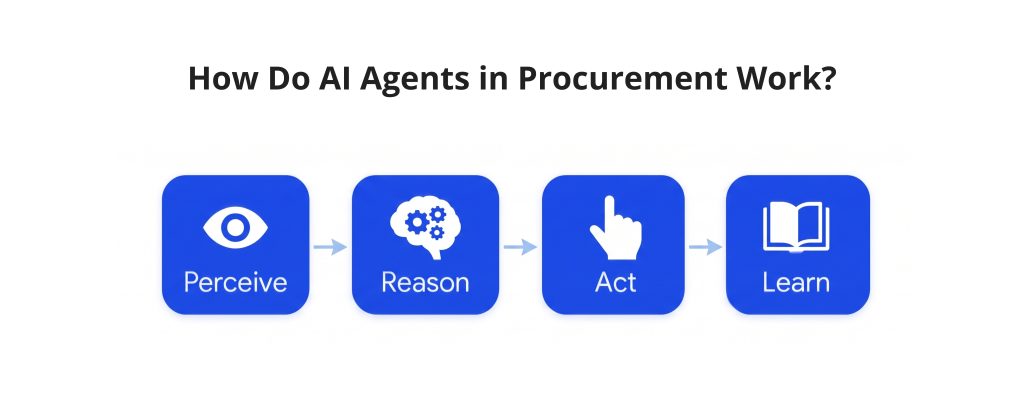
Agentic AI works through a repeating loop of four steps. Each pass moves a task closer to the goal.
- Perceive: The agent reads spend data, contracts, supplier records, and market signals.
- Reason: A language model, the engine of generative AI, interprets context and weighs options. This decision-making follows the rules and thresholds you configure.
- Act: The agent sends an RFQ, updates a purchase order, or alerts a buyer through connected systems.
- Learn: Outcomes feed back into the agent, so later decisions improve.
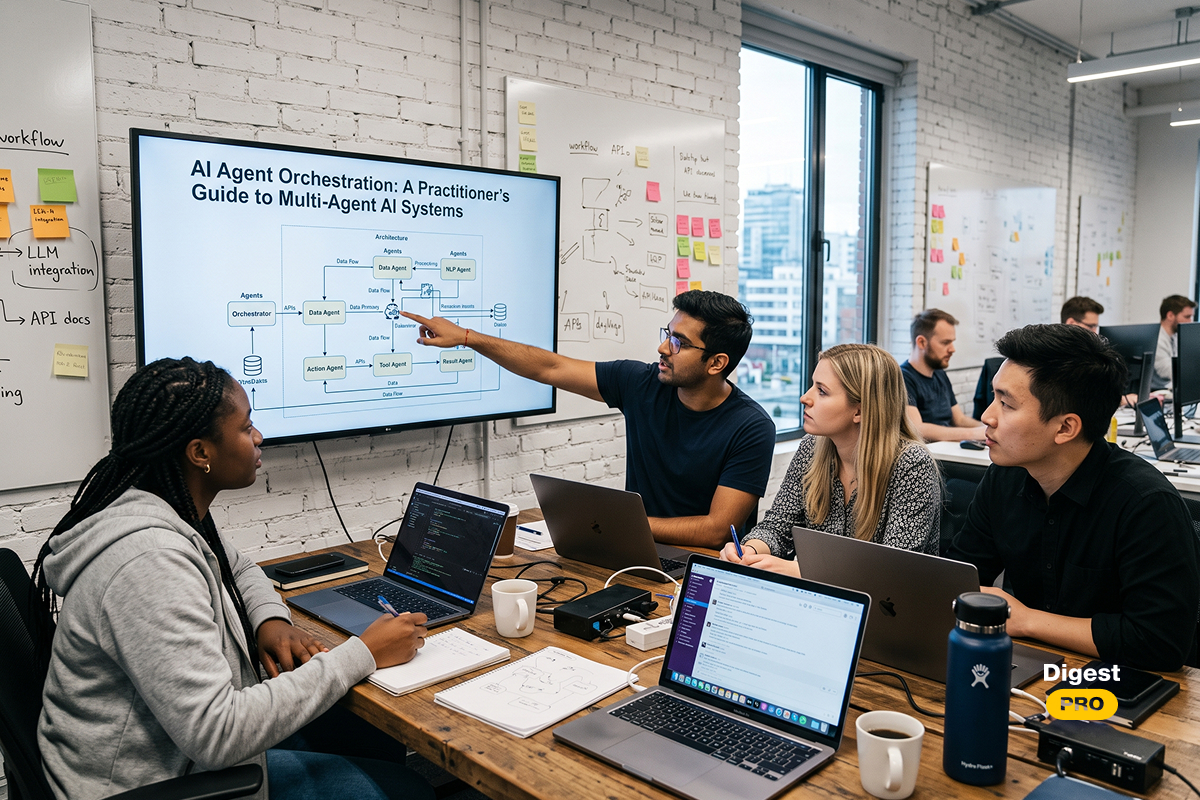
Most enterprise setups rely on a multi-agent design. Specialist agents handle intake, sourcing, contracts, and supplier management, and an orchestrator coordinates them under company policy. Gartner expects leaders to invest in clusters of simple agents that run multi-step workflows, with or without humans in the loop [1].
The AI agents’ procurement platforms shipped today rely on four layers:
- Data layer: unified spend, contract, and supplier records.
- Reasoning layer: language models plus machine learning models.
- Integration layer: APIs and connectors to ERP and source-to-pay suites.
- Governance layer: approval limits, audit logs, and escalation rules.
These agentic AI systems only work when all four layers are in place. High-value or high-risk actions still route to a human, which keeps AI systems accountable. AI agent technology needs the same controls as any financial system.
Benefits of AI agents in procurement
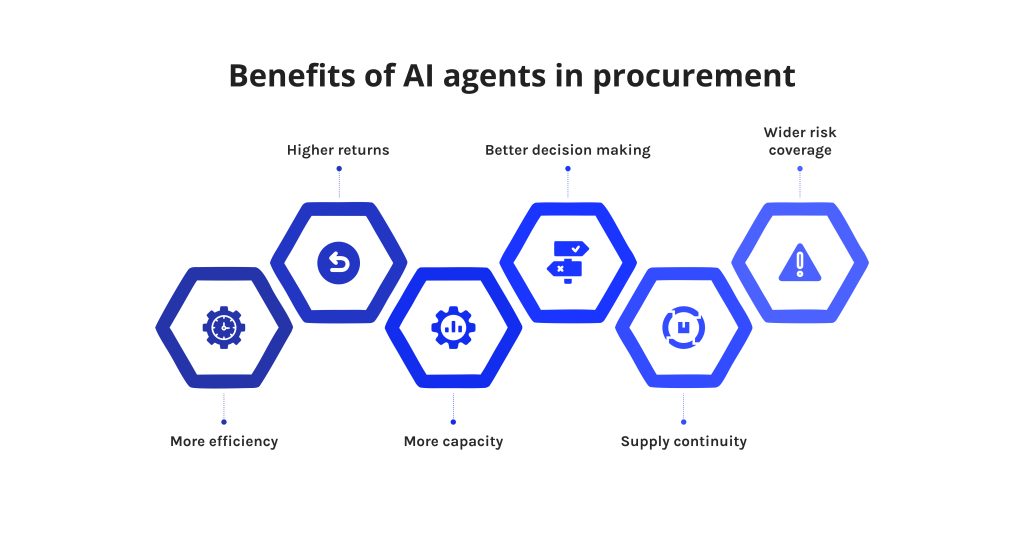
AI agents in procurement functions can deliver speed, coverage, and stronger decisions at the same time. The evidence for agentic AI systems is growing.
- More efficiency: McKinsey’s analysis shows a potential efficiency gain of 25 to 40 percent from agentic AI in procurement [3].
- Higher returns: Deloitte’s 2025 survey found that top-performing “Digital Masters” earned an average 3.2x return on generative AI investments. Followers projected slightly above 1.5x [4].
- More capacity: Each procurement team member now manages 50 percent more spend than five years ago, according to McKinsey. Agents absorb the transactional load.
- Better decision-making: Agents compare bids on total cost, not unit price alone. SAP’s bid analysis agent, for example, factors in unit prices, shipping, and payment terms [5].
- Supply continuity: Agents link purchasing to inventory management, so buying follows real stock levels.
- Wider risk coverage: Agents monitor supplier signals continuously instead of relying on periodic reviews.
Subscribe to Digest.Pro on LinkedIn to get new expert analysis on AI and procurement as soon as it publishes.
Use cases: AI agents in procurement and supply chains
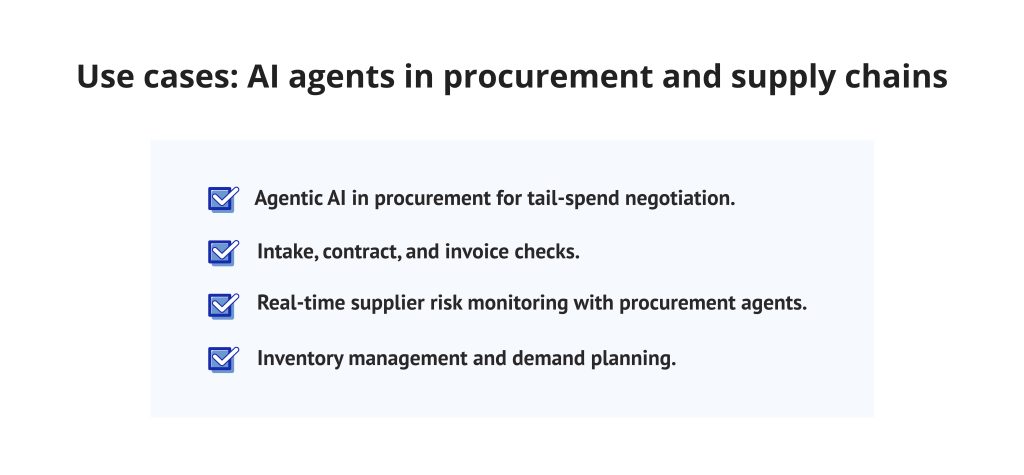
AI in procurement is scaling fast. Gartner predicts that 60% of enterprises using supply chain management software will adopt agentic AI features by 2030, up from 5% in 2025 [1]. The AI agents’ procurement teams deploy first to share a pattern: high volume, clear rules, and measurable outcomes. These agentic AI in procurement use cases lead the field.
Agentic AI in procurement for tail-spend negotiation
Procurement agents run RFx events from shortlist to award recommendation. They invite suppliers, compare bids, and flag outliers. Zycus, for example, applies agentic AI to tail-spend management through autonomous negotiation [6]. Buyers keep control by setting price ceilings and approved terms.
Intake, contract, and invoice checks
Intake agents let employees describe a need in plain language. Natural language processing lets the agent read free-text requests, classify them, and check policy. SAP’s Joule Agent in Ariba Intake Management routes requests across SAP and non-SAP systems [7]. Contract and invoicing assistants then handle drafting, duplicate detection, and payment proposals.
Real-time supplier risk monitoring with procurement agents
Risk agents watch supplier financials, delivery performance, and news signals around the clock. They alert the procurement team before a delay reaches production. AI for procurement pays off when visibility turns into action. CPOs agree: they rank maintaining active alternative sources (74%) and supply chain visibility (64%) among their most effective risk strategies [4].
Inventory management and demand planning
Planning agents connect purchasing to inventory management. They track stock levels, forecast demand with machine learning, and trigger replenishment orders within budget limits. Accurate supplier lead times make inventory management more reliable. This link across the procurement supply chain keeps stock levels aligned with real demand.
Best practices for AI agents in procurement
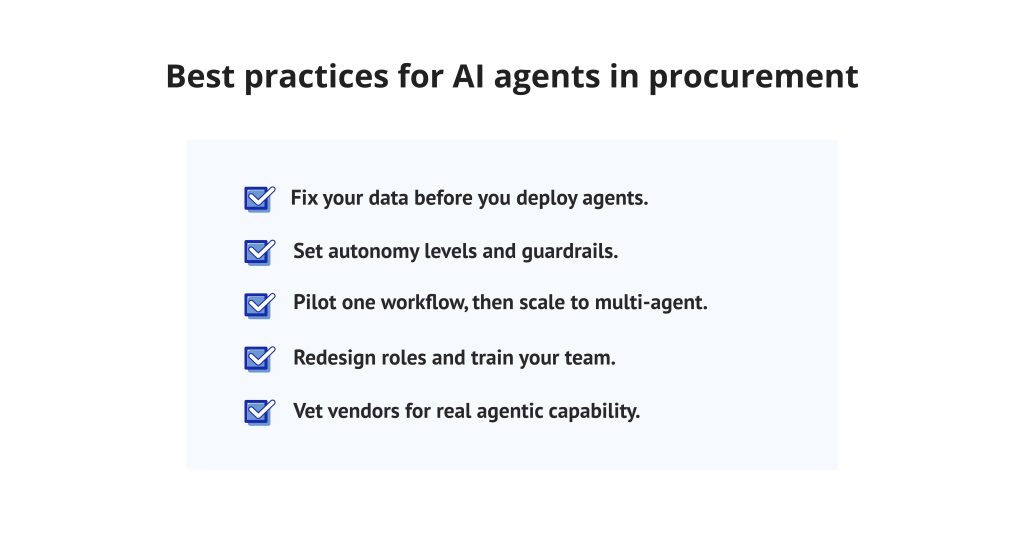
Gartner predicts that over 40% of agentic AI projects will be canceled by the end of 2027. The causes are escalating costs, unclear business value, and inadequate risk controls [8]. AI agent technology is maturing fast, but these five agentic AI in procurement best practices target the causes of failure directly.
Fix your data before you deploy agents
Agentic AI acts on the data it reads, so poor data produces poor actions. Weak data breaks even well-designed AI systems. Gartner advises leaders to focus change management investments on layers such as data management and workforce AI-readiness [1]. Start by placing spend, contract, and supplier records under one owner.
Set autonomy levels and guardrails
Define three autonomy tiers for the AI agents procurement managers configure. Use “recommend only,” act with approval, and act within limits. Treat AI systems like new hires with limited approval rights. McKinsey partner Rich Isenberg notes that an agent approving invoices needs more human interaction because financial risk is attached [9]. Log every action and give buyers a one-click override.
Pilot one workflow, then scale to multi-agent
Pick one workflow with a clear KPI, such as tail-spend cycle time. McKinsey describes a pharmaceutical company that ran a four-week proof of concept. Its AI-based invoice-to-contract reconciliation tool found more than $10 million in value leakage [3]. After a pilot proves value, add the AI agents procurement analysts’ requests next, one at a time, and connect them through an orchestrator. Agentic AI systems scale best in small steps.
Redesign roles and train your team
Individual productivity gains do not scale without new operating models. Gartner’s Fareen Mehrzai says generative AI gains “remain confined to the individual level” without intentional redesign of roles and processes [2]. Train each procurement team to supervise AI systems, review exceptions, and manage supplier relationships.
Vet vendors for real agentic capability
Gartner estimates that only about 130 of the thousands of agentic AI vendors are real. It warns that many others engage in agent washing by rebranding chatbots and RPA [8]. Ask each AI procurement vendor to prove its agentic AI in procurement claims on your data. Demand live demos of the AI agents procurement buyers will actually use, not slides. Compare agentic AI tools in procurement by autonomy tier, integration depth, and audit controls. Agentic AI systems worth buying show audit logs and override controls.
Also ask which agents are generally available today and which sit on the roadmap. SAP’s H2 2025 innovation guide, for example, listed its bid analysis agent as planned for a Q1 2026 release.
Editorial note: We compared announcements from SAP, Zycus, GEP, and Ivalua. All four describe agents for intake, sourcing, or contract work. None of those announcements replace a proof of concept on your own data.
Summary
In procurement, agentic artificial intelligence advances AI from advice to action. Throughout the procurement industry, the definition of artificial intelligence has shifted from just providing insight to executing tasks. Procurement leaders make use of agentic AI to handle various activities from input processes to supplier monitoring while under human control. Gartner projects $53 billion in spend on supply chain software with agentic AI by 2030. Any procurement team that builds these foundations now will set the pace across the procurement supply chain.
Subscribe to Digest.Pro on LinkedIn for more expert guides on AI in procurement, project management, and enterprise technology.
FAQs
The best procurement software in the market are SAP Ariba, Coupa, Jaggaer, Ivalua, GEP SMART, Zycus, Oracle Cloud Procurement, Zip, Precoro, and Procurify. Enterprise businesses, including SAP and Coupa, are leading in complexity in global source-to-pay processes, while easy solutions like Procurify and Precoro offer straightforward controls and processes for teams in the mid-market.
Agentic AI in procurement automates manual processes, accelerates the routine sourcing procedure, and contributes to better decision-making. According to McKinsey, the efficiency gain might be estimated at 25 to 40 percent. Agentic AI also provides an opportunity to monitor more suppliers and contracts than is possible with manual checking, which increases transparency for the team.
The principal hazards of AI in procurement consist of inadequate data, ineffective governance, absence of evident ROI, and agent washing. Gartner projects that more than 40% of agentic AI initiatives will be terminated by the year 2027 due to expenses, lack of clarity about their efficacy, and poor management. It is recommended to govern AI systems wisely by using good quality data, enforcing spending thresholds, and restricting tests.
Generative AI creates content on request, while agentic AI takes action toward a goal. A generative tool drafts an RFP when prompted. An agentic system builds the sourcing event, contacts suppliers, compares bids, and escalates exceptions to a buyer for approval. Most platforms combine both.
RPA follows fixed scripts, while an AI agent reasons about context and adapts. An RPA bot fails when an invoice format changes. The agent interprets the new layout, decides how to proceed, and escalates only true exceptions to a person. This flexibility is the core difference.
Yes, the AI can perform negotiations on its own with vendors within limits set by buyers. This makes it perfect for small purchases that occur frequently in high volumes. For instance, Zycus employs this practice for tail spending. However, negotiations with key suppliers and complicated contracts are still handled by people.
No. Agentic AI in procurement shifts work but does not remove the need for specialists. Agents take transactional tasks. Category managers focus on strategy, supplier relationships, and judgment. Humans set goals and own outcomes.
Agents integrate through APIs, prebuilt connectors, and native embedded agents. SAP’s Joule Agent in Ariba Intake Management routes requests across SAP and non-SAP systems. Coupa and Oracle also embed AI in their platforms. Confirm integration depth in a proof of concept before you buy.
Procurement agents monitor risk by continuously reading supplier, market, and performance signals. They flag financial distress, delivery delays, and compliance gaps. Then they alert buyers or start contingency sourcing. Human approval remains in place for high-impact supplier changes, such as switching a sole-source vendor.
A multi-agent architecture splits source-to-pay into specialist agents coordinated by an orchestrator. Intake, sourcing, contract, and invoice agents each own one task. The orchestrator sequences them, applies policy, and escalates exceptions.
References
- Gartner. (2026, April 7). Gartner forecasts supply chain management software with agentic AI will grow to $53 billion in spend by 2030 [Press release]. https://www.gartner.com/en/newsroom/press-releases/2026-04-07-gartner-forecasts-supply-chain-management-software-with-agentic-ai-will-grow-to-53-billion-in-spend-by-2030
- Gartner. (2026, May 19). Gartner survey shows just 36% of chief procurement officers are very confident in ability to redesign function for AI [Press release]. https://www.gartner.com/en/newsroom/press-releases/2026-05-19-gartner-survey-shows-just-36-perecent-of-chief-procurement-officers-are-very-confident-in-ability-to-redesign-function-for-ai
- McKinsey & Company. (2025, October 27). Transforming procurement functions for an AI-driven world. https://www.mckinsey.com/capabilities/operations/our-insights/transforming-procurement-functions-for-an-ai-driven-world
- Deloitte. (2025, August 19). Procurement at the tipping point: Deloitte’s 2025 Chief Procurement Officer Survey reveals the pressure and promise of technology disruption [Press release]. https://www.deloitte.com/us/en/about/press-room/2025-chief-procurement-officer-survey.html
- SAP. (2025). SAP innovation guide H2 2025. https://www.sap.com/topics/innovation-guide/h2
- Zycus. (2026, January 23). Zycus named a Leader in the 2026 Gartner Magic Quadrant for Source-to-Pay Suites [Press release]. https://www.zycus.com/press-releases/zycus-named-a-leader-in-the-2026-gartner-magic-quadrant-for-source-to-pay-suites
- Thurman, E. (2026, May 14). Enabling autonomous spend management with AI and connected processes. SAP News Center. https://news.sap.com/2026/05/enabling-autonomous-spend-management-ai-connected-processes/
- Gartner. (2025, June 25). Gartner predicts over 40% of agentic AI projects will be canceled by the end of 2027 [Press release]. https://www.gartner.com/en/newsroom/press-releases/2025-06-25-gartner-predicts-over-40-percent-of-agentic-ai-projects-will-be-canceled-by-end-of-2027
- McKinsey & Company. (2026, March 5). Trust in the age of agents [Audio podcast episode]. In The McKinsey Podcast. https://www.mckinsey.com/capabilities/risk-and-resilience/our-insights/trust-in-the-age-of-agents