Nearly half of US banked households (48.3%) used mobile banking as their primary way to access their accounts in 2023, according to the Federal Deposit Insurance Corporation [1]. In 2019 the share was 34.0% [2]. Digital transformation in banking is not simply moving those services into an app. It means connecting customer journeys, core systems, data, risk controls and the operating model so the bank changes how work gets done, not only where customers click.
Supervisors are watching the same shift. ECB Banking Supervision lists banks’ digital and AI-related strategies, governance and risk management as a medium to long-term priority for 2026 to 2028, next to operational resilience and ICT capabilities [3].
This guide explains the transformation areas that matter, shows how to sequence change around customer and business outcomes, and names the trade-offs bank leaders should make explicit before they scale a program.
Key takeaways
- Treat transformation as a redesign of journeys, operations, data and technology together. A new app on an old process is digitization, not transformation.
- Tie every priority to a measurable outcome and a named risk owner before you fund it.
- Modernize core systems in phases, run old and new platforms side by side, and gate each migration wave on data reconciliation and resilience limits.
- Measure completion time, adoption, service quality, reliability, cost-to-serve and control outcomes, each with a baseline, denominator, segment and window.
- Verify current obligations with your regulator at each gate. Rules such as DORA in the EU and third-party guidance in the US shape how change can be delivered.
What does digital transformation in banking mean?
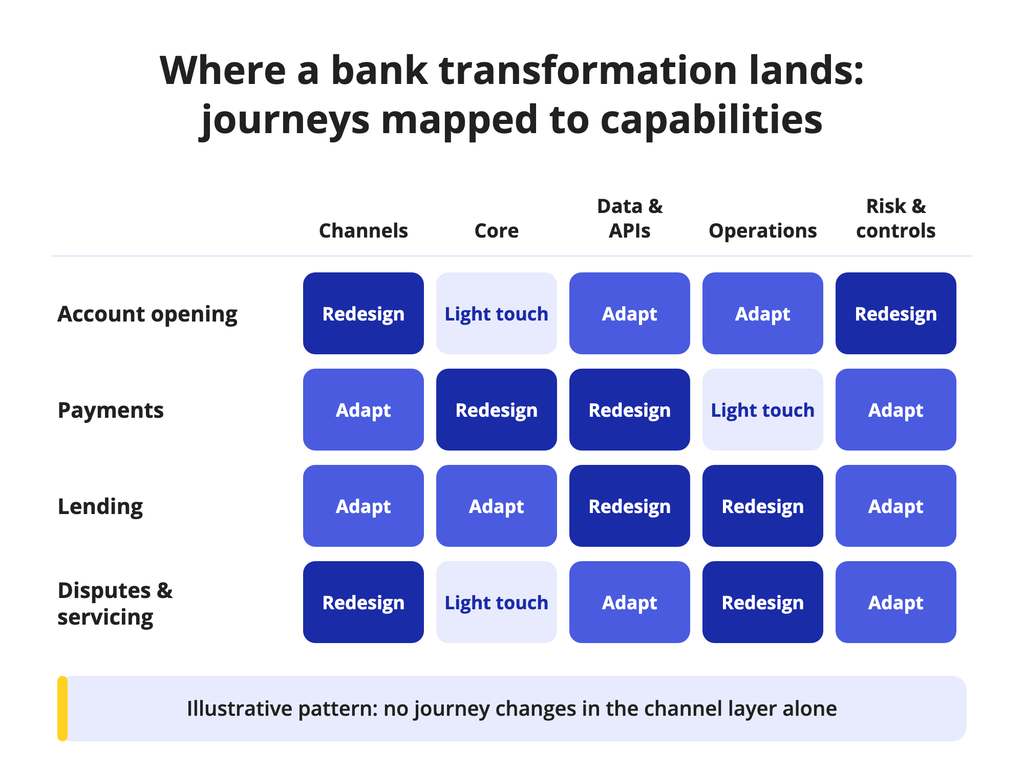
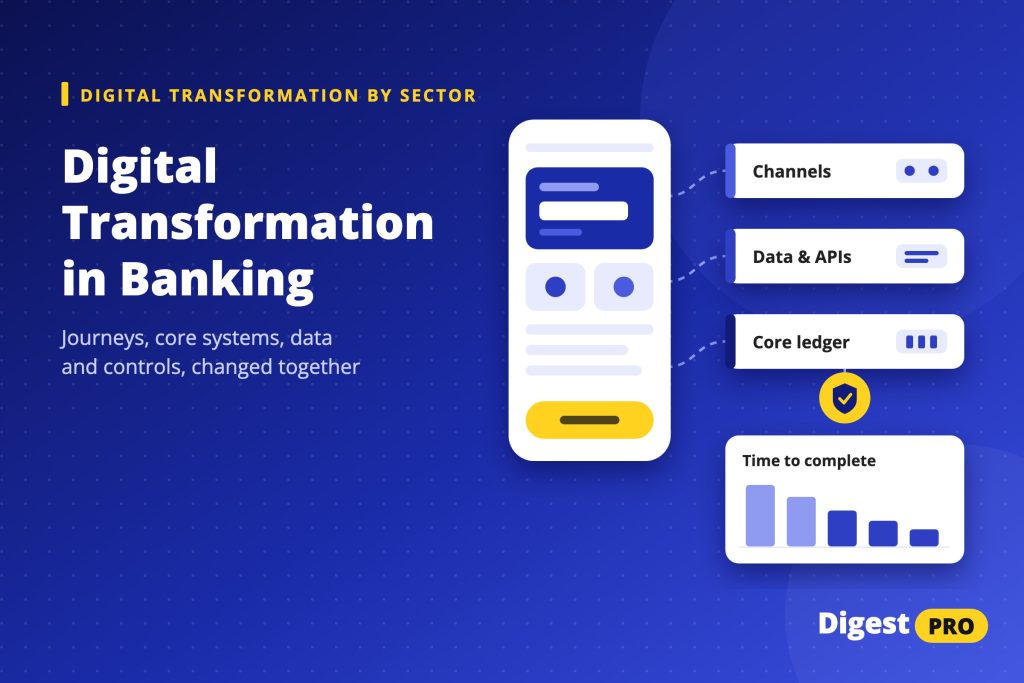
Digital transformation in banking is a coordinated change to how a bank serves customers, runs its processes, manages data and operates technology. It touches four layers at once: the customer experience, the operating processes behind it, the data that moves between them and the platforms that carry the load.
The useful distinction is between digitization and redesign. Digitization converts an existing step into a digital one. A paper application becomes an online form, and staff still rekey it into the loan system. Redesign asks whether the step should exist at all, who owns it and what data the bank already holds that makes it unnecessary.
Most programs need both. Digitization delivers quick wins and builds credibility. Redesign delivers the real change in cost, speed and control, but it touches policies, systems and roles that many teams own.
Be careful with any framework that claims a universal set of pillars. Consultancies and vendors each publish their own lists. Deloitte, for example, frames digital banking around six strategic imperatives, from customer strategy and operating model design to risk and compliance and technology platforms [4]. Use lists like this to check coverage, not as a standard your bank must match.
The main transformation priorities for banks
Six priorities appear in most bank programs. Each one should connect to an outcome you can measure and a risk you can control.
| Priority | Outcome to target | Risk or control to plan for |
|---|---|---|
| Digital channels and servicing | Faster completion of common tasks, fewer contacts per issue | Accessibility, onboarding fraud, channel outages |
| Core and legacy modernization | Faster product changes, lower run cost | Migration failure, data errors, dual running cost |
| Data and APIs | Customer data reused across journeys and partners | Data quality, consent, privacy, third-party access |
| Automation and AI | Shorter cycle times in operations and compliance | Model risk, explainability, human oversight |
| Security and resilience | Stable service through incidents | Cyber threats, concentration on a few providers |
| Workforce capabilities | Teams that can build and run new platforms | Skills gaps, key-person dependency |
Channels and servicing are where customers feel the change first. Design them for every segment you serve, including customers who still rely on branches and phones.
Data and APIs connect everything else, and the rules around them are moving. In the US, the Consumer Financial Protection Bureau finalized a personal financial data rights rule in October 2024 and opened a reconsideration in August 2025 [5]. Check the current status before you build a business case on it.
Automation and AI promise the largest efficiency gains in operations. Start with bounded tasks such as document intake or reconciliations, and keep a person accountable for each decision. Our guide to AI agents in finance covers that emerging capability in depth. It is one tool inside a transformation, not a proxy for the whole program.
Security and resilience decide whether the bank can run what it builds. ECB supervisors report that significant cyber incidents have doubled in recent years and that operational and ICT risk continue to receive the worst average scores in their supervisory review [3].
Build around customer and employee journeys
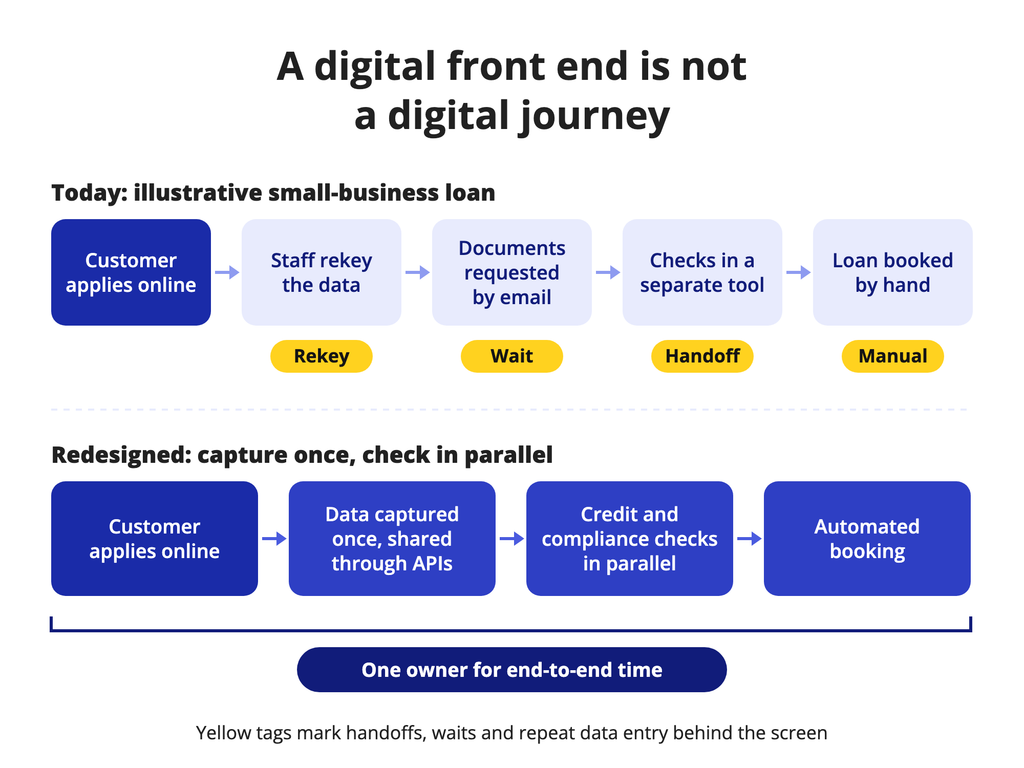
A journey view shows where the bank creates friction for itself. Map one journey end to end, from the customer’s first action to the final booking in the core system, and include every employee step behind the screen.
Look for three patterns:
- Handoffs, where work moves between teams and waits in a queue.
- Repeat data entry, where staff rekey information the customer already provided.
- Service friction, where customers must call, visit or resend documents because a step failed silently.
Take an illustrative small-business loan. The customer applies online in ten minutes. Behind the form, a relationship manager rekeys the data into the origination system, credit requests documents by email, compliance runs checks in a separate tool and operations books the loan by hand. The front end is digital. The journey is not.
Redesign targets those internal steps. Capture data once, pass it between systems through APIs, run checks in parallel where policy allows and give one owner accountability for end-to-end time. Employee journeys matter as much as customer journeys, because staff workarounds are often where errors and control gaps begin.
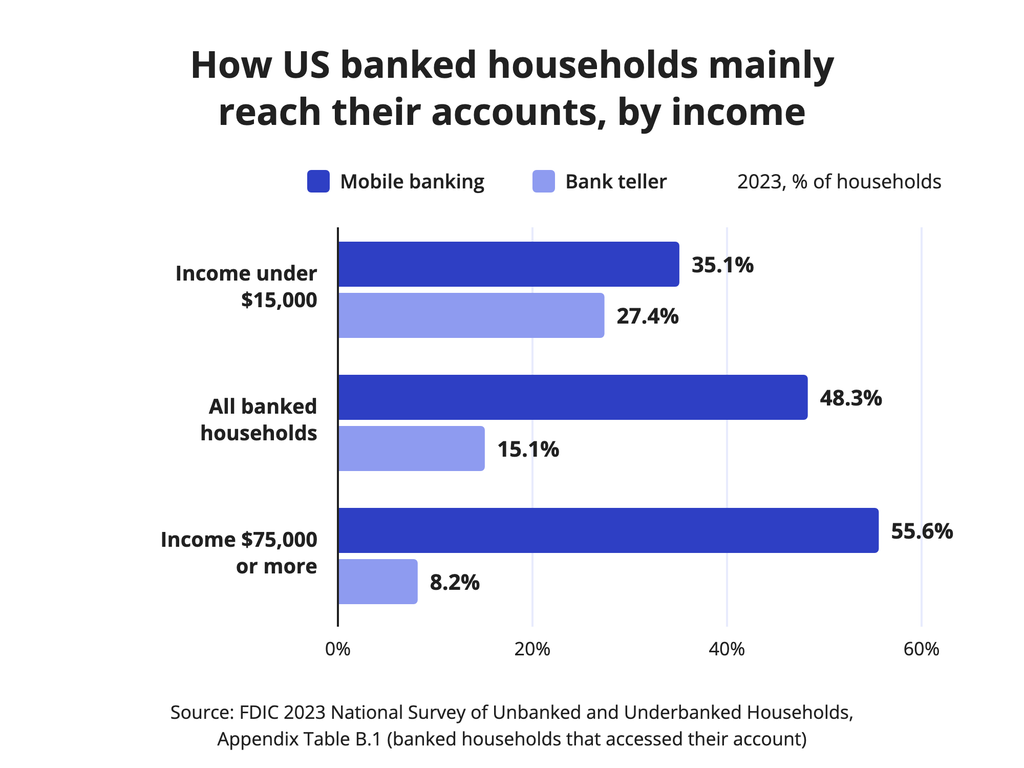
Segment journeys from the start. In the FDIC’s 2023 data, 35.1% of banked households with income under $15,000 used mobile banking as their main access method, and 27.4% relied mainly on bank tellers [2]. A journey that only works in the app leaves part of your base behind.
Use named bank case studies with care. A published case describes one bank’s baseline, context and measurement. Borrow the method, not the headline result.
Modernize core systems without losing control
Core modernization carries the most risk in any bank program. The safer pattern is phased: wrap legacy systems with APIs, move products or customer segments in waves and run old and new platforms in parallel until data reconciles and service holds.
The cost of a failed cutover is public. In April 2018, UK bank TSB moved customer data to a new IT platform that immediately experienced technical failures. All branches and a significant proportion of its 5.2 million customers were affected, and TSB did not return to business as usual until December 2018 [6]. The Bank of England reports that the FCA and PRA fined TSB £48.65 million in 2022 for failing to organize and control the migration and to manage risks from its IT outsourcing arrangements [6].
Four controls reduce that risk:
- Interoperability first. Define the integration layer and data contracts before you move products, so channels do not depend on which core holds the account.
- Data quality as a gate. Reconcile balances and records before each wave. ECB supervisors say progress on fixing risk data aggregation and reporting weaknesses “remains slow” [3].
- Third-party oversight. Core vendors and cloud providers sit inside your risk perimeter. US banking agencies’ 2023 guidance covers the full relationship life cycle, from planning and due diligence to termination [7].
- Resilience limits. Know how much disruption each important service can tolerate. The PRA expects UK firms to set impact tolerances for important business services [8], and the Basel Committee’s principles aim to help banks absorb events such as cyber incidents and technology failures [9].
In the EU, the Digital Operational Resilience Act has applied since 17 January 2025. EIOPA summarizes its scope as ICT risk management, incident reporting, resilience testing, third-party risk and information sharing [10].
Partnerships fall inside the same perimeter. Our overview of AI fintech startups covers the challenger side. For an incumbent bank, each partnership is also a third-party risk decision. Link every architecture choice to a business outcome and a resilience requirement, and question any choice that serves neither.
How to measure digital transformation in banking
Measure outcomes, not launches. A new app is an output. Fewer abandoned applications, faster resolution and lower cost-to-serve are outcomes.
| Metric | Definition to agree | Segment by | Window |
|---|---|---|---|
| Completion time | Median time from start to booked outcome | Journey, channel | Monthly |
| Digital adoption | Share of eligible customers completing the task digitally | Age, income, region | Quarterly |
| Service quality | First-contact resolution, complaints per 1,000 customers | Journey, channel | Monthly |
| Reliability | Availability and time to recover for important services | Service | Monthly and per incident |
| Cost-to-serve | Operating cost per transaction or per active customer | Product, channel | Quarterly |
| Control outcomes | Exceptions, manual overrides, audit findings closed on time | Business unit | Quarterly |
Set the baseline before a change goes live. Define the denominator, because adoption among all customers, eligible customers and active customers can tell three different stories. Segment the results. In the FDIC data, mobile was the main access method for 55.6% of banked households earning at least $75,000, against 35.1% of those under $15,000 [2]. An average hides that gap.
Pair each outcome with a control measure, so speed gains do not come from skipped checks. Finance leaders will ask for the same numbers in the business case. Our analysis of CFO trends shows how finance teams are reshaping planning and investment decisions.
A practical roadmap for bank leaders
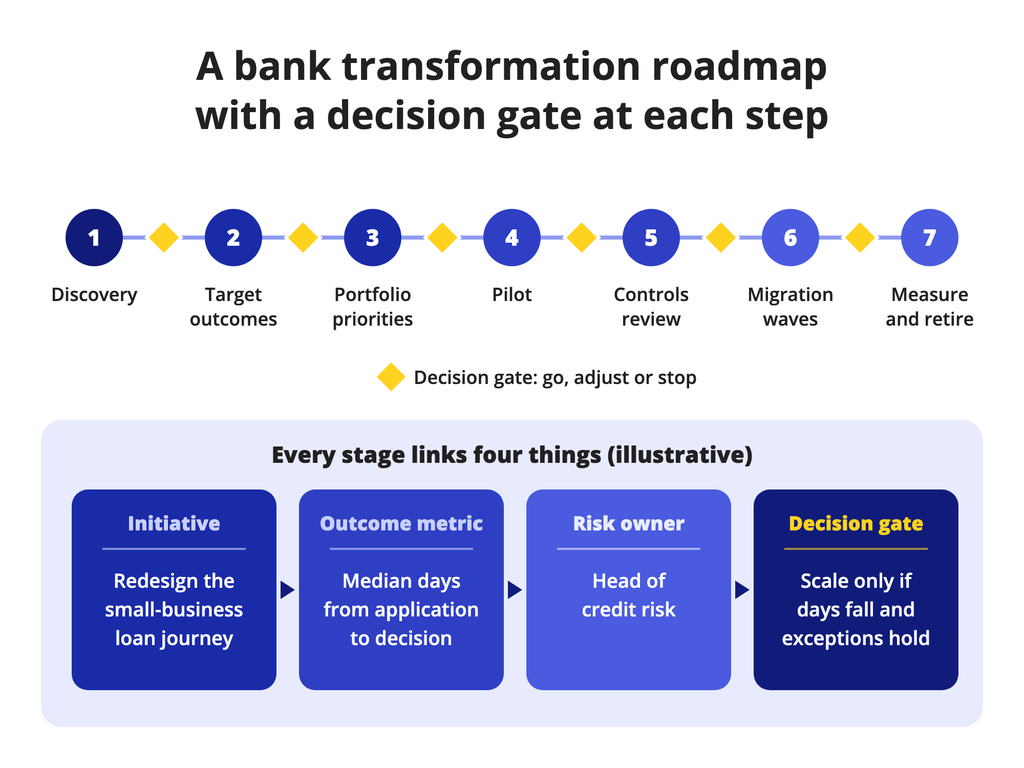
Sequence the program so each stage earns the next one. Every stage needs an outcome metric, a named risk owner and a decision gate.
- Discovery. Map priority journeys with their systems, data flows and controls. Gate: agreed problem statement and baseline.
- Target outcomes. Set two or three measurable outcomes per journey, each with an owner.
- Portfolio prioritization. Rank initiatives by value, dependency, risk and effort. Fund a few journeys end to end rather than many partial fixes.
- Pilot. Deliver one journey for one segment. Gate: outcome moved against baseline with no new control gaps.
- Controls review. Bring in risk, compliance and security before scaling, and engage supervisors where your obligations require it. Verify current rules directly at this point, not from last year’s plan.
- Migration. Move products or segments in waves with reconciliation and rollback plans.
- Measurement. Track outcomes against baseline, then retire legacy steps and systems once the new path is stable.
Keep stakeholders close. Business owners approve outcomes, risk owners approve controls and technology owners approve architecture. A gate without all three signatures is a status meeting, not a decision.
Summary
Digital transformation in banking works when journeys, operations, data, technology and controls change together. Prioritize by outcome, modernize the core in controlled waves, treat partners as part of your risk perimeter and measure results by segment against a baseline. Your next step: pick one high-volume journey this quarter, map it end to end, set its baseline and name the owner of its outcome and its risk.
FAQs
What is digital transformation in banks?
It is a coordinated change to customer journeys, operating processes, data and technology, aimed at better outcomes for customers and the bank. A program redesigns how work flows and how risks are controlled. A channel launch, such as a new mobile app, is one output of that program. Without changes to the processes and systems behind the app, the bank has digitized a step, not transformed the service.
What are the five types of digital banking?
There is no single regulatory or industry-standard list of five types. Lists vary by author. One sourced way to group digital access is by channel: the FDIC survey tracks mobile banking, online banking, ATMs and telephone banking, alongside bank tellers [2]. Other lists group by business model, such as digital-only banks. Check who defined a taxonomy before you rely on it.
How should banks measure digital transformation?
Use outcome measures, not launch counts. Track completion time, digital adoption, service quality, reliability, cost-to-serve and control outcomes. For each metric, set a baseline before the change, agree the denominator, segment by customer group and channel, and fix the measurement window. Pair every speed or cost gain with a control measure, so improvements do not come from skipped checks.
References
- FDIC Survey Finds 96 Percent of U.S. Households Were Banked in 2023. Federal Deposit Insurance Corporation, 12 Nov 2024. Accessed 28 Oct 2026.
- 2023 FDIC National Survey of Unbanked and Underbanked Households: Appendix Tables. Federal Deposit Insurance Corporation, Nov 2024. Accessed 28 Oct 2026.
- ECB Banking Supervision: Supervisory priorities for 2026 to 2028. European Central Bank, Nov 2025. Accessed 28 Oct 2026.
- Winning in the future of digital banking. Deloitte US, undated page. Accessed 28 Oct 2026.
- Personal Financial Data Rights. Consumer Financial Protection Bureau, updated 27 Aug 2025. Accessed 28 Oct 2026.
- TSB fined £48.65m for operational resilience failings. Bank of England, 20 Dec 2022. Accessed 28 Oct 2026.
- Agencies issue final guidance on third-party risk management. Board of Governors of the Federal Reserve System, FDIC and OCC, 6 Jun 2023. Accessed 28 Oct 2026.
- SS1/21 Operational resilience: Impact tolerances for important business services. Prudential Regulation Authority, updated 11 Mar 2022. Accessed 28 Oct 2026.
- Principles for operational resilience. Basel Committee on Banking Supervision, Bank for International Settlements, 31 Mar 2021. Accessed 28 Oct 2026.
- Digital Operational Resilience Act (DORA). European Insurance and Occupational Pensions Authority, accessed page. Accessed 28 Oct 2026.