Venture investors say deal sourcing, deal selection and post-investment support all create value, and rank selection first, according to a survey of 885 VCs at 681 firms by Gompers, Gornall, Kaplan and Strebulaev [1]. A venture capital CRM is the system that keeps the record behind all three.
It is more than a contact database. It should preserve relationship context, track opportunities, coordinate diligence and help the team learn from its own pipeline. The right system depends on fund size, sourcing model, data sensitivity and how the team works across deals and portfolio companies.
This guide maps the core workflows, sets out a neutral evaluation scorecard and explains how to test vendor claims in a live demo. Products named here are examples of vendor-reported capabilities, not a ranking.
Key takeaways
- Start from workflows (sourcing, relationship history, pipeline, diligence, IC and portfolio follow-up), not from feature lists.
- Treat permissions, audit trails, retention and full data export as pass/fail gates before you score anything else.
- Run the same sanitized sample deal through every vendor demo and record evidence, not impressions.
- Keep required fields to a minimum; adoption by the deal team decides whether the data is worth anything.
- There is no universal best VC CRM. Fit depends on your team, sourcing model and integrations.
What is a venture capital CRM?
A venture capital CRM records the relationships and deal activity of an investment team: who knows whom, which companies are in play, what was discussed, and why the firm invested or passed. Its core objects are people, companies and deals, linked by interactions over years rather than a single sales cycle.
That separates it from two neighbors. A generic sales CRM is built around a funnel that ends in a closed sale, with quotas and forecasts. Portfolio administration and fund accounting tools handle ownership, valuations, capital calls and LP reporting. A VC CRM sits upstream of both and should hand clean data to them.
Several roles use it. Partners need search and a quick view of relationship strength before a meeting. Associates and principals log meetings, run screening and assemble IC materials. Platform teams track introductions and support for portfolio companies. Operations owns the data model, integrations and access rules. Corporate venture teams add one more user: business-unit colleagues who need limited, controlled access.
Which VC workflows should a CRM support?
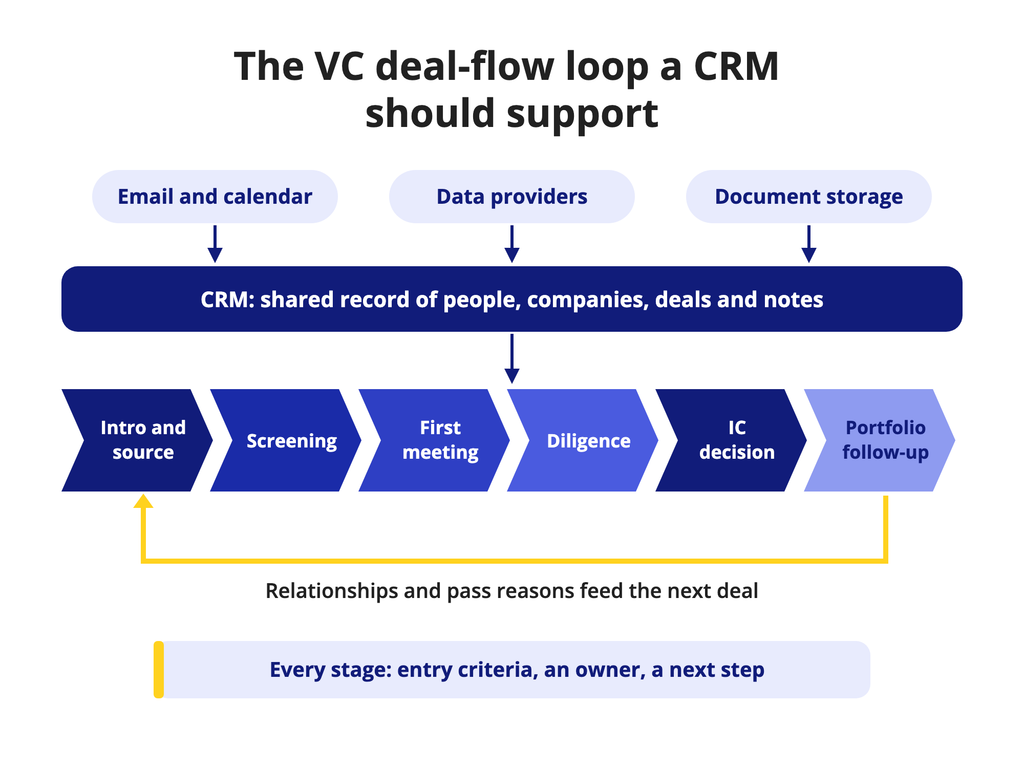
Map these six workflows before you look at any product.
Sourcing and warm introductions. The CRM should show who on the team, or in your wider network, can introduce you to a founder. Record the source of every deal, including scouts and the venture partner role, so you can see which channels produce investments rather than just meetings.
Contact and company history. Every meeting, note and pass reason should attach to the company and the people. A startup you passed on at the pre-seed funding stage may come back at Series A, and the next partner should see what changed.
Pipeline stages. Keep a short list of stages with entry criteria, for example sourced, screening, first meeting, diligence, investment committee, term sheet, closed or passed. Every active deal needs an owner and a next step. Each quarter, review conversion by source and the most common pass reasons; that review is how the pipeline teaches the team something.
Diligence collaboration. Track tasks, reference calls and open questions in one place, with links to the data room rather than copies of sensitive files.
IC preparation. Pull meeting history, metrics and venture capital valuation assumptions into the memo, and record the decision and its reasons.
Portfolio relationships. After closing, log board interactions, follow-on discussions, co-investors and the introductions your platform team makes.
Integration points matter as much as screens. Email and calendar capture keeps history complete without manual logging. Data providers enrich company and funding records. Document storage holds memos and diligence files under its own permissions, with the CRM linking to them.
Features and data controls to evaluate
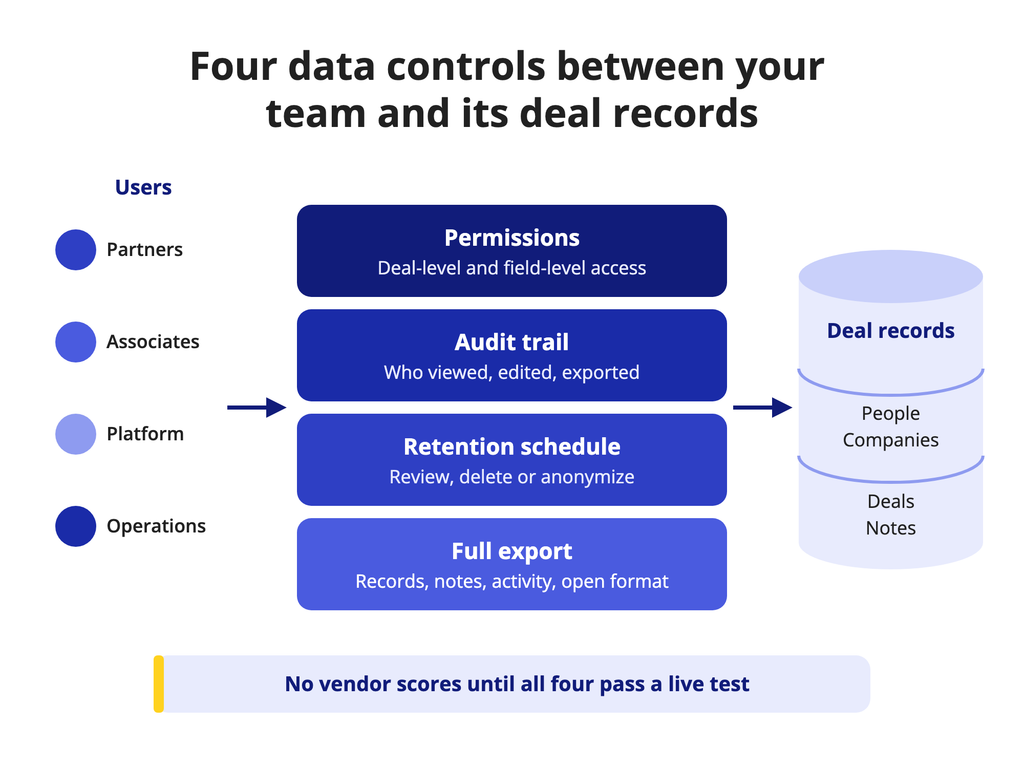
Test features against your workflows, not a vendor checklist:
- Relationship mapping: how connection strength is calculated, and whether you can see why a score is high.
- Deduplication: companies with several domains, founders who change email addresses, merged records.
- Search: across people, companies, notes and activity, with filters a partner will actually use.
- Permissions: deal-level and field-level restrictions for conflicts, sensitive deals and investor data.
- Audit trail: who viewed, edited, exported or deleted a record, and when.
- Reporting: conversion by source, time in stage and pass reasons, built without an analyst.
- Integrations and API: native connectors versus third-party middleware.
- Import and export: a full export of records, notes and activity in an open format.
- Mobile: logging a note in the minute after a meeting.
Treat security, access and retention as core requirements. Founder and investor contacts are personal data. The UK data protection regulator, the ICO, explains that the storage limitation principle bars keeping personal data longer than you need it, and recommends a documented retention schedule with periodic review [2]. Your CRM should support deletion or anonymization on that schedule.
If your firm is an SEC-registered investment adviser, the SEC’s 2024 amendments to Regulation S-P require an incident response program and notice to affected individuals no later than 30 days after you become aware of unauthorized access to their sensitive customer information [3]. Ask each vendor how its logs and alerts would support that process.
How to compare venture capital CRM vendors with a neutral scorecard
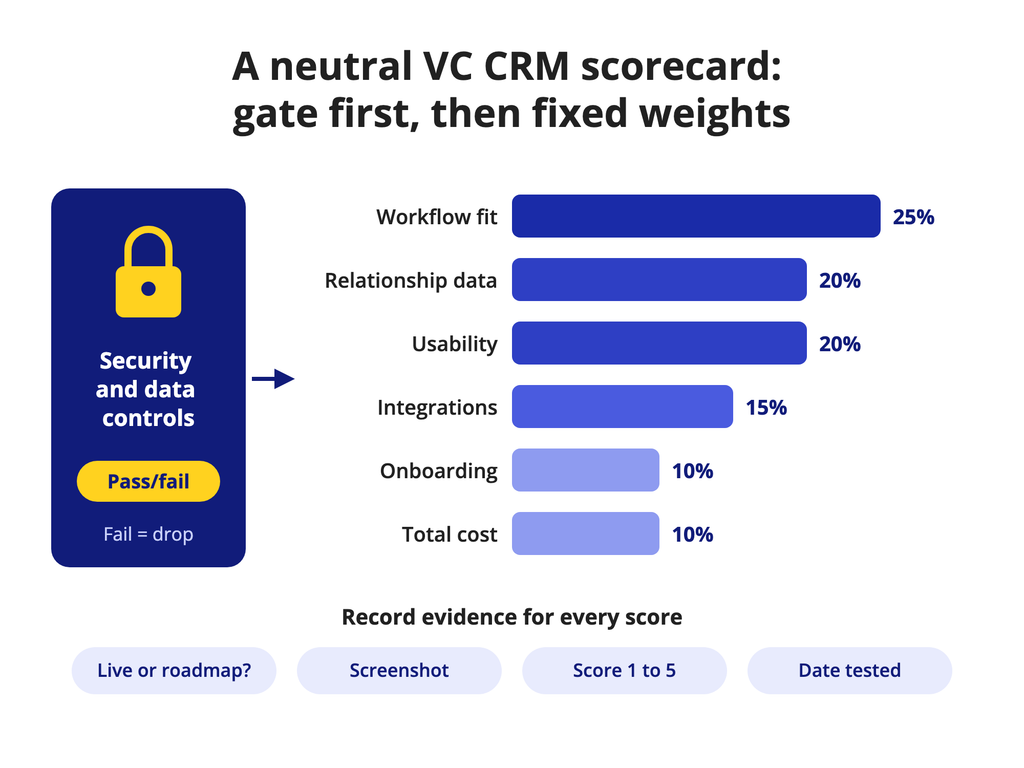
Use the same sample deal in every demo. Build a fictional company with an introduction from a co-investor, three meetings, a reference call, a diligence folder and an IC memo. Use sanitized data only; never load a live deal into a trial account. Ask each vendor to run the workflow live, then repeat it yourself.
| Criterion | Weight | Demo test | Evidence to record |
|---|---|---|---|
| Security and data controls | Pass/fail gate | Restrict a deal from a test user, show the audit log, run a full export | Attestation report and date, export sample |
| Workflow fit | 25% | Move the sample deal from introduction to IC | Steps done live versus workarounds |
| Relationship data and data model | 20% | Import a sanitized contact sample | Duplicates found, match accuracy |
| Usability | 20% | An associate logs a note on desktop and mobile | Time and clicks per task |
| Integrations | 15% | Connect email, calendar, one data provider and document storage | Native or third-party, sync delay |
| Onboarding and support | 10% | Review the implementation plan | Named contacts, timeline in writing |
| Total cost | 10% | Price three years at current and planned seats | Written quote with add-ons |
Score each criterion from 1 to 5, multiply by the weight and adjust weights to your firm before the first demo, not after.
Build the candidate list from current sources, not a ranking. VC Stack lists 39 CRM tools for VC investors, from general-purpose CRMs such as HubSpot and Salesforce to investor-focused products such as Dynamo and Edda [4]. The vendor-reported capabilities below, in alphabetical order, show what to verify in a demo:
| Product | Capabilities as described by the vendor |
|---|---|
| 4Degrees | Relationship strength scoring for introductions; syncs email, calendar and sources such as Crunchbase and PitchBook [5] |
| Affinity | Automatic capture from email and calendar; relationship scoring; lists SOC 2 Type II, GDPR and CCPA compliance [6] |
| Attio | Deal flow CRM with custom data tracking, enrichment, Kanban pipeline views and contact-level permissions [7] |
| DealCloud (Intapp) | Relationship maps and scores; activity logging from Outlook; data feeds including PitchBook and FactSet; role-based permissions and audit trails [8] |
Each claim comes from the vendor’s own website. Confirm it live, in your sandbox, before it earns a score.
Implementation and adoption
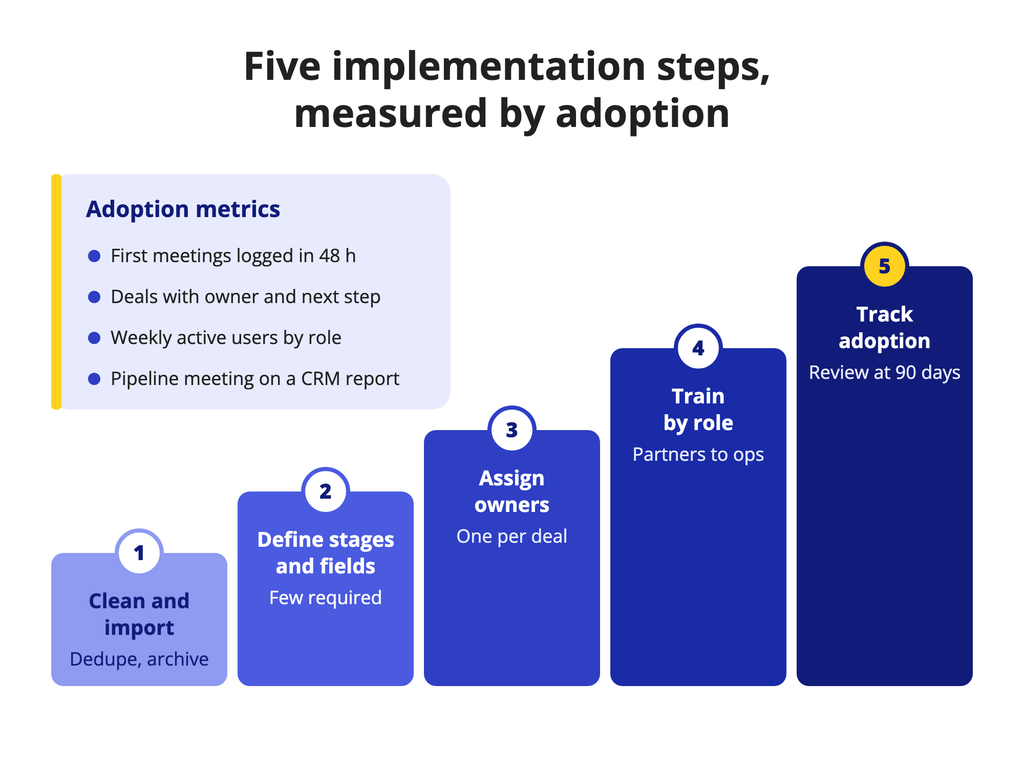
Most CRM projects fail on adoption, not features. Affinity’s own guide argues that generic CRMs often go unused at VC firms and that low adoption produces incomplete data, which lowers adoption further [6]. Treat that as a vendor’s view, but plan for the loop it describes.
- Clean and import. Deduplicate contacts and companies, archive stale records and map old stages to new ones before migration.
- Define stages and fields. Keep required fields to the few that reports actually use.
- Assign ownership. Every active company has one owner. Operations owns the data model and access rules.
- Train by role. Partners learn search and reports; associates learn logging; platform learns portfolio records.
- Set adoption metrics. Track first meetings logged within 48 hours, active deals with an owner and next step, weekly active users by role, and whether the pipeline meeting runs from a CRM report.
Avoid over-customization. Every extra required field, stage or approval step is a tax on the deal team, and teams that feel taxed stop logging. Start small, review after 90 days and add fields only when a report needs them.
Migrating from spreadsheets or an older CRM deserves its own plan. Run old and new systems side by side for a short, fixed period, then retire the old one so the team has a single place to log.
Common buying mistakes
- Choosing on brand. A tool that suits a large multi-strategy firm may overwhelm a three-person seed fund.
- Counting features. Twenty unused modules cost more than five that fit your workflow.
- Deferring to one partner. The person who logs the most data is often an associate; include every role in demos.
- Skipping the portability test. Export everything during the trial and open it. If notes and activity history do not come out cleanly, switching later will be painful.
- Ignoring reporting needs. Decide which pipeline and sourcing reports you need before the demo, and ask the vendor to build one live.
- Trusting roadmaps and price pages. Confirm pricing, integrations and features against current vendor documentation and a written quote.
- Buying AI from the demo script. Vendors now market AI features, such as Affinity’s meeting notetaker and DealCloud’s plain-English questions about firm data [6] [8]. Test them on your sanitized sample, and ask what data each feature reads, whether it respects deal-level permissions and where its outputs are stored.
Summary
A venture capital CRM earns its cost when it captures relationship context automatically, mirrors your pipeline and keeps sensitive data under control. Map your workflows, gate on security and data export, score vendors on the same sample deal, and plan adoption before you sign.
Close the selection with a proof of concept that covers:
- the sanitized sample deal run from introduction to IC in each shortlisted tool;
- a sanitized contact import with a duplicate check;
- a permissions test that hides a restricted deal from a test user;
- a full data export opened in a spreadsheet;
- one pipeline report built live;
- a written quote and implementation plan.
FAQs
What is the best CRM for venture capital?
There is no universal best CRM for venture capital. The right choice depends on your workflows, team size, sourcing model, integrations, security requirements and how likely your team is to use it daily. Shortlist three or four tools, run the same sanitized sample deal through each, gate on data controls and export, and score the rest with fixed weights.
What is CRM in venture capital?
In venture capital, a CRM is the system an investment team uses to manage relationships and deal flow. It records sourcing channels and introductions, contact and company history, pipeline stages, diligence and IC decisions, and portfolio interactions. Unlike a sales CRM, it tracks relationships over years and many rounds, not a single purchase decision.
What should a VC CRM demo include?
A useful demo runs a realistic workflow from introduction to investment committee using sanitized data you supply. Ask the vendor to import a contact sample, show deduplication, restrict a deal with permissions, display the audit log, build a pipeline report and export all records. Then repeat the key steps yourself in a trial account.
References
- How Do Venture Capitalists Make Decisions?. Paul Gompers, William Gornall, Steven N. Kaplan and Ilya A. Strebulaev, NBER Working Paper 22587, September 2016 (published in the Journal of Financial Economics, 2019). Accessed 28 Oct 2026.
- Principle (e): Storage limitation. Information Commissioner’s Office (UK), undated guidance page. Accessed 28 Oct 2026.
- SEC Adopts Rule Amendments to Regulation S-P to Enhance Protection of Customer Information. US Securities and Exchange Commission, 16 May 2024. Accessed 28 Oct 2026.
- CRM Tools for VC Investors. VC Stack, undated directory page. Accessed 28 Oct 2026.
- The AI-Powered CRM for Private-Market Deals and the Relationships That Drive Them. 4Degrees (vendor), undated home page. Accessed 28 Oct 2026.
- How to choose the best CRM for venture capital. Affinity (vendor), updated 3 Jun 2026. Accessed 28 Oct 2026.
- Deal flow CRM. Attio (vendor), undated solution page. Accessed 28 Oct 2026.
- DealCloud: The AI-powered deal and relationship intelligence platform. Intapp (vendor), undated product page. Accessed 28 Oct 2026.