Through September 2026, corporate investors took part in 20.7% of US venture deals, yet those rounds held 80.1% of US deal value, according to the PitchBook-NVCA Venture Monitor [1]. Corporate venture capital (CVC) now sits inside the largest rounds in the market. The same report also notes several high-profile CVC program closures this year [1].
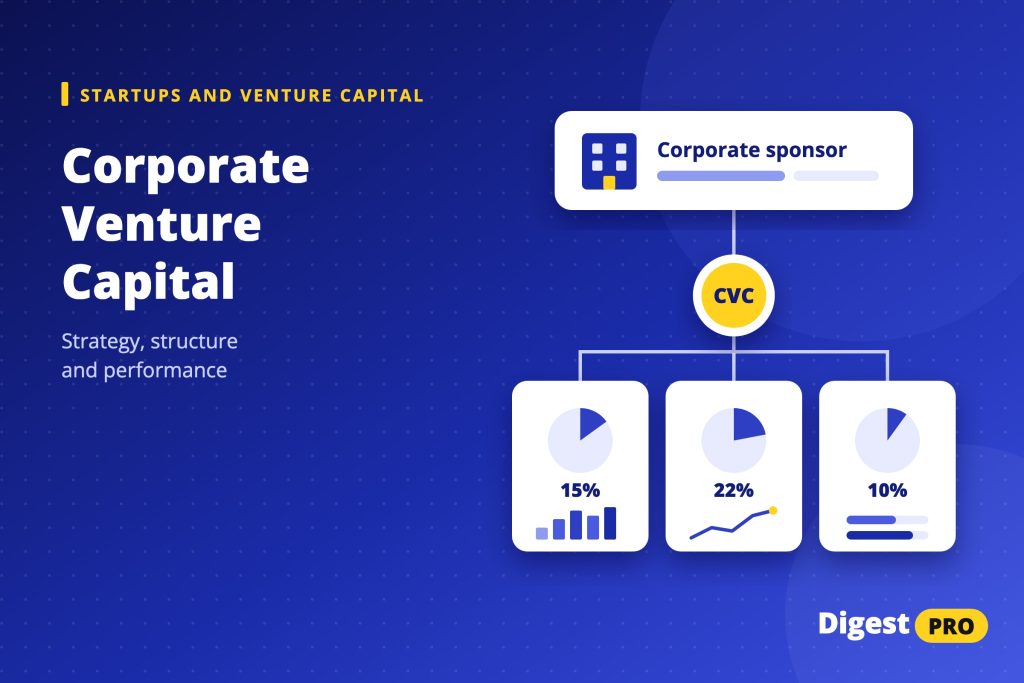
CVC is a way for established companies to invest in startups while pursuing financial returns, strategic learning or both. The label covers very different structures, from balance-sheet deals to independently managed funds, and each design choice changes speed, incentives, access and conflicts. This guide explains the models, how to tie investments to corporate strategy, and how to measure performance without confusing strategic value with financial return.
Key takeaways
- Decide the primary objective first: financial return, strategic learning, ecosystem access or a ranked mix with stated trade-offs.
- Structure follows objective. Balance-sheet programs stay close to the business; dedicated funds gain speed and discipline but loosen strategic ties.
- Run commercial partnerships on their own track, so a pilot never depends on an equity check.
- Measure financial and strategic results on separate scorecards, each with its own time horizon and benchmark.
- Protect founders with information barriers, clear decision rights and few special terms.
What is corporate venture capital?
Corporate venture capital is a minority equity investment by an operating company in a startup it does not control. PitchBook counts both rounds led by established CVC arms and direct equity investments by corporations into VC-backed companies as CVC activity [1].
The money is large and concentrated. In the US, deals with CVC participation fell from 4,271 in 2021 to 2,597 in 2025, while their value rose to $192.5 billion. Through September 2026, value reached $397.6 billion across just 1,683 deals [1]. Globally, Global Corporate Venturing counted $146 billion raised across 1,364 corporate-backed rounds in Q2 2026, up from $44 billion a year earlier [2].
CVC is easy to confuse with nearby tools:
| Vehicle | Primary purpose | Equity position |
|---|---|---|
| Corporate venture capital | Strategic and/or financial return from startups the company does not control | Minority stake |
| Independent VC | Financial return for the fund’s limited partners | Minority stake |
| Corporate development | Acquire capabilities, products or market share | Majority or full control |
| Accelerator | Early access to startups through a time-bound program | Small stake or none |
| Strategic partnership | Joint product, distribution or supply deal | Usually none |
Mandate, governance and source of capital vary widely between programs. A “CVC” label tells you little until you know who approves deals and whose money is at risk.
Why do corporations invest in startups?
Four motives recur, and they pull in different directions.
Strategic learning. A portfolio gives early sight of technologies, business models and talent before they reach competitors’ products. GoingVC calls this market sensing and notes that a corporation can gain it from startup interactions even without investing [3].
Access to innovation. Equity can open a path to partnerships, licensing or a later acquisition with a longer diligence period.
Ecosystem development. Backing startups that build on your platform, use your inputs or serve your customers can grow demand for your core business.
Financial return. Some programs run like a fund and expect venture-level returns. Others treat return as secondary. In interviews reported by Stanford Graduate School of Business, one CFO said he wrote off each investment as an R&D expense at closing [4].
The trap is pursuing all four at once without ranking them. A strategic deal that would fail a financial screen is legitimate, but only if the program said in advance that it accepts that trade. Write down the primary objective, the secondary one and what you will give up: return for access, speed for control, or exclusivity for founder appeal.
Market conditions make this sharper. PitchBook links 2026 CVC closures and slower deployment to corporate AI spending and weak venture returns [1]. Programs with no stated objective are the easiest to cut.
CVC structures and operating models
Structures sit on a spectrum from tightly linked to the parent to fully independent. Four are common.
Internal team investing deal by deal
Investors sit inside strategy or corporate development and invest from the balance sheet one deal at a time. Strategic fit is strong; speed and talent retention are the weak points.
Balance-sheet program with an investment committee
Ilya Strebulaev and Amanda Wang interviewed 74 units, representing 78% of active CVC units at S&P 500 companies. In their study, most units invest from parent balance sheets rather than committed funds, and committees where parent executives play a pivotal role are common [5].
Dedicated subsidiary or evergreen vehicle
A separate legal entity gets its own budget, staff and approval limits. It can reserve follow-on capital and hire experienced investors while keeping a strategic link.
External fund manager
The corporation commits capital to a fund run by an outside manager. GoingVC describes the external fund as a popular model that works at arm’s length from corporate bureaucracy, but warns that too much distance weakens the link to the parent [3].
Four design choices matter more than the label:
- Autonomy: who can approve a deal, and up to what size.
- Investment committee: membership, quorum and turnaround time. Most units in the Stanford interviews use a two-tier process that often needs near-unanimous approval from a committee outside the team [4].
- Follow-on capacity: reserve capital at the start, or you dilute or exit by default.
- Information barriers: separate deal teams from business units that compete with or buy from portfolio companies.
Incentives lag venture norms too. Only 15% of the professionals interviewed received profit sharing or carried interest, and nearly two-thirds had no bonus tied to fund performance [4].
Deal process, portfolio and partnership design
A CVC deal follows the familiar venture path, with one extra question at each step: what does the business unit need, and what must it not see?
- Sourcing. Pull deal flow from business-unit problem statements, co-investors and startup programs, not only inbound pitches.
- Diligence. Run financial diligence like any investor. Add a business-unit sponsor who confirms the strategic hypothesis and commits time.
- Decision. Set a committee turnaround target in days, and tell founders what it is.
- Post-investment. Assign one relationship owner, agree on information scope and define a successful collaboration within 12 months.
- Exit planning. Decide early whether you will hold, sell secondaries or consider acquisition, and disclose any rights that could affect a future sale.
Keep commercial partnerships on a separate track. A startup should be able to pilot with you, or become a supplier, without taking your money. BMW runs this as a venture client unit. BMW Startup Garage, founded in 2015, pilots startup technology inside BMW business units while startups keep their independence and intellectual property, and the company reports 4 to 8 weeks from first touchpoint to final evaluation [6]. Cemex Ventures, launched in 2017, combines acceleration, investment and commercialization support in one CVC and open-innovation arm, according to the company [7].
Founders weigh these offers against independent capital. A startup still raising pre-seed funding often needs cash and customers more than a strategic investor’s brand. Many CVCs borrow the venture partner role from independent firms: an experienced operator who opens doors inside the corporation and supports founders.
How to measure corporate venture capital performance
Measure financial and strategic outcomes on separate ledgers. Adding them into one “total value” figure double-counts the same deal and hides weak returns behind soft benefits.
| Dimension | Example metrics | Time horizon | Benchmark |
|---|---|---|---|
| Financial | Realized distributions (DPI), total value to paid-in (TVPI), net IRR | 10 years or more | Venture funds of the same vintage and stage |
| Strategic | Pilots started, pilots converted to contracts, partnership revenue | 1 to 3 years | Business-unit plan or a non-portfolio vendor baseline |
| Learning | Technology briefs delivered, build, buy, partner or stop decisions informed | Quarterly | Agreed learning milestones |
| Pipeline | Qualified opportunities, sponsor-backed deals, time to decision | Quarterly | Program targets |
| Portfolio health | Follow-on decisions made on time, reserve use, concentration | Annual | Charter limits |
Three rules keep the scorecard honest. First, set the time horizon before investing: traditional VCs judge performance over a decade or longer, while many CVC professionals report being judged on short cycles [4]. Second, attribute a strategic outcome only when the investment changed the result, such as a contract that would not exist without the relationship. Third, mark holdings consistently, using the same venture capital valuation approach at entry and at each review.
Do not assume strategic value is measurable on every deal. Some learning shows up as a decision not to build something, which is real but hard to price. Record it; do not convert it into a return.
Risks and governance safeguards
Five risks recur in CVC programs:
- Conflicts of interest. A portfolio company may compete with a business unit or sell to its rivals.
- Information access. Broad reporting rights raise the risk that sensitive data is misused or leaked, Ashfords warns, so scope them to what oversight needs [8].
- Procurement pressure. Founders may feel an investment obliges them to supply the parent on weak terms, or rivals may stop buying from them.
- Slow decisions. Two-tier approvals create bottlenecks that independent investors avoid [4].
- Portfolio concentration. Through September 2026, CVC-backed rounds were 20.7% of US deal count but 80.1% of deal value [1], so a few large bets can dominate results.
Special rights are where conflicts surface. In a 2022 Global Corporate Venturing poll of its community (sample size not disclosed), slightly more than half of corporate investors said they negotiated pre-emptive terms such as first negotiation, first offer, first refusal or blocking rights, and 38.8% wanted advance notice of a sale [9]. Each can deter other buyers.
Founder-friendly boundaries reduce the risk:
- Firewall deal teams from competing business units and log who sees portfolio data.
- Limit information rights to what a financial investor of the same size would receive.
- Avoid first-refusal rights on a sale unless the partnership genuinely needs one.
- Write escalation rules: who resolves a conflict, how fast, and when the CVC steps back from a board vote.
Summary
Corporate venture capital works when the corporation knows why it is investing and builds structure, process and measurement around that answer. Rank your objectives, choose a structure with matching decision rights, run commercial pilots on a separate track, and keep financial and strategic scorecards apart.
Next step: draft a one-page CVC charter before your next deal. State the primary objective, approval limits, committee turnaround target, information barriers, reserve policy and both scorecards with their time horizons, then have the executive sponsor sign it.
FAQs
What does corporate venture capital mean?
Corporate venture capital means an established company invests its own money in startups it does not control, usually as a minority shareholder alongside other investors. Unlike an acquisition, the startup stays independent. Unlike an accelerator, the investment is a negotiated equity round rather than a time-bound program, and it can continue through follow-on rounds as the startup grows.
How is corporate venture capital different from traditional VC?
Traditional VC funds invest limited partners’ money and must return it within a fixed fund life. Corporate venture capital usually invests the parent’s balance sheet, adds strategic goals to financial ones and answers to corporate executives, often through an investment committee. That gives CVCs patience and industry access, but also slower decisions and more potential conflicts.
How should a CVC program measure success?
Keep two separate scorecards. The financial one tracks realized and unrealized returns against venture benchmarks over 10 years or longer. The strategic one tracks pilots, contracts, learning milestones and decisions informed over 1 to 3 years. Agree on both, plus the attribution rule, before investing, and never add strategic value to financial returns.
References
- Q3 2026 PitchBook-NVCA Venture Monitor. PitchBook and National Venture Capital Association, October 2026 (US data as of 30 Sep 2026). Accessed 28 Oct 2026.
- Q2 2026 sets new corporate venture funding record as AI mega-rounds dominate. Global Corporate Venturing, 8 Jul 2026. Accessed 28 Oct 2026.
- Understanding Corporate Venture Capital: The Ultimate Guide. GoingVC, 27 Oct 2022. Accessed 28 Oct 2026.
- A Peek Inside the Hidden, Messy World of Corporate Venture Capital. Stanford Graduate School of Business, 20 Jan 2022. Accessed 28 Oct 2026.
- Organizational Structure and Decision-Making in Corporate Venture Capital. Ilya A. Strebulaev and Amanda Wang, Stanford GSB Research Paper 4008, 2021. Accessed 28 Oct 2026.
- BMW Startup Garage. BMW Group, company page, undated. Accessed 28 Oct 2026.
- Corporate Venture Capital. Cemex Ventures, company page, undated. Accessed 28 Oct 2026.
- Information rights: enhancing transparency and protecting interests. Ashfords LLP, 22 Jan 2025. Accessed 28 Oct 2026.
- Half of corporate investors negotiate special rights for portfolio company exits. Global Corporate Venturing, 24 Oct 2022, updated 1 Aug 2023. Accessed 28 Oct 2026.