
In marketing, agentic AI transitions AI from simply producing content to executing campaigns. Marketing executives already utilize AI and machine learning to carry out nearly one-quarter (24%) of their automation and optimization activities [1]. In the next three years, this portion is expected to increase to 56%, as indicated by The CMO Survey 2026 conducted by Duke University, Deloitte, and the American Marketing Association [1].
Yet the technology is still young. McKinsey finds that 62% of organizations are at least experimenting with AI agents, while no more than 10% report scaling them in any single function [3]. After reading this guide, you will know how an agentic system works, where it pays off, which risks to control, and how to launch a safe first pilot.
Follow Digest.Pro on LinkedIn. Get fresh guides on AI, project management, and enterprise technology. Subscribe to our LinkedIn page and keep your strategy current.
What Is Agentic AI in Marketing?
Agentic AI in marketing is the use of autonomous AI agents to plan, execute, and improve marketing work toward a defined goal. The agents connect to your data and tools. They take actions such as segmenting audiences, launching tests, and adjusting budgets. People set the goals, the limits, and the approvals.
How Agentic AI Differs from Generative AI and Traditional Automation
Three technologies often get confused. The table shows how they differ in practice.
| Dimension | Rule-based automation | Generative AI | Agentic AI |
| Core job | Runs fixed if-then rules | Creates text, images, or code on request | Pursues a goal through multi-step actions |
| Trigger | Preset event or schedule | Human prompt | Goal, signal, or schedule |
| Autonomy | None; follows the script | Low; waits for the next prompt | High, within set guardrails |
| Adaptability | Breaks when conditions change | Adapts inside a single response | Re-plans using results and feedback |
| Marketing example | Sends a welcome email after signup | Drafts ten subject lines | Tests subject lines, picks a winner, updates the journey and reports the lift |
| Human role | Builds and maintains the rules | Prompts and reviews each output | Sets goals, limits, and approvals |
Agents do not replace generative AI models. They use those models as one tool among many. The agent decides when to call the tool and what to do with the result.
A buyer-beware point follows. Gartner estimates that only about 130 of the thousands of vendors claiming agentic features are real [5]. The firm calls the rebranding of chatbots and basic automation “agent washing.” Ask every AI solution vendor to show an agent completing a multi-step task, not a single prompt.
How Agentic AI Works in Marketing?
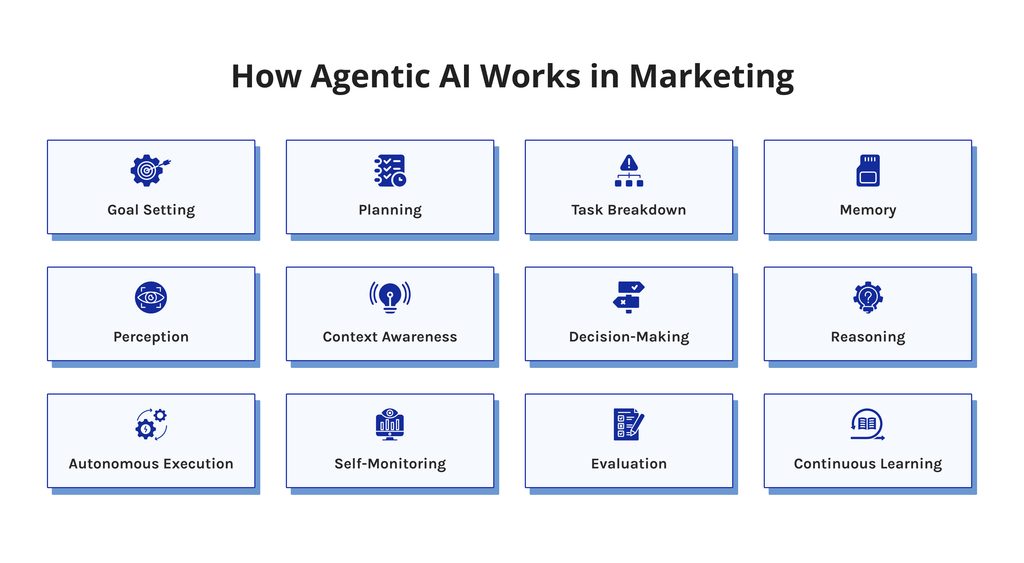
An agentic AI solution works through a loop of goal, plan, act, observe, and adjust, and in each of these stages there is a capability that can be tested in a vendor demo.
Goal Setting, Planning and Task Breakdown
A goal plus constraints always start the process, with the marketer formulating the objective in natural language. Next, the marketer would apply a budget, brand guidelines, channels, and a deadline – the constraints.
Then, the objective needs to be broken down into tasks. Anthropic talks about this breakdown in terms of an orchestrator-workers pattern, in which a main model will break down a task, delegate the parts, and then merge them. In the case of marketing, a planning agent could delegate audience building, copywriting, and scheduling to specialist agents.
Memory, Perception, and Context Awareness
Agents need context to operate, meaning that they should perceive live signals from the CRM, web analytics, email platforms, and ad accounts. They should also have short-term memory (the state of the current campaign) as well as long-term memory (brand guidelines, historical data) and machine learning (calculating intent scores, predicting churn).
Context quality limits agent quality. Only 30.3% of companies in The CMO Survey 2026 have consolidated customer intelligence across all touchpoints [1]. Many agents therefore start with partial context.
Decision-Making, Reasoning, and Autonomous Execution
Next, the agent reasons about which action will move the goal. It compares options, predicts outcomes, and picks one. Adobe’s documentation describes an orchestrator with a reasoning engine for decision-making and planning, specialized agents, and a knowledge base [6].
The agent then acts through connected tools. It can call a generative AI model to draft copy, send an email, change a bid, update a CRM field, or open a task for a person. Autonomy should scale with risk. Low-risk actions run on their own, and high-risk actions wait for approval.
Self-Monitoring, Evaluation, and Continuous Learning
At last, the agent evaluates its results. It assesses the outcome in relation to the objectives, identifies any discrepancies, and makes another attempt or alters its course of action. Gartner has reported that AI agents can learn from each interaction and make improvements in the next communication with the customer.
Machine learning drives that improvement. Every loop should end with measurement. A well-built agent also logs what it did and why, so your team can audit every step of its decision-making.
Get the next guide first. Digest.Pro shares executive-level research on AI and marketing technology. Follow us on LinkedIn for new articles.
Top Use Cases and Examples of Agentic AI in Marketing
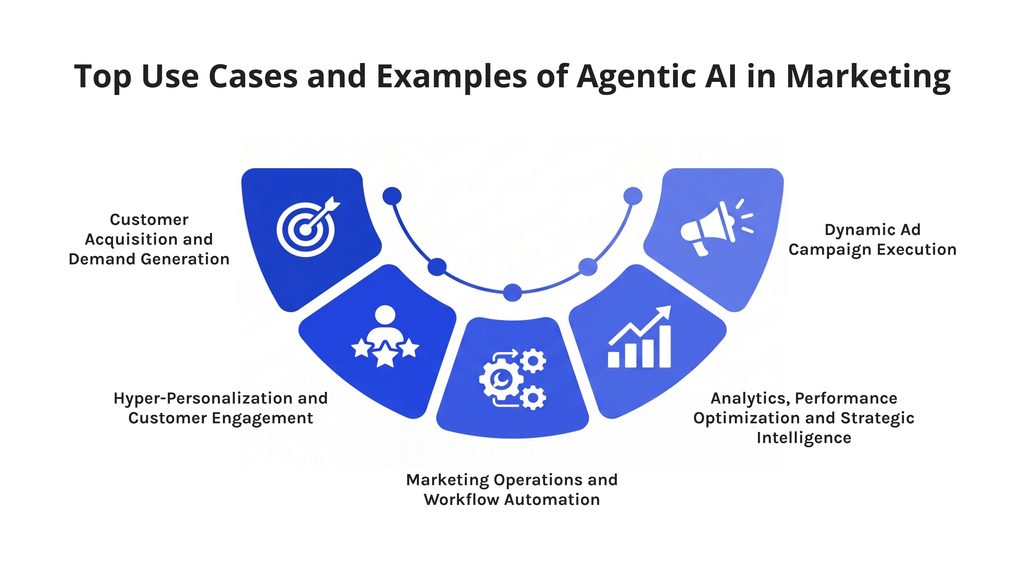
The AI agents marketing leaders deploy first sit inside vendor platforms. Agentic AI in marketing automation already appears inside vendor platforms. The table maps five areas of agentic AI marketing campaigns to agent tasks and the metric to track.
| Use case area | What the agent does | KPI to track |
| Demand generation | Research accounts, scores leads, and routes them to nurture programs | Marketing-qualified leads, cost per lead |
| Personalization | Chooses message, offer, and channel for each customer | Engagement rate, conversion rate |
| Marketing operations | Checks campaign assets, tracks tasks, and compiles reports | Cycle time, error rate |
| Analytics | Detects anomalies, answers data questions, and flags audience overlap | Time to insight, forecast accuracy |
| Paid media | Shifts budget and tests creative within caps | Return on ad spend, cost per acquisition |
Customer Acquisition and Demand Generation
Acquisition agents research accounts, score leads, and decide who enters which nurture path. Salesforce reports that its Agentforce Lead Generation and Management agents add leads to nurture programs, retrieve scores, and recommend content (vendor-reported). An agentic marketing platform can also draft outreach for review.
Start with lead routing and follow-up. These tasks are repeatable and easy to measure. Marketing teams keep control of messaging and targeting rules.
Hyper-Personalization and Customer Engagement
AI personalization moves from segment rules to individual decisions. In social media marketing, an agent can adapt creative to each audience. The agent picks the message, offer, timing, and channel for each person. The base is ready: 65.4% of companies in The CMO Survey 2026 already use AI for content personalization.
Gartner researcher Emily Weiss says, “This marks the end of channel-based marketing as we know it”. For customer engagement, that means one agent coordinates email, chat, and web instead of separate channel teams.
Marketing Operations and Workflow Automation
Marketing operations is the type of operation responsible for informing project managers and PMO leaders early on. Agents make sure that all campaign inventors are acting in line with brand requirements, report on different stages of carrying out tasks and conflicts, and generate reports every week. According to Salesforce, Agentforce Campaign Creation allows marketers to create and implement a campaign in a few hours (data provided by vendors).
This automates many marketing processes. Marketing managers save planners’ time for creativity.
Analytics, Performance Optimization, and Strategic Intelligence
Analytics agents work constantly. Adobe’s Audience Agents pick up large changes in audience size, as well as duplicates, and the Data Insights Agent provides answers concerning data represented in natural language. Salesforce Segment Intelligence is able to identify the audience that brings the biggest revenues back (data provided by the vendors).
Agents also help you track AI search impact. 41.5% of companies in The CMO Survey 2026 already use AI for generative engine optimization. Your team can task an agent to log how often AI answers cite your brand.
Dynamic Ad Campaign Execution
Ad platforms already automate much of paid media. Google’s Performance Max runs one campaign across Search, YouTube, Display, Discover, Gmail, and Maps, and applies Google AI to bidding, budgets, audiences, and creatives. It optimizes in real time toward the conversion goals you set.
That is goal-driven automation. It is a step toward agentic behavior, but it is not the full loop. An agentic marketing platform adds cross-platform budget moves, creative tests, and reporting under your caps. In social media marketing, the same agent can pause weak creative and shift spend between networks. Always set hard spend caps.
Key Benefits of Agentic AI in Marketing
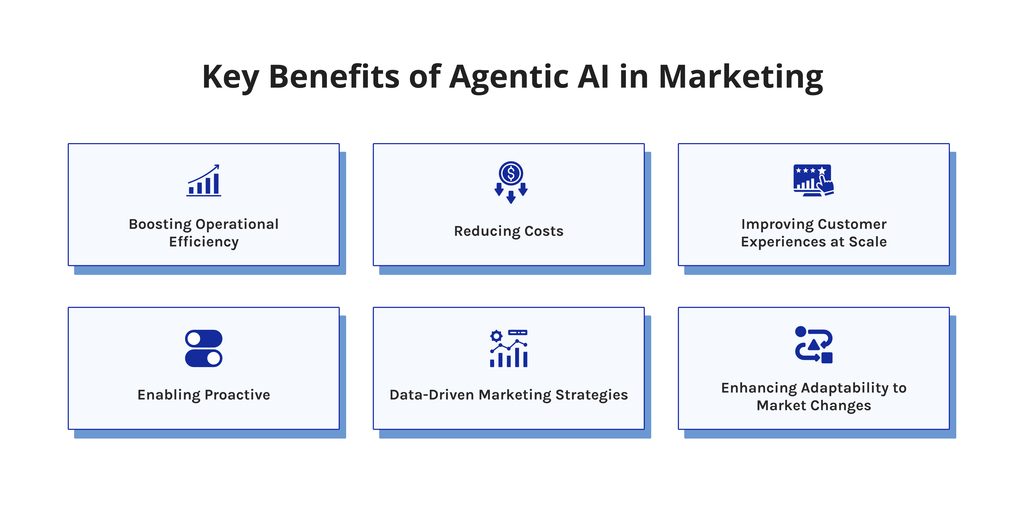
Agentic AI provides five major benefits in marketing if properly implemented. In fact, all AI agents that assist the marketing team have only one common feature: a specific purpose. The numbers in the next sections are either taken from surveys or vendor documents, so it is better to treat them as approximate. Evaluate any AI solution on the basis of the results, not the demonstration’s glamour.
Boosting Operational Efficiency
Agents shorten the duration of the cycle as they operate all the time. According to the leaders of The CMO Survey 2026, the average increase in sales productivity due to AI is around 14.1%, as all reports have to be done without any action taken by the team regarding the updates.
Reducing Costs
The respondents in the survey claim to have experienced a 14.6% improvement in marketing operational costs. The savings are mainly because of fewer hours used for manual work, reduced rework efforts, and much more effective expenditures on the media. The numbers are based on self-reports from marketing leaders across the US; as such, one’s results may vary.
Improving Customer Experiences at Scale
One agent can tailor messages for thousands of customers and adjust them after each response. The agent adjusts messages in real time after each response. This lifts customer engagement because the offer arrives in the right channel at the right time. Gartner expects 60% of brands to use AI agents for one-to-one interactions by 2028.
Enabling Proactive, Data-Driven Marketing Strategies
Agents respond to signals before human detection occurs. A risk of churn prompts a retention proposal. A signal of altering budget pace means opting for redistribution. According to Gartner data, autonomous decision-making will be performed by agents for at least 15% of various tasks by 2028 as opposed to 0% in 2024 [5]. This facilitates the process of making decisions based on data.
Enhancing Adaptability to Market Changes
Market changes happen rapidly. In the CMO Survey 2026, 71.0% of interviewees acknowledge that agility is one of their key assets. Agents reorganize their plans according to the new realities. They can stop running campaigns in case there is a launch by a competitor or redistribute the budget if one of the channels becomes expensive.
Build your AI playbook with Digest.Pro. Join our professional community on LinkedIn for data-backed analysis and practical guides. Subscribe here.
Challenges of Implementing Agentic AI in Marketing
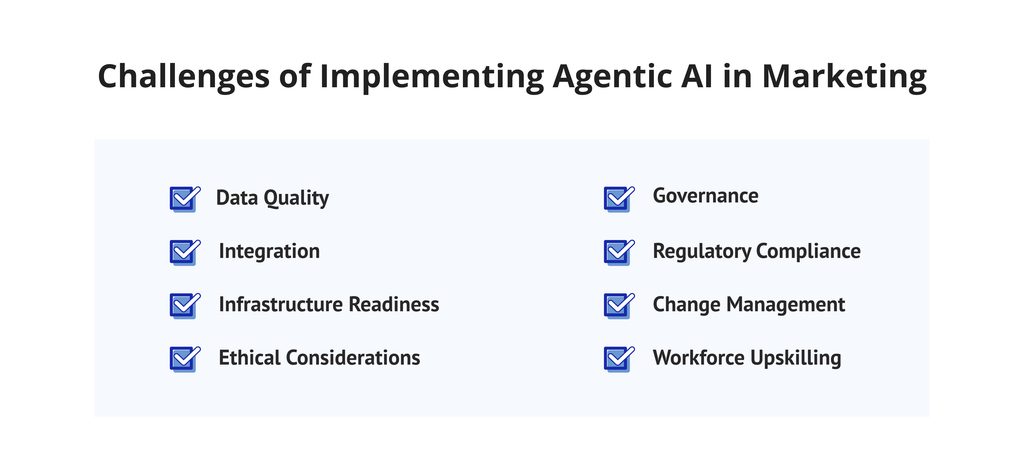
Three risks decide whether an agentic AI marketing program succeeds. Each one is manageable with early planning.
Data Quality, Integration, and Infrastructure Readiness
Various agents process data they use to operate, which means that poor-quality data can lead to false confidence. The CMO Survey 2026 states that integration issues and data architecture represent the most significant technology challenge for 19.1% of decision-makers, trailing only budget problems at 20.1%. According to Gartner, the majority of agent-based AI projects, or more than 40%, will be canceled by the end of 2027 due to the increasing costs, vagueness of business value, and insufficient risk controls.
Evaluate any AI solution on integration depth, not demo polish. Test every agentic AI solution on how it reads your CRM and analytics data, and how it writes back.
Ethical Considerations, Governance, and Regulatory Compliance
There is a regulation now in place. Article 50 of the EU AI Act will take effect starting from August 2nd, 2026, and it requires developers to create a system that will ensure humans understand when they contact an AI system. Consumers care: according to a survey conducted by Gartner, 78% of 335 US consumers believe it is crucial to label AI-generated content in order to keep the same level of trust.
Search quality rules matter too. Google warns that using generative AI tools to produce many pages without adding value for users may violate its scaled content abuse policy. Set four controls from day one:
- Approval tiers for any public content.
- Brand and claim guardrails written as rules the agent must follow.
- Consent and privacy checks on every data source.
- Action logs that let you reconstruct every decision.
Change Management and Workforce Upskilling
Technology can’t account for all of a business’s woes; to put it rather bluntly, it’s a human aspect. Marketing leaders need to have staff able to undertake the supervision of AI agents. According to The CMO Survey 2026, company leaders rated their businesses as low as 3.68 (out of 7) on hiring personnel to manage marketing technologies and 3.94 on training employees to use their marketing technology. Only 3.8% of budgets are allocated to personnel training in marketing.
Focus on the training of the marketing team in skills such as goal design, data literacy, experiment design, and supervision of AIs. Classic marketing skills like brand perception and customer insights are becoming more relevant since AI would take care of its workings. Strong marketing skills also let people spot weak agent output quickly. Our editorial view: pilots stall on data and ownership more often than on model quality. We infer this from the surveys above, not from our own deployments.
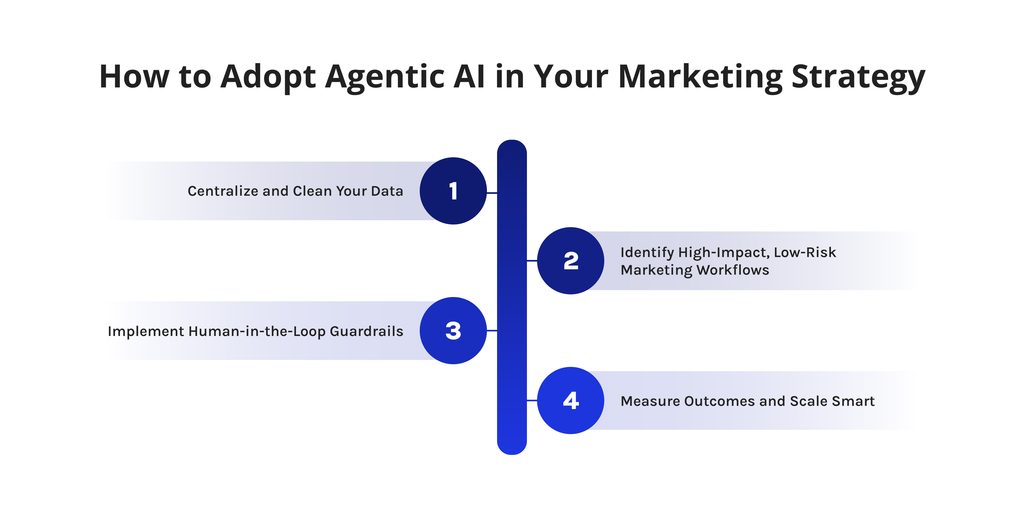
How to Adopt Agentic AI in Your Marketing Strategy
Follow these 4 steps to help you create an agentic AI marketing blueprint. Each of these steps aims to eliminate risk ahead of the next step, which implements autonomy.
Step 1: Centralize and Clean Your Data
In order to help your agents carry out their duties effectively, they need to have access to one reliable record of a customer. Be sure to organize your data before you even attempt to buy anything.
- Bring together data related to all the elements of your business operation into a single customer profile, which includes information obtained by CRM and marketing automation, advertising accounts, and analytical data that you possess.
- Get rid of duplicates and normalize campaign actions by utilizing the same names for them and the same UTM parameters for the actions.
- Mark if a customer has consented to the processing of their data next to their contact information.
- Assign a data source owner for every piece of information you have collected.
Step 2: Identify High-Impact, Low-Risk Marketing Workflows
Select actions that are frequent, measurable, and reversible, because this way your agentic AI marketing system will provide results. For instance, reporting, asset quality checks, lead routing, and budget pacing alerts are the most suitable tasks to execute. Do not include pricing, legal claims, and crisis communication in the first outstanding initiative.
Afterwards, select a marketing AI that works with your stack and relays its logs. It has to be checked against every system. Evaluate all the workflows based on numbers, measurability, and risk. Choose the two most promising of those.
Step 3: Implement Human-in-the-Loop Guardrails
Match human control to risk. The table shows a simple autonomy ladder.
| Risk tier | Example agent actions | Human control |
| Low | Reports, tagging, internal alerts | Weekly spot checks |
| Medium | Emails to existing segments, bid changes within caps | Pre-approved rules, daily monitoring, spend caps |
| High | New public content, pricing, claims, new audiences | Mandatory approval before action |
Add a kill switch, full action logs, and clear AI disclosure labels. These controls also prepare you for the EU transparency rules described above. Any AI solution you pick should support them natively.
Step 4: Measure Outcomes and Scale Smart
Establish a baseline prior to implementing a 90-day pilot with agentic AI marketing. Measure the cycle time, cost of acquisition, conversion rates, error rates, and percentage of agent activities overridden by humans. According to Gartner, it is advisable to only implement agentic systems when they give a clear benefit or ROI.
Develop AI marketing-related abilities during the pilot and implement autonomous systems once targets are met. Introduce only one workflow at a time and ensure that there are approvals at various stages.
Conclusion
Agent-based AI is changing from being in the experimentation stages and moving towards implementation in the field of marketing. However, its significance is dictated by certain industries. Taking into account that the successful implementation of AI relies on clear rules and the availability of the necessary data, it is natural to start with the implementation of risk-free processes and seek improvements with the help of available and open data results. In other words, companies that adopt these strategies now can be in the news.
Stay ahead of the AI curve. Subscribe to the Digest.Pro LinkedIn page for expert guides on AI, startups, and project management.
Frequently Asked Questions About Agentic AI in Marketing
Agentic AI is software that pursues a goal by planning, acting, and learning on its own. It sets tasks, uses tools such as a CRM and ad platforms, checks results, and adjusts. People define the goals, limits, and approvals.
Generative AI creates content on request, traditional AI predicts or classifies, and agentic systems act toward a goal. Agentic systems often combine all three: machine learning predicts outcomes, a generative model drafts assets, and the agent decides the next step.
Agentic marketing uses AI agents that run campaign tasks toward a goal, while AI marketing often means tools that assist single tasks. In AI marketing, a person triggers each step. In agentic marketing, the agent triggers, sequences, and measures the steps.
It is fundamentally different because automation follows fixed rules, while agentic marketing chooses actions from goals and live results. Automation sends the same email after the same trigger. An agent tests alternatives, reads the outcome, and changes the plan.
Omnichannel marketing is a strategy for consistent experiences across channels, and agentic marketing is a way to execute it. Omnichannel defines where customers meet your brand. Agents decide the message, timing, and channel for each person.
Common examples include lead routing, campaign building, audience monitoring, and ad optimization. Salesforce agents add leads to nurture programs, Adobe’s Audience Agent flags duplicate audiences, and Google’s Performance Max optimizes bids and creatives across channels. These are vendor-reported capabilities.
Repeatable, measurable, and low-risk functions suit agents best. Reporting, asset quality checks, lead routing, audience monitoring, and budget pacing fit well. Any AI solution should start there. Brand strategy, pricing, and sensitive communications still need human leadership.
Agentic marketing operations means AI agents manage the planning, tracking, and quality control of marketing work. Agents draft campaign plans, check assets, flag resource conflicts, and compile reports. Humans approve exceptions, so work shifts from handoffs between people to supervision of agents.
An agentic marketing strategy assigns defined goals and guardrails to AI agents across the customer journey. Start with clean data, pick two low-risk workflows, set approval tiers, then measure and scale. Gartner advises focusing on clear ROI.
It improves conversion by testing and personalizing continuously. Agents run more experiments, match offers to intent in real-time, and shift traffic toward winning variants. No published benchmark proves a fixed uplift, so set a baseline and measure your own lift.
References
The CMO Survey. (2026). The CMO Survey topline report: 35th edition [Report]. Duke University Fuqua School of Business, Deloitte, & American Marketing Association. https://cmosurvey.org/wp-content/uploads/2026/03/The_CMO_Survey-Topline_Report-2026.pdf
European Commission. (n.d.). Transparency obligations under Article 50 of the AI Act. https://digital-strategy.ec.europa.eu/en/faqs/transparency-obligations-under-article-50-ai-actAdobe. (n.d.).
McKinsey & Company. (2025). The state of AI in 2025: Agents, innovation, and transformation. https://www.mckinsey.com/capabilities/tech-and-ai/our-insights/the-state-of-ai-2025
European Commission. (n.d.). Guidelines on transparency obligations for providers and deployers of certain AI systems. https://digital-strategy.ec.europa.eu/en/policies/guidelines-ai-transparency-obligations
Gartner. (2025, June 25). Gartner predicts over 40% of agentic AI projects will be canceled by end of 2027 [Press release]. https://www.gartner.com/en/newsroom/press-releases/2025-06-25-gartner-predicts-over-40-percent-of-agentic-ai-projects-will-be-canceled-by-end-of-2027
Adobe Experience Platform Agent Orchestrator [Product documentation]. Adobe Experience League. https://experienceleague.adobe.com/en/docs/cx-enterprise-ai/experience-cloud-ai/agents/agent-orchestrator
Gartner. (n.d.). Marketing predictions for 2026. https://www.gartner.com/en/marketing/research/marketing-predictions/unlocked
Gartner. (2026, January 15). Gartner predicts 60% of brands will use agentic AI to deliver streamlined one-to-one interactions by 2028 [Press release]. https://www.gartner.com/en/newsroom/press-releases/2026-01-15-gartner-predicts-60-percent-of-brands-will-use-agentic-ai-to-deliver-streamlined-one-to-one-interactions-by-2028
Google. (n.d.). About Performance Max campaigns. Google Ads Help. https://support.google.com/google-ads/answer/10724817
Google. (n.d.). Google Search’s guidance on using generative AI content on your website. Google Search Central. https://developers.google.com/search/docs/fundamentals/using-gen-ai-content
Salesforce. (2025, June). Salesforce ends the era of “do-not-reply” marketing with Marketing Cloud Next. https://www.salesforce.com/news/stories/marketing-cloud-next-announcement/
Schluntz, E., & Zhang, B. (2024, December). Building effective agents. Anthropic. https://www.anthropic.com/research/building-effective-agents