
The most important AI trends for 2027 have less to do with new models and more to do with results. After two years of pilots, most companies use AI somewhere, yet only a small group gets measurable value from it. IBM found that just 25% of AI initiatives delivered the return executives expected, and only 16% scaled across the enterprise. In 2027, that gap will shape budgets, org charts, and regulation, and it will separate the AI business trends that matter from the noise. AI agents are moving into real workflows, governance is catching up, and more companies want AI they control. Here are the 10 AI trends business leaders should plan for, what changed in 2026, and what to do next.
Executive Summary
- The AI value gap is the story of 2027: adoption is broad, but measurable impact is rare. Enterprise AI trends now revolve around proving value, not proving the technology works.
- AI agents start doing multi-step work, but most organizations are still experimenting.
- Governance, sovereignty, and regulation move from legal checkboxes to design choices.
- Companies redesign leadership roles around AI; chief AI officers become the norm.
- The bottleneck shifts from technology to data, skills, and process redesign.
What Changed in 2026: A Quick Recap of AI Trends 2026
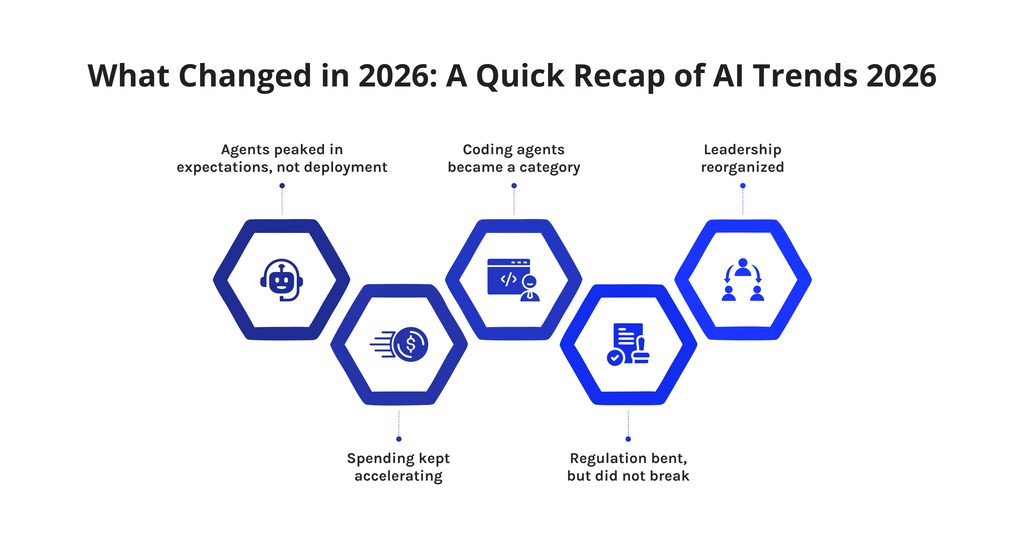
The AI trends of 2026 delivered were less about breakthroughs and more about consolidation. Agentic AI hit the peak of the hype cycle while real deployment stayed low, spending kept climbing, a formal market for coding agents emerged, the EU delayed its toughest AI Act deadlines, and the distance between AI adoption and AI results became impossible to ignore.
Agents peaked in expectations, not deployment. Gartner’s first Hype Cycle for agentic AI (April 2026) placed it at the Peak of Inflated Expectations, while its 2026 CIO survey found only 17% of organizations had deployed agents.
Spending kept accelerating. Gartner’s May 2026 forecast put worldwide AI spending at $2.59 trillion for the year, up 47%.
Coding agents became a category. On May 20, 2026, Gartner released its first Magic Quadrant for Enterprise AI Coding Agents, marking the shift from code suggestions to agents that execute multi-step engineering work.
Regulation bent but did not break. The EU’s Digital Omnibus on AI, agreed on May 7, 2026, and published on July 24 as Regulation (EU) 2026/1744, moved the high-risk deadline for stand-alone systems from August 2, 2026, to December 2, 2027.
Leadership reorganized. IBM’s 2026 CEO study found that 76% of organizations now have a Chief AI Officer, up from 26% a year earlier. Of the AI trends 2026 produced, this is the clearest sign that AI moved from the IT agenda into the operating model.
10 AI Trends for 2027
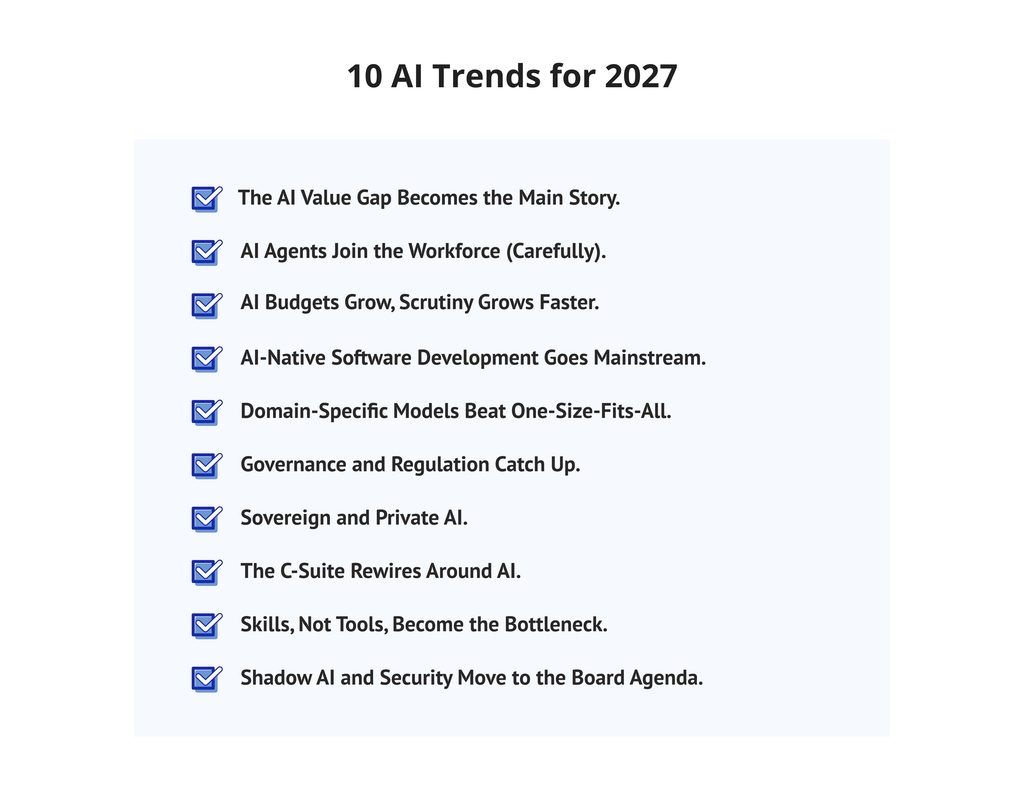
The 10 AI trends for 2027 that matter most to business leaders are: the AI value gap, AI agents in the workforce, budget scrutiny, domain-specific models, AI-native software development, governance and regulation, sovereign AI, C-suite redesign, the skills bottleneck, and shadow AI as a board-level risk. Each one comes with a decision leaders need to make.
1. The AI Value Gap Becomes the Main Story
Most companies have AI; few have results. BCG’s Build for the Future 2025 study of more than 1,250 firms found that only 5% are “future-built” and achieve AI value at scale. Another 35% see some returns, while 60% report minimal revenue and cost gains despite substantial investment.
IBM’s 2025 CEO Study (2,000 CEOs, fielded February to April 2025) points the same way: only 25% of AI initiatives delivered the expected ROI over recent years, and just 16% scaled enterprise-wide. McKinsey’s State of AI 2026 survey (1,719 respondents, May to June 2026) found that only 44% of organizations say AI is scaling across the enterprise, and just 37% attribute any EBIT impact to it.
This is the defining pattern behind enterprise AI adoption trends heading into 2027. The cause is rarely model quality: it is unclear ownership and processes never redesigned around AI. Our guide to AI adoption challenges covers root causes; measurement is the subject of AI ROI.
What to decide in 2027: which AI initiatives have a named business owner and a measurable target, and which ones should be stopped.
Mohamad Ali, Senior Vice President, IBM Consulting (source). “The CEOs delivering real results from AI transformation aren’t just deploying AI faster, they’re redesigning their organizations to bring together the best people with the best technology.”
2. AI Agents Join the Workforce (Carefully)
AI agents plan and execute multi-step tasks, calling tools and data along the way, rather than answering a single prompt. They top every trend list, and the adoption data shows why caution is warranted.
Gartner’s 2026 CIO survey found 17% of organizations have deployed agents, with more than 60% planning to do so within two years. McKinsey’s 2026 survey found about two in ten organizations scaling AI agents, rising to 40% among companies with more than $1 billion in revenue. Gartner also predicts that over 40% of agentic AI projects will be canceled by the end of 2027 due to escalating costs, unclear business value, or inadequate risk controls.
Agents work best on bounded, well-documented processes with clear handoffs to people. Coordinating several agents adds complexity, covered in our guide to AI agent orchestration. For sector examples, see AI agents in finance, and for the full picture, our analysis of agentic AI trends.
What to decide in 2027: which two or three processes are stable enough for agents and where a human must approve the output.
“Agentic AI isn’t a future concept—it’s already reshaping workflows and redefining roles. Companies should view it as the next step in scaling AI, not as the starting point,” said Amanda Luther, a managing director and senior partner at BCG and a coauthor of the report.
3. AI Budgets Grow, Scrutiny Grows Faster
AI spending is still rising steeply. Gartner’s May 2026 forecast puts worldwide AI spending at $2.59 trillion in 2026, up 47%, and projects $3.49 trillion in 2027. More than 45% goes to infrastructure, driven largely by vendors and hyperscalers.
Gartner’s John-David Lovelock noted that CIOs “face challenges in proving the value from AI investments.” In 2027, CFOs will ask for the evidence any capital allocation requires: baseline, target, payback period, and the cost of running AI at scale, including inference.
Expect fewer open-ended innovation budgets and more stage-gated funding tied to milestones, with harder questions about operating costs that teams budgeting only for licenses tend to miss. AI ROI will cover measurement in depth.
What to decide in 2027: the value metrics every AI investment must report and who signs off on them.
4. Domain-Specific Models Beat One-Size-Fits-All
General-purpose large language models often fall short on specialized work where accuracy, terminology, and compliance matter. Gartner named domain-specific language models one of its top strategic technology trends for 2026 and predicts that by 2028, over half of the GenAI models used by enterprises will be domain-specific.
This is where generative AI trends are heading: from chat to work. The next wave is models tuned or grounded for a specific domain, such as financial analysis, contract review, or industrial maintenance, where a confident wrong answer is expensive.
Two routes dominate: fine-tuning smaller models on company data or grounding a general model in company knowledge through retrieval, explained in our guide to RAG pipelines. The choice depends on data, accuracy needs, and cost, not on benchmark rankings.
What to decide in 2027: for each high-value use case, whether a general model is good enough or a specialized or grounded model is required.
5. AI-Native Software Development Goes Mainstream
Software engineering is where AI’s impact is most visible. Gartner listed AI-native development platforms among its top strategic trends for 2026 and predicts that by 2030, these platforms will lead 80% of organizations to evolve large software engineering teams into smaller, more nimble teams augmented by AI.
Gartner’s first Magic Quadrant for Enterprise AI Coding Agents (May 20, 2026) formalized the market. Gartner defines these as autonomous or semi-autonomous systems that turn intent into multi-step plans, then execute and verify them across code and tests: delegation, not autocomplete.
Cheaper software changes build-versus-buy decisions and puts domain experts closer to the build process. It also raises questions about code quality, security review, and who maintains what agents produce. Teams starting out can use our guide on how to build an AI agent.
What to decide in 2027: how engineering productivity will be measured once agents write a growing share of code, and how review and security gates adapt.
6. Governance and Regulation Catch Up
Governance lags adoption. Deloitte’s State of AI in the Enterprise 2026 (3,235 leaders in 24 countries, surveyed August to September 2025) found that only about one in five organizations (21%) has a mature governance model for agentic AI, while 74% expect to use AI agents at least moderately by 2027.
Mature governance means clear limits on what an agent decides alone, monitoring that flags unusual behavior, and audit trails for each action. Without these, scaling agents means scaling unmanaged risk.
Regulation sets the outer limits. Under the EU AI Act as amended by the Digital Omnibus (Regulation (EU) 2026/1744, in force since July 27, 2026), transparency obligations apply from August 2, 2026, stand-alone high-risk systems must comply by December 2, 2027, and high-risk AI embedded in regulated products by August 2, 2028. The delay is a planning window, not an exemption. See AI governance trends.
What to decide in 2027: who owns AI risk, which systems fall into high-risk categories, and what the approval path is for new agents.
“Speed and governance should not be viewed as opposing forces, as there can be alignment when you establish the right foundational capabilities upfront,” Jim Rowan, US Head of AI, Deloitte said.
7. Sovereign and Private AI
Control over AI is now a strategic question. In IBM’s 2026 CEO Study, 83% of respondents agreed that AI sovereignty is essential to business strategy. Sovereignty means control over where data and models run and which jurisdiction’s rules apply.
Gartner captures the infrastructure side with “geopatriation,” the move of data and applications out of global public clouds into sovereign clouds, regional providers, or company data centers because of geopolitical risk. Gartner predicts that by 2030, more than 75% of European and Middle Eastern enterprises will geopatriate their virtual workloads, up from less than 5% in 2025.
This drives private deployments: open-weight models and agents on company-controlled infrastructure, especially in regulated industries. More control also means more responsibility for security and updates. Our guide to self-hosted AI agents walks through the options and trade-offs.
What to decide in 2027: which data and workloads must stay under direct control, and which can safely run on shared cloud AI services.
“Shifting workloads to providers with an increased sovereignty posture can help CIOs gain more control over data residency, compliance and governance,” said Gene Alvarez, Distinguished VP Analyst at Gartner .
8. The C-Suite Rewires Around AI
AI is reshaping leadership teams. IBM’s 2026 CEO Study, based on 2,000 CEOs and senior leaders across 33 geographies, found that 76% of organizations now have a Chief AI Officer, up from 26% the year before.
Decision-making is shifting too. In the same study, 64% of CEOs said they are comfortable making major strategic decisions based on AI-generated input. That raises the bar for the quality and traceability of the data behind them.
A title alone does not close the value gap. The role works when it carries authority over priorities and budgets across functions and when its split of work with the CIO, CFO, and Chief Data Officer is explicit.
What to decide in 2027: the mandate, budget authority, and success metrics for whoever leads AI, whatever the title.
9. Skills, Not Tools, Become the Bottleneck
Technology is no longer the scarcest resource; people who can use it are. IBM’s 2026 CEO Study found that only 25% of employees currently use AI regularly, even though 86% of CEOs believe their workforce has the skills. CEOs also expect 29% of the workforce to need reskilling for different roles and 53% to need upskilling for current roles between 2026 and 2028.
BCG’s AI at Work 2025 survey of more than 10,600 workers in 11 countries found that only 36% of employees feel adequately trained in AI. Training intensity matters: employees who received five or more hours of training, especially in person and with coaching, were significantly more likely to become regular users.
Fund AI literacy as seriously as AI licenses, and redesign roles rather than bolting tools onto old ones. The real jobs question is which tasks inside each role change. AI skills and reskilling will cover workforce planning in depth.
What to decide in 2027: the minimum AI literacy expected for every role and the training hours budgeted to reach it.
10. Shadow AI and Security Move to the Board Agenda
When approved tools lag, employees bring their own. IBM’s Cost of a Data Breach 2025 report (600 breached organizations, March 2024 to February 2025) found that one in five organizations reported a breach due to shadow AI, meaning unsanctioned AI tools. High levels of shadow AI added about $670,000 to the average breach cost, and only 37% of organizations had policies to manage or detect it.
The threat is also growing from outside. IBM’s 2026 edition (602 organizations, March 2025 to February 2026) found that one in four malicious breaches was AI-enabled, involving tactics such as deepfake impersonation and AI-enabled malware, at an average cost of $6 million.
Bans push usage out of sight. The better policy is “allow safely”: approved tools good enough to use, clear rules on data that may never leave the company, and monitoring. Shadow AI often signals slow internal rollout, one of the AI adoption challenges worth fixing at the source.
What to decide in 2027: the approved AI tool set, the data classes that are off-limits, and how unsanctioned use will be detected.
“The data shows that a gap between AI adoption and oversight already exists, and threat actors are starting to exploit it,” said Suja Viswesan, Vice President, Security and Runtime Products, IBM.
Emerging AI Trends to Watch (Beyond the Top 10)
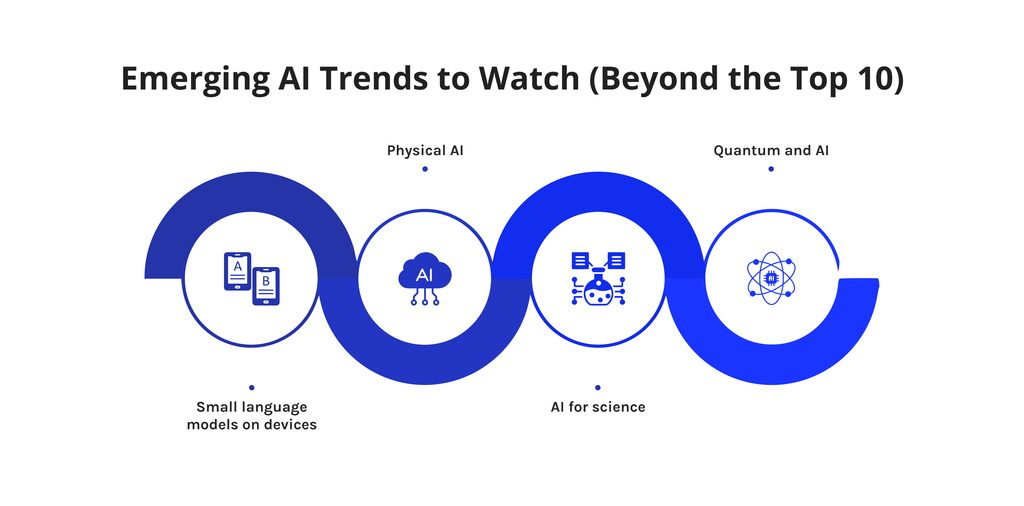
Beyond the top 10, four emerging AI trends deserve a place on the watch list for 2027: small language models running on devices, physical AI in robotics and operations, AI for scientific discovery, and the intersection of quantum computing and AI. Most are early for business use, but each could shift costs or capabilities quickly.
Small language models on devices. Compact models on laptops, phones, and edge hardware cut inference costs and keep sensitive data local.
Physical AI. AI that acts in the physical world, from warehouse robots to inspection drones, is moving into manufacturing and logistics pilots.
AI for science. Models that accelerate materials discovery and drug design are a credible long-term value pool on R&D timelines.
Quantum and AI. Still experimental: worth tracking, not budgeting for, unless your industry depends on complex optimization.
For function-specific developments, see our coverage of AI trends in sales and marketing.
How to Act on These AI Trends in 2027
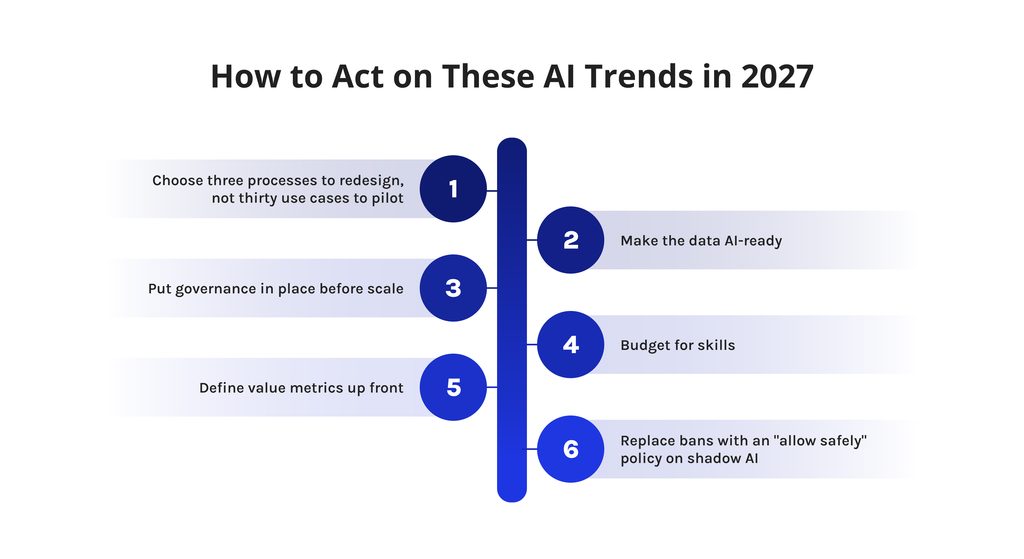
To act on these AI trends, leaders should make six decisions early in 2027: pick a small number of processes to redesign, fix the data those processes depend on, set governance before scaling agents, fund skills, define value metrics, and replace AI bans with a safe-use policy.
- Choose three processes to redesign, not thirty use cases to pilot. Pick high-volume processes with clear metrics and a willing owner, and redesign the workflow around AI.
- Make the data AI-ready. Prioritize access, quality, and documentation for the data behind those three processes.
- Put governance in place before scale. Define decision boundaries, monitor and audit trails for agents, and map which systems may fall under EU AI Act high-risk rules.
- Budget for skills. Set a minimum AI literacy standard per role and fund the training as a program cost.
- Define value metrics up front. Every initiative needs a baseline, a target, and a review date. Stop projects that miss their gates.
- Replace bans with an “allow safely” policy on shadow AI. Approved tools, clear data rules, and monitoring.
For the barriers that derail this plan, see AI adoption challenges.
| Trend | Decision for leaders in 2027 |
|---|---|
| AI value gap | Owners and targets; what to stop |
| AI agents | Which processes are where humans approve |
| Budget scrutiny | Mandatory value metrics |
| Domain-specific models | General, specialized or grounded model |
| AI-native development | Productivity metrics and code review |
| Governance and regulation | Risk owner; high-risk inventory |
| Sovereign AI | What stays under direct control |
| C-suite redesign | AI leader’s mandate and budget |
| Skills | Literacy standard and training budget |
| Shadow AI | Approved tools, off-limits data, detection |
AI Predictions Beyond 2027
The main AI trends predictions beyond 2027 point toward more autonomous decision-making. CEOs expect AI to take a much larger share of operational decisions by 2030, and Gartner forecasts that agentic AI will make a measurable share of daily work decisions by 2028. Both assume data and governance foundations most companies lack today.
In IBM’s 2026 CEO Study, CEOs expected AI to make 48% of operational decisions without human involvement by 2030, up from 25% today. Gartner predicts that by 2028, at least 15% of day-to-day work decisions will be made autonomously through agentic AI, up from 0% in 2024, and that 33% of enterprise software applications will include agentic AI, compared with less than 1% in 2024.
Treat these as directional forecasts. The companies that get there will be the ones that closed the value gap first.
Our Methodology
This article draws on primary research published between June 2025 and August 2026 from IBM, BCG, McKinsey, Deloitte, and Gartner, plus Regulation (EU) 2026/1744. It complements our overview of digital transformation trends.
Every statistic was checked against the publisher’s own release or report, with sample and fieldwork dates noted. Forecasts are labeled as predictions; figures without a traceable primary source were excluded. Each trend had to pass one test: does it change a decision a business leader must make in 2027? Data is current as of October 2026; this article is updated each autumn.
Key Takeaways
- The defining AI trends for 2027 are about results: only 5% of companies achieve AI value at scale (BCG 2025), and only 25% of AI initiatives met ROI expectations (IBM 2025).
- AI agents are spreading, but deployment is still early: 17% of organizations had deployed them in 2026 (Gartner).
- Governance lags adoption: about one in five organizations has mature governance for agentic AI (Deloitte 2026), and EU AI Act high-risk rules apply from December 2, 2027.
- Leadership is reorganizing: 76% of organizations have a Chief AI Officer (IBM 2026).
- Skills and data are the binding constraint: only 25% of employees use AI regularly (IBM 2026).
References
- IBM Newsroom, “IBM Study: CEOs Double Down on AI While Navigating Enterprise Hurdles,” May 6, 2025. https://newsroom.ibm.com/2025-05-06-ibm-study-ceos-double-down-on-ai-while-navigating-enterprise-hurdles
- IBM Newsroom, “IBM Study: CEOs are Reshaping C-suite Roles for the AI Era,” May 4, 2026. https://newsroom.ibm.com/2026-05-04-ibm-study-ceos-are-reshaping-c-suite-roles-for-the-ai-era
- BCG, “The Widening AI Value Gap: Build for the Future 2025,” 2025. https://media-publications.bcg.com/The-Widening-AI-Value-Gap-October-2025.pdf
- BCG, “AI at Work 2025: Momentum Builds, But Gaps Remain,” press release, June 26, 2025. https://www.bcg.com/press/26june2025-beyond-ai-adoption-full-potential
- McKinsey & Company, “The state of AI in 2026: On the road to ROI,” August 25, 2026. https://www.mckinsey.com/capabilities/quantumblack/our-insights/the-state-of-ai
- Gartner, “What the 2026 Hype Cycle for Agentic AI Reveals,” April 2026. https://www.gartner.com/en/articles/hype-cycle-for-agentic-ai
- Gartner, “Gartner Forecasts Worldwide AI Spending to Grow 47% in 2026,” May 19, 2026. https://www.gartner.com/en/newsroom/press-releases/2026-05-19-gartner-forecasts-worldwide-ai-spending-to-grow-47-percent-in-2026
- Gartner, “Gartner Predicts Over 40% of Agentic AI Projects Will Be Canceled by End of 2027,” June 25, 2025. https://www.gartner.com/en/newsroom/press-releases/2025-06-25-gartner-predicts-over-40-percent-of-agentic-ai-projects-will-be-canceled-by-end-of-2027
- Gartner, “Gartner Identifies the Top Strategic Technology Trends for 2026,” October 20, 2025. https://www.gartner.com/en/newsroom/press-releases/2025-10-20-gartner-identifies-the-top-strategic-technology-trends-for-2026
- Gartner, “Magic Quadrant for Enterprise AI Coding Agents,” May 20, 2026. https://www.gartner.com/en/documents/7879277
- Deloitte, “State of AI in the Enterprise,” 2026 edition. https://www.deloitte.com/us/en/what-we-do/capabilities/applied-artificial-intelligence/content/state-of-ai-in-the-enterprise.html
- Deloitte Insights, State of AI in the Enterprise 2026 findings on AI agents and governance, April 24, 2026. https://www.deloitte.com/us/en/insights/topics/emerging-technologies/ai-agents-scaling-faster.html
- IBM Newsroom, “IBM Report: 13% of Organizations Reported Breaches of AI Models or Applications, 97% of Which Reported Lacking Proper AI Access Controls,” July 30, 2025. https://newsroom.ibm.com/2025-07-30-ibm-report-13-of-organizations-reported-breaches-of-ai-models-or-applications,-97-of-which-reported-lacking-proper-ai-access-controls
- IBM Newsroom, “IBM Study: One in Four Malicious Breaches are AI-Enabled, Costing Companies $6 Million on Average,” July 29, 2026. https://newsroom.ibm.com/2026-07-29-ibm-study-one-in-four-malicious-breaches-are-ai-enabled,-costing-companies-6-million-on-average
- Hunton Andrews Kurth, “EU Digital Omnibus on AI Enters Into Force,” July 2026. https://www.hunton.com/privacy-and-cybersecurity-law-blog/eu-digital-omnibus-on-ai-enters-into-force
FAQs
The biggest AI trends for 2027 are the AI value gap, AI agents entering real workflows, tighter scrutiny of AI budgets, domain-specific models, AI-native software development, governance and regulation, sovereign AI, the rise of the Chief AI Officer, skills as the main bottleneck, and shadow AI as a board-level security risk.
The latest AI trend is agentic AI: systems that plan and carry out multi-step tasks rather than answering single prompts. Interest far exceeds deployment. Gartner’s 2026 survey found only 17% of organizations had deployed AI agents, though more than 60% expect to within two years. Gartner places it at the Peak of Inflated Expectations.
Five current trends in AI are AI agents that execute multi-step work, domain-specific language models built for particular industries, AI-native software development with coding agents, sovereign and private AI deployments that keep data under company control, and stronger AI governance driven by regulation such as the EU AI Act. All five shift focus from model capability to control and results.
The top AI trends in 2026 were agentic AI reaching the peak of the hype cycle while deployment stayed near 17%, worldwide AI spending forecast at $2.59 trillion, the first Gartner Magic Quadrant for enterprise AI coding agents, the EU’s Digital Omnibus delaying high-risk AI Act deadlines to December 2027, and Chief AI Officers appearing at 76% of organizations.
AI will change tasks inside jobs more than it eliminates whole professions. IBM’s 2026 CEO Study found only 25% of employees use AI regularly, while CEOs expect 29% of the workforce to need reskilling for new roles and 53% to need upskilling between 2026 and 2028. The practical shift is toward AI literacy, redesigned workflows, and more human review of automated output.
Most companies struggle because they adopt AI as a series of pilots without redesigning the processes, data, and skills around it. BCG found only 5% of companies achieve AI value at scale, and IBM found only 25% of AI initiatives delivered expected ROI. Common causes include poor data readiness, unclear ownership and weak training. See our guide to AI adoption challenges.