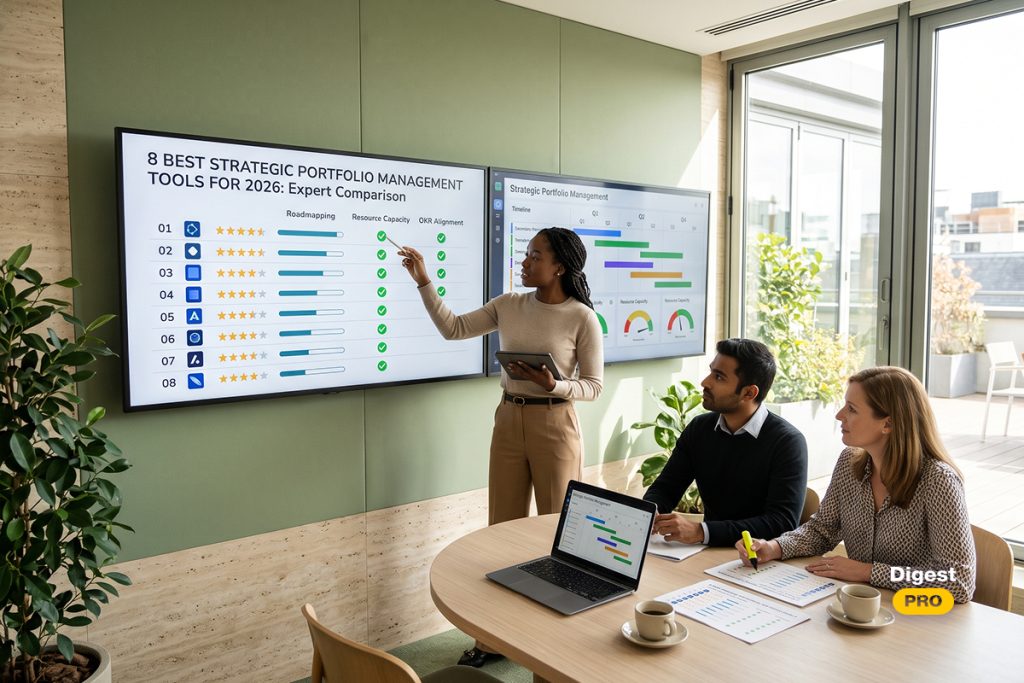
In order to deliver corporate strategy in actionable, resourced, and traceable programs, tools for strategic portfolio management are required. The field is small and rapidly evolving. The Gartner Magic Quadrant for Strategic Portfolio Management published on June 11th, 2026 includes only 9 vendors of solutions [1]. At the same time, according to the Pulse of the Profession report issued by PMI in 2025, only 18% of project practitioners possess advanced business skills [2]. This gap makes the need for a shared and closely controlled portfolio even more important.
TL;DR
- Analyst-validated enterprise breadth: Planview.
- Shared specialists across many projects: Epicflow.
- Organizations already on the Now Platform: ServiceNow SPM.
- Regulated, data-heavy portfolios: Planisware.
- IT finance and agile at scale: Apptio (IBM) Targetprocess.
- Configurable, multi-methodology governance: Triskell.
- Lean, OKR-driven teams with public pricing: Businessmap.
- Microsoft 365-centric PMOs: OnePlan.
What Are Strategic Portfolio Management Tools?
Strategic portfolio management tools are systems that support coordinating business strategy with programs, budgets, and personnel necessary to implement it. The SPM sector is defined by Gartner as solutions that allow treating programs like an investment portfolio. The strategic portfolio management system gets rid of spreadsheets, thus using a single model of demand, capacity, and financing.
PPM tools schedule and track projects. SPM tools decide which initiatives deserve funding. Our guide to product portfolio management tools covers the product-led side.
Core Capabilities and Strategic Alignment
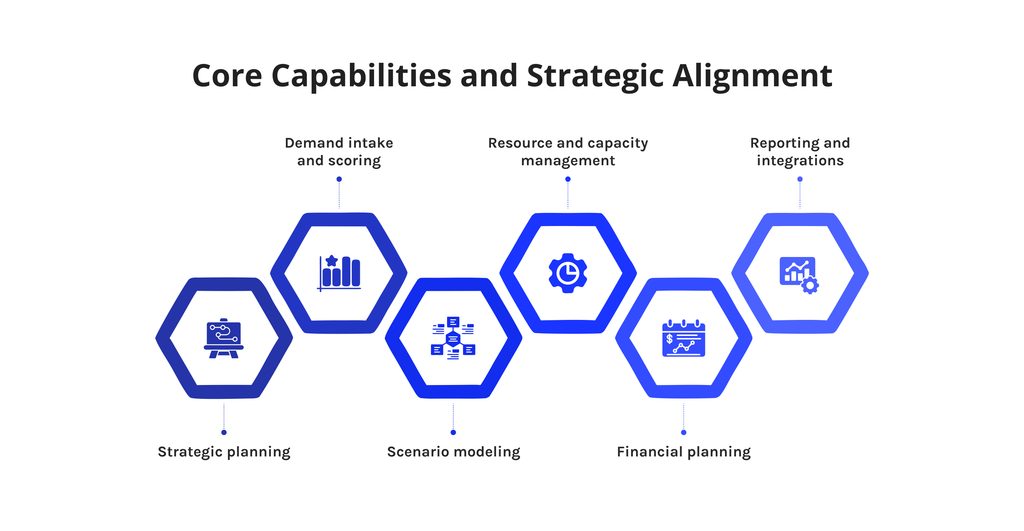
Every serious SPM platform covers six capabilities:
- Strategic planning: goals, OKRs, and investment themes.
- Demand intake and scoring: one front door for ideas.
- Scenario modeling: what-if comparisons before you commit.
- Resource and capacity management: skills and bottlenecks.
- Financial planning: budgets and funding requests.
- Reporting and integrations: dashboards and connectors such as Jira.
Strategic alignment means each funded initiative traces to a goal. Moreover, strong software flags work that serve no goal.
Why Organizations Use SPM Tools
Organizations buy SPM tools to close the gap between strategy and delivery. PMI’s research shows 83% of high-acumen professionals meet business goals, versus 78% of others. Strategic judgment improves outcomes, and software scales it.
Planview’s Chief Product Officer, Louise K. Allen, says the gap “has never been more costly — or more visible.” Planview sells SPM software, so treat this as a vendor view.
Teams adopt these tools for four outcomes:
- Fewer low-value projects reach funding.
- Delivery dates reflect real capacity.
- Funding moves when priorities move.
- Executives get one board-ready view.
Why You Should Trust Us
We evaluated each platform on six aspects:
1. Strategic fit — objectives, OKRs, and ability to track.
2. Resource optimization and possible scenarios — feasibility of cases, reflecting reality.
3. AI functions — the application can not just summarize the data, but also predict and give recommendations.
4. Scalability and safety — maximum number of users and ways of implementation.
5. Transparent pricing — prices, minimum number of users, and possible paid functions.
6. Reputation validation — evaluations from Gartner, G2, Capterra, and TrustRadius.
Pricing transparency separated the field fastest. Epicflow, Businessmap, and OnePlan publish list prices. However, we found no public list price for the other five tools during our review.
Strategic Portfolio Management Software Comparison Table
| Tool | Best for | Listed pricing | Third-party signal | Standout capability |
| Planview | Large, complex enterprises | Custom quote | Leader, 2026 Gartner SPM Magic Quadrant (fifth year) | Anvi AI and scenario planning |
| Epicflow | Shared-resource, engineering-heavy portfolios | Growth: €22.50; Enterprise from €45 per user/month (annual) | G2 4.4/5 (15 reviews) | Cost of delay and What-if on real capacity |
| ServiceNow SPM | Now platform estates | Custom quote | Gartner Peer Insights 4.2 (273 ratings) | One data model from strategy to delivery |
| Planisware | Regulated, data-driven portfolios | On request (Capterra lists Orchestra from $45 per user/month) | Leader, 2026 Gartner APMR Magic Quadrant | Embedded Oscar AI agent |
| Apptio (IBM) Targetprocess | IT finance and agile at scale | Marketplace reference: $40,500/year for 125 users | G2 4.3/5 (243 reviews) | SPM Control Center with financials |
| Triskell | Multi-methodology governance | On request | First Gartner APMR placement (2026); SOC 2 Type II | Scenario evaluation and AI analytics |
| Businessmap | Lean, OKR-driven teams | €9.20 per user/month (annual, 15-user minimum) | Software Advice 4.8/5 (215 reviews) | Portfolio workspaces and Monte Carlo forecasting |
| OnePlan | Microsoft 365-centric PMOs | Basic $10 per user/month (annual, 5+ users) | Capterra 4.5/5 (2 reviews) | Portfolio Modeler with what-if scenarios |
Prices and ratings reflect public listings on 11 November 2026. Confirm current terms with each vendor.
Top Strategic Portfolio Management Tools
1. Planview – Best for Large, Complex Enterprise Portfolios
Planview is an enterprise vendor that covers strategic planning, portfolio management, and delivery.
Key features
- Strategic planning, scenario planning, and investment prioritization.
- Financial planning and capacity planning in the same model.
- Planview Anvi, an AI assistant that surfaces portfolio insights.
- Agent resource management, announced in 2026, which tracks AI agents next to people and shows their costs.
Pros and cons
Pros:
- Named a Leader in the 2026 Gartner SPM Magic Quadrant for the fifth consecutive year, according to Planview.
- Built for multinational portfolios.
- Deep feature coverage across strategy, finance, and resources.
- Finance and capacity share one planning model.
- Anvi and agent resource management address AI-workforce planning.
Cons:
- No published pricing.
- A broad product family means buyers must confirm which modules a quote covers.
- Capterra lists a per-user model, while Planview sells by custom quote, so the true price structure is unclear.
- Smaller PMOs may find the scope larger than they need.
- Agent resource management is new in 2026, so its track record is short.
Pricing and scalability
Planview sells by custom quote. Capterra lists a per-user model. Planview positions the platform for complex, multinational enterprises.
Our verdict
Choose Planview when analyst validation and breadth matter more than price transparency. Smaller PMOs may find the scope larger than they need.
2. Epicflow – Best for Shared-Resource, Engineering-Heavy Portfolios
Epicflow is an AI-based portfolio and resource platform for organizations that run many projects against one pool of specialists.
Key features
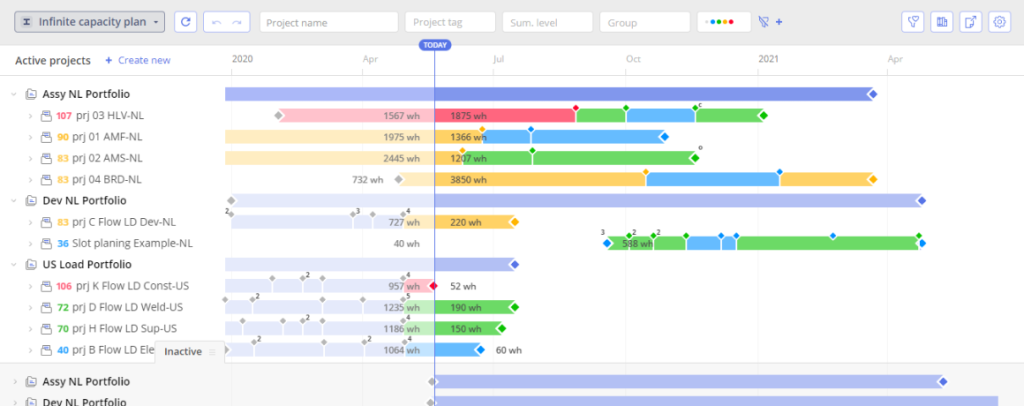
- Portfolio ordering by business value and capacity through the Epicflow Portfolio Optimizer.
- Cost of delay per task.
- Return on Remaining Investment (RRI).
- What-if Analysis on a copy of the plan, under real capacity.
- Bottleneck analysis and capacity planning.
- A Resource Allocation Advisor.
- An optional AI resources module that plans an AI agent like a team member.
Pros and cons
Pros:
- Published prices.
- A 30-day trial.
- Microsoft Project and Oracle Primavera P6 integrations come with the Enterprise plan.
- On-time delivery at KPN rose from 18% to 80% in under a year.
- A half-price start until three agreed delivery metrics are met.
- Unlimited projects on the Enterprise plan.
- G2 rates it 4.4/5 across 15 reviews.
Cons:
- Growth caps at 50 projects and 20–50 users.
- Enterprise requires at least 50 users.
- The Jira interface, REST API, and Epica AI assistant cost extra.
Pricing and scalability
Growth costs €22.50 per user per month billed annually, or €25 monthly. Enterprise starts at €45 annually, or €50 monthly, with unlimited projects. Epicflow also offers a half-price start until three agreed delivery metrics are met.
Our verdict
Epicflow fits engineering and manufacturing PMOs that balance finite specialists across projects. Teams that prioritize OKR cascades or enterprise-architecture mapping should compare it with Planview or OnePlan.
3. ServiceNow SPM – Best for Teams Already Running the Now Platform
ServiceNow Strategic Portfolio Management extends the Now Platform into strategy, demand, and delivery.
Key features
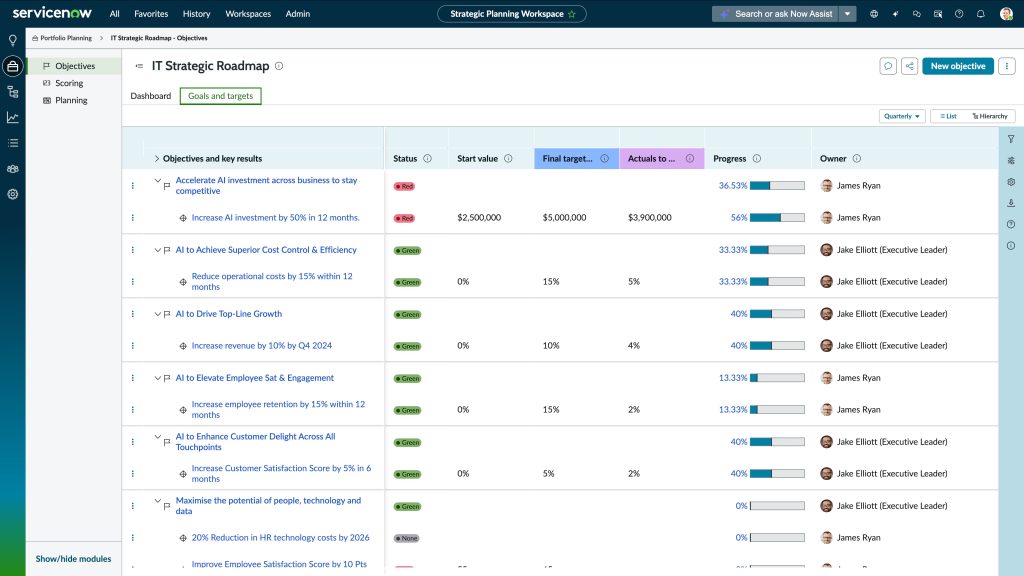
- A goals framework that links objectives to projects, demand, and epics.
- Agile program boards and a unified backlog.
- Support for the Scaled Agile Framework.
- Scenario planning in the Strategic Planning Workspace (SPM Pro).
- Scenario planning in the Portfolio Planning Workspace (SPM Standard).
Pros and cons
Pros:
- One platform and data model for portfolio and service workflows.
- Gartner Peer Insights rating of 4.2 across 273 ratings.
- ServiceNow says Forrester named it a Leader in the Q2 2026 SPM Wave.
- Scenario planning is available in both Standard and Pro editions.
Cons:
- No public list price.
- Review sites cite complexity and a steep learning curve.
- Review sites also cite high cost.
- Add-on modules and implementation services raise total cost, according to reviewers.
- Scenario features differ by edition, so confirm yours in the quote.
Pricing and scalability
ServiceNow quotes custom enterprise subscriptions. Scenario planning features differ between SPM Standard and SPM Pro, so confirm the edition in your quote.
Our verdict
ServiceNow SPM pays off when your service workflows already live on the Now Platform. Organizations without that footprint should price the platform and implementation carefully.
4. Planisware – Best for Regulated, Data-Driven Portfolios
Planisware offers Planisware Enterprise for strategic portfolio management and Planisware Orchestra for faster PPM rollouts.
Key features
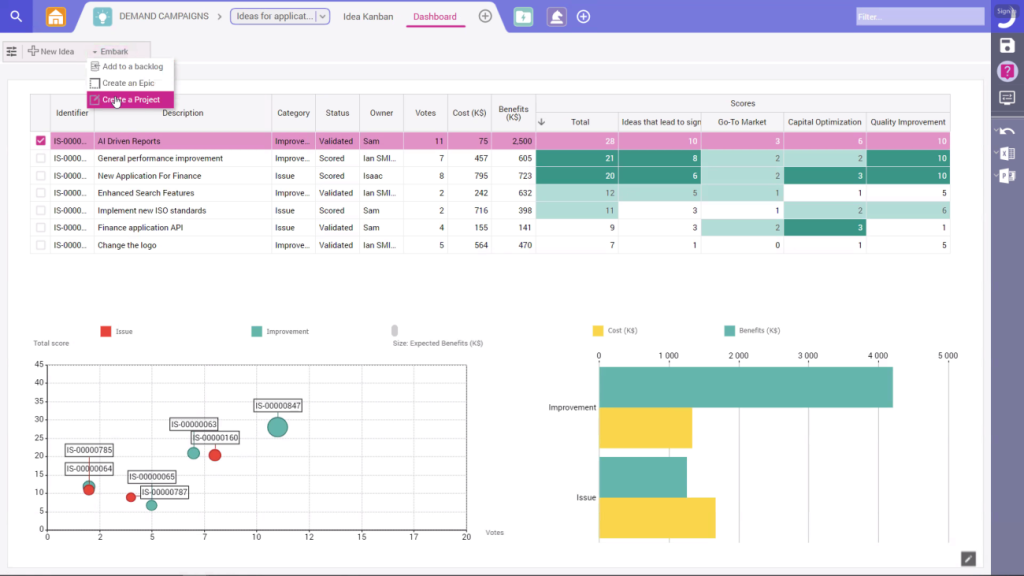
- Portfolio scenarios and simulations.
- Resource management with capacity planning.
- Oscar, an embedded AI agent for portfolio intelligence, AI-powered project intake, and dynamic resource management.
Pros and cons
Pros:
- Named a Leader in the 2026 Gartner Magic Quadrant for Adaptive Project Management and Reporting for the fifth consecutive year.
- Capterra rates Orchestra 4.2/5 across 19 reviews.
- Customer engagements span life sciences, product development, engineering, and IT, per Capterra.
- Orchestra offers a faster PPM rollout than the full Enterprise product.
- Oscar adds AI-powered project intake.
Cons:
- No published pricing.
- Planisware advises teams that are still standardizing portfolio data to run a preparatory phase first.
- A Fitgap review notes that dashboards can go stale when teams skip plan maintenance.
- The $45 per-user Capterra figure is third-party and unconfirmed.
- Capterra shows target company sizes from 201 employees upward.
- Only 19 Capterra reviews support the Orchestra rating.
Pricing and scalability
Planisware quotes on request. Capterra lists Orchestra from $45 per user per month, a third-party figure you should confirm with the vendor. Capterra shows target company sizes from 201 employees upward.
Our verdict
Planisware suits mature PMOs with clean schedule and cost baselines. Teams without that data discipline should budget time for cleanup.
5. Apptio (IBM) Targetprocess – Best for IT Finance and Agile at Scale
IBM Targetprocess, formerly Apptio Targetprocess, links strategy, funding, and agile, waterfall, and hybrid delivery.
Key features
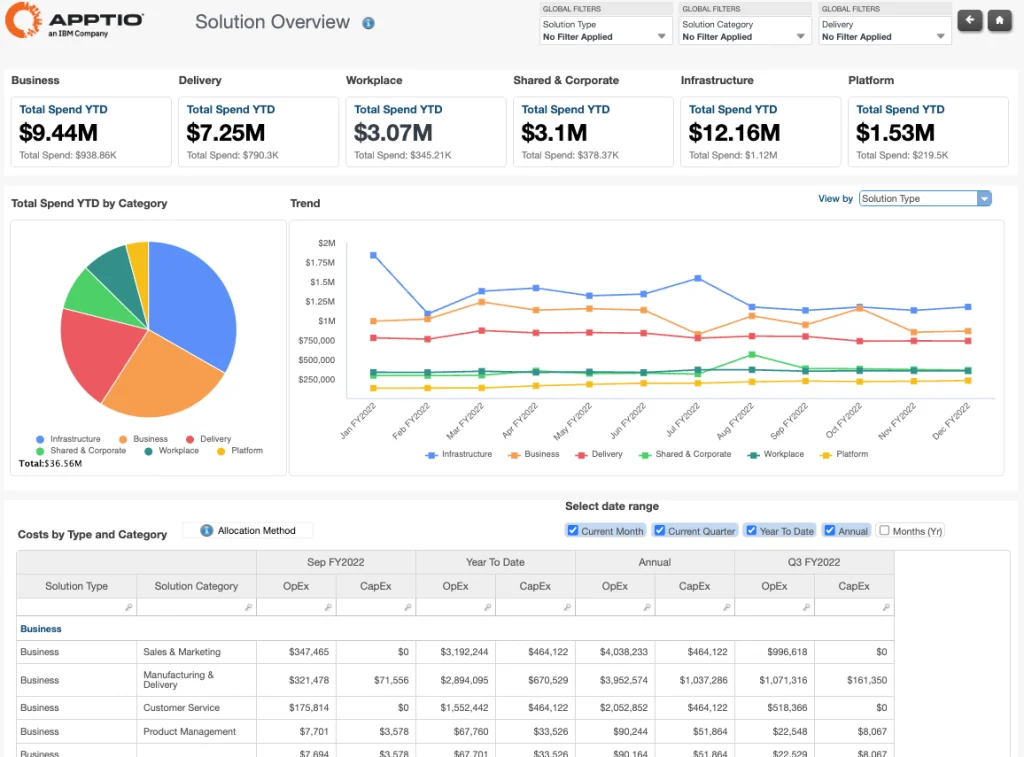
- A priorities dashboard in the SPM Control Center.
- Funding-request workflows.
- Workforce insights and delivery alerts.
- Workforce planning with rosters and headcount planning.
- Holistic financials with IBM Apptio, covering labor and non-labor costs.
Pros and cons
Pros:
- Strong fit for IT finance teams that fund work continuously.
- G2 rates it 4.3/5 across 243 reviews.
- TrustRadius scores it 8.4/10 across 83 reviews.
- Reviewers on TrustRadius call support a strength.
- Supports agile, waterfall, and hybrid delivery.
- Labor and non-labor costs sit in one financial view.
Cons:
- G2 reviewers report complex setup.
- G2 reviewers also report a cluttered interface and a steep learning curve.
- Performance can slow on large datasets.
Pricing and scalability
Targetprocess pricing is subscription-based and contract-driven. A Microsoft Marketplace listing prices a one-year subscription for up to 125 connected users at $40,500, or about $324 per user per year.
Our verdict
Pick Targetprocess when finance and agile delivery must share one funding model. Budget for configuration and training.
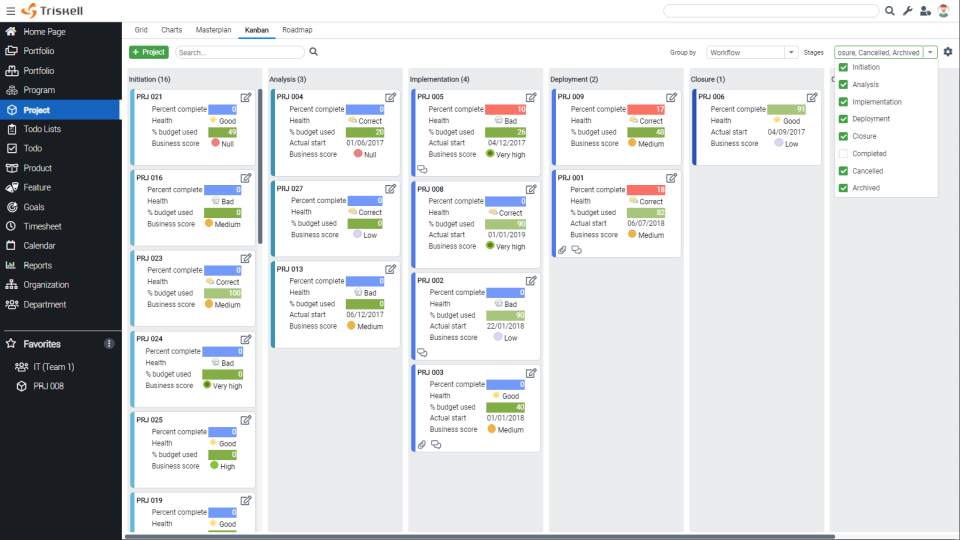
6. Triskell – Best for Configurable, Multi-Methodology Governance
Triskell is a Madrid-based platform for portfolio governance across waterfall, agile, and hybrid work.
Key features
- Demand, capacity, resource, and financial management.
- Application portfolio and project portfolio management.
- Scenario evaluation and AI-enabled analytics.
Pros and cons
Pros:
- SOC 2 Type II certification, announced on 13 January 2026.
- Positioned for the first time in Gartner’s 2026 Magic Quadrant for Adaptive Project Management and Reporting.
- Ready Suite offers preconfigured solutions for IT governance, product development, and portfolio management.
- Covers waterfall, agile, and hybrid work.
Cons:
- Pricing is available on request only.
- The 2026 Gartner placement is its first, so its record in that report is short.
- Listings target medium and large enterprises, so small teams may find it oversized.
Pricing and scalability
Gartner Peer Insights describes subscription pricing that varies with users, features, and configuration. Triskell targets medium and large enterprises, according to listings on Software Review.
Our verdict
Triskell fits organizations that want to configure governance to their own methods. Ask for a pricing quote early to compare it with published rivals.
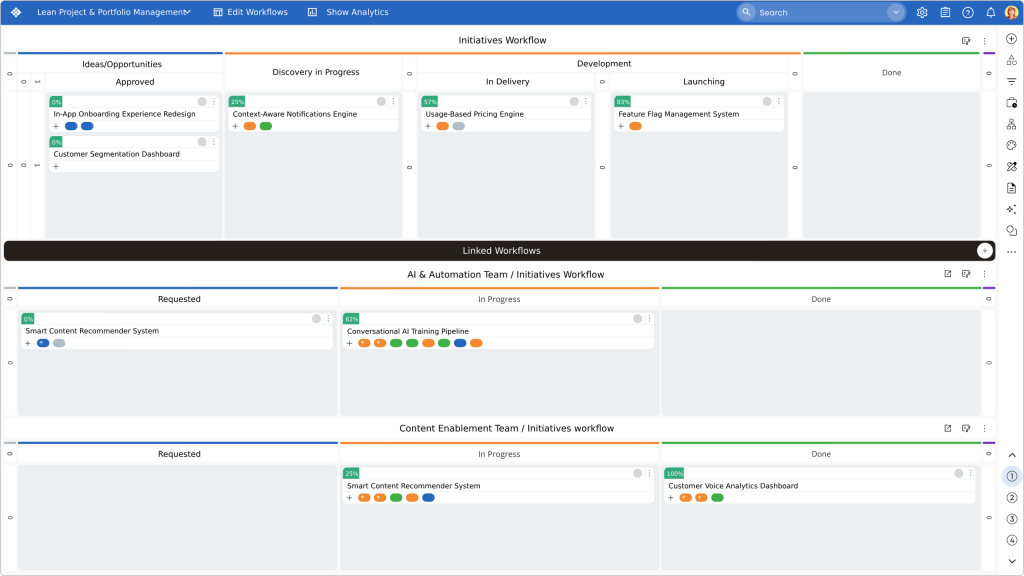
7. Businessmap – Best for Lean, OKR-Driven Portfolio Teams
Businessmap, previously known as Kanbanize, is a combination of Kanban boards, OKRs, and portfolio workspaces.
Key features
- Have unlimited portfolio workspaces and management dashboards.
- OKRs and KPIs are linked to work items.
- Flow analytics, including cumulative flow, cycle time, and Monte Carlo simulation.
- AI Smart Canvases for planning.
Pros and cons
Pros:
- Transparent pricing with all features available on the standard plan.
- A free 14-day trial without requiring a credit card.
- Software Advice rates it 4.8 out of 5 in the total customer satisfaction rating from 215 reviews.
- A low entry price of €9.20 per user per month on annual billing.
Cons:
- 15-user minimum.
- Only 10 automation rules come standard.
- SSO and 2FA cost extra.
- The published feature list shows no dedicated funding or financial-planning module.
- Dedicated cloud instance and IP whitelisting require an Enterprise quote.
Pricing and scalability
Standard costs €9.20 per user per month billed annually, or €11 per user per month. Enterprise adds a dedicated cloud instance, unlimited automation, 24/7 hotline support, and IP whitelisting by quote.
Our verdict
Businessmap suits lean-agile organizations that manage flow and OKRs more than capital funding. Finance-led PMOs should look elsewhere.
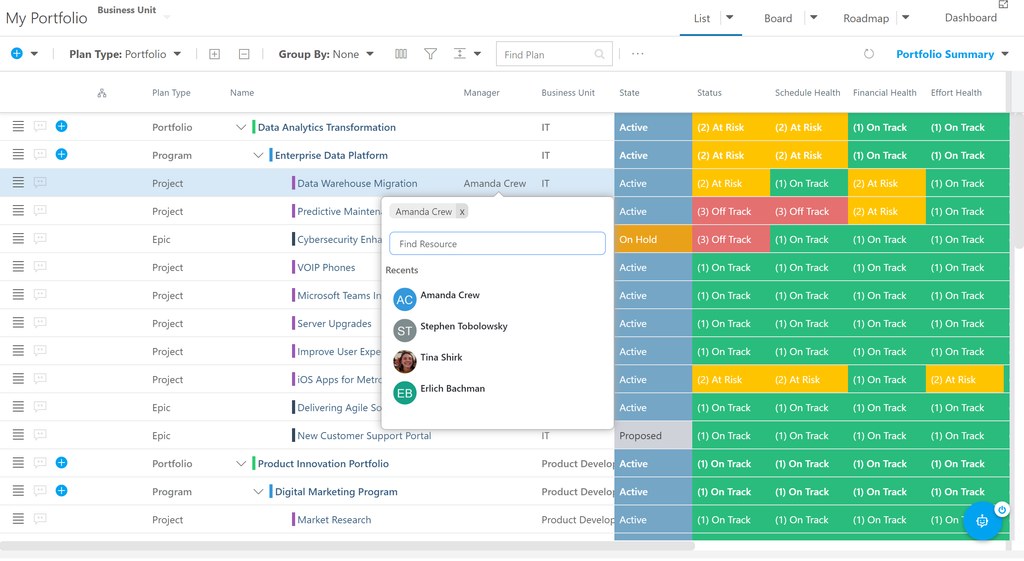
8. OnePlan – Best for Microsoft 365-Centric PMOs
OnePlan is a portfolio management system that is completely embedded in the Microsoft ecosystem.
Key features
- Strategic, portfolio, resource, and financial planning.
- Enterprise plan users have access to the portfolio modeler and What-If Scenario Planning feature.
- The basic edition includes the Sofia AI assistant.
- Integration with Microsoft Project, Planner, Teams, Azure DevOps, and Jira.
- The cloud version starts at $3,000 per portal.
Pros and cons
Pros:
- The price and free trial are clearly defined.
- FedRAMP-certified hosting.
- Realistic migration plan for organizations that leave Microsoft Project Online.
- Works great together with Microsoft Office products.
Cons:
- The basic edition does not include the Portfolio Modeler, What-If Scenario Planning, Financial Plan, and Resource Plan.
- Only two reviews on Capterra, which means that the evidence base is small.
- The price for the Enterprise edition is determined on a case-by-case basis, which makes it impossible to know the prices for financial and modeling levels beforehand.
Pricing and scalability
Basic costs $10 per user per month billed annually, with five or more users. Enterprise is custom-quoted and adds modeling, finance, resource planning, audit logs, and an enterprise API.
Our verdict
OnePlan fits Microsoft-first PMOs that want modeling without a heavy suite. Budget for Enterprise if scenario planning is your main goal.
How to Choose Strategic Portfolio Management Software
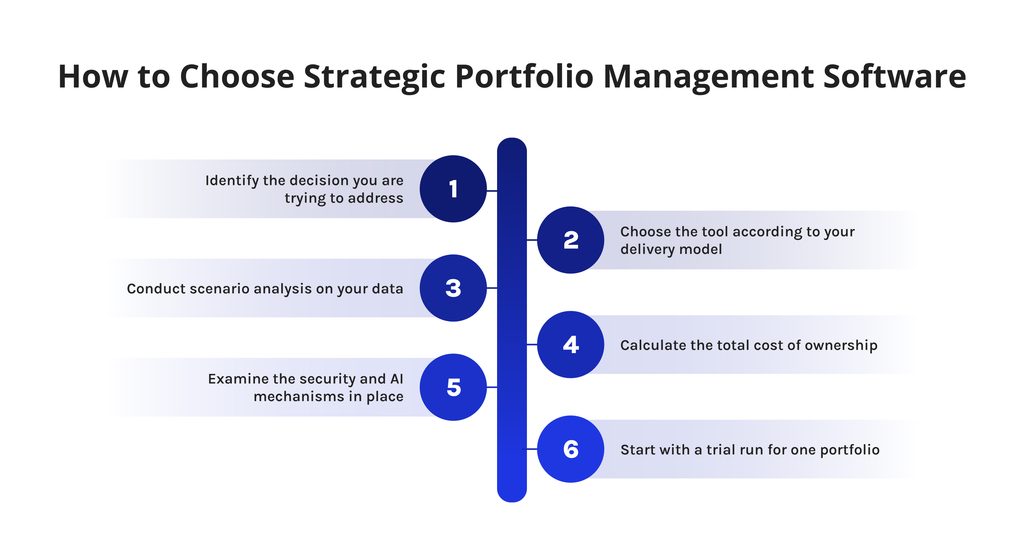
The ideal strategic portfolio management software for your organization should be in tune with your delivery process and data level. In order to arrive at the right software choice, follow these steps:
- Identify the decision you are trying to address. Different tools may be needed for making investment decisions, dealing with capacity conflicts, and implementing agile governance.
- Choose the tool according to your delivery model. A heavily agile delivery model would require Targetprocess. An organization with shared specialist portfolios would opt for Epicflow, while Microsoft die-hards would use OnePlan.
- Conduct scenario analysis on your data. Ask vendors to carry out simulated funding transfers.
- Calculate the total cost of ownership. Include the licensing costs and costs of the modules of interest, such as the minimum number of users and implementation costs.
- Examine the security and AI mechanisms in place. Make sure to learn the company’s certifications, data residency, and the AI usage policy.
- Start with a trial run for one portfolio.
Editorial note: Five of the eight tools in this guide publish no list price. We therefore suggest a shortlist of two published-price tools and two quote-based tools, so you can benchmark total cost.
For wider context, see our guide to enterprise project management software and our explainer on program management.
Summary
Strategic portfolio management solutions connect strategy to investment, capability, and execution. Analysts rank Planview as the leading solution for this space, while Epicflow ranks highest for shared resource optimization. Above that, ServiceNow’s SPM ranks highest in terms of platform integration. Planisware, Targetprocess, and Triskell cater to portfolios that require strict compliance, are in finance-oriented industries, and need tailored solutions. Businessmap and OnePlan can kick off at the lowest cost. Don’t forget to apply the six-step checklist to narrow down your options before making your choice.
FAQ
Strategic portfolio management tools are types of software that connect the enterprise strategy with its funded projects/initiatives and resources, as well as delivery-based information. They help to create a model of demand, resources, and budget in a single place. Business leaders use these tools to determine what projects are to be funded, initiated, halted, or stopped.
PPM software concerns how projects are run. SPM software focuses on determining the projects that require additional investments. While PPM deals with scheduling, resources, and the current status of projects, SPM uses strategic planning, funding, and scenario modeling aspects rather than projects themselves.
There is no ideal software solution available for all organizations in order to operate under SPM. Planview is the leading company, according to the findings of the 2026 Magic Quadrant for SPM, for the 5th consecutive year, according to Gartner. Epicflow, ServiceNow SPM, and OnePlan can be utilized within organizations that prefer the Now platform or Microsoft tools for their operations.
Published prices start near $10 per user per month and rise to custom enterprise quotes. Businessmap lists €9.20, and OnePlan Basic lists $10. Epicflow Growth lists €22.50, and its Enterprise plan starts at €45. Most enterprise vendors quote on request.
Look for strategic planning, demand intake, scenario modeling, capacity management, financial planning, and live reporting. Add security controls and integrations with delivery tools. Judge AI features by whether they predict or recommend, not only summarize.
SPM tools let you copy the portfolio plan and test changes before you commit. Epicflow runs What-if analysis on a copy of the plan under real capacity. OnePlan Enterprise includes a Portfolio Modeler, and ServiceNow offers scenario planning in its planning workspaces.
AI now flags risks, answers portfolio questions, and tracks AI agents as resources. Planview announced agent resource management in 2026, Planisware embeds its Oscar agent, and Epicflow offers AI resources as an optional module. Check where prompt data goes before you buy.
Gartner has indeed published its Magic Quadrant for Strategic Portfolio Management, June 11, 2026. This report assesses nine vendors based on their ability to implement and the completeness of their vision. It points out that Gartner does not suggest customers simply choose the highest-rated vendors.
Yes, there are many low-entry vendors available to the market. For instance, Businessmap can be used by 15 users from the start, while OnePlan Basic is for 5 users. Similar large suites like Planview and ServiceNow SPM are targeted at complex business portfolios
The most significant threat is associated with poor data involved within the portfolio management process. As such, Planview instructs the majority of teams that are standardizing the data in their organizations to consider the preparatory phase first. This, in turn, would allow obtaining a clean baseline on the schedule, costs, and capacity for implementing effective dashboards.
References
Gartner. (2026, June 11). Magic Quadrant for strategic portfolio management [Abstract]. https://www.gartner.com/en/documents/7988837
Project Management Institute. (2025). Pulse of the Profession 2025: Boosting business acumen. https://www.pmi.org/learning/thought-leadership/pulse
Capterra. (2026). OnePlan software pricing, alternatives and more 2026. https://www.capterra.com/p/191707/OnePlan/
Capterra. (2026). Planisware Orchestra software pricing, alternatives and more 2026. https://www.capterra.com/p/146320/Planisware-Orchestra/
Epicflow. (2026). Pricing plans. https://www.epicflow.com/pricing-plans/
Finout Writing Team. (2026, March 20). Apptio Targetprocess: Solution overview, pricing, pros and cons. Finout. https://www.finout.io/blog/apptio-targetprocess
G2. (2026). Epicflow vs. Resource Management by Smartsheet. https://www.g2.com/compare/epicflow-vs-resource-management-by-smartsheet
G2. (2026). IBM Targetprocess reviews. https://www.g2.com/products/ibm-targetprocess/reviews
Gartner. (2026, November 4). Gartner survey reveals just 4% of customer service leaders have achieved the expected ROI of their AI initiatives [Press release]. https://www.gartner.com/en/newsroom/press-releases/2026-11-04-gartner-survey-reveals-just-4-percent-of-customer-service-leaders-have-achieved-the-expected-roi-of-their-ai-initiatives
Gartner Peer Insights. (2026). Strategic portfolio management reviews and ratings. https://www.gartner.com/reviews/market/strategic-portfolio-management
OnePlan. (2026). Pricing. https://oneplan.ai/pricing/
Planisware. (2026, August 6). Planisware recognized as a Leader in the 2026 Gartner Magic Quadrant for adaptive project management and reporting [Press release]. https://planisware.com/resources/corporate-news/planisware-recognized-leader-2026-gartner%C2%AE-magic-quadrant%E2%84%A2-adaptive
Planview. (2026). 2026 Gartner Magic Quadrant for strategic portfolio management. https://info.planview.com/gartner-spm-mq-_report_sp_en_reg.html
Planview. (2026, June 16). Planview again named by Gartner as a Leader in strategic portfolio management [Press release]. Business Wire. https://www.businesswire.com/news/home/20260616691154/en/Planview-Again-Named-by-Gartner-as-a-Leader-in-Strategic-Portfolio-Management
Raymond, D. (2026, June 12). Businessmap pricing plans and costs guide. ProjectManagers.net. https://projectmanagers.net/businessmap-pricing/
ServiceNow. (2026, May 11). Forrester: ServiceNow is a leader in strategic portfolio management. https://www.servicenow.com/workflow/news/forrester-leader-strategic-portfolio-management.html
Software Advice. (2026). Businessmap 2026: Benefits, features and pricing. https://www.softwareadvice.com/project-management/kanbanize-profile/
Triskell Software. (2026, January 13). Triskell Software achieves SOC 2 Type II certification. https://triskellsoftware.com/news-events/triskell-software-achieves-soc-2-certification/
Triskell Software. (2026, September 3). Triskell Software positioned for the first time in the 2026 Gartner Magic Quadrant for adaptive project management and reporting [Press release]. PR Newswire. https://www.newswire.ca/news-releases/triskell-software-positioned-for-the-first-time-in-the-2026-gartner-r-magic-quadrant-tm-for-adaptive-project-management-and-reporting-870761478.html
TrustRadius. (2026). IBM Targetprocess reviews and ratings. https://www.trustradius.com/products/ibm-targetprocess