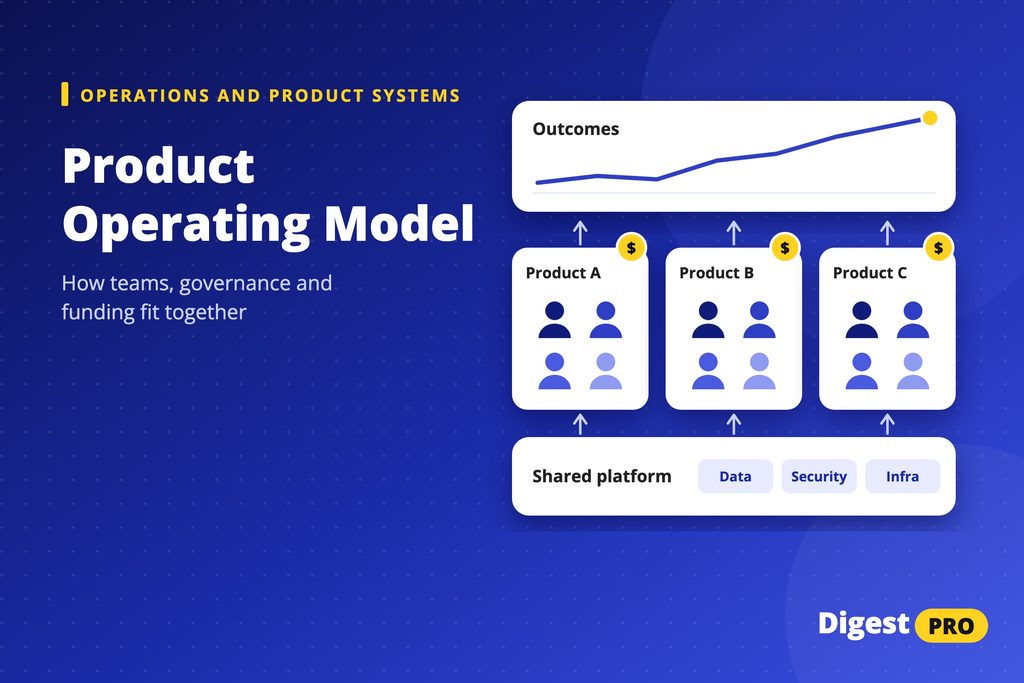
Many organizations now say they want a product operating model. Far fewer run one. In a Scrum.org survey of 136 organizations in late 2025, 72% reported a product-centric organizational goal, but only 28.7% described themselves as fully product-focused, and 73% reported inconsistent coordination across products [1].
A product operating model organizes people, funding, governance and delivery around products and the outcomes they create. It is more than renaming project teams. You have to change how work is selected, how teams stay accountable, how discovery connects to delivery and how leaders judge results.
This guide explains the components, how they differ from project-centric structures and how to adopt the model in stages. No single framework is universal, so treat named models as references, not rulebooks.
Key takeaways
- A product operating model is a system: strategy, persistent teams, decision rights, funding and outcome measures have to change together.
- Teams own problems and outcomes over time, not a fixed scope that ends at launch.
- Funding moves from individual projects toward products or value streams, inside guardrails that leaders review on a cadence.
- Measure outcomes alongside delivery speed, reliability, risk and team health. Output counts alone mislead.
- Start with a bounded pilot that has an executive sponsor, explicit decision rights and baseline measures.
What is a product operating model?
A product operating model is an integrated way to organize value streams, teams, funding, governance and measures around durable products, whether those products serve customers or internal users.
The Silicon Valley Product Group (SVPG), whose introduction to the model is one of the most cited practitioner references, frames it around three changes: how you build, how you solve problems and how you decide which problems to solve. In its words, the model is “about achieving outcomes versus merely producing output” [2]. That is one consultancy’s point of view, but most definitions share the same core: teams receive problems and target outcomes, not lists of features.
Three distinctions keep the term clear:
- Not a role. Product management is a discipline inside the model. The model also covers engineering, design, finance and leadership.
- Not a method. Agile and Scrum describe how teams plan and deliver. The operating model also decides funding, ownership and accountability.
- Not a software category. Tools such as those in our guide to the best product management tools can support the model. Buying them does not create one.
Core components of a product operating model
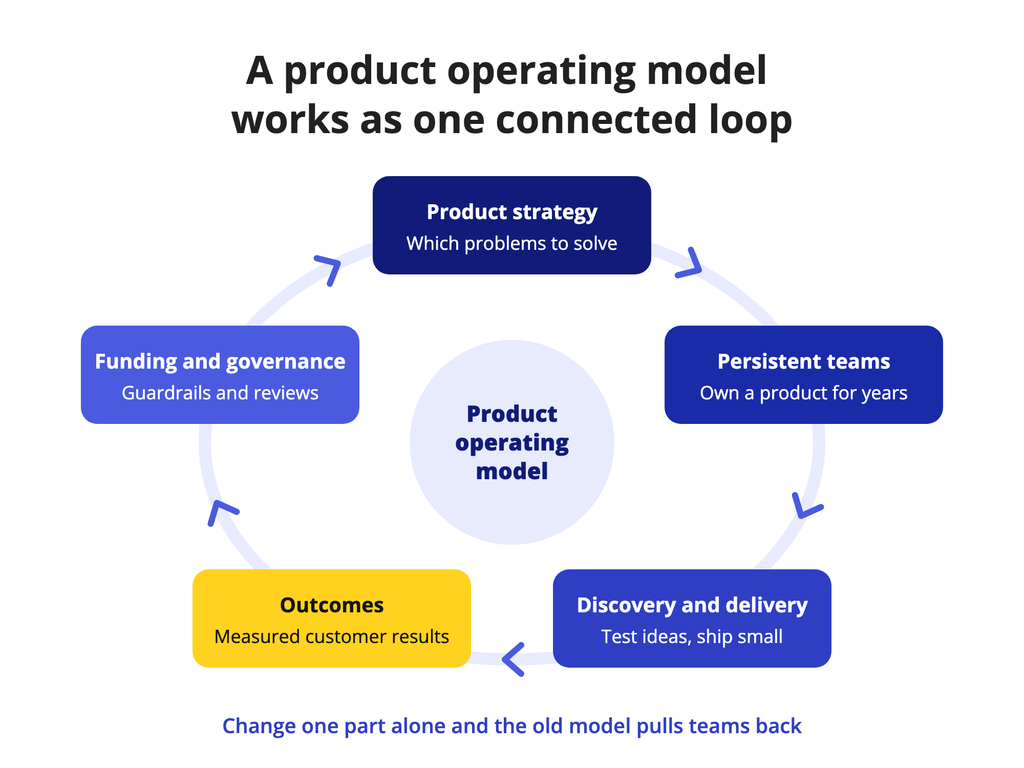
The components only work as a set. Change one and leave the rest, and the old model pulls teams back.
Product strategy and boundaries
Start by defining products and the value streams they serve. Deloitte describes value streams as mapping customer segments and journeys to where and how the organization creates value [3]. Strategy then picks the problems worth solving. Roadmaps express outcomes and bets rather than fixed feature lists. If you are comparing software for that, see the best product roadmap tools.
Persistent cross-functional teams
Teams stay together and own a product area for years, not months. SVPG describes durable, cross-functional, empowered teams that own meaningful problems [2]. Stability builds domain knowledge and makes accountability real.
Discovery and delivery
Teams test ideas quickly before committing to build, then ship small, frequent and reliable releases [2]. Discovery needs protected capacity. Without it, teams drift back to taking orders. In practice, that means prototypes, customer interviews and data analysis run alongside delivery every week, not as a separate phase that ends before coding starts.
Decision rights
Write down who decides what: strategy, priorities, architecture, release and spend. Stable teams need durable ownership and clear escalation paths, not only new ceremonies. A simple test: if a team wants to drop a planned feature because evidence shows it will not move the target outcome, can it do so without a steering committee? If not, decision rights have not moved.
Funding and outcome measures
Money follows products, and success is judged on outcomes. The sections below cover both, because they are where most transitions stall.
How the components connect
Each component depends on the others. Persistent teams without product funding end up chasing short projects to justify their budget. Outcome targets without decision rights leave teams accountable for results they cannot influence. Discovery without strategy produces interesting experiments that do not add up. Governance without measures falls back on dates and scope, because those are the only facts on the table. Design the components together, even if you roll them out in stages.
Product teams, roles and accountability
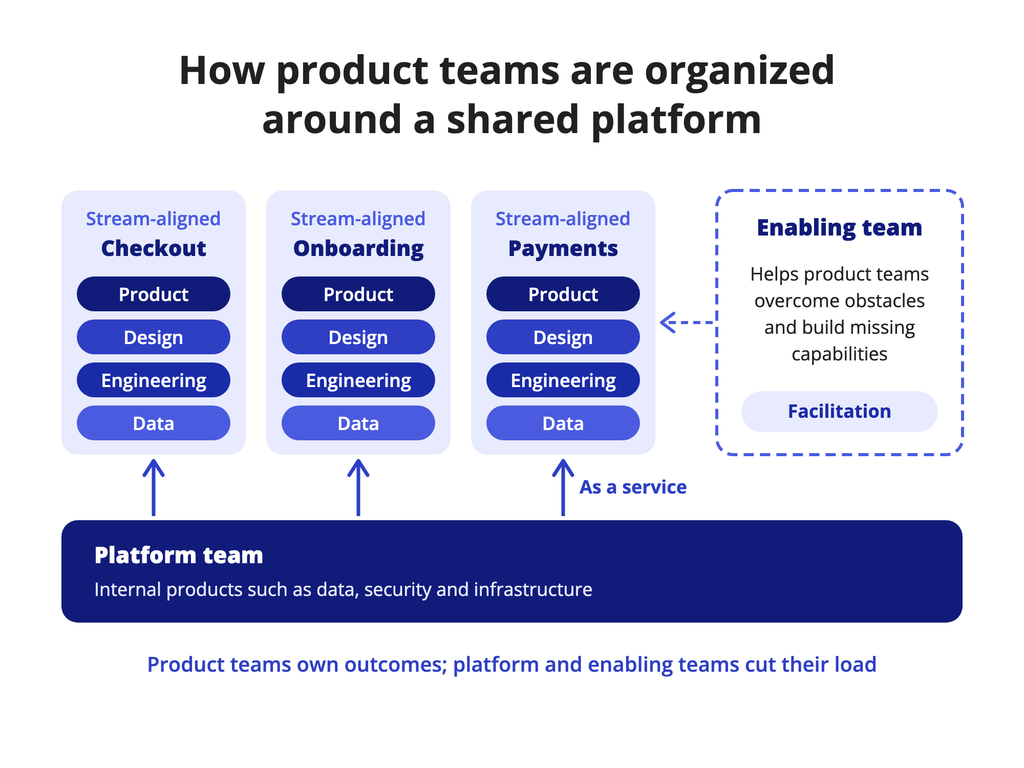
There is no single correct org chart, but responsibilities need owners.
- Product manager: owns value and viability, and decides what problem the team tackles next.
- Designer: owns usability and the customer experience.
- Engineering lead: owns feasibility, architecture and delivery quality.
- Data or analytics partner: owns instrumentation and evidence for decisions.
- Business partner: brings commercial, operational or regulatory context and shares accountability for the outcome.
SVPG’s model splits responsibility in a similar way across product managers, designers and tech leads, with product leaders coaching teams and providing strategic context [2].
Dependencies are the hard part. Team Topologies, the team-design approach from Matthew Skelton and Manuel Pais, distinguishes stream-aligned teams that follow a flow of business work from platform teams that provide a compelling internal product to speed them up, plus enabling teams that help others overcome obstacles [4]. Deloitte similarly recommends centrally managed shared services, such as security, infrastructure and data, that support product teams [3]. Treat these platforms as products with their own users and roadmaps.
Keep dependencies visible. Map which teams need work from which others each quarter, and redesign boundaries when one team waits on another for most of its roadmap. Some coordination is healthy. Constant hand-offs mean the product boundary is in the wrong place.
Accountability also needs a sponsor. The UK Government Service Manual asks for a multidisciplinary team that can create and operate a service sustainably, and says people involved in decision making should be part of the team so they are accountable to it [6]. An executive sponsor protects that arrangement when quarterly pressure arrives.
Funding, portfolio governance and measures
Project funding asks, “What will this scope cost?” Product funding asks, “How much capacity should this product have, and what outcomes should it deliver?”
The Scaled Agile Framework (SAFe) calls this approach Lean Budgets: it funds value streams instead of projects, while each portfolio still operates within an approved budget [5]. You do not need SAFe to apply the idea. Set a funding envelope per product or value stream, attach guardrails (spend limits, approval thresholds, a minimum share for discovery and technical health) and review allocations on a fixed cadence.
Bring finance in early. Initial envelopes usually start from the current run rate of the teams involved, then shift as evidence comes in. Finance partners will want to know how capital and operating costs are tracked, how large investments still get a business case and who signs off when a product asks for more capacity. Agree those rules before the pilot, not during the first budget cycle.
Portfolio governance then shifts from approving projects to balancing products. Leaders compare outcomes, risks and dependencies, and move capacity between products when evidence changes. Our guide to product portfolio management tools covers software for this layer.
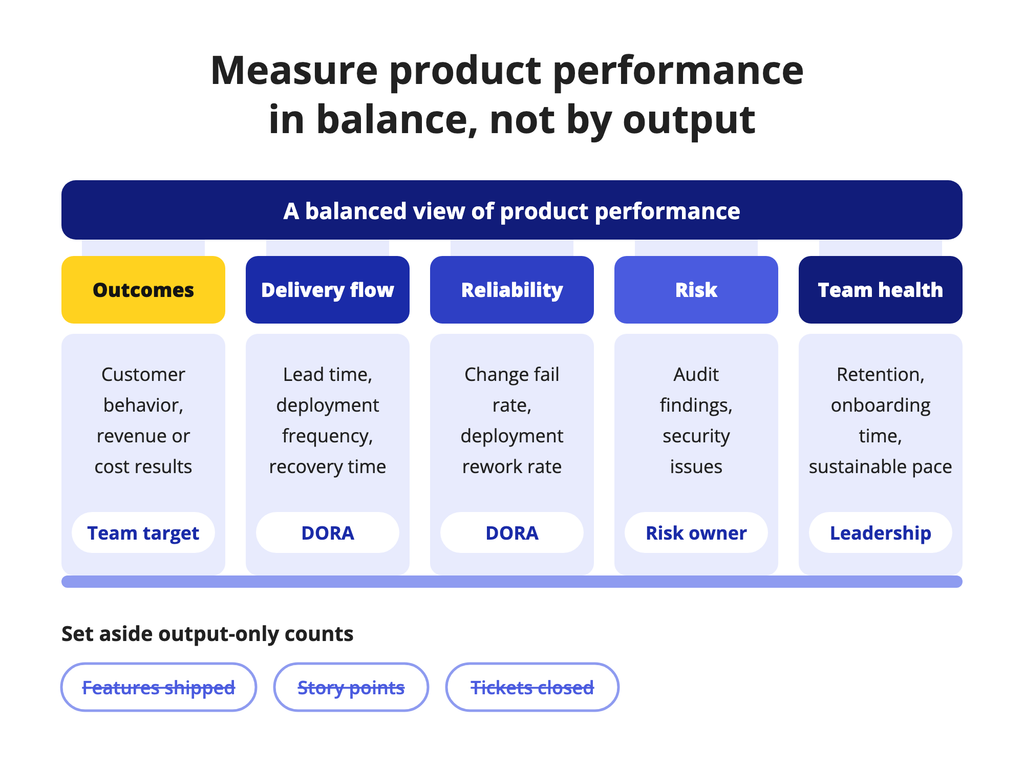
Measure in balance:
- Outcomes: customer behavior, revenue, cost or service results the team targets.
- Delivery flow: DORA tracks change lead time, deployment frequency and failed deployment recovery time [7].
- Reliability: DORA’s change fail rate and deployment rework rate show instability [7].
- Risk and compliance: audit findings, security issues and control exceptions.
- Team health: retention, onboarding time and sustainable pace.
Avoid output-only metrics such as features shipped or story points. They reward activity, not results.
Moving from project-centric delivery to a product operating model
The biggest change is who decides what. Use this before-and-after view to agree decision rights early.
| Decision | Project-centric | Product operating model |
|---|---|---|
| What gets worked on | Steering committee approves project scope | Product leaders set strategy; teams choose solutions to outcome targets |
| How money is allocated | Per project, per business case | Per product or value stream, reviewed on a cadence |
| Who owns results after launch | A run team; the project closes | The same persistent team |
| How scope changes | Change request against a baseline | Team reprioritizes within guardrails |
| How success is judged | On time, on budget, scope delivered | Outcomes, reliability, risk and customer value |
| How work is staffed | People assigned temporarily | Stable teams with dedicated capacity |
Sequence the transition:
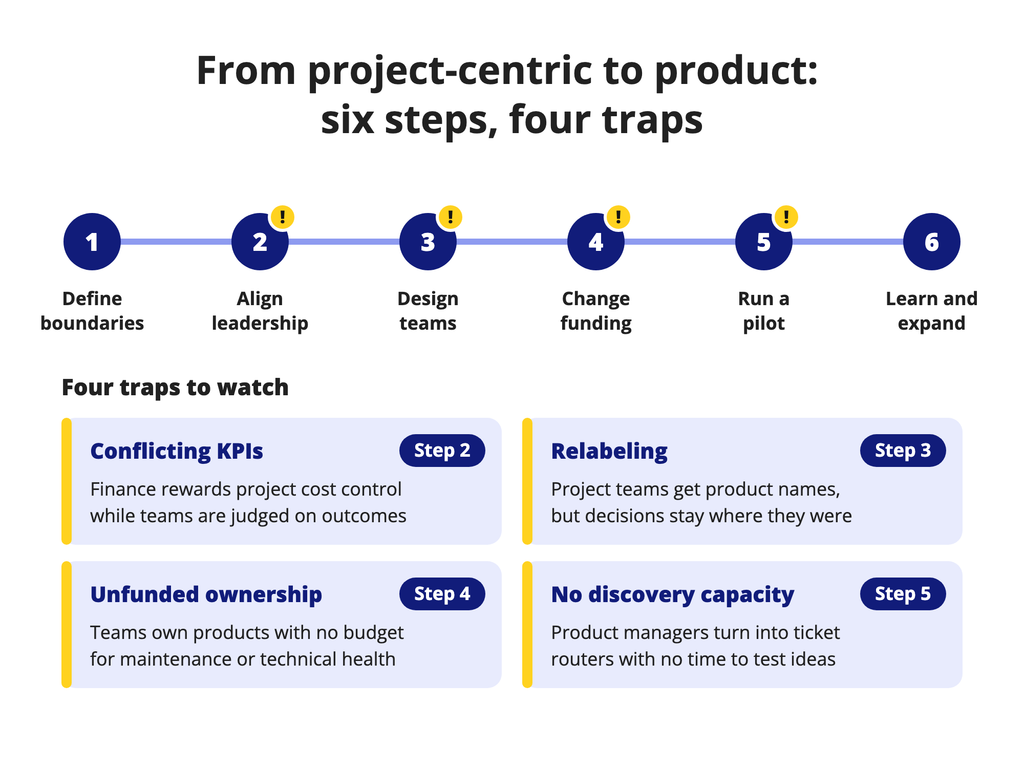
- Define boundaries: map products and value streams, and name an owner for each.
- Align leadership: agree decision rights and funding rules at executive level.
- Design teams: set team topology, including platform and enabling teams.
- Change funding: move the pilot products to a funding envelope with guardrails.
- Pilot: run one or two products for at least two review cycles with baseline measures.
- Learn and expand: fix what broke, then add products in waves.
Watch for four failure modes. Relabeling renames project teams without changing decisions. Unfunded ownership asks teams to own products with no budget for maintenance. No discovery capacity turns product managers into ticket routers. Conflicting KPIs reward finance for project cost control while teams chase outcomes. Many of these are classic digital transformation challenges: leadership habits change more slowly than org charts. In Scrum.org’s survey, portfolio management scored lowest of all areas measured, at 53% effective [1].
When the model fits, and when it needs adaptation
The model fits best where a product or service lives for years and keeps changing: digital channels, internal platforms, data products and software-heavy offerings.
Ask three questions before you convert an area. Will this product or service still exist and change in three years? Can a stable team own most of the work without constant hand-offs? Can you measure an outcome the team can influence? If the answers are mostly no, a product team may add cost without adding value.
It needs adaptation in three situations:
- Temporary initiatives. A one-off migration, an acquisition integration or a facility build has a clear end. Run it as a project, then hand the result to a product team.
- Regulated environments. Banks, health systems and public bodies need separation of duties, documented approvals and audit trails. Build those controls into team workflows and guardrails rather than adding gates outside the team.
- Client and capital projects. Contract-driven work with fixed scope and dates still suits project governance. Persistent teams can own the reusable assets behind those projects.
Treat the product operating model as a design choice. Apply it where durable ownership creates value, and keep project management where bounded delivery is the right answer.
Summary
A product operating model ties strategy, persistent teams, decision rights, funding and outcome measures into one system. Changing only the org chart or the tools rarely works. Start small, make decision rights explicit and measure outcomes alongside reliability and risk. Your next step: pick one product or value stream, name an executive sponsor, write its decision rights and funding guardrails, and record baseline measures before the pilot starts.
FAQs
What is a product operating model?
A product operating model is a way of organizing strategy, teams, funding, governance and measures around durable products and their outcomes. Instead of forming temporary project teams to deliver fixed scope, the organization funds persistent cross-functional teams that own a product area, discover what to build and stay accountable for results after launch.
How is a product operating model different from Agile?
Agile practices describe how teams plan, build and learn in short cycles. A product operating model is broader. It also decides how money is allocated, who owns each product, which decisions teams can make and how leaders judge success. Agile teams can still sit inside project funding, which is why many agile adoptions stall.
How should a company start adopting a product operating model?
Start with a bounded pilot: one or two products or value streams with an executive sponsor. Define the product boundary, write explicit decision rights, set a funding envelope with guardrails and record baseline outcome, delivery and reliability measures. Review results on a fixed cadence, fix what breaks and expand in waves only when the pilot shows evidence.
References
- Unlocking the Agile Product Operating Model (APOM): Addressing the Core Barriers to Value Delivery. Scrum.org, January 2026. Accessed 28 Oct 2026.
- The Product Operating Model: An Introduction. Silicon Valley Product Group, February 10, 2023. Accessed 28 Oct 2026.
- From project to product: The next frontier of value creation. Deloitte Consulting LLP, undated (page copyright 2026). Accessed 28 Oct 2026.
- Key concepts and practices for applying a Team Topologies approach. Team Topologies, undated (site copyright 2021 to 2026). Accessed 28 Oct 2026.
- Lean Budgets. Scaled Agile, Inc., undated. Accessed 28 Oct 2026.
- Service Standard point 6: Have a multidisciplinary team. GOV.UK Service Manual, updated January 29, 2026. Accessed 28 Oct 2026.
- DORA’s software delivery performance metrics. DORA, updated January 5, 2026. Accessed 28 Oct 2026.