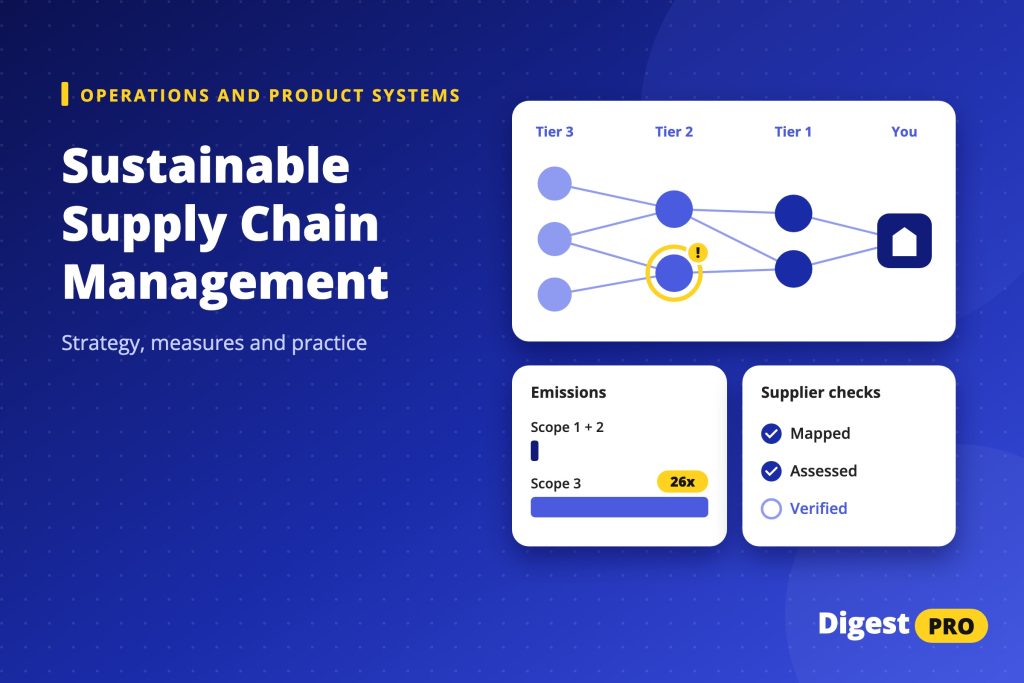
Most of a company’s environmental footprint sits outside its own walls. CDP found that supply chain (scope 3) emissions were on average 26 times greater than operational emissions across more than 23,000 companies that disclosed in 2023, yet only 1 in 4 disclosing companies factored supply chain climate risks into risk management [1].
Sustainable supply chain management brings environmental and social impacts into decisions about sourcing, production, logistics and supplier relationships. It is broader than measuring emissions. You need to know where impacts occur, engage suppliers, prioritize material risks and show progress with reliable evidence.
This guide gives you a practical sequence, explains common measurement boundaries and shows why sector, geography and data quality matter when you compare performance. Regulation in this area is moving fast, so every rule cited here is dated.
Key takeaways
- Sustainable supply chain management covers environmental, labor, human rights and governance impacts, not carbon alone.
- Map tiers and hotspots first. Tier-one visibility is rarely the full picture, so disclose data gaps.
- Supplier questionnaires and certifications are inputs, not proof. Combine them with risk-based due diligence and follow-up.
- Label every metric by data type: supplier-specific, estimated or unknown. Measuring emissions is not the same as reducing them.
- Check rules by jurisdiction and date. The EU narrowed CSRD and CSDDD scope in 2026, and the GHG Protocol is revising its standards.
What is sustainable supply chain management?
Sustainable supply chain management is the discipline of identifying, preventing and reducing the environmental, social and governance impacts linked to how you source, make, move and sell products. It applies across the value chain, from raw materials to end of life, and it runs alongside cost, quality and delivery decisions rather than after them.
Separate the dimensions, because each needs different evidence:
- Environmental: greenhouse gas emissions, water, land use, pollution, waste and materials.
- Labor: wages, working hours, health and safety, and freedom of association.
- Human rights: forced and child labor, community impacts and land rights. The International Labour Organization reports 27.6 million people in forced labor in its 2022 global estimates, with 63% of forced labor in the private economy [8].
- Governance: anti-corruption, transparency, supplier contracts and grievance handling.
Material issues vary. A cocoa buyer, an electronics brand and a construction firm face different hotspots, in different countries, at different stages of the product lifecycle. Start from your own impacts, not a generic checklist.
Map the supply chain and identify material impacts
You cannot manage what you cannot see. Mapping comes first, and it is rarely finished.
- Set boundaries. Decide which business units, product lines and spend categories are in scope, and write the exclusions down.
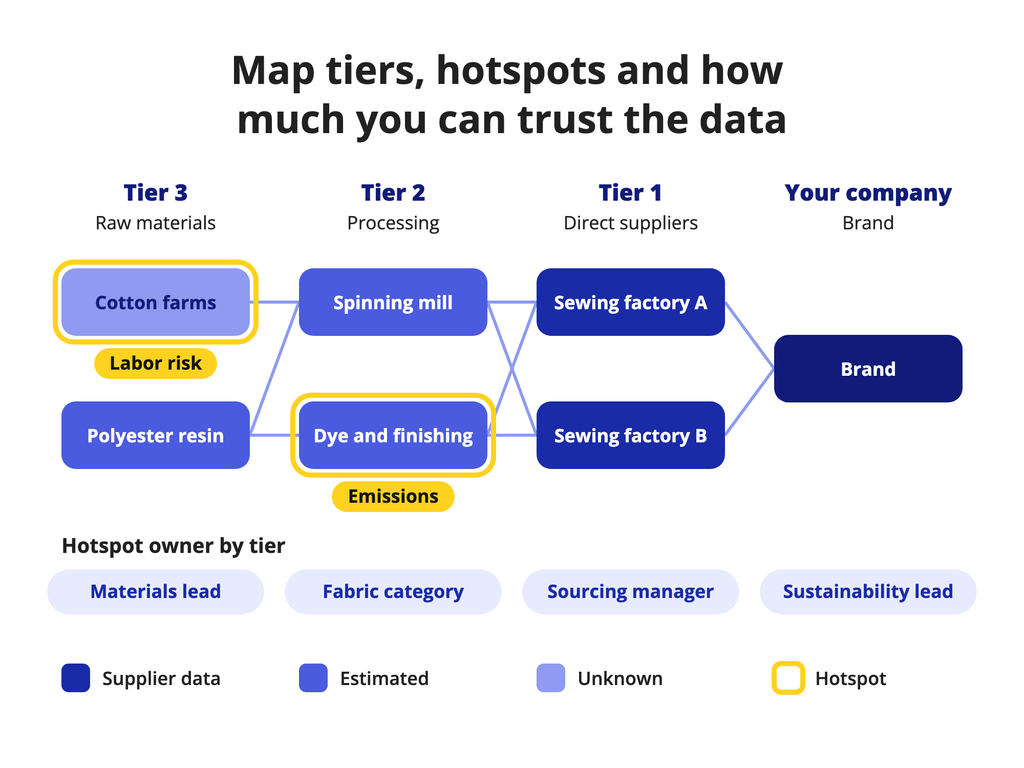
- Map tiers. List tier-one suppliers from procurement data, then trace key materials upstream to processors (tier two) and raw material sources (tier three and beyond).
- Find hotspots. Flag high-impact materials, energy-intensive processes, high-risk geographies and suppliers with past incidents.
- Rate data confidence. For each node, record whether data comes from the supplier, from an estimate or is unknown.
- Name owners. Assign a category manager or sustainability lead to each hotspot.
Use risk-based prioritization. Rank hotspots by severity (scale, scope and how hard the harm is to remedy) and likelihood, then by your leverage and spend. A small supplier of a high-risk mineral may matter more than a large office-supplies vendor. For example, an apparel brand might find that its tier-one sewing factories are well audited, while its largest emissions sit in tier-two dyeing and finishing mills and its most severe labor risks sit in raw fiber at tier three. The map should show that shift, not hide it.
Be honest about gaps. Many companies know their direct suppliers well and their tier-two and tier-three suppliers poorly. Do not assume tier-one data covers the chain. Disclose where your map ends and how you plan to extend it. This also protects you from overstated claims later.
Build supplier engagement and due diligence
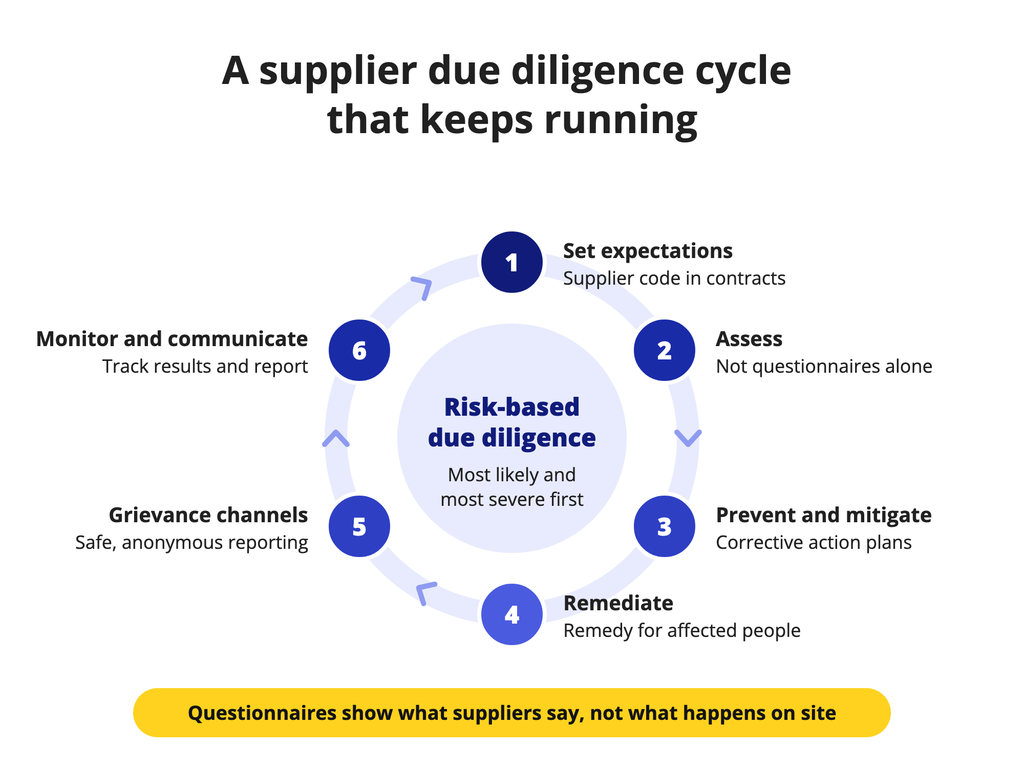
Due diligence turns a map into action. The EU’s Corporate Sustainability Due Diligence Directive (CSDDD) gives one widely referenced structure: identify and address actual and potential adverse human rights and environmental impacts in operations and chains of activities, take measures to prevent, mitigate or bring them to an end, run complaints and notification procedures, and monitor and communicate publicly [6]. After the 2026 amendments, the Commission says companies may focus on areas where impacts are most likely and most severe, based on reasonably available information [6].
Whether or not the directive applies to you, the cycle works:
- Set expectations. Publish a supplier code and build it into contracts, with clear escalation steps.
- Assess. Combine questionnaires with site visits, worker interviews, third-party audits and external risk data. A questionnaire tells you what a supplier says, not what happens on the line.
- Prevent and mitigate. Agree corrective action plans with deadlines. Change your own purchasing practices too, because short lead times and late order changes can push suppliers toward excessive overtime.
- Build capacity. Help suppliers measure emissions or improve health and safety. Incentives matter: CDP found suppliers were 52% more likely to reduce annual emissions when buyers offered financial incentives than when buyers only offered training [1].
- Remediate. When harm occurs, make sure affected people get a remedy. Exit a supplier only as a last resort, as an abrupt exit can leave workers worse off.
- Provide grievance channels. Give workers and communities a safe way to raise concerns, including anonymously.
Certifications help, but they cover defined criteria at a point in time. Treat them as evidence to verify, not as proof of sustainability.
Measure emissions, traceability and social outcomes
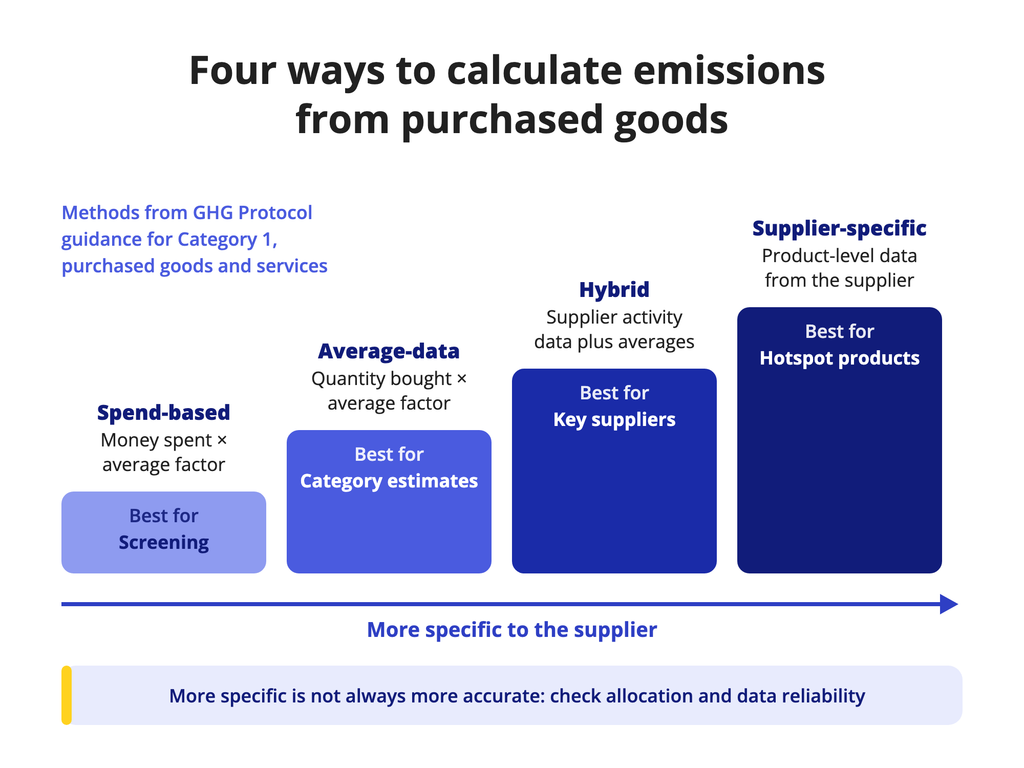
Measurement needs clear boundaries and honest labels on data quality.
Scope 3 emissions. The GHG Protocol Scope 3 Standard, released in 2011, covers 15 categories of upstream and downstream value chain emissions [2]. For purchased goods and services, the GHG Protocol’s calculation guidance describes four methods: supplier-specific (product-level data from suppliers), hybrid (supplier activity data plus secondary data), average-data (quantities times industry-average factors) and spend-based (money spent times industry-average factors) [3]. The guidance also warns that supplier-specific data is not automatically more accurate than industry averages, because allocation and data reliability matter [3]. Start with spend-based screening, then collect supplier data where it changes decisions.
The standards are changing. The GHG Protocol’s July 2026 development plan consolidates the Corporate Standard, Scope 2 Guidance and Scope 3 Standard into one revised standard, with public consultation estimated for Q2 2027 and publication for Q4 2028 [4]. Build inventories that can adapt.
Use a measurement table that keeps dimensions, boundaries and data types visible:
| Dimension | Example indicators | Boundary to state | Data type to label |
|---|---|---|---|
| Environmental | Scope 3 by category, water use in high-stress basins, recycled content | Categories, tiers and sites included | Supplier-specific, average or spend-based |
| Social | Audit findings closed, wage gap to living wage, grievances resolved | Supplier tiers and countries covered | Verified, self-reported or unknown |
| Governance | Share of spend under a supplier code, due diligence coverage, corruption incidents | Spend and supplier segments covered | Contract data, assessed or estimated |
| Traceability | Share of a material traced to origin | Material, volume and origin level | Documented chain of custody or claimed |
Add circularity and product-level measures where they are material, such as repairability, take-back volumes or a product carbon footprint. Data platforms and supplier portals belong to broader digital transformation trends, but software does not replace verification.
Set targets, governance and reporting
Give sustainable supply chain management a clear owner, usually shared between procurement and sustainability, with executive accountability and board oversight. Set baselines before targets, define the target boundary (which categories, tiers and products count) and review progress with suppliers on a fixed cadence. Combine outcome targets, such as absolute or intensity reductions in a category, with engagement targets, such as the share of spend with suppliers that have their own reduction plans. The second type is easier to influence early, but it is not a substitute for the first. Only a small leading group of about 15% of companies target their value chains in emissions reduction efforts, according to CDP [1].
Align every claim with evidence. In the EU, rules against greenwashing applied from 27 September 2026, and the Commission’s retail platform guidance says generic terms such as “eco-friendly” should not be used without recognized certification [9]. Say “estimated” when data is estimated.
Reporting rules depend on jurisdiction, size and date, so check them with counsel. In the EU, the Omnibus I directive was published on 26 February 2026 and entered into force on 18 March 2026, according to the European Parliament [5]. It limits CSRD reporting to EU companies with more than 1,000 employees and over €450 million in net turnover, lets value chain companies with fewer than 1,000 employees refuse information requests beyond voluntary standards, sets CSDDD scope at more than 5,000 employees and €1.5 billion in turnover, and removes the CSDDD climate transition plan obligation [5]. The Commission lists 26 July 2029 as the date CSDDD national measures apply [6], and it adopted delegated acts simplifying the ESRS reporting standards on 3 July 2026 [7]. Large customers may still request your data even if you are out of scope.
A practical implementation roadmap
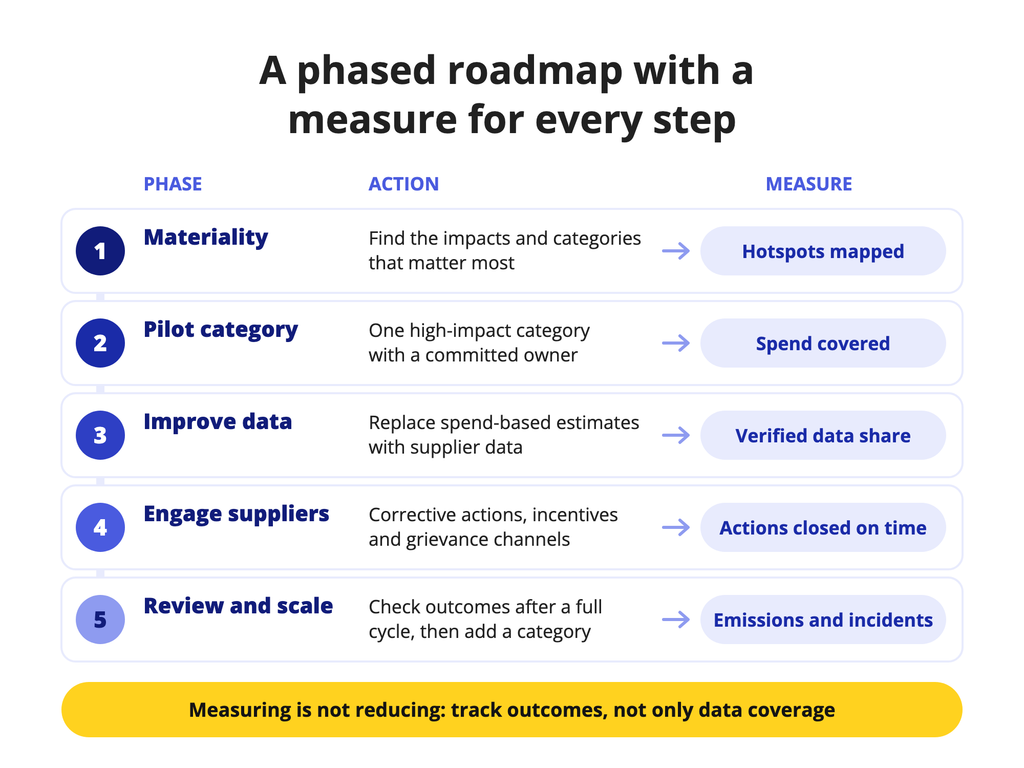
Start narrow and build evidence.
- Materiality: identify the impacts and categories that matter most for your products and regions.
- Pilot category: pick one high-impact category with engaged suppliers and a committed category owner.
- Improve data: move hotspots from spend-based estimates to supplier data, and record confidence levels.
- Engage suppliers: agree expectations, corrective actions and incentives, and open grievance channels.
- Review and scale: check outcomes after a full cycle, fix the process, then extend to the next category.
Run the pilot for at least one full reporting cycle before you scale, so you see whether supplier data arrives on time and corrective actions actually close. Then track four kinds of measures. Coverage: share of spend and of hotspots mapped and assessed. Verified data: share of scope 3 and social data based on supplier-specific or independently verified sources. Corrective actions: share closed on time, and repeat findings. Operational outcomes: emissions intensity, incidents and remediation delivered in the pilot category.
Expect data systems and roles to change along the way. Many of the obstacles are classic digital transformation challenges, such as fragmented supplier data and unclear ownership.
Summary
Sustainable supply chain management means finding where your environmental and social impacts occur, working with suppliers to reduce them and proving progress with evidence you label honestly. Map tiers and hotspots, run risk-based due diligence, measure with stated boundaries and keep claims within what your data supports. Remember that measurement and impact reduction are different things: a better scope 3 inventory does not cut a tonne of emissions on its own. Your next step: choose one high-impact category, map it to tier two, and set baselines for coverage, verified data and corrective actions before you engage suppliers.
FAQs
What is sustainable supply chain management?
Sustainable supply chain management is the practice of identifying, preventing and reducing environmental, social and governance impacts across the value chain, from raw materials to end of life. It combines supply chain mapping, supplier engagement, risk-based due diligence, measurement and continuous improvement, and it treats sustainability as part of sourcing, production and logistics decisions rather than a separate report.
How do companies measure supply chain sustainability?
They choose material indicators for each dimension, such as scope 3 emissions, audit findings closed or share of a material traced to origin. They state the boundary for each metric, label data as supplier-specific, estimated or unknown, and seek independent verification where it matters. There is no single universal score, so compare companies with care.
What is the difference between sustainable sourcing and sustainable supply chain management?
Sustainable sourcing focuses on what you buy and from whom: supplier selection, specifications and purchasing terms. Sustainable supply chain management is broader. It also covers mapping beyond tier one, due diligence, logistics, production, product use and end of life, plus measurement, governance and reporting. Sourcing is one part of the larger management system.
References
- Strengthening the Chain: Industry Insights to Accelerate Sustainable Supply Chain Transformation. CDP, September 25, 2024. Accessed 28 Oct 2026.
- Corporate Value Chain (Scope 3) Standard. GHG Protocol, standard released 2011 (page undated). Accessed 28 Oct 2026.
- Technical Guidance for Calculating Scope 3 Emissions, Category 1: Purchased Goods and Services. GHG Protocol, 2013. Accessed 28 Oct 2026.
- Corporate Standard Version 3.0: Standard Development Plan. GHG Protocol, version 2.0, July 29, 2026. Accessed 28 Oct 2026.
- Omnibus I: simplification of the directives on corporate sustainability reporting (CSRD) and due diligence (CSDDD). European Parliament Legislative Train, updated September 20, 2026. Accessed 28 Oct 2026.
- Corporate sustainability due diligence. European Commission, undated (reflects Directive (EU) 2026/470). Accessed 28 Oct 2026.
- Corporate sustainability reporting. European Commission, updated July 3, 2026. Accessed 28 Oct 2026.
- Forced labour, modern slavery and trafficking in persons. International Labour Organization, undated (2022 global estimates). Accessed 28 Oct 2026.
- New EU rules against greenwashing enter into application on 27 September 2026. EU Retail Platform, European Commission (DG GROW), September 2, 2026. Accessed 28 Oct 2026.