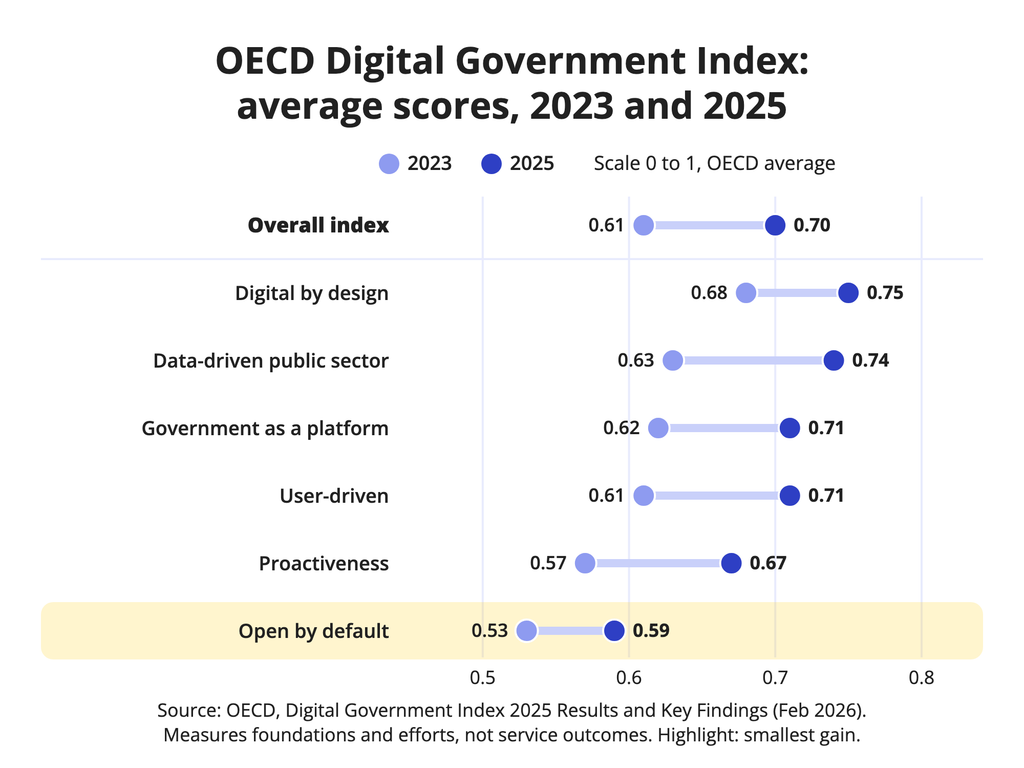
OECD governments raised their average score on the OECD Digital Government Index from 0.61 in 2023 to 0.70 in 2025, on a scale of 0 to 1 [1]. Globally, the UN E-Government Survey 2024 found that the share of the world’s population lagging in digital government fell from 45.0% in 2022 to 22.4% in 2024 [2]. Foundations are improving. Service outcomes are harder to prove.
Government digital transformation is the redesign of public services and internal operations around the needs of people, businesses and public institutions. It takes more than new software. Agencies must deal with accessibility, legacy systems, data sharing, procurement, workforce capability and trust.
This guide lays out a practical public-sector framework, explains the dependencies that make delivery difficult and shows how to measure progress in service outcomes rather than technology installed.
Key takeaways
- Start from the user need and the policy intent, then redesign process, data and technology around them. Putting a paper form online is not transformation.
- Measure public value: task completion, time to service, error rates, channel equity and trust. App downloads and portal visits are not outcomes.
- Modernize legacy systems in stages, behind shared platforms with clear owners for identity, data and payments.
- Use procurement and governance to keep options open: modular contracts, open standards and a named service owner.
- Strategies and legal duties differ by country and agency. Always check the official strategy that applies to you.
What does government digital transformation mean?
Government digital transformation is a change in how public services are designed, delivered and run, enabled by digital capabilities. The Inter-American Development Bank defines it as a change in culture, organizational models, methods and processes that uses technology to help public institutions meet citizens’ and businesses’ needs efficiently, transparently and securely [3]. Its guide groups the work into five areas: governance and institutional framework, legal and regulatory framework, digital talent and change management, infrastructure and technology, and new digital processes and services [3].
The key distinction is between digitizing a form and redesigning a service. Digitizing moves the same questions online. People still upload documents the government already holds, and staff still check them by hand. Redesigning starts from what the person is trying to achieve and what the policy is meant to deliver, then removes steps that serve neither.
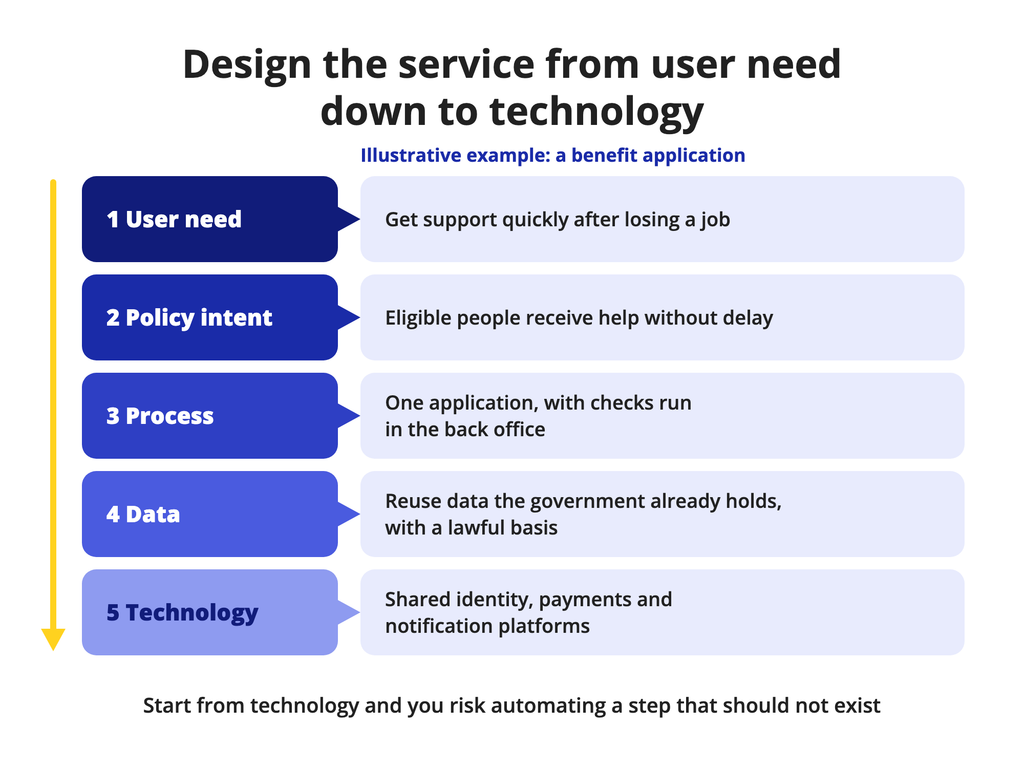
Work through the layers in order: user need, policy intent, process, data, then technology. When teams start from technology, they often automate a process that should not exist.
Take an illustrative benefit application. The user need is to get support quickly after losing a job. The policy intent is that eligible people receive help without delay. The process becomes one application with checks run in the back office. The data layer reuses information the government already holds, with a lawful basis. Only then does technology come in: shared identity, payments and notifications.
For the broader cross-sector picture, see our overview of digital transformation trends. This guide covers the public-sector application.
Public-service outcomes and design principles
Good digital public services share a few principles. The OECD frames digital government around six dimensions, including being digital by design and data-driven, and calls for using technology and data across the whole policy and service life cycle, from design to evaluation [4]. National standards turn this into practice. The UK Service Standard, for example, has 14 points, from “Understand users and their needs” to “Operate a reliable service” [5].
Build these principles into every service:
- Accessibility and inclusion. Design for people with disabilities and low digital skills. WCAG 2.2, the W3C accessibility Recommendation, organizes requirements around content that is perceivable, operable, understandable and robust [6].
- User-centered design. Research with real users, including those who struggle most. Solve the whole problem, not one form [5].
- Privacy and security. Build services that are secure and protect users’ privacy [5].
- Transparency. Define what success looks like and publish performance data [5].
- Reliability. Operate the service so people can depend on it, including at peak demand [5].
- Multi-channel access. Keep phone, mail and in-person routes for people who need them, joined up with the digital channel [5].
Inclusion gaps are real. The UN survey reports that digital government averages for the African region, least developed countries and small island developing states remain below the global average [2].
Openness also lags. In the OECD index, the “open by default” dimension improved least between 2023 and 2025, from 0.53 to 0.59 [1]. Remember what the index measures: government efforts to build foundations, reported through a survey of senior digital government officials in 36 OECD countries and six accession countries [1]. It is not a measure of service outcomes.
Modernize legacy systems and data responsibly
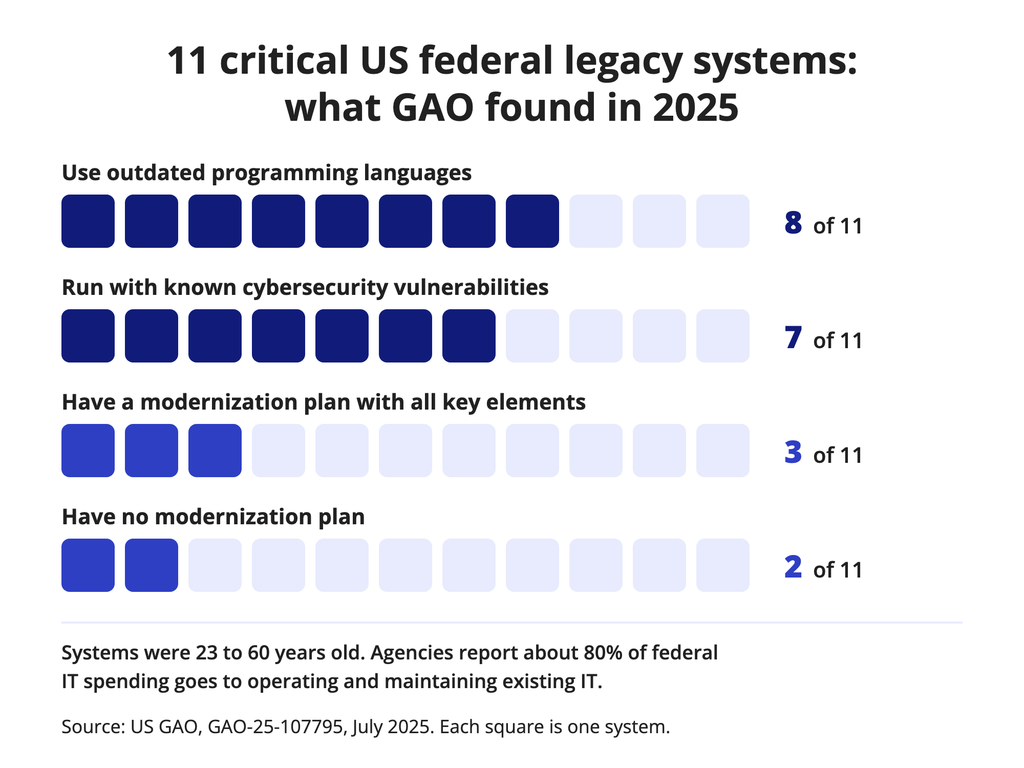
Legacy systems carry many public services, and they are expensive to keep alive. In July 2025, the US Government Accountability Office identified 11 federal legacy systems most in need of modernization, between 23 and 60 years old [7]. Eight used outdated programming languages, seven were running with known cybersecurity vulnerabilities, and only three had modernization plans with all key elements [7]. GAO also notes that agencies typically report about 80% of IT spending going to operating and maintaining existing systems [7].
Modernize in stages, and treat these areas as one program:
- Interoperability. Agree data standards and APIs so services can share information without manual transfers. In the EU, the Interoperable Europe Act entered into force on 11 April 2024. It introduces mandatory interoperability assessments when administrations change IT systems and digital services, with a focus on cross-border public services [8].
- Identity. A trusted digital identity lets people prove who they are once and reuse that proof across services.
- Data standards and ownership. Name an owner for each core data set, define quality rules and record the legal basis for sharing.
- Legacy dependencies. Map which services depend on which systems before you switch anything off.
- Cybersecurity. Build security into new services and reduce known vulnerabilities in old ones.
- Records management. Public records must stay retrievable and lawful after migration.
Sequence the work by risk and volume. Put a new front end and APIs in front of the old system, move one function at a time and retire each legacy component only when the new path has run reliably at full load. Keep a rollback plan for every cutover.
Shared platforms for identity, payments, notifications and forms can save effort across agencies. They need clear ownership, funding and service levels. A shared platform without an accountable owner becomes another legacy system.
Procurement, governance and delivery models
Procurement shapes what agencies can build. Large, long contracts that bundle design, build and operation make it hard to change course. Smaller, modular contracts with clear exit terms let teams test and switch suppliers.
Write requirements as user outcomes and service levels, not long feature lists. Keep enough technical and product expertise in-house to challenge supplier designs, own the architecture and take over work when a contract ends.
Reduce vendor lock-in with open standards, common components and data you can export. The UK Service Standard asks teams to make new source code open and to use and contribute to open standards, common components and patterns [5].
Governance needs to match how services cross agency lines:
- Cross-agency governance. Agree who decides on shared data, shared platforms and service boundaries.
- Service ownership. Name one owner accountable for each service end to end, not only for the systems behind it.
- Delivery model. Use multidisciplinary teams and agile, iterative delivery, as the UK standard recommends [5]. Release small changes, learn from users and improve.
- Legal and regulatory fit. Check whether laws require paper, wet signatures or in-person steps that block redesign.
Use published frameworks as guides, not universal mandates. The IDB’s five areas and the OECD dimensions are helpful checklists [3][4]. Your binding rules come from your own jurisdiction’s laws, procurement regulations and digital strategy.
Build a measurable government digital transformation roadmap
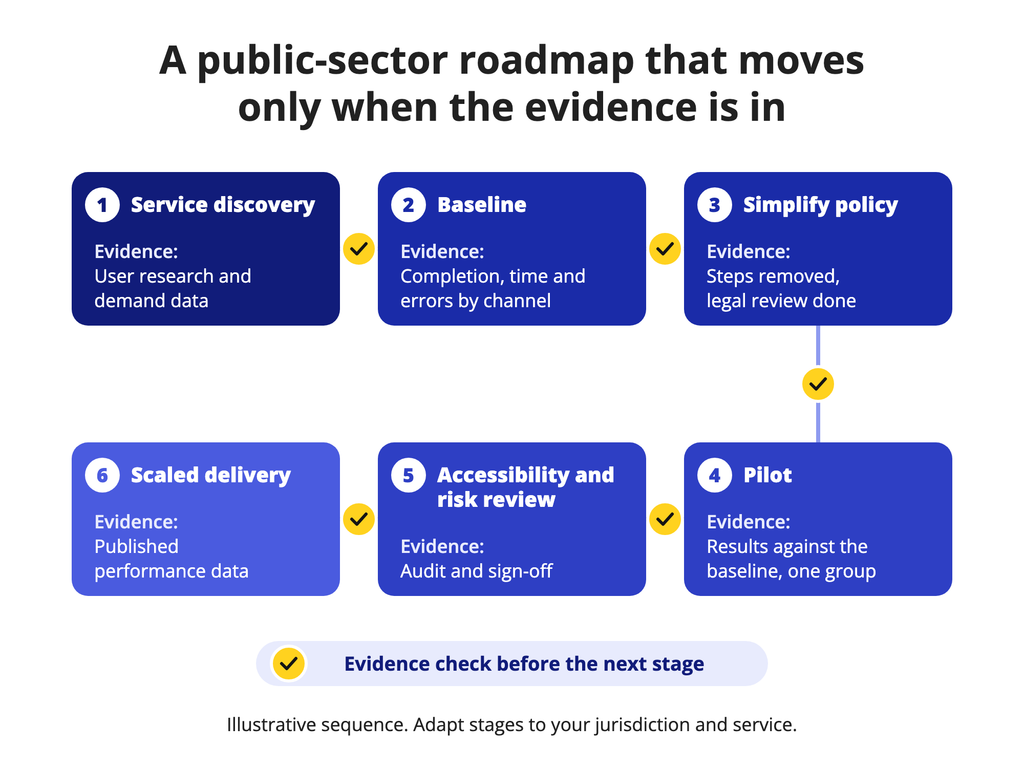
Sequence the work so every stage produces evidence:
| Stage | Accountable role | Public outcome | Evidence |
|---|---|---|---|
| Service discovery | Service owner | Clear user need and policy intent | User research, demand data |
| Baseline | Performance lead | Current completion, time and error rates | Measured baseline by channel |
| Policy and process simplification | Policy owner | Fewer steps and documents | Removed requirements, legal review |
| Pilot | Delivery team | Better results for a defined group | Pilot metrics against baseline |
| Accessibility and risk review | Accessibility, security and privacy leads | Service usable and safe for all | Audit results, risk sign-off |
| Scaled delivery | Service owner | Outcomes hold at full volume | Published performance data |
Track a small set of measures:
- Task completion: share of people who finish the task.
- Time to service: days from application to decision or delivery.
- Error rates: rejected applications, corrections and appeals.
- Channel equity: outcomes by channel and user group, so offline users are not left behind.
- User trust: satisfaction and confidence in how data is used.
Run pilots with a defined user group and compare results against the baseline, including people who use phone or in-person channels. Review service measures monthly and the wider portfolio quarterly, so funding follows evidence.
Publish results where you can. Public reporting builds accountability and shows whether changes help the people they target [5].
Common barriers and how to address them
Most public-sector programs hit the same barriers. Pair each one with an owner and a mitigation:
| Barrier | Accountable owner | Practical mitigation |
|---|---|---|
| Siloed budgets | Finance ministry and program sponsors | Fund services and shared platforms, not single-agency projects |
| Skills gaps | Chief digital officer and HR | Build in-house product, design and data roles; pair them with suppliers |
| Legacy procurement | Procurement lead | Modular contracts, exit terms and open standards |
| Weak data ownership | Data owner per data set | Named owners, quality rules and sharing agreements |
| Change fatigue | Service owner and frontline managers | Release small improvements and show staff the results |
For a general list of transformation obstacles, see our guide to digital transformation challenges. In government, the difference is accountability: every barrier sits inside a public budget, a legal mandate and a duty to serve everyone.
Summary
Government digital transformation succeeds when services change around user needs and policy intent, not when new systems go live. Apply inclusive design principles, modernize legacy systems in stages behind owned platforms, use procurement to keep options open and measure public outcomes against a baseline. Your next step: pick one high-volume service, map it from user need to technology and set its baseline before you commission anything new.
FAQs
What is digital transformation in government?
It is the redesign of public services and internal operations around the needs of people and businesses, enabled by digital capabilities. It covers service design, policy and process simplification, data sharing, technology and workforce skills. Putting an existing form online is digitization. Transformation changes how the service works, so people get the right outcome with less effort and fewer errors.
What is the government’s strategy for digital transformation?
There is no single strategy. Each country, and often each agency, publishes its own, shaped by its laws, institutions and priorities. Look for your national digital strategy, your service standard and your agency’s plan. International frameworks such as the OECD’s six dimensions and the IDB’s five areas can help you compare approaches, but they do not replace official national policy [3][4].
How can governments measure digital transformation?
Measure service outcomes: task completion, time to service, error rates, channel equity and user trust. Add operational reliability and accessibility results. Set a baseline before changes, segment results by user group and channel, and publish performance data so the public can hold agencies accountable. Indexes such as the OECD’s measure foundations and efforts, not the outcomes of individual services.
References
- Digital Government Index and Open, Useful and Re-usable Data Index: 2025 Results and Key Findings. OECD Working Papers on Public Governance, OECD, 16 Feb 2026. Accessed 28 Oct 2026.
- UN E-Government Survey 2024. United Nations Department of Economic and Social Affairs, Sep 2024. Accessed 28 Oct 2026.
- Government Digital Transformation Guide. Inter-American Development Bank (Cubo, Hernández Carrión, Porrúa, Roseth), Aug 2022. Accessed 28 Oct 2026.
- Digital government. OECD, topic page, accessed version. Accessed 28 Oct 2026.
- Service Standard. UK Government Digital Service, GOV.UK Service Manual, undated page. Accessed 28 Oct 2026.
- Web Content Accessibility Guidelines (WCAG) 2.2. World Wide Web Consortium, W3C Recommendation, 12 Dec 2024 version. Accessed 28 Oct 2026.
- Information Technology: Agencies Need to Plan for Modernizing Critical Decades-Old Legacy Systems (GAO-25-107795). US Government Accountability Office, 17 Jul 2025. Accessed 28 Oct 2026.
- Interoperable Europe Act. European Commission, Interoperable Europe Portal, accessed version. Accessed 28 Oct 2026.