
The biggest digital transformation trends for 2027 are less about new technology and more about how companies change the way they work. AI is moving from pilots into daily operations, and AI agents are starting to run whole workflows. Data has to be AI-ready before any of that pays off. Cloud strategy is shifting toward sovereignty and regional control. And planning itself is becoming continuous, because annual roadmaps rarely survive the first quarter. The pressure is real: Gartner found that only 48% of digital initiatives meet or exceed their business targets. Below are the 10 shifts we expect to define digital transformation in 2027, the data behind each one, and where to start.
Executive Summary
These are the latest digital transformation trends in five points. The common thread: a move from one-off projects to a permanent operating discipline.
- AI moves from experiments to the operating model. Only 44% of organizations are scaling AI enterprise-wide (McKinsey, 2026).
- Agentic AI and multiagent systems start replacing task-level automation, though only 17% of organizations have deployed agents (Gartner).
- AI-ready data becomes the gating factor. Gartner predicts organizations will abandon 60% of AI projects unsupported by AI-ready data.
- Sovereign cloud and geopatriation reshape infrastructure decisions, especially in Europe and the Middle East.
- Funding shifts from projects to outcomes, with continuous reprioritization replacing the annual planning cycle.
What Is Digital Transformation in 2027?
Digital transformation is the ongoing redesign of how an organization creates value using data, software, and AI. In 2027, it is less a project with an end date than an operating model: strategy, processes, skills, and funding are continuously reshaped as technology and markets change.
It helps to separate three terms. Digitization converts analog information into digital form. Digitalization uses digital tools to improve existing processes. Transformation changes the business model, the operating model, or both.
Most frameworks describe five pillars that have to move together:
- Strategy: which business outcomes technology must change.
- Customer experience: journeys built around real customer behavior.
- Data: governed, accessible, and fit for AI.
- Technology: modern, secure, integrated platforms.
- People and culture: skills, incentives and leadership that make change stick.
What Changed in 2026
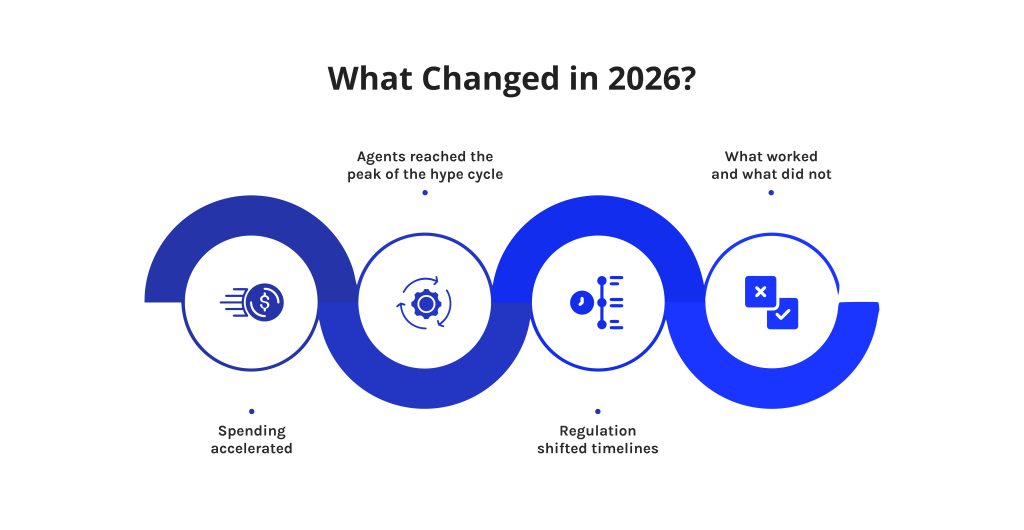
2026 was the year AI spending surged while results lagged. Budgets grew at the fastest rate in decades, AI agents hit peak hype, and Europe delayed parts of its AI rulebook. The organizations that pulled ahead were the ones that redesigned workflows and pivoted plans mid-year, not those that simply bought more technology.
Spending accelerated. Gartner’s July 2026 forecast puts worldwide IT spending at $6.37 trillion in 2026, up 14.2% from 2025. Data center systems are growing 62.5%, driven by AI infrastructure. Gartner separately forecasts AI spending of $2.52 trillion in 2026, a 44% increase, while placing AI in the Trough of Disillusionment throughout the year.
Agents reached the peak of the hype cycle. Gartner’s first standalone Hype Cycle for Agentic AI (April 2026) places agentic AI at the Peak of Inflated Expectations. Only 17% of organizations had deployed AI agents, but more than 60% expect to within two years.
Regulation shifted timelines. The EU’s AI Omnibus entered into force on July 27, 2026. It moves rules for stand-alone high-risk AI systems to December 2, 2027, and for high-risk AI embedded in regulated products to August 2, 2028.
What worked and what did not. The share of companies reporting EBIT impact from AI was flat at 37% (McKinsey, August 2026). Roughly 6% of high performers redesigned workflows around AI instead of bolting it onto existing ones.
Top 10 Digital Transformation Trends for 2027
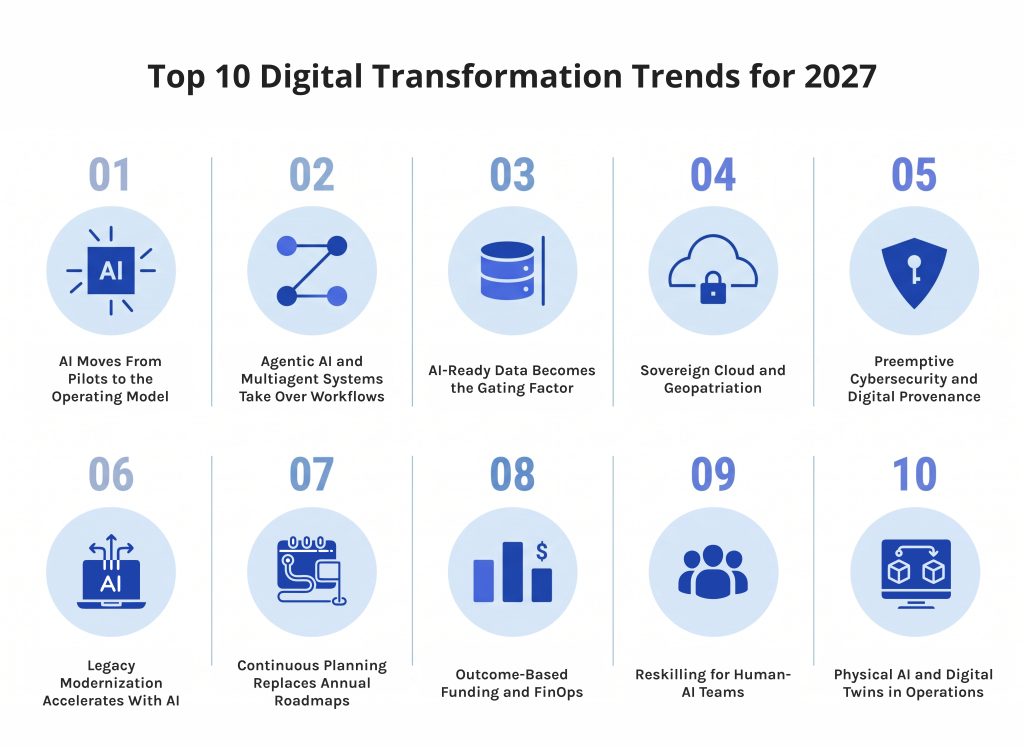
The ten shifts for 2027 are AI scaled into the operating model, agentic and multiagent systems, AI-ready data, sovereign cloud, preemptive cybersecurity and digital provenance, AI-accelerated legacy modernization, continuous planning, outcome-based funding, reskilling for human-AI teams, and physical AI with digital twins.
1. AI Moves From Pilots to the Operating Model
What’s happening. Nearly nine in ten organizations use AI regularly in at least one business function, according to McKinsey’s State of AI 2026 survey (1,719 respondents, fielded May to June 2026). But only 44% say AI is scaling across the enterprise, up from 38% a year earlier. Just 37% attribute any EBIT impact to AI.
Why it matters. The gap between usage and financial impact is now the central problem. Individual productivity gains (80% of respondents report them) do not add up to enterprise value unless workflows, roles and decision rights change.
What to do in 2027: Pick two or three end-to-end workflows, redesign them around AI from scratch, and attach a financial target to each before funding the build. For the wider technology picture, see our AI trends for 2027.
2. Agentic AI and Multiagent Systems Take Over Workflows
What’s happening. Gartner lists multiagent systems among its Top Strategic Technology Trends for 2026: collections of AI agents that interact to achieve individual or shared goals. Adoption is uneven. McKinsey reports that about two in ten organizations are scaling AI agents, with large companies (over $1 billion in revenue) at 40%, up from 27% a year earlier.
Why it matters. Agents shift automation from tasks to outcomes, and the risk profile changes too. Gartner predicts that over 40% of agentic AI projects will be canceled by the end of 2027 due to escalating costs, unclear business value or inadequate risk controls.
What to do in 2027: Deploy agents where the cost of error is bounded, with permissions, budget, and escalation path defined upfront. More in our analysis of agentic AI trends.
“To get real value from agentic AI, organizations must focus on enterprise productivity, rather than just individual task augmentation,” said Anushree Verma, Senior Director Analyst, Gartner.
3. AI-Ready Data Becomes the Gating Factor
What’s happening. In a July 2024 survey of 1,203 data management leaders, 63% of organizations said they either lack or are unsure whether they have the right data management practices for AI. Gartner predicts that through 2026, organizations will abandon 60% of AI projects unsupported by AI-ready data (Gartner, February 2025).
Why it matters. Traditional data governance was built for reporting: structured, slow and centralized. AI needs data representative of each use case, including errors and outliers, with metadata that proves fitness for purpose. Without it, projects stall at proof of concept regardless of model quality.
What to do in 2027: Define “AI-ready” per use case, not per data domain, and fund metadata, observability and governance as a continuous practice, not a one-time cleanup.
“If the data has issues, then the data is not ready for AI.” — Roxane Edjlali, Senior Director Analyst, Gartner.
4. Sovereign Cloud and Geopatriation
What’s happening. Geopatriation, moving data and applications from global public clouds to sovereign, regional or on-premises options because of geopolitical risk, is a Gartner Top Strategic Technology Trend for 2026. Gartner forecasts sovereign cloud IaaS spending of $80 billion in 2026, up 35.6%, with Europe set to overtake North America in 2027. In IBM’s 2026 CEO Study (2,000 CEOs), 83% agree AI sovereignty is essential to business strategy.
Why it matters. Vendor and region choices are now strategic risk decisions. Gartner’s CIO Agenda 2026 found that CIOs who proactively manage geopolitical and vendor risk are 51% more likely to outperform, yet only 28% do.
What to do in 2027: Classify workloads by sovereignty exposure and build an exit plan for the most sensitive ones. We cover the infrastructure side in our cloud computing trends analysis.
“To compete for local customers’ cloud business, large cloud providers must seriously acknowledge the sovereignty concerns and requirements per country, and act accordingly. Solely treating digital sovereignty as a pure security, regulatory and compliance topic is not enough,” Rene Buest, Senior Director Analyst, Gartner.
5. Preemptive Cybersecurity and Digital Provenance
What’s happening. Three of Gartner’s ten 2026 technology trends are about trust: preemptive cybersecurity, digital provenance and AI security platforms. Gartner forecasts that by 2030, preemptive solutions will account for half of all security spending. It also predicts that by 2028, over 50% of enterprises will use AI security platforms.
Why it matters. AI-generated content, open-source code and autonomous agents widen the attack surface faster than reactive defenses can respond. Digital provenance (verifying the origin and integrity of software, data and media) becomes a compliance issue: Gartner warns underinvestors could face sanction risks running into billions of dollars by 2029.
What to do in 2027: Inventory every AI system and agent in use, including shadow AI, and require provenance records for AI-generated assets that reach customers or regulators.
6. Legacy Modernization Accelerates With AI
What’s happening. AI-native development platforms, another Gartner 2026 trend, use generative AI to build and rewrite software faster. Gartner predicts that by 2030 these platforms will lead 80% of organizations to evolve large software engineering teams into smaller, AI-augmented teams. McKinsey’s 2026 survey adds a telling signal: 32% of organizations decided against buying at least one software product because they could build it internally with agentic coding tools.
Why it matters. Technical debt is the main brake on AI integration: agents cannot act on systems they cannot reach through clean interfaces. Cheaper code generation changes the build-versus-buy math and makes rewriting brittle legacy components viable.
What to do in 2027: Rank legacy systems by how much they block priority AI workflows, then modernize the top blockers first. See our guide to legacy system modernization.
7. Continuous Planning Replaces Annual Roadmaps
What’s happening. According to Gartner’s 2026 CIO and Technology Executive Survey, 94% of CIOs expect major changes to their plans and outcomes within the next 24 months. Only 18% practice dynamic, off-cycle reprioritization, yet those who do are 24% more likely to be top performers.
Why it matters. An annual roadmap assumes stable priorities and stable capacity. Neither holds. The binding limit is rarely budget; it is a few shared, overloaded teams. When too many initiatives run in parallel, multitasking stretches every timeline and the cost of delay compounds across the portfolio. Continuous planning means re-sequencing work around those constrained resources when a trigger fires, not when the calendar says so.
What to do in 2027: Add defined triggers (a market shift, a missed milestone, a new regulation) that force reprioritization between quarterly reviews, and set work-in-progress limits on your most constrained teams. Related reading: project management trends.
“Technology leaders face a pivotal year in 2026, where disruption, innovation, and risk are expanding at unprecedented speed,” said Gene Alvarez, Distinguished VP Analyst at Gartner.
8. Outcome-Based Funding and FinOps
What’s happening. Gartner found that only 48% of digital initiatives meet or exceed their business outcome targets (2025 CIO and Technology Executive Survey, 3,186 CIOs in 88 countries). The CIO Agenda 2026 adds that only 33% of CIOs consistently pursue financial outcomes from technology initiatives, while those who do are 25% more likely to excel.
Why it matters. Project-based funding rewards delivery against scope and date, not value. With about 20% of McKinsey’s 2026 respondents saying AI operating costs already constrain usage, CFOs want continuous evidence of return. Funding moves to persistent teams with outcome metrics, and FinOps extends from cloud to AI.
What to do in 2027: Fund your top initiatives in tranches released against measured outcomes, and put AI consumption costs on the same dashboard as the value they create. For why initiatives miss, see digital transformation challenges.
9. Reskilling for Human-AI Teams
What’s happening. CEOs surveyed for IBM’s 2026 CEO Study expect 29% of employees to need reskilling for a different role and 53% to need upskilling between 2026 and 2028. Yet they say only 25% of the workforce uses AI regularly in their jobs, even though 86% believe employees have the skills to collaborate with AI.
Why it matters. The adoption bottleneck is behavioral, not technical. Tools rolled out without redesigned roles, incentives and manager support produce low usage and no measurable return.
What to do in 2027: Tie reskilling budgets to the specific workflows being redesigned, and measure regular AI use per role rather than license counts. Useful starting points: change management tools and change management challenges.
10. Physical AI and Digital Twins in Operations
What’s happening. Physical AI, intelligence in machines that sense, decide and act (robots, drones, smart equipment), is on Gartner’s 2026 trends list. Digital twins, virtual models of assets and plants, are where those machines are planned and tested.
Why it matters. Physical AI moves transformation to the shop floor and the warehouse, where safety, uptime and capacity are hard numbers. Twins let leaders test changes to layout, schedules or staffing before committing capital. Gartner notes this requires new skills bridging IT, operations and engineering.
What to do in 2027: Choose one constrained physical process (a bottleneck line, a congested dock) and build a twin to test interventions before scaling automation. Read our guide to digital twins for planning and forecasting.
Digital Transformation Trends by Industry
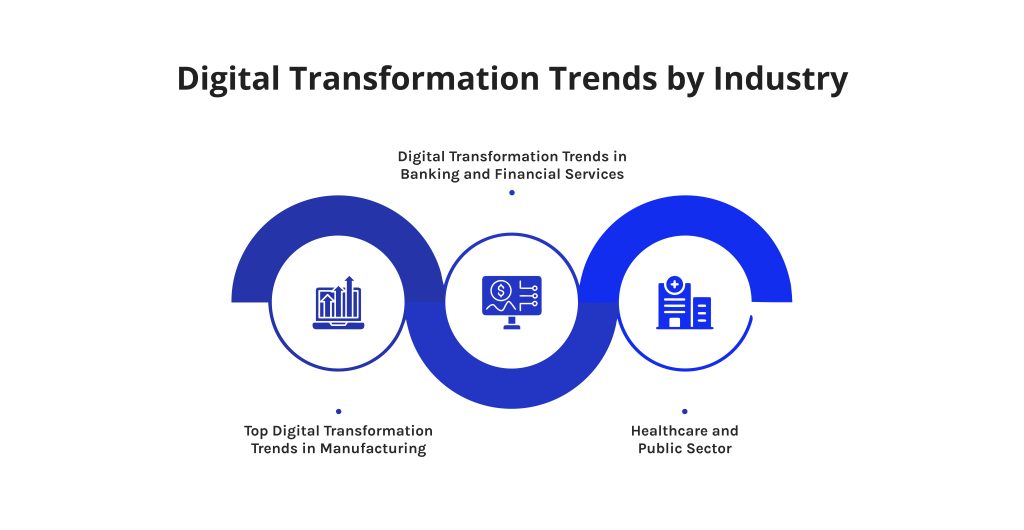
The same ten shifts play out differently by sector. Manufacturing leads on physical AI and digital twins, banking on agents under tight regulation, and healthcare and the public sector on sovereignty and compliance. Regulatory calendars, especially the EU AI Act, set the pace as much as technology does.
Top Digital Transformation Trends in Manufacturing
Manufacturing’s agenda for 2027 centers on three areas. Physical AI brings robots and smart equipment that adapt rather than repeat. Digital twins model lines and plants so engineers can test schedule and layout changes virtually. Predictive maintenance shifts from dashboards to agents that schedule interventions on their own.
The practical constraint is rarely sensors; it is scarce engineering capacity shared across many concurrent projects, and twins pay off fastest when used to plan around those bottlenecks. Under the AI Omnibus, high-risk AI embedded in regulated products such as machinery falls under AI Act rules from August 2, 2028. See our digital twins guide.
Digital Transformation Trends in Banking and Financial Services
Banks are moving AI agents into credit operations, fraud, reconciliation and finance close, where workflows are rules-heavy and well documented. The constraint is regulation: credit scoring is among the high-risk uses listed in the AI Act, and rules for stand-alone high-risk systems now apply from December 2, 2027. That gives institutions a defined window to build governance and audit trails.
Core banking modernization runs in parallel, because agents need clean APIs into legacy cores. Our analysis of AI agents in finance covers use cases in depth.
Healthcare and Public Sector
Healthcare focuses on documentation and diagnostics support, with AI-enabled medical devices under AI Act high-risk rules from August 2, 2028. In the public sector, governments remain the main buyers of sovereign cloud, according to Gartner.
How to Prioritize These Trends in Your 2027 Roadmap
Do not pursue all ten trends at once. Pick no more than three priorities for 2027 based on your binding constraint: data, skills, regulation or delivery capacity. Fund each with a 90-day first step and a measurable outcome, and revisit the choice at every quarterly or trigger-based review.
The most common failure mode is starting too much. Every additional initiative competes for the same architects, data engineers and business experts, so ten parallel programs typically deliver less than three focused ones. The table maps the main trends in digital transformation to who should prioritize them and a realistic first step.
| Trend | Priority for | First step in 90 days |
|---|---|---|
| AI in the operating model | All enterprises with AI pilots | Select 2 to 3 workflows and set financial targets |
| Agentic and multiagent systems | Service-heavy and back-office operations | Define agent permissions, budgets and escalation rules |
| AI-ready data | Any organization scaling AI | Assess data readiness for the top 3 AI use cases |
| Sovereign cloud | EU, Middle East, regulated sectors | Classify workloads by sovereignty risk |
| Preemptive security and provenance | Regulated and IP-intensive firms | Inventory all AI systems, including shadow AI |
| Legacy modernization | Firms with old cores and ERPs | Rank legacy systems by AI blockage |
| Continuous planning | Organizations with many parallel initiatives | Set reprioritization triggers and WIP limits |
| Outcome-based funding | CFO-led and margin-pressured firms | Move top initiatives to tranche funding |
| Reskilling | Large workforces with low AI use | Measure regular AI use by role |
| Physical AI and digital twins | Manufacturing, logistics, energy | Model one bottleneck process |
If two trends compete for the same scarce team, sequence them rather than running them in parallel. For the obstacles that typically derail these programs, see our guide to digital transformation challenges.
The Future of Digital Transformation Beyond 2027
The future of digital transformation is a permanent cycle of redesigning work around AI, data and shifting priorities. Gartner’s forecasts point to 2028 to 2030 as the period when agents make routine decisions, software teams shrink, and sovereign infrastructure becomes the default in Europe and the Middle East.
Gartner predicts that at least 15% of day-to-day work decisions will be made autonomously through agentic AI by 2028, up from 0% in 2024, and that 33% of enterprise software applications will include agentic AI by then.
By 2030, Gartner predicts that more than 75% of European and Middle Eastern enterprises will geopatriate virtual workloads, up from less than 5% in 2025. It also forecasts that preemptive solutions will take half of security spending.
The human role shifts toward judgment: setting goals for agents, deciding trade-offs between competing priorities, and owning outcomes.
Our Methodology
This analysis uses only primary sources published from 2024 onward: Gartner research and forecasts, McKinsey’s State of AI 2026, IBM Institute for Business Value’s 2026 CEO Study, and the European Commission (full list in References).
Every figure was checked against the original source page on October 7, 2026, including wording, date and sample. Forecasts are labeled as forecasts. We excluded widely circulated statistics we could not trace to a primary source.
Trends were selected by cross-referencing analyst technology lists with CIO survey priorities, filtered for operating model impact rather than novelty. Gartner’s full 2026 list (AI-native development platforms, AI supercomputing platforms, confidential computing, multiagent systems, domain-specific language models, physical AI, preemptive cybersecurity, digital provenance, AI security platforms and geopatriation) informed six of our ten trends.
Key Takeaways
- The defining digital transformation trends for 2027 concern how work is organized, not which technology is bought.
- Only 48% of digital initiatives meet business targets (Gartner); co-ownership between CIOs and business leaders lifts that to 71% for the Digital Vanguard.
- AI usage is widespread, but only 37% of organizations see EBIT impact (McKinsey, 2026). Workflow redesign separates the leaders.
- AI-ready data, agent governance and sovereignty are prerequisites, not follow-ups.
- Continuous, trigger-based planning beats annual roadmaps: off-cycle reprioritizers are 24% more likely to be top performers.
- Limit 2027 to three priorities and sequence work around your scarcest teams.
References
- Gartner. “Gartner Identifies the Top Strategic Technology Trends for 2026.” October 20, 2025. https://www.gartner.com/en/newsroom/press-releases/2025-10-20-gartner-identifies-the-top-strategic-technology-trends-for-2026
- Gartner. “Strategic Pivots Will Define the CIO’s Agenda in 2026” (The CIO Agenda 2026). November 25, 2025. https://www.gartner.com/en/articles/cio-agenda
- Gartner. “Gartner Survey Reveals That Only 48% of Digital Initiatives Meet or Exceed Their Business Outcome Targets.” October 22, 2024. https://www.gartner.com/en/newsroom/press-releases/2024-10-22-gartner-survey-reveals-that-only-48-percent-of-digital-initiatives-meet-or-exceed-their-business-outcome-targets
- Gartner. “What the 2026 Hype Cycle for Agentic AI Reveals.” April 15, 2026. https://www.gartner.com/en/articles/hype-cycle-for-agentic-ai
- Gartner. “Lack of AI-Ready Data Puts AI Projects at Risk.” February 26, 2025. https://www.gartner.com/en/newsroom/press-releases/2025-02-26-lack-of-ai-ready-data-puts-ai-projects-at-risk
- Gartner. “Gartner Forecasts Worldwide IT Spending to Grow 14.2% in 2026, Totaling $6.37 Trillion.” July 27, 2026. https://www.gartner.com/en/newsroom/press-releases/2026-07-27-gartner-forecasts-worldwide-it-spending-to-grow-14-point-2-percent-in-2026-totaling-6-point-37-trillion
- Gartner. “Gartner Says Worldwide AI Spending Will Total $2.5 Trillion in 2026.” January 15, 2026. https://www.gartner.com/en/newsroom/press-releases/2026-1-15-gartner-says-worldwide-ai-spending-will-total-2-point-5-trillion-dollars-in-2026
- Gartner. “Gartner Says Worldwide Sovereign Cloud IaaS Spending Will Total $80 Billion in 2026.” February 9, 2026. https://www.gartner.com/en/newsroom/press-releases/2026-02-09-gartner-says-worldwide-sovereign-cloud-iaas-spending-will-total-us-dollars-80-billion-in-2026
- Gartner. “Gartner Predicts Over 40% of Agentic AI Projects Will Be Canceled by End of 2027.” June 25, 2025. https://www.gartner.com/en/newsroom/press-releases/2025-06-25-gartner-predicts-over-40-percent-of-agentic-ai-projects-will-be-canceled-by-end-of-2027
- McKinsey & Company. “The state of AI in 2026: On the road to ROI.” August 25, 2026. https://www.mckinsey.com/capabilities/quantumblack/our-insights/the-state-of-ai
- IBM. “IBM Study: CEOs are Reshaping C-suite Roles for the AI Era” (IBM Institute for Business Value 2026 CEO Study). May 4, 2026. https://newsroom.ibm.com/2026-05-04-ibm-study-ceos-are-reshaping-c-suite-roles-for-the-ai-era
- European Commission. “AI Omnibus enters into force.” July 27, 2026. https://digital-strategy.ec.europa.eu/en/news/ai-omnibus-enters-force
FAQs
The ten trends are: AI scaled into the operating model; agentic and multiagent systems; AI-ready data; sovereign cloud and geopatriation; preemptive cybersecurity and digital provenance; AI-accelerated legacy modernization; continuous planning; outcome-based funding and FinOps; reskilling for human-AI teams; and physical AI with digital twins in operations.
The five pillars are strategy, customer experience, data, technology, and people and culture. Strategy defines which outcomes must change. Customer experience redesigns journeys around real behavior. Data must be governed and AI-ready. Technology provides modern, secure platforms. People and culture supply the skills, incentives and leadership that make new ways of working last.
The latest trends are AI agents running multi-step workflows, AI-ready data practices, sovereign and regional cloud, and continuous planning that replaces annual roadmaps. Digitalization improves existing processes with digital tools, while transformation changes the operating or business model. In 2027, the two increasingly merge as AI redesigns processes end to end.
Transformation is becoming a permanent discipline rather than a project. Gartner predicts at least 15% of day-to-day work decisions will be made autonomously by agentic AI by 2028, and that by 2030 over 75% of European and Middle Eastern enterprises will geopatriate workloads. Human roles shift toward setting goals, making trade-offs and owning outcomes.
Gartner found that only 48% of digital initiatives meet or exceed their business outcome targets. Common causes include unclear outcome ownership, too many parallel initiatives competing for scarce talent, data that is not ready for AI, and funding tied to project delivery rather than value. Our guide to digital transformation challenges covers each in detail.
Financial services leads on AI agents in rules-heavy operations such as fraud and reconciliation. Manufacturing leads on physical AI, predictive maintenance and digital twins. Healthcare is advancing in clinical documentation and diagnostics support under tightening regulation. The public sector drives sovereign cloud demand, which Gartner identifies as its main buyer group.