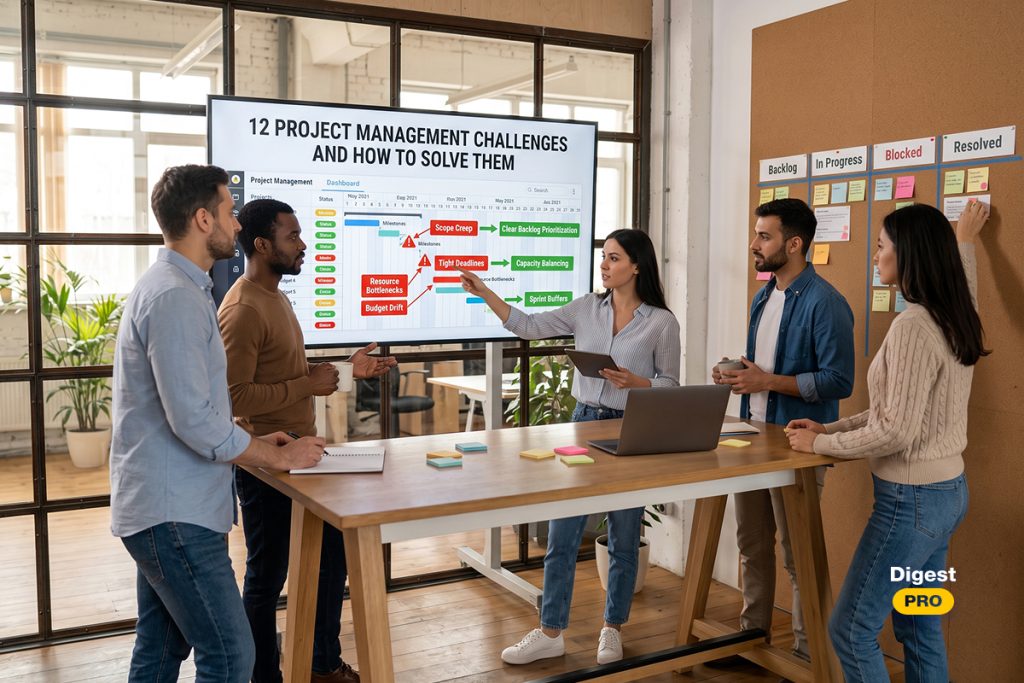
Most project management challenges fall into three groups: problems inside a single project, problems within the team, and problems created by the portfolio around it. Scope creep and unclear goals are the classic challenges of project management. But many of today’s hardest problems come from outside the project: the same specialists are booked on five projects, priorities change mid-quarter, and one delay ripples across the portfolio. Complexity is rising, too. PMI’s Pulse of the Profession 2026 found that 31% of complex projects fail to deliver their full intended benefits. Below are the 12 challenges project managers face most often, how to spot each one early, and how to solve it.
Executive Summary
- Problems appear at three levels: project, team and portfolio. Each level has a different owner.
- Shared resources, shifting priorities and cross-project dependencies are portfolio problems that a single project manager cannot fix alone.
- PMI’s 2026 data shows teams that manage complexity well succeed 88% of the time, versus 14% for teams that do not.
- Early warning signs, clear decision rights and one agreed view of workload across all projects prevent most failures.
“Strategy isn’t delivered in the boardroom, it’s delivered through projects” Pierre Le Manh, President & CEO, PMI
What Are Project Management Challenges?
Project management challenges are recurring obstacles that stop a project from delivering its intended scope, schedule, cost or benefits. They show up at three levels: inside one project (scope, estimates, risk), within the team (communication, skills, alignment) and across the portfolio (shared people, competing priorities, dependencies). The level tells you who can fix it.
Most advice treats every problem as the PM’s job. A PM can rebaseline scope or tighten a risk register. A PM cannot stop three other projects from pulling the same test engineer, and cannot decide which of two sponsors’ projects goes first.
A useful test: could this problem exist if yours were the only project in the company? If not, it is a portfolio problem and needs a PMO, portfolio owner or executive decision.
12 Project Management Challenges and How to Solve Them
The 12 most common challenges are unclear goals, scope creep, unrealistic deadlines, weak risk management, communication gaps, stakeholder misalignment, skill gaps and burnout, the wrong methodology, shared resources across projects, changing priorities, cross-project dependencies and growing complexity. The first four sit inside the project, the next four in the team, the last four in the portfolio.
Below are the project management challenges and solutions in one format: warning signs, a short example, how to solve it. The table is the quick version.
| # | Challenge | Earliest warning sign | First fix | Who owns it |
|---|---|---|---|---|
| 1 | Unclear goals | Team can’t state what “done” means | Measurable success criteria signed by the sponsor | PM + sponsor |
| 2 | Scope creep | “Small” requests skip the change log | Baseline plus change control | PM |
| 3 | Unrealistic deadlines | Dates set before estimates exist | Estimate from historical data, add a project buffer | PM |
| 4 | Weak risk management | Risk register untouched for a month | Named risk owners, fortnightly review | PM |
| 5 | Communication gaps | Same question asked in three channels | One status location, fixed cadence | PM + team |
| 6 | Stakeholder misalignment | Sponsors give conflicting instructions | Stakeholder map, documented trade-off decisions | PM + sponsor |
| 7 | Skill gaps and burnout | Same two names on every critical task | Load review, cross-training | PM + line manager |
| 8 | Wrong methodology | Ceremonies with no decisions | Fit method to uncertainty, go hybrid | PM + PMO |
| 9 | Shared resources | Specialists overbooked across projects | Portfolio-wide load view, limit work in progress | PMO |
| 10 | Changing priorities | Priority list changes weekly | Published prioritization rules, set review rhythm | PMO + executives |
| 11 | Cross-project dependencies | Delays arrive “from nowhere” | Dependency map, protect the critical chain | PMO + program manager |
| 12 | Growing complexity | Plans rebuilt every month | Frameworks, scenario planning, PMO support | PMO + executives |
Project-Level Challenges
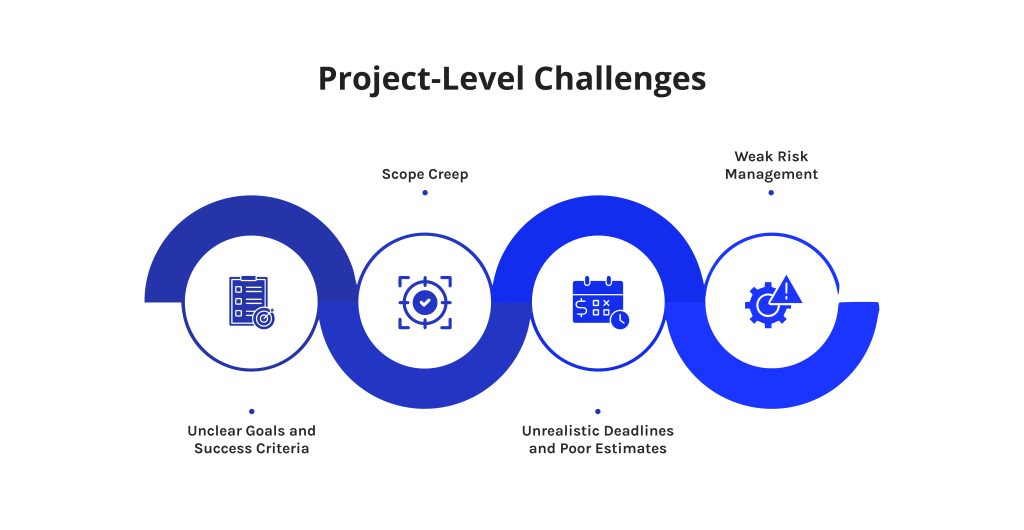
A project manager can solve these largely with their own authority. They are the most written about, which is why teams often stop here and miss bigger causes further up.
1. Unclear Goals and Success Criteria
Warning signs: The charter describes activities, not outcomes. Ask five team members what success looks like and you get five answers.
Example: A team is asked to “modernize the customer portal.” Six months in, the sponsor expected lower support call volume; the team optimized page speed. Both are reasonable. Neither was written down.
How to solve it:
- Write two or three measurable success criteria (a number, a date, an owner) before work starts.
- Get the sponsor to sign them. PMI’s Pulse of the Profession 2026 found sponsor alignment at initiation is used by 39% of high performers versus 30% of low performers.
- Separate outputs (what you ship) from outcomes (what changes because you shipped it).
“Complexity doesn’t just appear at delivery — you can anticipate it from the very start, in the way objectives are set and how stakeholder interests collide.”
Joseph Uwazie
Programme Officer, Department of International Development, UK Aid
2. Scope Creep
Warning signs: Requests arrive through hallway conversations. The backlog grows while the end date stays fixed.
Example: A reporting project adds “one more dashboard” per sprint for a quarter. Each request takes two days. Together they consume the testing window, and the release slips five weeks.
How to solve it:
- Freeze a scope baseline and log every change, however small.
- Price each change in time and money before approving it, so the sponsor makes a real trade-off.
- Use critical path software to show how a change moves the end date, not just the task.
3. Unrealistic Deadlines and Poor Estimates
Warning signs: The end date was announced before anyone estimated the work. Every task estimate is a single optimistic number. Most tasks finish on or after their estimate, almost none early.
Example: A team pads each task “just in case.” Work expands to fill the time (Parkinson’s law), people start late because there is slack (student syndrome), and the project still finishes late.
How to solve it:
- Estimate from historical actuals of similar work, not memory.
- Remove padding from individual tasks and pool it into one shared project buffer at the end. This is the core idea of the critical chain method.
- Track how fast the buffer is being consumed relative to progress. That ratio is an earlier warning than milestone dates.
4. Weak Risk Management
Warning signs: The risk register was filled in at kickoff and never opened again. Risks have no owners. Every risk is rated “medium.”
Example: A supplier delay is logged as a risk in month one. Nobody owns it. In month four the parts arrive late, and the team treats it as a surprise.
How to solve it:
- Give every risk a named owner and a trigger (the observable event that means the risk is materializing).
- Review the top ten risks every two weeks, not every quarter.
- Use risk management tools that link risks to the tasks and dates they threaten.
Team-Level Challenges
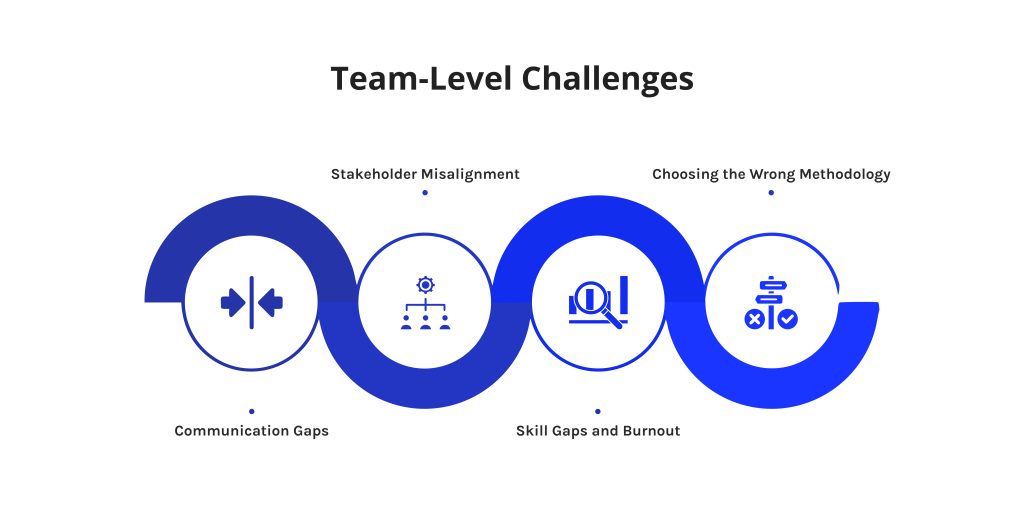
The PM usually spots team challenges first but needs a line manager, sponsor or PMO to fix them.
5. Communication Gaps
Warning signs: Status lives in email, chat, spreadsheets and a PM tool, and they disagree. The same question is asked in three channels.
Example: An engineer updates a task date in the PM tool. The account manager reads last week’s slide deck and promises the client the old date.
How to solve it:
- Agree on one place where status is official, and treat everything else as conversation.
- Set a fixed cadence: short daily or twice-weekly check-ins, a weekly written status, a monthly sponsor review.
6. Stakeholder Misalignment
Warning signs: Two sponsors give conflicting instructions. Decisions get reopened after they are made.
Example: Sales wants a product launched by trade-show season; quality wants another test cycle. Each tells the team their priority is non-negotiable.
How to solve it:
- Map stakeholders by influence and interest, and name the single decision-maker for scope and date trade-offs.
- Bring conflicts to a decision forum quickly instead of absorbing them in the team.
- Record every trade-off decision with its date and owner, so it stays decided.
7. Skill Gaps and Burnout
Warning signs: The same two or three names appear on every critical task. Overtime is routine. Knowledge sits in one person’s head.
Example: One senior architect reviews every design across the program. When she takes two weeks of leave, four workstreams stop.
How to solve it:
- Review planned load per person, not just per team. Averages hide the overloaded specialist.
- Cross-train a second person for every single-point-of-failure skill.
- Treat sustained overtime as a planning defect. PMI’s 2026 research reports that four out of five complex projects experience negative fallout, including strained team morale, and that teams carry that strain into the next project.
8. Choosing the Wrong Methodology
Warning signs: Teams run ceremonies that produce no decisions. A fixed-price, regulated deliverable is managed as an open backlog, or exploratory work is forced into a rigid Gantt chart.
Example: A hardware team adopts two-week sprints, but long-lead components and certification gates make most sprint commitments meaningless.
How to solve it:
- Match the method to uncertainty: predictive planning where requirements are stable, iterative delivery where they are not.
- Accept hybrid as normal. Many teams run agile software work inside a stage-gated program.
- Common agile project management challenges, such as weak product ownership and sprint goals that ignore dependencies outside the team, are usually fixed by clearer roles, not more ceremonies. See Scrum tools and our overview of project management trends.
Portfolio-Level Challenges in Project Management
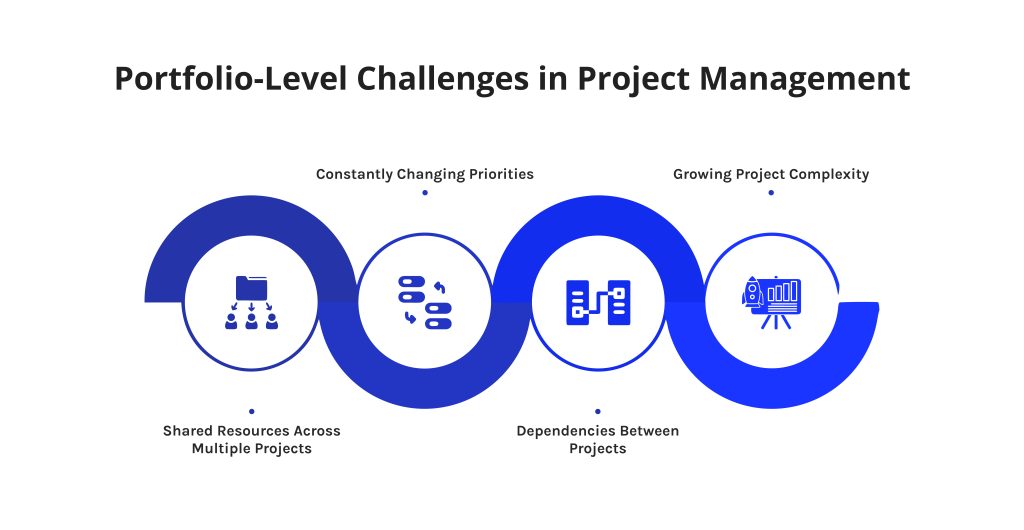
Portfolio challenges in project management exist only because more than one project competes for the same people, money and attention. No single PM can solve them. They need a PMO, a portfolio owner and executive decisions, often supported by enterprise project management software. We cover them in depth in project portfolio management challenges.
9. Shared Resources Across Multiple Projects
Warning signs: Specialists sit on four or five projects at once. Each PM believes they have “50% of Anna.” Overloads are discovered when tasks are already late. Resource meetings feel like negotiations.
Example: Three projects each plan two weeks of work for the same test lab team in March. Every project plan looks feasible on its own. Combined, March demand is three times capacity, and all three projects slip.
How to solve it:
- Plan load on shared specialist groups across all projects, not project by project. In multi-project environments, resource planning tools such as Epicflow, Planview or Smartsheet Resource Management can model the combined demand on each shared group and show overloads weeks ahead.
- Limit work in progress. A specialist switching between five projects finishes all five later than one who completes them in sequence, because every switch costs ramp-up time and every task waits in someone’s queue.
- Identify the current constraint (the most overloaded group) and sequence work around it. In a portfolio, the constraint moves as projects start and finish, so re-check it monthly.
- Use capacity planning tools to compare demand against real availability.
“putting the same people on two high-priority projects only creates the illusion of progress,” said Johanna Rothman, author of Manage It! and over ten other books on project and product management.
10. Constantly Changing Priorities
Warning signs: The priority list changes weekly. Everything is “priority one.” Teams restart work they paused a month ago.
Example: A portfolio board reshuffles its top ten projects after each executive meeting. Engineers drop half-finished work to follow the new order, and nothing reaches completion.
How to solve it:
- Publish the rules for ranking projects (value, urgency, strategic fit, risk) so changes are explainable.
- Rank by cost of delay: what each week of waiting costs the business. It makes trade-offs comparable.
- Review on a fixed rhythm and protect in-flight work between reviews. Gartner’s 2026 CIO and Technology Executive Survey found 94% of CIOs expect major changes to their plans within 24 months, yet only 18% practice dynamic, off-cycle reprioritization.
- Add an intake gate: no new project starts until it is compared against current capacity. PMO tools help run it.
“Top performing technology executives have three things in common: the ability to be agile in their platforms and people; the ability to manage risk; and the ability to be tenacious, to see things through to the end, to get value and to keep going,” said Chris Howard, Distinguished VP Analyst and Chief of Research.
11. Dependencies Between Projects
Warning signs: Delays arrive “from nowhere.” Project plans reference other projects’ deliverables without dates. Integration milestones slip repeatedly.
Example: A platform team’s API release slips three weeks. Two product teams waiting on it lose their launch windows, though both reported green status until the day before.
How to solve it:
- Build a cross-project dependency map, with dates and owners for every handoff.
- Manage related projects as a program, with one owner for integration.
- Protect the critical chain: the longest path through tasks and shared resources, not just task logic. Critical path software shows the task side; resource conflicts must be added on top.
12. Growing Project Complexity
Warning signs: More stakeholders, more regulations, more technology changes per project. Plans are rebuilt monthly. Success depends on factors outside the team’s control.
Example: A regional rollout must coordinate new AI tooling, changing data regulations and five business units with different goals.
How to solve it:
- Use a framework. PMI’s 2026 survey found projects using frameworks succeed at a rate of 72% versus 61% without, yet 35% of professionals used none on their latest complex project.
- Run scenario planning to map interdependencies early. Only one in five practitioners do.
- Give the PMO a coordinating role. Respondents in PMO-equipped organizations rated complex project management very or extremely successful more often (63% vs. 57%).
- Track complexity as a trend: see project management trends and project portfolio management challenges.
Why Projects Fail: What the Data Says
Projects fail mostly because complexity outpaces the organization’s ability to coordinate, not because of a single bad decision. PMI’s Pulse of the Profession 2026 found 31% of complex projects miss their full intended benefits, roughly twice the rate for projects overall. Teams that manage complexity effectively succeed 88% of the time; ineffective teams, 14%.
PMI’s 16th Pulse of the Profession report, Driving Success in Complex Projects, was published on May 12, 2026. Its headline is that complexity is now the norm, not the exception: 97% of project professionals managed at least one complex project in the past year, and 81% say projects have become more complex in recent years (37% describe a significant increase).
PMI groups the drivers into three dimensions:
- Organizational: unclear governance, siloed teams, misaligned objectives.
- Environmental: AI evolution, regulatory volatility, geopolitical instability.
- Human: competing incentives, political dynamics, diverse stakeholder groups.
Most of these map to the team and portfolio levels above. The most common project management problems are coordination failures, not technical ones, which is also why digital transformation challenges look so similar to project challenges.
Challenges New Project Managers Face
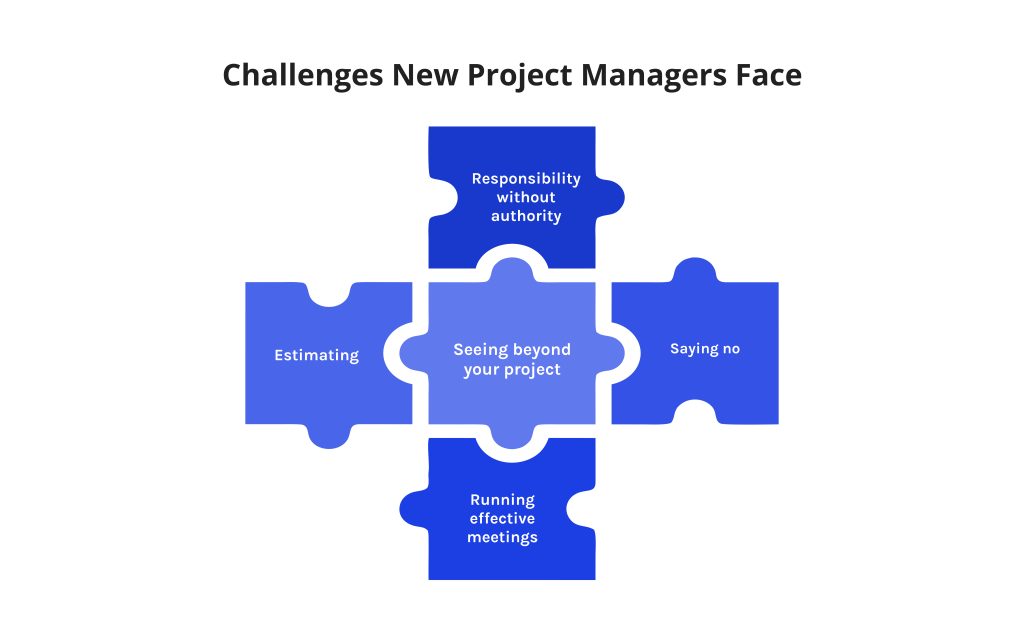
New project managers mostly struggle with authority, not technique. They are accountable for outcomes but rarely control the people, budget or priorities involved. The five most common project manager challenges in the first year are listed below, each with a practical first step.
- Responsibility without authority: you influence people who report to someone else. Agree on decision rights with your sponsor in week one.
- Saying no: new PMs accept every request. Route all changes through a change log from day one.
- Estimating: borrow actuals from past projects and ask the people doing the work.
- Running effective meetings: end every meeting with decisions, owners and dates.
- Seeing beyond your project: ask early which of your people are also on other projects, and for how much of their time.
How to Overcome Challenges in Project Management: 7 Habits
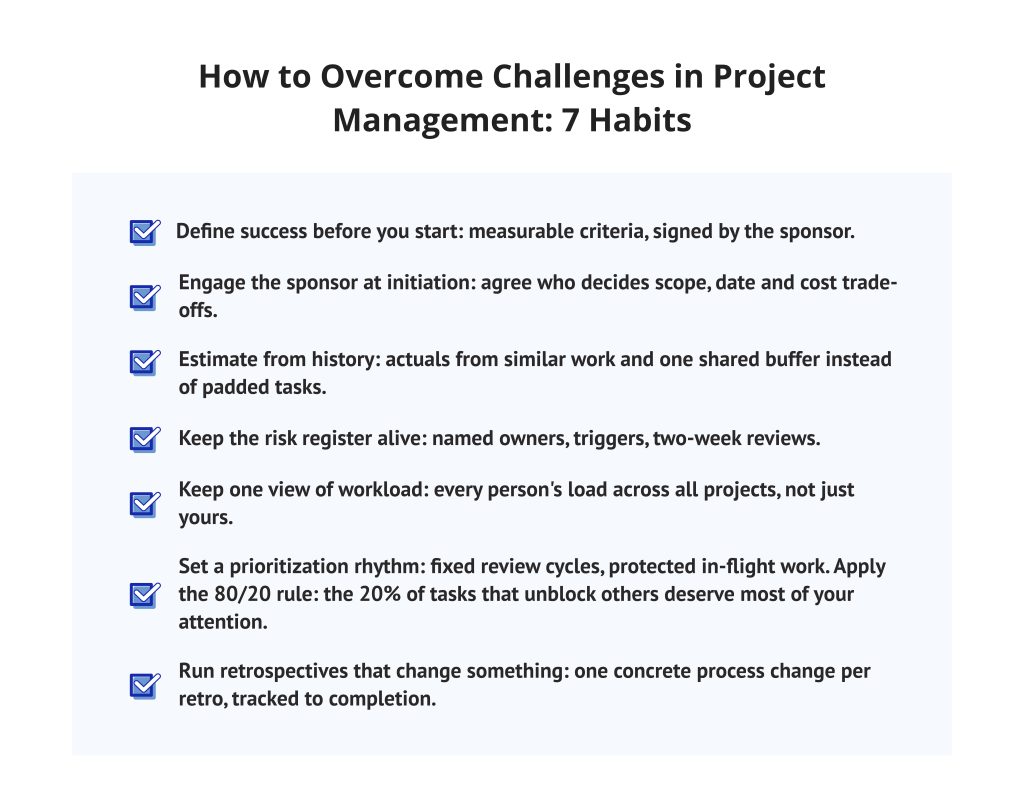
To overcome challenges in project management, build habits that catch problems early: clear success criteria, an engaged sponsor, evidence-based estimates, a living risk register, one view of workload across projects, a steady prioritization rhythm and honest retrospectives. Together they turn surprises into early signals.
- Define success before you start: measurable criteria, signed by the sponsor.
- Engage the sponsor at initiation: agree who decides scope, date and cost trade-offs.
- Estimate from history: actuals from similar work and one shared buffer instead of padded tasks.
- Keep the risk register alive: named owners, triggers, two-week reviews.
- Keep one view of workload: every person’s load across all projects, not just yours.
- Set a prioritization rhythm: fixed review cycles, protected in-flight work. Apply the 80/20 rule: the 20% of tasks that unblock others deserve most of your attention.
- Run retrospectives that change something: one concrete process change per retro, tracked to completion.
Software helps with habits 3 to 6. See our guide to the best AI project management tools.
Our Methodology
We analyzed the top-ranking articles on this topic in US Google results (September 2026) to find gaps, then built the list around three levels of ownership. Statistics come only from primary sources published in 2025-2026: PMI’s Pulse of the Profession 2026 and Gartner’s 2026 CIO and Technology Executive Survey (2,501 respondents, fielded May-June 2025). Each figure was checked on the publisher’s page on October 15, 2026. No vendor paid for inclusion.
Key Takeaways
- Project management problems appear at three levels: project, team and portfolio. Identify the level first; it tells you who can fix it.
- Scope creep, unclear objectives and poor estimates remain the most common project-level challenges.
- Shared resources, shifting priorities and cross-project dependencies are portfolio problems a single PM can’t fix alone.
- Teams that manage complexity well succeed far more often: 88% versus 14% (PMI, 2026).
- Early warning signs, clear decision rights and one view of workload across all projects prevent most project management challenges from becoming failures.
References
- Project Management Institute. “Why Complex Projects Fail: Best Practices Are Not Enough, System Thinking Gives Your Team the Edge.” Press release, May 12, 2026. https://www.pmi.org/about/press-media/2026/pulse-why-complex-projects-fail-best-practices-are-not-enough-system-thinking
- Project Management Institute. Pulse of the Profession 2026: Driving Success in Complex Projects: From Navigating Tasks to Navigating Systems. May 2026. https://www.pmi.org/learning/thought-leadership/driving-success-in-complex-projects
- Gartner. “Strategic Pivots Will Define the CIO’s Agenda in 2026.” Daniel Sánchez Reina, November 25, 2025. https://www.gartner.com/en/articles/cio-agenda
- Gartner. “Gartner Survey Reveals 50% of Non-U.S. CIOs and Technology Executives Anticipate Changes to Vendor Engagement Based on Regional Factors.” Press release, October 21, 2025 (survey methodology). https://www.gartner.com/en/newsroom/press-releases/2025-10-21-gartner-survey-reveals-50-percent-of-non-us-cios-and-technology-executives-anticipate-changes-to-vendor-engagement-based-on-regional-factors
FAQs
They are recurring obstacles that keep a project from delivering its scope, schedule, budget or benefits. They occur at three levels: the project (scope creep, poor estimates), the team (communication gaps, stakeholder conflict, burnout) and the portfolio (shared resources, changing priorities, cross-project dependencies). Knowing the level tells you who can solve the problem.
The most common ones are scope creep, unclear goals, unrealistic deadlines, specialists shared across several projects and constantly changing priorities. The first three can usually be fixed by the project manager. The last two are portfolio problems that require a PMO or executive decisions, because they depend on what other projects are doing.
The top five are scope risk (requirements grow or change), schedule risk (tasks take longer than planned), cost risk (spending exceeds budget), resource risk (key people are unavailable or overloaded) and stakeholder risk (sponsors disagree or disengage). Each needs a named owner, a trigger that signals it is happening and a pre-agreed response.
Build seven habits: define measurable success before starting, engage the sponsor at initiation, estimate from historical data, review risks every two weeks, keep one view of workload across all projects, reprioritize on a fixed rhythm and run retrospectives that change something. These habits catch problems while they are still cheap to fix.
Most projects fail from coordination problems rather than technical ones: unclear goals, misaligned stakeholders, overloaded shared resources and unmanaged complexity. PMI’s Pulse of the Profession 2026 found 31% of complex projects miss their full intended benefits, while teams that manage complexity effectively succeed 88% of the time, compared with 14% for teams that do not.
What are project management challenges?
New project managers struggle most with responsibility without authority, saying no to scope changes, estimating without personal history, running decisive meetings and seeing how other projects compete for their team’s time. Agreeing on decision rights with the sponsor in the first week and routing every change through a change log solve the first two quickly.