
Agentic AI trends for 2027 will be shaped by how much authority companies can safely delegate to software. The technology can already combine reasoning with tools, but production reliability depends on the surrounding system. Gartner’s 2026 Hype Cycle places agentic AI at the Peak of Inflated Expectations and reports that 17% of organizations had deployed agents, while more than 60% expected deployment within two years [1]. Those figures describe adoption and intentions, not demonstrated returns. For technology leaders, the next planning cycle should address execution boundaries, operating costs, and recovery before adding autonomy. The ten shifts below distinguish observed developments from Digest.Pro’s expectations about what they mean for enterprise architecture and investment.
Executive Summary
- Multi-agent designs are useful when specialization justifies the cost and complexity of coordination.
- MCP connects applications with tools and data; A2A connects independent agents with each other.
- Permissions and approvals need enforcement when an action executes, beyond instructions in a prompt.
- Evaluate cost per accepted business outcome, including retries, failed runs, and human review.
- Treat 2027 expectations as planning hypotheses and expand autonomy only when evidence supports it.
What Is Agentic AI
Agentic AI is an approach in which a system pursues a goal by selecting and executing actions through tools, checking results, and adjusting its next steps. Its autonomy is bounded by the permissions and workflow it receives. A conversational interface alone does not establish that a system can reliably complete a business process.
An assistant may explain an overdue invoice. An agent might retrieve its status, check an approved communication policy, prepare a reminder, and request authorization to send it. A scripted automation can handle predictable steps in the same process. The appropriate combination depends on where judgment or variable sequencing adds value. Digest.Pro’s guide to the agentic workflow examines that execution pattern in more detail.
What Changed in 2026: Agentic AI Trends in Review
The important change in 2026 was the move toward production systems whose costs and authority could be evaluated. Agent adoption expanded, public interoperability specifications matured, and operating disciplines attracted greater attention. These developments support more practical deployments, but they do not establish that broadly autonomous work is dependable across an enterprise.
The 2026 evidence varies by sample. McKinsey’s 2025 survey found 23% of respondents scaling agents in at least one function and another 39% experimenting [2]. Its August 2026 report found agent scaling among 40% of respondents at companies with revenue above $1 billion, versus 22% at smaller organizations. The newer survey covered 1,719 participants; these figures are not comparable to Gartner’s overall deployment measure [3].
Public infrastructure changed alongside adoption. MCP joined the Linux Foundation’s Agentic AI Foundation in December 2025 [4]. A2A’s current documentation describes a Linux Foundation project with public specifications and a technical steering committee [5]. Both offer common interfaces, although security decisions still belong to the deploying organization.
The governance timetable changed too. The European Commission’s current AI Act timeline lists transparency obligations from August 2, 2026, and later dates for high-risk categories following the AI Omnibus [6]. Teams should map the intended use to the applicable rules instead of treating regulation as one uniform deadline for every agent.
10 Agentic AI Trends for 2027
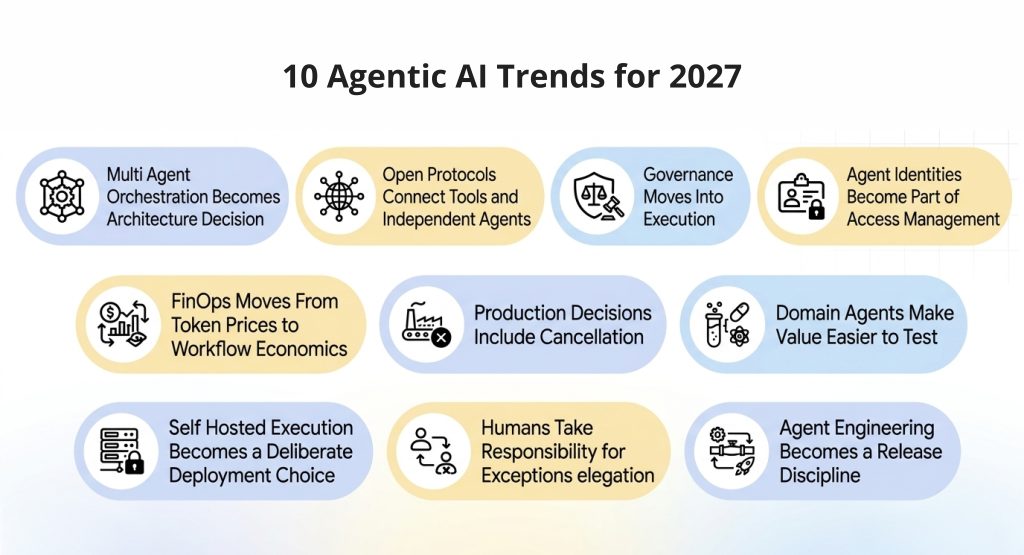
The ten shifts below describe decisions organizations will need to make as deployments become more consequential. Each combines an observable signal with an architectural implication. Our expectation is increased use of controlled delegation, with different autonomy levels for different tasks. Each organization should select patterns that fit its processes and requirements.
1. Multi-Agent Orchestration Becomes an Architecture Decision
Gartner included multi-agent systems in its strategic technology trends for 2026 [7]. That signals attention to coordinated systems, rather than proof that a team of agents is the default solution for every workflow. The useful AI agent orchestration trends concern how responsibility moves between specialized components.
An illustrative purchasing process could separate supplier research, policy checks, and preparation of an approval request. Each component receives a restricted task and produces a defined output. An orchestrator maintains the process state and decides whether the evidence is sufficient to proceed. The final authorization still belongs to a permitted approver.
Every handoff adds potential latency, context loss, and another failure path. Compare the workload with one agent and with deterministic automation before accepting that overhead. Several agents repeating the same model judgment can reinforce the same error; independent checks need meaningful evidence.
Selective specialization needs explicit handoff contracts. Assess multi-agent AI orchestration trends through completed outcomes and recoverability. The AI agent orchestration guide covers the implementation patterns.
2. Open Protocols Connect Tools and Independent Agents
The official MCP documentation defines a standard for connecting AI applications to external systems, including tools and data [8]. A2A addresses discovery, task delegation, and result exchange between independent agents [5]. These are complementary interfaces, with different jobs in an architecture.
For example, a planning agent could use MCP to query an authorized internal database, then use A2A to ask an independent specialist service for an assessment. A2A does not define all internal subagent communication, and neither protocol supplies the business policy that permits the request.
As of October 12, 2026, MCP’s public documentation and foundation governance announcement and A2A’s public governance documentation establish their respective status. Procurement teams should still verify the versions and features a product actually implements. A claim of protocol support is insufficient evidence of interoperability with your chosen tools.
Our expectation is that common interfaces will reduce some custom connection work and make integration choices easier to inspect. They will not remove switching costs from proprietary data models or workflow state. When comparing the best AI agent frameworks, test real connections, authentication, and failure handling.
3. Governance Moves Into Execution
Deloitte’s 2026 research found mature agentic governance at only 21% of surveyed organizations; its sample comprised 3,235 business and IT leaders across 24 countries [9]. This finding supports investment in operational controls, although maturity is self-reported and does not establish that any particular control prevents every incident.
A written rule such as “request approval before changing payment details” must become a condition on the actual write operation. The model can propose an action. A separate control should validate the target, permitted fields, and approval record before allowing execution. If any requirement is missing, the request stops or enters an exception queue.
As workflows cross systems, a tool response or retrieved document must not expand authority by supplying instructions. External content can inform the task while remaining untrusted as a source of permission.
For 2027, expect buyers to request demonstrations of denied actions, interrupted runs, and revoked access. A governance feature becomes assessable when a team can show the rule being enforced and explain who owns the resulting exception.
4. Agent Identities Become Part of Access Management
OWASP’s Top 10 for Agentic Applications 2026 treats agent security as an operational risk area [10]. Our architectural recommendation is to give a production agent an identifiable principal and the narrowest permissions that allow its assigned work. A shared administrator account makes attribution and containment unnecessarily difficult.
Specify both the agent identity and the authority delegated by the user or process. A support agent might read one customer’s tickets and draft a reply without being allowed to export the customer database. Access should also expire or be revocable when the task or deployment ends.
Test identity across handoffs. A downstream agent must not silently inherit broader permissions just because an upstream component can call it. Log who requested the action, which principal executed it, and which scope permitted it. Keep secrets in the credential system rather than in prompts or long-term conversational memory.
Include agent inventories in service-identity access reviews. Specify which additional action a principal may perform and what evidence justifies granting it.
5. FinOps Moves From Token Prices to Workflow Economics
The newer McKinsey survey reports that AI operating costs constrained use for about one in five respondents’ organizations [3]. That finding covers AI broadly. For agentic deployments, our recommendation is a more precise unit of evaluation: total cost per accepted workflow outcome.
Include model calls, retrieval, external tools, repeated attempts, infrastructure, and reviewer effort. Keep the denominator fixed. A system that generates ten drafts and finishes two accepted cases should not price the process as if every draft were a success. Inspect the most expensive cases as well as the average.
FinOps for agentic AI also changes the engineering specification. Put limits on steps, elapsed time, and spending. A workflow should escalate when it reaches its budget, and it should report why. Less expensive models can handle some narrow tasks, but savings matter only while outcome quality remains acceptable.
For 2027, we expect budget discussions to move closer to process ownership. The business owner specifies the value of a completed case; engineering explains how the workflow consumes resources. Together they can decide whether greater autonomy improves the economics or just creates more activity.
6. Production Decisions Include Cancellation
Gartner predicted in June 2025 that more than 40% of agentic AI projects would be canceled by the end of 2027 because of escalating costs, unclear value, or inadequate risk controls [11]. This is an analyst forecast, not a measured cancellation rate in 2026.
The practical implication is disciplined investment review. Before a pilot starts, define the circumstances in which it scales, receives a specific repair, or closes. A cancellation can be a sound outcome when an experiment disproves its value hypothesis. Keeping it alive does not recover the money already spent.
Test representative volume, difficult exceptions, and normal staff availability. A workflow that depends on a developer watching every run has demonstrated a different operating model from unattended production. Include that labor in the decision and identify who will provide support after launch.
Our 2027 expectation is greater emphasis on proof of value and operational readiness. Portfolio reports should show accepted outcomes, unresolved exceptions, and cost trends alongside the number of deployments. The analysis of enterprise AI adoption barriers explains how to diagnose the dependencies that often prevent this transition.
7. Domain Agents Make Value Easier to Test
Oracle’s October 15, 2025 announcement described planned finance agents for payables, ledger work, planning, and payments [12]. It is a vendor announcement of capabilities, not independent proof of customer ROI. It nevertheless illustrates how agent design is becoming attached to defined business processes.
A narrow domain gives a team clearer acceptance criteria. An invoice agent can be evaluated against correct vendor identification, valid matching, policy checks, and appropriate routing. A general assistant answering arbitrary questions is harder to assess through one stable business metric. Domain boundaries also help restrict tool permissions and the data required.
Specialization does not guarantee accuracy. The workflow still needs authoritative records, reliable calculations, and an exception route. Use deterministic services for arithmetic and transactional validation; use the agent where interpretation or variable sequencing adds value.
Our expectation is stronger demand for evidence tied to the buyer’s process. Digest.Pro’s guide to agentic AI in procurement examines purchasing workflows, while AI agents for project management cover planning tasks. AI agents in finance need an additional focus on approvals and evidence of completed transactions.
8. Self-Hosted Execution Becomes a Deliberate Deployment Choice
IBM’s 2026 study of 2,000 CEOs found that 83% considered AI sovereignty essential to business strategy [13]. Sovereignty encompasses dependencies and control; it is broader than the physical location of a server. An organization may need authority over data use, model selection, supplier change, and continued operation.
Self-hosting can support those requirements when a team has the capacity to operate the environment. Inspect the whole data path, including models, retrieval services, telemetry, and connectors. A runtime installed in a company cloud can still send information to third parties. Hosting location alone therefore cannot prove that a workflow meets a residency or confidentiality requirement.
EpicStaff provides one example: a source-available platform for agent flows that can be self-hosted, with a visual editor, role-based access, and an action audit trail described in its public documentation. Those features require evaluation in the organization’s own configuration.
Evaluate deployment against process requirements and operating capacity. The guide to self-hosted AI agents examines those choices. Source availability, deployment control, and compliance remain distinct questions.
9. Humans Take Responsibility for Exceptions and Delegation
BCG’s 2025 survey found that only 13% of respondents reported agents broadly integrated into workflows [14]. It indicates limited integration in that worker sample, rather than a universal measure of how autonomous enterprise systems already are.
Introducing agents changes the work that remains for people. Staff may spend less time collecting information and more time checking exceptions, revising policy, and determining what the system can do next. This requires a capacity plan. If every run waits for approval, the available reviewers define the throughput limit.
Design approval around the consequence of the action. Present the proposed change, supporting records, and relevant policy. Route uncertain or unusual cases to someone who can resolve them. Measure whether reviewers catch errors; a button labeled “approve” is not evidence of informed oversight.
For 2027, our expectation is clearer supervision responsibilities within business roles. The owner should know when to pause the workflow and how to change a permission boundary. Revisit the agentic workflow whenever the remaining human tasks differ substantially from the original process.
10. Agent Engineering Becomes a Release Discipline
The 2026 Gartner Hype Cycle identifies the agent development life cycle, context graphs, and agent experience as emerging practices alongside execution platforms [1]. Their appearance signals developing disciplines, not evidence that every enterprise needs a new graph database or a separate agent experience team.
Treat an agent deployment as a versioned system. Record prompts, models, tool definitions, policies, and the evaluation cases used for release. Run representative tasks and adversarial cases before granting new permissions. A change to retrieval or a connected tool can affect behavior even when the model stays the same.
Context management needs similar care. Distinguish current policy, verified operational facts, and temporary task state. Remove expired information and preserve provenance. A context graph can be useful when relationships matter to the task; a simpler approved record may be sufficient for a narrow process.
Our expectation is release reviews that examine behavior, authority, and recovery together. For implementation details, see how to build an AI agent. A release should include evidence that the new version performs acceptably and a procedure for restoring the previous working configuration.
Hype vs Reality: What Agents Can and Cannot Do Yet
Agents can complete bounded workflows when tools, context, and permissions fit the task. Claims about arbitrary autonomous business execution require much stronger evidence. Separate capability demonstrations from independently measured results. The relevant test is whether the system finishes your representative cases, respects its authority, and recovers from failures at an acceptable operating cost.
Gartner’s 2025 analysis warned about “agent washing,” meaning conventional tools rebranded without substantive agentic capabilities [11]. The response is a task-based evaluation, rather than a rejection of useful assistants or automation. A tool can be valuable without needing broad autonomy.
| Market claim | Reality to establish today | Planning implication |
|---|---|---|
| More agents improve performance | Coordination can add overhead and shared errors | Benchmark against simpler designs |
| Protocol support makes integrations interchangeable | Authentication, versions, and workflow state still differ | Test the complete connection |
| Human approval makes actions safe | Review can be rushed or poorly informed | Test error detection and authority |
| Self-hosting keeps every datum local | Connected services may transmit data | Inspect the full data path |
| A successful demo proves production readiness | Exceptions and recovery may remain untested | Require workload evidence |
Use the best autonomous AI agents guide to explore categories and tools, then validate the proposed system against your own process. AI agent trends are useful for planning; a market label is not an acceptance criterion.
How to Prepare Your Organization for Agentic AI
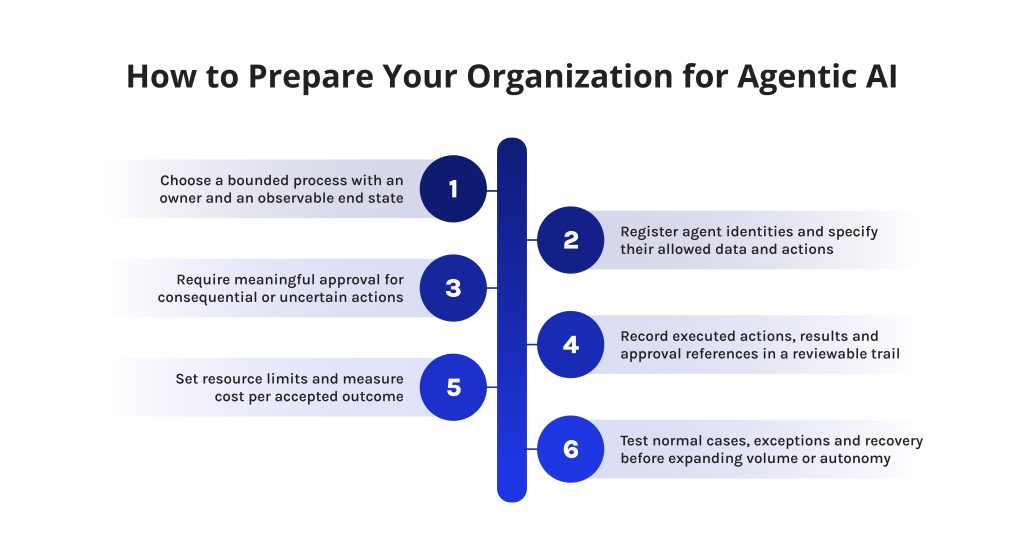
Prepare by defining a process outcome and the authority needed to achieve it. Establish observability and recovery before increasing permissions. Keep evaluation conditions close to normal operations so review effort and exception volume are visible. The next autonomy level should be a deliberate release decision, supported by evidence from the current one.
- Choose a bounded process with an owner and an observable end state.
- Register agent identities and specify their allowed data and actions.
- Require meaningful approval for consequential or uncertain actions.
- Record executed actions, results, and approval references in a reviewable trail.
- Set resource limits and measure cost per accepted outcome.
- Test normal cases, exceptions, and recovery before expanding volume or autonomy.
Use this delegation ladder to make the proposed change explicit. These are design stages, not measured market maturity categories. A workflow may remain at an earlier stage indefinitely if its consequences require human authorization.
| Delegation stage | Agent authority | Evidence required |
|---|---|---|
| Assist | Retrieve and draft | Supported outputs and access checks |
| Act with approval | Execute an approved change | Approval is bound to exact action |
| Act within limits | Perform defined low-risk actions | Enforced limits and recovery |
| Coordinate agents | Delegate bounded responsibilities | Handoff traceability and preserved permissions |
The Future of Agentic AI Predictions Beyond the Next Planning Cycle
The future of agentic AI depends on how reliably organizations can delegate specific work, not on autonomy as an abstract capability. Analyst forecasts and executive expectations suggest a larger role for agents. They should guide scenario planning while remaining separate from evidence about what a particular deployment can do today.
Gartner forecasts that at least 15% of everyday work decisions will be made autonomously through agentic AI by 2028 [11]. IBM’s surveyed CEOs expect AI to make 48% of operational decisions without human intervention by 2030, where consistency and guardrails can be codified [13]. The populations and decision definitions differ; these percentages do not form a shared growth curve.
Treat agentic AI predictions as hypotheses to revisit. Expand delegation when outcomes, boundaries, and exceptions remain manageable. If performance deteriorates, reduce scope and address the specific dependency.
Our Methodology
This analysis reviews primary research and official specifications available on October 7, 2026. Survey findings retain their samples and dates; analyst forecasts and vendor announcements are identified separately. The ten implications, the delegation ladder, and the workflow examples are in Digest.Pro’s editorial analysis. They are planning frameworks, not tested performance benchmarks. Product descriptions reflect public documentation, and references to capabilities do not imply certification or independent validation.
Key Takeaways
- Agentic AI trends point toward measurable, bounded delegation in enterprise workflows.
- Adopt multi-agent coordination only when it earns its complexity through better outcomes.
- Verify protocol connections and permissions, and review quality and total costs in your environment.
- Use production evidence to decide how much autonomy to grant next.
References
1. Gartner. Hype Cycle for Agentic AI 2026. April 15, 2026; includes 2026 CIO survey findings. Read source
2. McKinsey. State of AI 2025. November 5, 2025; n=1,993. Read source
3. McKinsey. State of AI 2026. August 25, 2026; fieldwork May–June 2026, n=1,719. Read source
4. Model Context Protocol. MCP joins the Agentic AI Foundation. December 9, 2025. Read source
5. A2A Protocol. Protocol overview and governance. Accessed October 7, 2026. Read source
6. European Commission. AI Act application timeline. Accessed October 7, 2026. Read source
7. Gartner. Strategic Technology Trends for 2026. October 20, 2025. Read source
8. Model Context Protocol. Official introduction. Documentation current at access October 7, 2026. Read source
9. Deloitte. AI agents are scaling faster than their guardrails. April 24, 2026; n=3,235. Read source
10. OWASP. Top 10 for Agentic Applications 2026. December 9, 2025. Read source
11. Gartner. Agentic AI project cancellation and decision forecasts. June 25, 2025. Read source
12. Oracle. Finance AI agent announcement. October 15, 2025. Read source
13. IBM Institute for Business Value. CEO Study 2026 findings. May 4, 2026; n=2,000. Read source
14. BCG. AI at Work 2025 findings. June 26, 2025; n>10,600. Read source
FAQs
Enterprise planning priorities include selective multi-agent coordination, common tool and agent interfaces, enforceable execution controls, distinct identities and workflow-level cost measurement. Domain-specific deployments make outcomes easier to test. Self-hosting is one deployment option when control requirements and operating capacity support it, rather than a universal prerequisite. Evaluate each choice against the process you intend to delegate.
In 2026, organizations expanded agent experimentation, and large companies increased scaled use. Interoperability, governance, and operating costs received greater attention. Public MCP and A2A documentation made connection patterns clearer. Adoption measures varied by survey, so deployment, experimentation, and scaled use should remain separate when interpreting the evidence for a particular market or process.
The future of agentic AI is likely to involve more delegated work within defined permissions and observable processes. Forecasts anticipate a larger role in operational decisions, but do not validate a particular system’s readiness. Organizations should use them for scenario planning and grant additional authority only after representative production evidence supports that change.
Agentic projects can fail when their operating costs exceed benefits, their business value is unclear, or their risk controls are inadequate. Integration failures and poorly handled exceptions can undermine an otherwise capable model. Establish acceptance criteria before the pilot, price completed outcomes, and test the failure path before treating a demonstration as production evidence.
There is no single comparable public ranking across all agent categories. Coding, IT support, customer service, and research are prominent use areas, but prominence is not a market-share measurement. Choose a category around the work you need completed and compare frameworks, integration capabilities, and control requirements rather than relying on a popularity claim.
Agentic AI can be deployed in regulated workflows when the intended use, permissions, approvals, evidence, and recovery procedures satisfy the applicable requirements. Self-hosting may support deployment control but does not establish compliance or eliminate external data transfers. Validate the actual configuration and preserve human accountability for consequential decisions before increasing autonomy.