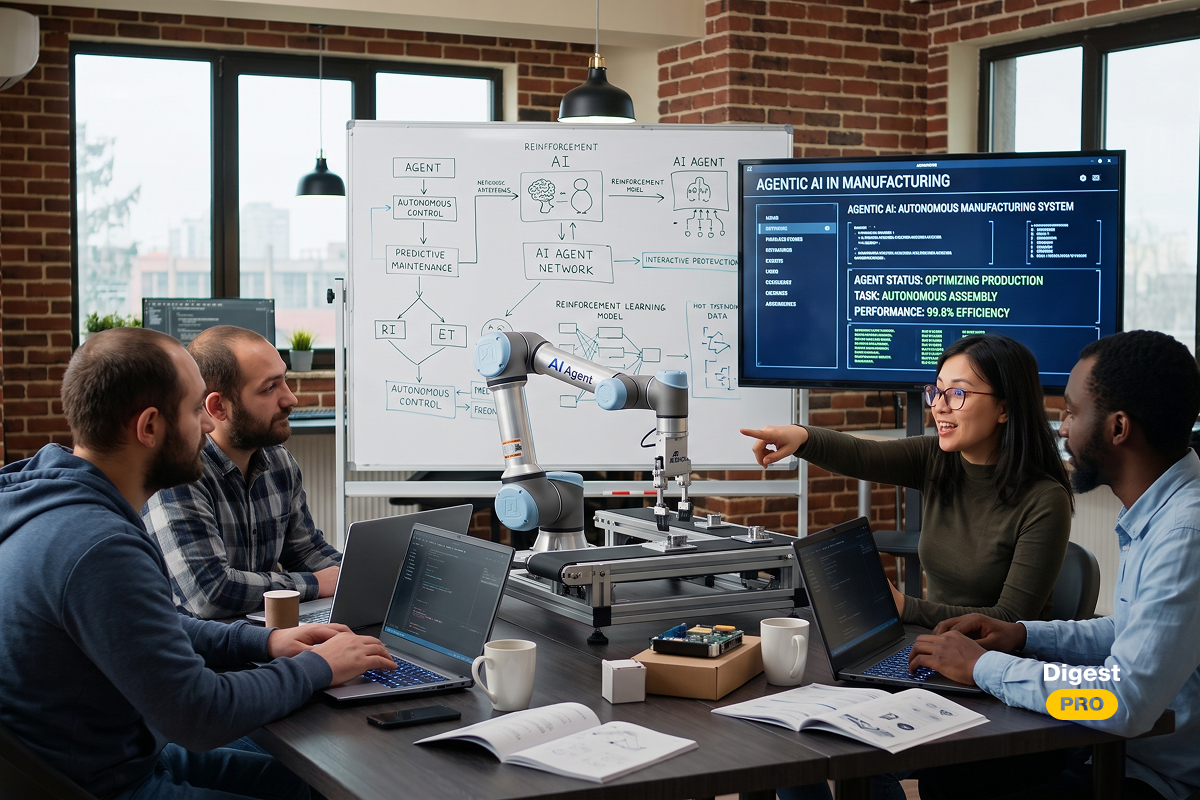
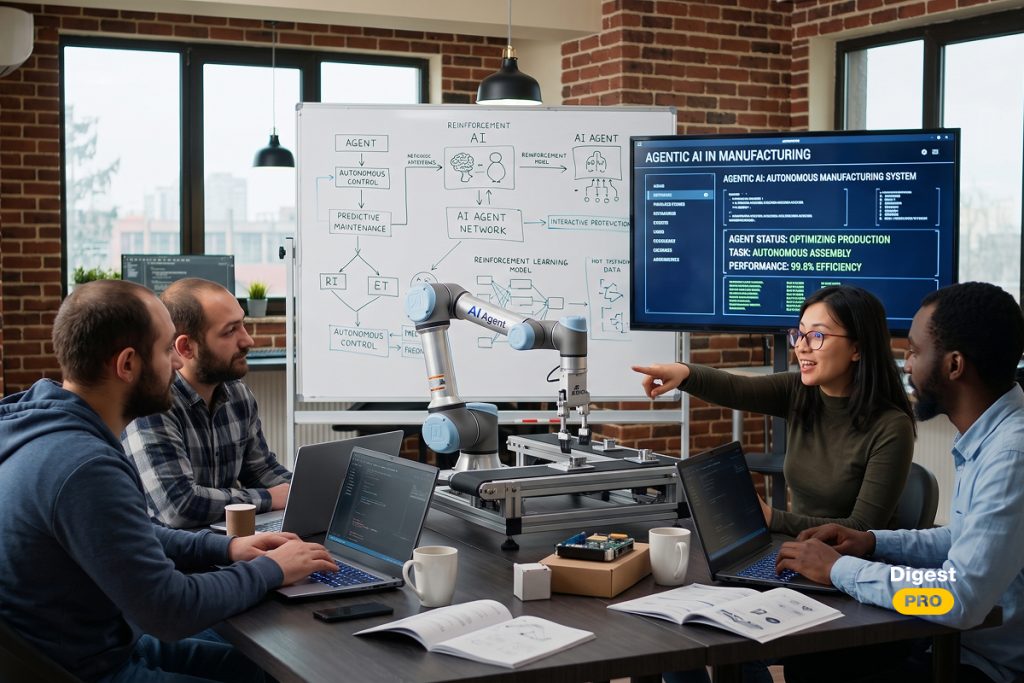
Agentic AI in manufacturing turns software from a tool that answers questions into a worker that plans, decides, and acts. The numbers show the shift. Gartner forecasts that supply chain management software with agentic capabilities will grow from under $2 billion in 2025 to $53 billion in spend by 2030 [1].
McKinsey’s 2026 survey finds that 40% of large organizations now scale AI agents, up from 27% a year earlier [2]. Plant pressures are equally significant, as Siemens has determined that the losses caused by unwanted downtime cost the top 500 companies of the world about $1.4 trillion annually [3].
By the end of this guide, you will become acquainted with the principles of autonomous technology applied in plants as well as the use cases that may be of interest to you along with the KPIs that guarantee the effectiveness of the investment made.
Want more expert analysis of enterprise AI and technology? Subscribe to Digest.Pro on LinkedIn and get executive-ready insights in your feed.
Key takeaways
- Agentic AI refers to software that is able to autonomously think and perform tasks on the factory floor rather than just responding to queries like a chatbot.
- The top applications of agentic AI at present include predictive maintenance, generating production schedules, ensuring quality control, and coordinating suppliers.
- It is estimated that unplanned downtime costs the world’s largest manufacturers $1.4 trillion annually, and according to Siemens, predictive maintenance systems lower downtime by 50% and reduce maintenance costs by 40%, the best ROI for any pilot implementation.
- Human oversight is still an integral part of every advanced deployment, because whenever there is an implementation of agentic AI, a human has to approve any changes in a schedule or contract in advance.
What Is Agentic AI in Manufacturing?
Agentic AI in manufacturing is a class of AI systems that set sub-goals, plan multistep actions, and execute them across plant software with limited human input. Deloitte defines these tools as autonomous generative AI agents that can both act and choose which actions to take. Humans define the goals, and the agents pursue them.
Generative AI manufacturing tools, such as chatbots, answer questions. Agents complete the work. In Deloitte’s CNC maintenance example, the agent acts across several systems: it builds tailored instructions, tells the scheduling agent the machine is down, adapts the steps if sensors detect an anomaly, and logs completion.
Most of these agents run on gen AI models that supply reasoning and language skills. Agents add memory, tool access, and planning on top.
Rainer Brehm, CEO of Factory Automation at Siemens Digital Industries, describes the shift as “moving beyond the question-answer paradigm” toward systems that independently execute complete industrial workflows.
How Is Agentic AI Used in Manufacturing?
Manufacturers deploy autonomous agents in maintenance, production planning, quality control, and the supply chain. McKinsey’s 2026 survey found that respondents in advanced manufacturing use agents mostly in supply chain and inventory management and in the manufacturing process itself [2].
Adoption is early but accelerating. A Manufacturing Leadership Council survey from early 2025 found that 6% of manufacturers used agentic systems, while 24% expected to within two years [5].
Benefits of Agentic AI in Manufacturing
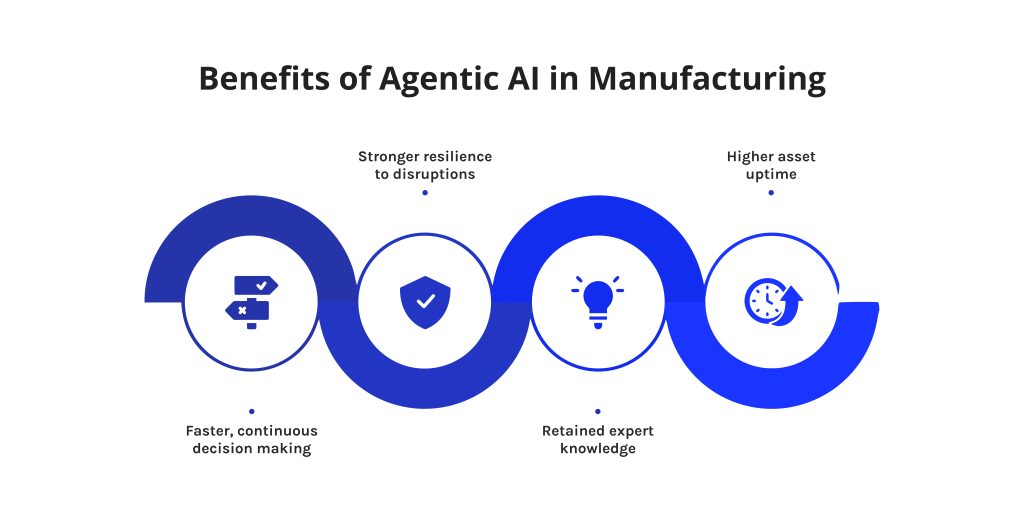
- Faster, continuous decision-making: With AI agents constantly monitoring plant conditions and acting whenever a threshold is exceeded, problems no longer wait until the next meeting for the shift to make decisions.
- Stronger resilience to disruptions: AI agents manage supplier risk, assess the impact of any delays, and propose alternatives to humans.
- Retained expert knowledge: Industrial generative AI agents create work instructions from CAD files, bills of materials, and historical quality information.
- Higher asset uptime: Agents book repairs and order parts before a failing asset stops a line.
What Is the Difference Between Agentic AI, Traditional AI, and Automation?
The level of autonomy separates the three approaches. Rule-based automation follows fixed scripts. Classic machine learning predicts or classifies. Agentic systems plan and act toward a goal.
| Dimension | Rule-based automation | Traditional AI | Agentic systems |
| Core logic | Fixed if-then rules | Trained models predict or classify | Goal-driven reasoning and planning |
| Response to change | Fails on exceptions | Adapts only within its training data | Replans when conditions shift |
| Typical output | A scripted task | A score, alert, or forecast | A completed multistep workflow |
| System reach | One system | One model or pipeline | Several systems and other agents |
| Human role | Writes and maintains rules | Reviews predictions and acts | Sets goals and approves high-risk actions |
| Plant example | A robot repeats a weld path | A vision model flags a defect | An agent finds the root cause and proposes a fix |
Gartner analyst Anushree Verma gives a practical selection rule: use agents when decisions are needed, automation for routine workflows, and assistants for simple retrieval. Her colleague Kaitlynn Sommers adds that, unlike RPA, agents complete tasks without predefined outcomes and keep learning from real-time data.
Key Elements of Agentic AI Systems in Manufacturing
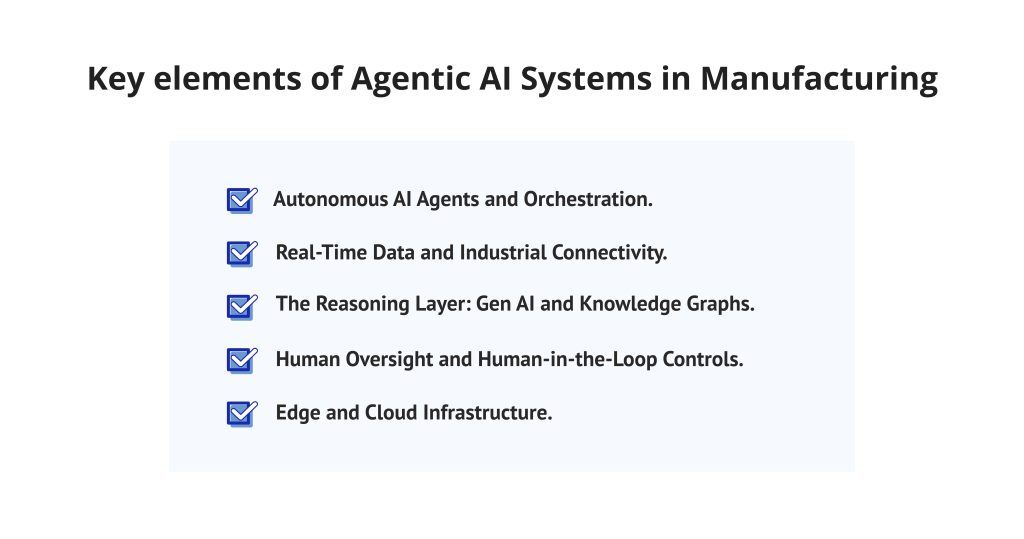
Advanced AI systems that act on their own need more than a strong model. Agentic AI systems share five building blocks, and each one answers a specific operational risk.
Autonomous AI Agents and Orchestration
Each agent owns a narrow job, such as maintenance planning or material handling. An orchestrator assigns tasks and resolves conflicts between agents. Deloitte calls multi-agent systems in manufacturing the clear choice for operations that span several ISA-95 levels and balance conflicting KPIs. Siemens follows the same pattern: its orchestrator deploys a toolbox of specialized agents, and users choose which tasks to delegate.
Real-Time Data and Industrial Connectivity
AI systems act only as well as their inputs. Agents need real-time data from sensors, manufacturing execution systems (MES), enterprise resource planning (ERP), and maintenance records. Deloitte notes that agents capture value lost in handoffs between disparate systems. Siemens adds a warning: almost three-quarters of surveyed manufacturers still use factory historians, which lack the rich data that effective predictive maintenance needs.
The Reasoning Layer: Gen AI and Knowledge Graphs
Gen AI models supply reasoning and natural-language interfaces. Knowledge graphs give agents a shared map of assets, parts, and processes. Deloitte recommends knowledge graphs for shared understanding and event-driven coordination among agents.
Human Oversight and Human-in-the-Loop Controls
Autonomous AI systems need limits. Deloitte’s examples keep a person in the approval chain: a planner approves a revised schedule, and a procurement manager approves contract talks. Gartner urges leaders to set the right level of human-in-the-loop control for supply chain decision-making, especially early in deployment. Deloitte also finds that 81% or more of task hours in industrial manufacturing will likely stay human-driven.
Editorial note: In our source review, the examples from Deloitte, Gartner, and Siemens all keep a human approval step for actions that change contracts, schedules, or work instructions. We treat human oversight as a design requirement, not a fallback.
Edge and Cloud Infrastructure
Latency matters on a production line, so agentic AI systems need fast local responses. Deloitte advises equipping factories with high-bandwidth connectivity, edge computing, and low-latency networks [4]. Rockwell Automation shows how generative AI manufacturing tools reach the edge: its small language model runs on HMI panels and supports air-gapped deployments.
Want more research-backed guides on enterprise technology? Follow Digest. Pro on LinkedIn for new analysis.
Agentic AI in Manufacturing: Use Cases
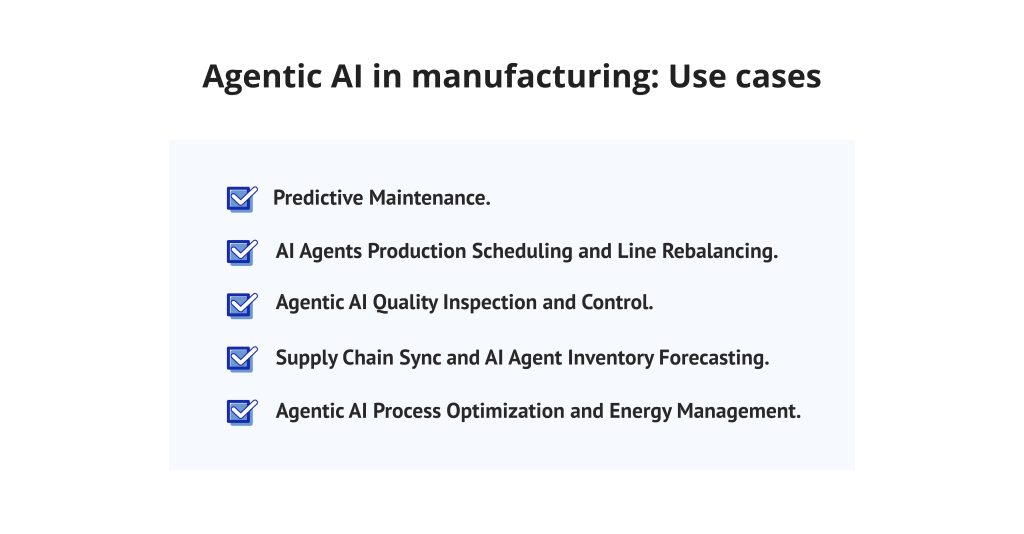
Five use cases lead the field today. Each one pairs a measurable KPI with a workflow that already crosses several systems.
Predictive Maintenance
Downtime creates the clearest business case. Siemens reports that its Senseye clients cut unplanned machine downtime by 50% and maintenance costs by 40%, though these are vendor-reported figures for AI-driven prediction, not for agents. The agentic layer adds action: the agent books the repair window, orders the part, and updates the schedule, with a human approving the final steps, as in Deloitte’s aftermarket example.
AI Agents Production Scheduling and Line Rebalancing
When a part runs short or a machine fails, the plan breaks. In Deloitte’s example, the agents track inventory, worker skills, equipment status, and demand. They generate a revised schedule, reroute workers by skill, and ask a production planner to approve the change.
Agentic AI Quality Inspection and Control
A vision model flags a defect but does not find the cause. Agentic AI quality inspection closes that gap. In Deloitte’s smartphone-plant example, monitoring agents inspect components in real time, and an audit agent investigates root causes and writes actionable reports. We recommend approval gates for any process parameter change.
Supply Chain Sync and AI Agent Inventory Forecasting
When a disruption hits, Deloitte says agents can monitor Tier 1 and Tier 2 suppliers, quantify the financial impact, recommend alternative suppliers, and start mitigation with human approval. AI agent inventory forecasting ties demand signals to reorder points and supplier lead times. Gartner predicts that 60% of enterprises using supply chain management software will adopt agentic features by 2030, up from 5% in 2025.
Agentic AI Process Optimization and Energy Management
Process plants use control agents that adjust equipment based on live sensor data. In Deloitte’s chemical-plant example, a process analysis agent finds trends and bottlenecks while control agents act on them. Agentic AI process optimization also reaches energy, where Schneider Electric is building agentic software that automates complex data analysis for energy and sustainability experts.
Editorial note: In our source review, the quantified evidence is strongest for maintenance and supplier coordination. Evidence for fully autonomous quality control rests mostly on vendor and consultancy examples, so pilot before you commit.
How to Implement Agentic AI in Manufacturing?
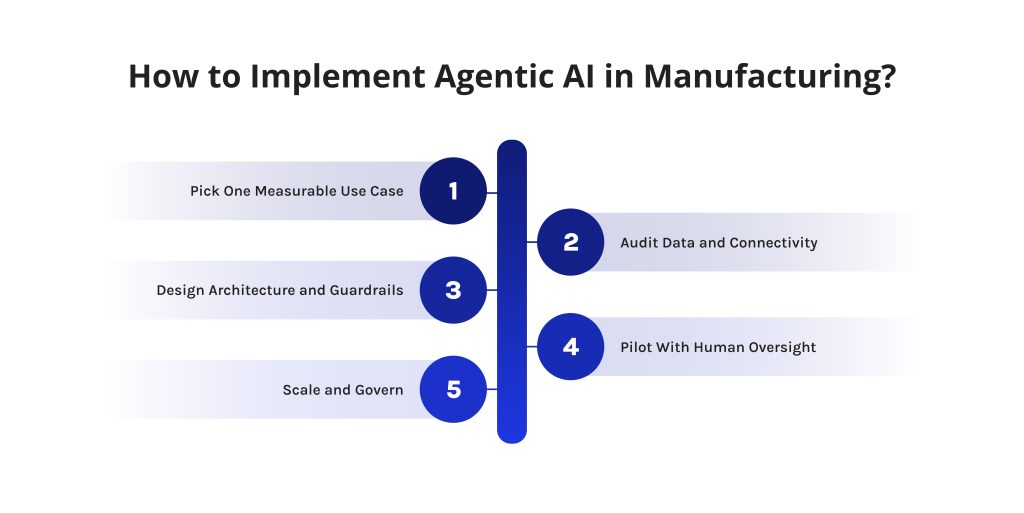
Gartner predicts that over 40% of agentic AI projects will be canceled by the end of 2027 because of escalating costs, unclear business value, or inadequate risk controls. A disciplined rollout addresses all three.
Pick One Measurable Use Case
Deloitte urges an “understand scale first” approach: prioritize the solutions with the highest value at scale. Score each candidate on coordination complexity, need for real-time responsiveness, and autonomy potential. Then weigh business impact. If a workflow needs only fixed rules, choose automation instead.
Audit Data and Connectivity
Map every system each agent must touch, such as ERP, MES, maintenance, and quality systems. Check data quality, access rights, and update frequency. Deloitte recommends strong data governance, a common data ontology, and knowledge graphs as the data backbone [5].
Design Architecture and Guardrails
Choose a modular architecture with clear agent roles, and prefer platforms that offer agentic AI for manufacturing with native MES and ERP connectors. Deloitte suggests a hybrid strategy that mixes tailored development with existing platforms. Log every agent action, because AI systems that change schedules or contracts need audit trails. Ask vendors to prove capability: Gartner estimates that only about 130 of the thousands of vendors claiming agent capabilities are real.
Pilot With Human Oversight
Launch in one plant or one line. Keep approval gates on changes to schedules, contracts, and work instructions. Track how often humans override the agent, and record why. Deloitte also recommends dashboards for human oversight and supervisory controls inside every agent workflow.
Scale and Govern
Expand only after the AI agents reach the pilot’s KPI targets. Deloitte’s guidance covers governance, workforce training, and change management. Its research also shows that organizations investing in human capabilities are almost twice as likely to achieve superior business outcomes.
How to Measure Success with Agentic AI?
Record baselines before the pilot starts, because without a baseline you cannot prove impact. Then track a small set of KPIs tied to the pilot’s goal.
- Plant-level KPIs to track: overall equipment effectiveness (OEE), unplanned downtime hours, scrap and rework rate, schedule adherence, changeover time, inventory turns, and energy use per unit produced.
- Agent health metrics: task completion rate, human override rate, escalation rate, and cost per agent action.
- Decision-making metrics: the share of agent decisions accepted without edits and the time from detection to action.
McKinsey’s 2026 survey shows why measurement matters. Only 37% of respondents attribute some EBIT impact to AI, and AI high performers — about 6% of respondents — are twice as likely to have defined processes for measuring impact.
Conclusion
Agentic AI works in manufacturing if the ambition matches the scope, data, and control. Start with a single use case with a measurable KPI. Use real data, keep people in the approval process, and scale only what is proven by the numbers.
The lesson of Gartner’s cancellation prediction and McKinsey’s flat EBIT figure is that discipline generates value, not hype. Established AI systems reward manufacturing plants that prepare their data and personnel beforehand. Teams treating agentic AI as an operations administration instead of a software purchase enjoy better decision-making process and faster recovery from disruptions.
Enjoyed this guide? Subscribe to Digest.Pro on LinkedIn for more research-backed guides on enterprise technology, AI, and project management.
FAQs
Agentic AI in manufacturing is an automated software that creates targets, plans multistep activities, and keeps executing them everywhere inside the plant. RPA is based on prescribed scripts and predictive models classification and forecasting. Agentic AI systems define their next steps, use tools and change as circumstances change, while humans approve risky actions only.
Gen AI produces a piece of content on request, while the AI agent performs an action to achieve the final result. Both types of AI operate on big language models. However, agents have a memory, access to tools and a plan. For instance, in Deloitte’s example, a chatbot responds to CNC maintenance questions, while an agent also informs the scheduler and registers the event.
A multi-agent system is a team of specialized AI agents that coordinate through an orchestrator to complete a plant workflow. In Deloitte’s automotive example, one agent validates orders, another allocates parts and labor, and a third ensures just-in-time delivery of components. The orchestrator resolves conflicts between them.
Closed-loop autonomy means an agent senses a condition, decides, acts, and checks the result within set limits. In Deloitte’s maintenance example, the agent adjusts instructions when sensors detect an anomaly and then logs completion data. Approval gates stay on high-risk actions through human-in-the-loop review.
Agents turn maintenance alerts into completed repairs. Standard predictive maintenance flags a failing asset. An agent also books the service window, orders the part, and updates the production schedule, with a human approving the final steps.
They monitor supply, labor, and equipment status, then rebuild the schedule when a disruption hits. In Deloitte’s example, agents track inventory, worker skills, machine status, and demand. After a part shortage or failure, they draft a revised schedule, reroute workers, and ask a planner to approve it.
Yes, within set guardrails. Agents can detect a defect, investigate the root cause, and propose or apply process adjustments, while humans approve high-risk changes. Gartner cautions that many use cases sold as agentic do not need agentic implementations, so test simpler automation first.
They track energy and resource use continuously and recommend or apply adjustments to equipment and schedules. Schneider Electric is building agentic software for energy and sustainability that works alongside human experts. Start with metered lines, where energy data already exists.
It links demand, inventory, supplier, and production signals so plans update as conditions change. In Deloitte’s example, agents monitor news, weather, and logistics data, compare alternative suppliers, share delays with the production scheduler, and update customers.
Yes, industrial AI systems now run on edge hardware, including air-gapped sites. Rockwell Automation runs a small language model on HMI panels, appliances, and desktop tools. Deloitte advises edge computing and low-latency networks for real-time alerts, so design time-critical steps for the edge.
References
- Gartner. (2026, April 7). Gartner forecasts supply chain management software with agentic AI will grow to $53 billion in spend by 2030 [Press release]. https://www.gartner.com/en/newsroom/press-releases/2026-04-07-gartner-forecasts-supply-chain-management-software-with-agentic-ai-will-grow-to-53-billion-in-spend-by-2030
- The state of AI in 2026: On the road to ROI. McKinsey & Company. https://www.mckinsey.com/capabilities/quantumblack/our-insights/the-state-of-ai
- Siemens AG. (2024). The true cost of downtime 2024: How much do leading manufacturers lose through inefficient maintenance? Senseye Predictive Maintenance. https://assets.new.siemens.com/siemens/assets/api/uuid:1b43afb5-2d07-47f7-9eb7-893fe7d0bc59/TCOD-2024_original.pdf
- Deloitte. (n.d.). Deciphering agentic AI for manufacturing: Key considerations and use cases. The Business Operations Room. https://www.deloitte.com/us/en/services/consulting/blogs/business-operations-room/agentic-ai-in-manufacturing.html
- Henderson, P., Chavali, A., Berckman, L., Hardin, K., & Morehouse, J. (2025, September 23). From vision to value: A road map for enterprise transformation in manufacturing with agentic AI. Deloitte Insights. https://www.deloitte.com/us/en/insights/industry/manufacturing-industrial-products/agentic-ai-manufacturing-digital-transformation.html
- Gartner. (2025, May 21). Gartner predicts half of supply chain management solutions will include agentic AI capabilities by 2030 [Press release]. https://www.gartner.com/en/newsroom/press-releases/2025-05-21-gartner-predicts-half-of-supply-chain-management-solutions-will-include-agentic-ai-capabilities-by-2030
- Gartner. (2025, June 25). Gartner predicts over 40% of agentic AI projects will be canceled by end of 2027 [Press release]. https://www.gartner.com/en/newsroom/press-releases/2025-06-25-gartner-predicts-over-40-percent-of-agentic-ai-projects-will-be-canceled-by-end-of-2027
- Rockwell Automation. (2025, November 13). Rockwell Automation to advance industrial intelligence through edge-based generative AI with NVIDIA Nemotron [Press release]. https://www.rockwellautomation.com/en-us/company/news/press-releases/rockwell-automation-to-advance-industrial-intelligence-through-e.html
- Schneider Electric. (2025, May 15). Schneider Electric announces multi-year initiative in AI-native ecosystem for sustainability and energy management [Press release]. PR Newswire. https://www.prnewswire.com/news-releases/schneider-electric-announces-multi-year-initiative-in-ai-native-ecosystem-for-sustainability-and-energy-management-302456420.html
- Shepley, S., Morehouse, J., Hardin, K., & Dwivedi, K. (2025, November 13). 2026 manufacturing industry outlook. Deloitte Insights. https://www.deloitte.com/us/en/insights/industry/manufacturing-industrial-products/manufacturing-industry-outlook.html
- Siemens AG. (2025, May 12). Siemens introduces AI agents for industrial automation [Press release]. https://press.siemens.com/global/en/pressrelease/siemens-introduces-ai-agents-industrial-automation