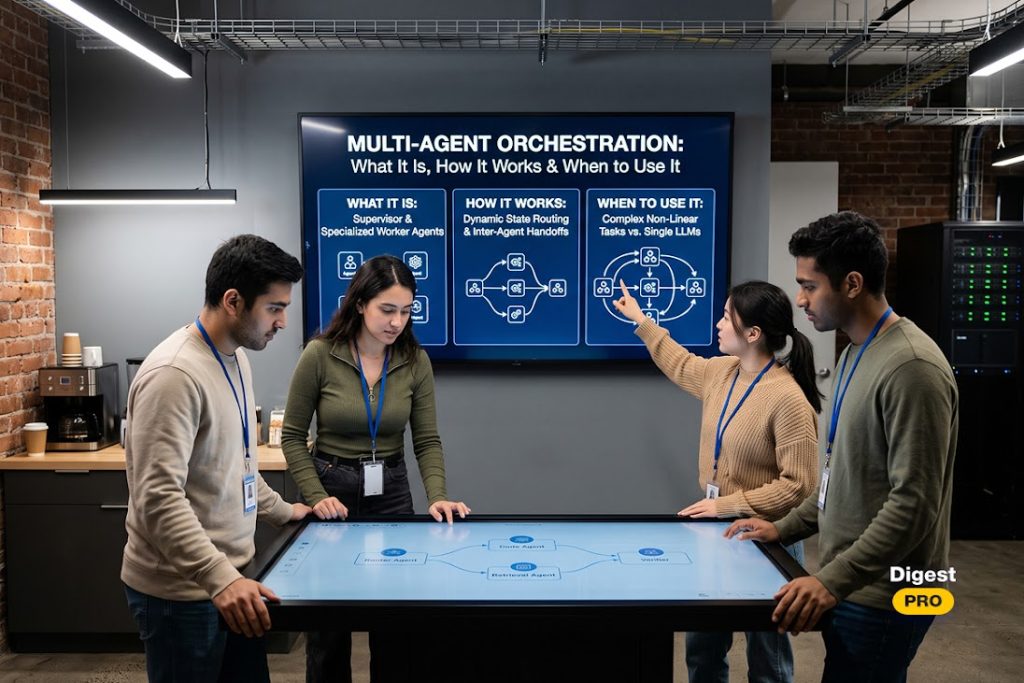
Multi-agent orchestration is the coordination layer for specialized AI agents. It assigns tasks, passes context between agents, and controls the order of work. Enterprises now treat it as a core design decision, not a lab experiment.
This demand is measurable. According to the 2025 Global Survey conducted by McKinsey, 62% of companies are exploring AI agents, while 23% have scaled their agentic solution to at least one organizational unit. Multi-agent systems are mentioned as part of Gartner’s Top Strategic Technology Trends for 2026.
The risk is just as clear. Gartner predicts that over 40% of agentic AI projects will be canceled by the end of 2027 [3]. The causes are rising costs, unclear business value, and weak risk controls.
After reading this guide, you will understand how multi-agent orchestration works, which pattern and framework fit your use case, and how to plan a rollout that avoids the main cost and failure traps.
What is multi-agent orchestration?
Multi-agent orchestration refers to the management of multiple AI agents collectively. The orchestrator makes decisions regarding the timing and data that should be used by each agent. In this context, the orchestrator could be LLMs, coded definitions, and/or their combination.
The multi-agent orchestration process involves the following stages:
1. Intake – the task is assigned to the orchestrator.
2. Planning – the orchestrator plans what needs to be done and decides which agents complete particular activities.
3. Execution – the agents perform their duties at once.
4. Synthesis – the results are collected by the orchestrator.
This principle is applied by Anthropic when implementing the Research function. In that, one main agent performs the planning and initiates the activity using three to five sub-agents, and one citing agent completes the attribution of findings.
Single-agent limitations vs multi-agent systems
A single agent handles narrow tasks well. It struggles when one context window must hold the tools, the history, and several roles at once. Instructions begin to conflict, and errors compound across steps. Single-agent orchestration remains the right baseline: one model, one tool set, and one loop.
Multi-agent systems split that load. Each agent gets its own context window, tools, and prompt. Anthropic reports that a lead Claude Opus 4 agent with Claude Sonnet 4 subagents outperformed a single Claude Opus 4 agent by 90.2% on its internal research evaluation. The same source warns that multi-agent systems use about 15 times more tokens than chat, while one agent uses about 4 times more.
| Dimension | Single agent | Multi-agent systems |
|---|---|---|
| Context | One shared window | Separate window per agent |
| Specialization | One prompt covers many roles | One role per agent |
| Parallel work | Sequential | Parallel subtasks |
| Token use vs chat | About 4× | About 15× |
| Debugging | One trace | Traces across several agents |
| Best fit | Narrow, linear tasks | Broad, parallel, high-value tasks |
The choice depends on the task. Multi-agent orchestration pays off when work splits into independent threads, and the result justifies the extra cost. It fits poorly when every agent needs the same context, as in most coding tasks, according to the same Anthropic analysis.
Core architectural components
Multi-agent orchestration rests on five layers: an orchestrator, specialized workers, shared state, communication protocols, and governance. Governance wraps every other layer, as the diagram shows.
Core architecture · orchestrator, 3 workers, shared state, governance
Central orchestrators and planner agents
The orchestrator is the single point of task decomposition. It reads the goal, plans the subtasks, selects agents, and merges their results. A planner agent handles only the planning step, while the orchestrator also supervises execution.
A multi-agent orchestrator must also control effort. Anthropic’s early agents spawned 50 subagents for simple queries, so its team added explicit scaling rules to the prompts. Simple fact-finding now gets one agent with 3 to 10 tool calls, while complex research can use more than 10 subagents.
Specialized worker agents and tool integration
Each worker owns a narrow role, a focused prompt, and a small tool set. Narrow scope improves tool choice. Anthropic found that poorly written tool descriptions can send agents down the wrong path, so every tool needs a distinct purpose.
Workers connect to the systems where work happens. Typical targets are a ticketing system, a CRM, a code repository, or a task management system. These connections turn model output into real workflow automation.
Shared state, persistent memory, and context transfer
State makes orchestration reliable. Anthropic’s lead agent saves its plan to memory because the context is truncated once it passes 200,000 tokens. Without that step, the plan would vanish mid-run.
Subagents can also write results to external storage and return only a short reference. According to the same source, this limits information loss between agents and cuts token overhead. LangGraph takes a similar approach with durable execution, so agents resume from where they left off after a failure.
Enjoying this guide? Follow Digest.Pro on LinkedIn for weekly briefings on AI agents and enterprise technology: Subscribe on LinkedIn
Agent-to-agent communication protocols and handoffs
Two protocols cover most communication. The Model Context Protocol (MCP) gives an agent access to external tools. The Agent2Agent (A2A) protocol is an open standard, originated by Google and donated to the Linux Foundation, for communication between different agent systems.
Handoffs transfer control inside one system. In the OpenAI Agents SDK, a handoff passes control from one agent to another during a run. Give each agent a stable agent ID, so logs, permissions, and handoffs always point to the right actor.
Governance, safety guardrails, and evaluation layers
Governance lays down the framework. Each agent is given a unique agent ID and is only granted the minimum level of access it needs to fulfill its role, thus ensuring that a confused agent will not come across sensitive information. Introduce an intermediary person before making decisions that have a significant impact, as these decisions are related to money, customers, or code.
Guardrails and tracing complement the layer of governance. OpenAI Agents SDK is equipped with input and output guardrails and tracing tools, while LangGraph offers a mechanism for inspecting the agent’s state through human intervention. Record all agent IDs, all tool calls, and handoffs for documenting possible issues later on.
Evaluation provides closure. Anthropic employs a constant flow using LLM judgment according to certain criteria such as reliability of the information used, proper citation of the sources of information, completeness of the information used, quality of the information sources, and effectiveness of the tools. Human testers still matter: they noticed that early agents preferred SEO-optimized content farms over authoritative sources. For deeper coverage of this layer, see our review of the best AI governance tools and how to choose them.
Teams can buy these layers as a multi-agent orchestration platform or assemble them from open-source multi-agent orchestration frameworks. The next section covers the design patterns that run on top of this stack.
The five primary orchestration design patterns
Anthropic’s guide to building effective agents names five composable workflow patterns. Anthropic describes them for LLM systems, and each maps onto a design with several agents when an agent replaces an LLM call. These multi-agent orchestration patterns range from fixed pipelines to open-ended dynamic workflows. Anthropic’s advice is to choose the simplest pattern that works and add complexity only when results improve.
| Pattern | How it works | Best for | Main trade-off |
|---|---|---|---|
| Orchestrator-workers | A lead agent splits the task at runtime and delegates | Unpredictable, multi-part tasks | Higher token cost |
| Prompt chaining | A fixed sequence where each step uses the previous output | Predictable, linear tasks | Added latency per step |
| Parallelization | Independent subtasks or repeated attempts run at once | Speed or higher confidence | Needs truly independent subtasks |
| Routing | A classifier sends each input to a specialist | Mixed inputs with clear categories | A wrong route sends work to the wrong agent |
| Evaluator-optimizer | One agent generates and another critiques in a loop | Tasks with clear quality criteria | Extra loops add cost and delay |
1. Orchestrator-workers
A central agent breaks the task down, delegates the pieces, and synthesizes the results. Subtasks are not predefined, because the orchestrator decides them from each input. This is the pattern behind Anthropic’s Research feature and its 90.2% gain over a single agent on an internal evaluation.
Use it for work with unknown steps, such as research across many sources. Expect a token bill of about 15 times a normal chat, according to the same source.
2. Prompt chaining
This pattern splits a task into a fixed sequence of steps. Each call processes the output of the previous one, and code can check quality between steps. A typical chain drafts an outline, reviews it, and then writes the document from the approved outline.
Choose it when the steps are known in advance. It trades some speed for accuracy, because each call has a narrower job.
3. Parallelization
Parallelization has two variants. Sectioning runs independent subtasks at the same time. Voting runs the same task several times and compares answers to raise confidence.
The speed gain is large. Anthropic reports that running subagents and tool calls in parallel cut research time by up to 90% on complex queries.
4. Routing
The process of routing involves the classification of inputs and directing them to handling specialists based on their field of expertise. This helps maintain the prompt and ensures that simpler questions can be answered by simpler models without burdening heavier models.
In customer experience automation, the routing agents can handle a variety of requests concerning billing, repairing a technical problem, or seeking a refund. The drawback is the possibility of misrouting, and therefore each routing decision should be logged.
5. Evaluator-optimizer
In this method, an output is developed by one agent and is then evaluated by another agent. The feedback loop continues until the output meets specific quality standards.
A limit needs to be placed on the number of rounds since this method is in no way optimal because it does not offer a solution.
In reality, several methods can be applied at the same time. An example of this could be the application of routing with follow-up processing of a query by a group of workers or further processing of the output provided by the evaluator-optimizer. Our Quick Guide to Agentic Workflow shows how to build these loops step by step.
Orchestration topologies and structural models
Topology defines who talks to whom in a multi-agent system. Decide it before you choose among multi-agent orchestration frameworks, because it sets your control, latency, and audit options.
Centralized vs hierarchical vs decentralized systems
| Topology | How control flows | Strength | Weakness |
|---|---|---|---|
| Centralized | One orchestrator directs all workers | Simple control and auditing | Bottleneck and single point of failure |
| Hierarchical | Orchestrators manage sub-orchestrators, each with its own workers | Scales to large task trees | More hops, latency, and cost |
| Decentralized | Agents pass control to each other with no central router | Flexible and resilient | Harder to trace and govern |
A centralized multi-agent orchestrator is the usual starting point. Its limit is speed: in Anthropic’s design, the lead agent waits for each set of subagents to finish, so it cannot steer them mid-run and one slow subagent blocks the whole system.
Hierarchical designs add a middle layer for large tasks. Decentralized designs remove the router. Microsoft Agent Framework offers a handoff orchestration for routed specialist teams, where control moves between agents based on context.
Deterministic graphs vs dynamic runtime workflows
A deterministic graph fixes the path in code. Nodes do the work, edges decide what runs next, and the same input follows the same route. LangGraph is built for this style: it provides low-level infrastructure for long-running, stateful workflows.
Dynamic workflows let the model choose the path at runtime. Anthropic separates workflows, which follow predefined code paths, from agents that direct their own process. Microsoft’s Magentic orchestration shows the dynamic end: a manager agent builds a plan, assigns work, checks progress after each round, and revises the plan.
Our reading of the framework documentation shows a common split. Teams run a deterministic outer graph for audit and repeatability, and they allow dynamic workflows only inside bounded steps. Choose fixed graphs for finance and compliance, where auditable decision-making matters, and dynamic workflows for open-ended research.
Want more guides on enterprise AI and project technology? Follow Digest.Pro on LinkedIn for weekly expert analysis: Subscribe on LinkedIn
Leading multi-agent frameworks comparison
Multi-agent orchestration frameworks differ most in how much control they hand to you. Some give a low-level graph. Others give a ready-made team abstraction. We compared four options against five criteria: control over state and flow, built-in multi-agent primitives, observability and tracing, human oversight features, and maturity. Our team used official documentation and repositories, and we did not run hands-on benchmarks.
LangGraph vs CrewAI vs AutoGen vs OpenAI Agents SDK
| Framework | Orchestration model | Strengths | Limits | Best for |
|---|---|---|---|---|
| LangGraph | Stateful graph of nodes and edges | Durable execution, human-in-the-loop, streaming and memory | Low-level, so you design more of the control flow | Long-running, auditable workflows |
| CrewAI | Crews of role-based agents, run sequentially or hierarchically | Built-in short-term, long-term and entity memory | Hierarchical mode requires a manager LLM | Role-based teams for research and content work |
| AutoGen | Conversation-driven agent groups | Large installed base from research and pilots | In maintenance mode since October 2025 | Existing projects only |
| Microsoft Agent Framework | Sequential, concurrent, group chat, handoff, and Magentic orchestrations | Stable 1.0 orchestrations in Python and .NET | Migration work for AutoGen users | Microsoft and .NET stacks |
| OpenAI Agents SDK | Agents that delegate through handoffs or agents-as-tools | Built-in guardrails, sessions, tracing and human-in-the-loop | Lightweight loop; durable runs may need an extra runtime | Lightweight apps with clear handoffs |
LangGraph leads on control. Its documentation lists durable execution, human-in-the-loop, and streaming as core capabilities, which suits regulated workflows. CrewAI leads on speed to a first working team, because you define agents, tasks, and a process.
AutoGen needs a clear decision. Atlan’s July 2026 analysis confirms that AutoGen has been in maintenance mode since October 2025, with Microsoft Agent Framework as its official successor. Teams on AutoGen should plan a migration, while new projects should start on the successor or another framework.
The OpenAI Agents SDK is the smallest of the group. It offers agents, handoffs, guardrails, and tracing in a compact package, and it supports MCP tools. Pick it when your workflow maps to a few specialists with clean handoffs.
Some buyers want a managed multi-agent orchestration platform instead of code. Score any orchestration platform for multi-agent systems, and any multi-agent orchestration software, on the same five criteria. For a wider tool list, see our guides The 9 Best AI Agent Frameworks in 2026 (Compared) and The Complete Guide to Self-Hosted AI Agents.
Engineering challenges and trade-offs
Coordinating several agents adds power and adds failure modes. Gartner analyst Anushree Verma warns that “Many use cases positioned as agentic today don’t require agentic implementations”. Test whether one agent solves the problem before you coordinate multiple AI agents.
Scale is the other warning sign. McKinsey reports that in any business function, no more than 10% of respondents say their organizations are scaling AI agents. Most teams are still learning how to run these systems.
The gap between pilots and scaled results is mostly organizational. Our guide to AI adoption challenges and how executives overcome them shows which barriers to clear before you fund a multi-agent build.
Latency, compounding token costs, and context drift
Cost grows fast. Anthropic measured that a single agent uses about 4 times the tokens of a chat, and multi-agent systems use about 15 times more. The same analysis found that token usage alone explains 80% of performance variance on a browsing benchmark. Better answers cost more, so the task must be worth the spend.
Latencies accrue much the same way. Each handover creates a model invocation, and a coordinator that supervises all participants advances at the speed of the slowest one. Execute independent subtasks in parallel and ensure that sequential chains stay short.
Context drift is a subtle danger. Knowledge disappears or is modified when the output goes through another agent. Keep large results outside of the dialogue, transmitting only references and saving plans in long-term memory. View every handover as a potential compromise of confidential information and share only data that the next agent requires.
Handling cascading failures and execution loops
Errors pile up in agents that run for an extended time. According to Anthropic, minor failures in the system may cause disastrous consequences for agents: the failure of a single step can change the trajectory of the execution. The first agents were also endlessly seeking non-existent resources and got distracted by unnecessary updates.
Use the following control measures to avoid failures:
- Checkpoints: Continue from the last successful step instead of restarting the execution.
- Limited number of retries: Retry an ineffective tool a fixed number of times before taking it to the next level of escalation.
- Turn and iteration caps: The OpenAI Agents SDK, for example, raises an error when the maximum number of turns is exceeded.
- Effort rules: Tell the orchestrator how many agents a task of each size deserves.
- Tracing: Log decisions and handoffs so you can find the failing step.
- Staged releases: Anthropic uses rainbow deployments, which shift traffic gradually so running agents are not disrupted.
These controls matter most for dynamic workflows, where the path is not known in advance.
Get new expert guides in your feed. Subscribe to Digest.Pro on LinkedIn for analysis of AI, PMO and startup trends: Subscribe on LinkedIn
Enterprise multi-agent use cases
Three domains show where multi-agent orchestration fits today. The agent roles below are design examples, not vendor benchmarks.
Omnichannel support, software engineering, and finance
| Domain | Typical agent roles | Pattern | Key control |
|---|---|---|---|
| Omnichannel support | Intake, routing, specialist and quality-check agents | Routing plus evaluator-optimizer | Policy guardrails and human escalation |
| Software engineering | Planner, coder, reviewer and test agents | Orchestrator-workers plus evaluator-optimizer | Shared context and tests as gates |
| Finance | Data, reconciliation, anomaly and compliance agents | Deterministic graph plus routing | Approval gates and a full audit trail |
Omnichannel support is the clearest fit for customer experience automation. A routing agent reads the request from chat, email, or voice and hands it to a billing, technical, or refund specialist. A quality agent then checks tone and policy before the reply goes out. Gartner predicts that agentic AI will autonomously resolve 80% of common customer service issues by 2029, which makes clean handoffs and escalation rules a priority.
Software engineering needs more care. A planner can split a feature into modules, coder agents can build them, and a reviewer agent can critique the result in an evaluator-optimizer loop. However, Anthropic notes that most coding tasks have fewer truly parallelizable parts than research. Keep shared context tight and use test results as the pass-or-fail gate.
Finance favors deterministic control. One agent collects data, another reconciles entries, a third flags anomalies, and a fourth checks compliance rules. Decision-making that posts entries or releases payments should stay behind human approval. Our guide to AI agents in finance: trends, use cases and controls for 2027 covers these controls in depth.
Across all three domains, the best first project is a bounded workflow automation task with a measurable outcome. Expand only after the pilot proves its value.
Step-by-step implementation roadmap
A disciplined rollout of multi-agent orchestration follows nine steps. Each step ends with a decision, so progress is easy to review.
From system scoping to production telemetry
- Scope the workflow. Pick one bounded process for workflow automation with a measurable outcome, such as ticket resolution time. Confirm that the task is valuable enough to justify higher token costs.
- Build a single-agent baseline. Single-agent orchestration with tools sets the quality bar. Add agents only where it fails.
- Choose a pattern and topology. Match the task to one of the five patterns and start centralized with one multi-agent orchestrator.
- Define agents, tools, and identities. Give each agent a narrow role, a clear tool list, an agent ID, and least-privilege access.
- Design state and handoffs. Decide what goes into shared state, what each agent receives, and which fields stay hidden.
- Add guardrails and approval gates. Validate inputs and outputs, and require human approval for high-impact actions.
- Evaluate early. Anthropic started with about 20 representative queries, then used an LLM judge and human testers. Copy that approach before you scale.
- Release in stages. Run the system in a sandbox, then on a small share of traffic, then widen the rollout.
- Monitor production telemetry. Trace every run and review the signals below weekly.
Track these telemetry signals from day one:
- Task success rate against the single-agent baseline
- Tokens and cost per completed task
- End-to-end latency, including the slowest agent
- Handoff count and loop count per run
- Tool error and retry rates
- Escalations to humans and their causes
For a step-by-step build, see our How to Build an AI Agent: A Practical Guide for 2026. The same discipline applies when you coordinate multiple AI agents on shared project data, for example inside a task management system.
PMO leaders can place this rollout in a wider delivery context. Our overview of project management trends for 2027 covers AI, hybrid delivery and the value-driven PMO.
Summary
Multi-agent orchestration coordinates specialized agents through an orchestrator, shared state, clear protocols, and governance. It outperforms a single agent on broad, parallel, high-value tasks, but it costs more in tokens, latency, and engineering effort.
Choose the pattern by task shape: fixed pipelines for known steps, routing for mixed inputs, parallelization for independent work, orchestrator-workers for unknown steps, and evaluator-optimizer for quality loops. Then pick a framework that matches your control and governance needs. Start small, measure, then scale is the safest path.
Gartner expects many agentic projects to be canceled by 2027, so disciplined scoping and telemetry matter more than agent count. Teams that prove value on one bounded workflow can then extend multi-agent orchestration patterns to wider workflow automation.
To see where governed autonomy is heading next, read our analysis of agentic AI trends for 2027, which tracks the shift from pilots to controlled deployments.
Stay ahead of enterprise AI shifts. Subscribe to Digest.Pro on LinkedIn for expert guides on AI agents, PMO technology, and startup ecosystems: Subscribe on LinkedIn
Frequently asked questions (FAQs)
What is multi-agent orchestration?
Multi-agent orchestration is the coordination of several specialized AI agents so they can complete one goal together. An orchestrator assigns subtasks, shares context, and merges the results. It turns separate agents into one controlled workflow.
How does the multi-agent orchestration process work?
The process runs in four steps: intake, planning, execution, and synthesis. The orchestrator reads the goal and splits it into subtasks. Worker agents run them, often in parallel, and the orchestrator merges and checks the results.
What are the different types of multi-agent orchestration?
Multi-agent orchestration comes in five design patterns and three topologies.
- Patterns: prompt chaining, routing, parallelization, orchestrator-workers, and evaluator-optimizer
- Topologies: centralized, hierarchical, and decentralized
What are some real-world use cases for multi-agent orchestration?
Common use cases are omnichannel customer support, software engineering, and finance operations. Customer experience automation uses routing agents to send requests to specialists. Engineering teams combine planner, coder, and reviewer agents, and finance teams add approval gates and audit trails.
Multi-agent vs single-agent orchestration: what’s the difference?
Single-agent orchestration runs one model with tools in a loop, while multi-agent orchestration coordinates several agents with separate roles and contexts. Multi-agent AI orchestration adds parallel work and specialization. It also raises cost: Anthropic measured about 15 times the chat tokens for multi-agent systems and about 4 times for one agent.
What is the difference between multi-agent orchestration and a single AI agent?
A single AI agent is one actor, while multi-agent orchestration is the layer that coordinates many actors. An agent plans and acts on its own task. The orchestration layer assigns work, routes handoffs, manages shared state, and enforces guardrails.
How can multi-agent orchestration be implemented?
Implement it in stages: scope one workflow, build a single-agent baseline, choose a pattern, then add agents, guardrails, and telemetry. Multi-agent orchestration can use tools such as LangGraph, CrewAI, Microsoft Agent Framework, or the OpenAI Agents SDK. Release it gradually, and track cost and success rates.
What are the main benefits of multi-agent orchestration?
The main benefits are parallel speed, specialization, and scale beyond one context window. In Anthropic’s internal evaluation, a multi-agent system outperformed a single agent by 90.2%. Parallel execution also cut research time by up to 90% on complex queries.
What challenges does multi-agent orchestration present?
The main challenges are token cost, latency, context drift, cascading failures, and governance.
- Costs rise with every added agent
- Handoffs lose or distort context
- One failed step can derail a whole run
- Agents need identities, permissions, and audit trails
What does multi-agent orchestration cost?
Cost depends mainly on token use, and multi-agent systems use about 15 times more tokens than a chat. Open-source frameworks add no license fee for the core library. You still pay for model usage, hosting, monitoring, and engineering time, so budget per completed task rather than per agent.
References
A2A Project. (n.d.). Agent2Agent (A2A) protocol. https://a2a-protocol.org/latest/
Atlan. (2026, July 27). What is AutoGen? Microsoft’s multi-agent framework explained. https://atlan.com/know/ai-agent/what-is-autogen/
CrewAI. (n.d.). Crews. CrewAI Documentation. https://docs.crewai.com/concepts/crews
Gartner. (2025a, March 5). Gartner predicts agentic AI will autonomously resolve 80% of common customer service issues without human intervention by 2029 [Press release]. https://www.gartner.com/en/newsroom/press-releases/2025-03-05-gartner-predicts-agentic-ai-will-autonomously-resolve-80-percent-of-common-customer-service-issues-without-human-intervention-by-20290
Gartner. (2025b, June 25). Gartner predicts over 40% of agentic AI projects will be canceled by end of 2027 [Press release]. https://www.gartner.com/en/newsroom/press-releases/2025-06-25-gartner-predicts-over-40-percent-of-agentic-ai-projects-will-be-canceled-by-end-of-2027
Gartner. (2025c, October 20). Gartner identifies the top strategic technology trends for 2026 [Press release]. Business Wire. https://www.businesswire.com/news/home/20251020453550/en/Gartner-Identifies-the-Top-Strategic-Technology-Trends-for-2026
Hadfield, J., Zhang, B., Lien, K., Scholz, F., Fox, J., & Ford, D. (2025, June 13). How we built our multi-agent research system. Anthropic. https://www.anthropic.com/research/multi-agent-research-system
LangChain. (n.d.). LangGraph overview. LangChain Documentation. https://docs.langchain.com/langgraph
Mattson, E. (2026, July 8). Agent Framework’s orchestration patterns reach 1.0. Microsoft Agent Framework Blog. https://devblogs.microsoft.com/agent-framework/agent-frameworks-orchestration-patterns-reach-1-0
McKinsey & Company. (2025). The state of AI in 2025: Agents, innovation, and transformation. https://www.mckinsey.com/capabilities/tech-and-ai/our-insights/the-state-of-ai-2025
OpenAI. (n.d.). OpenAI Agents SDK (JavaScript/TypeScript) [Source code repository]. GitHub. https://github.com/openai/openai-agents-js
Pan, L. (2026). Top 10 AI agent frameworks worth trying in 2026. ZimaSpace. https://shop.zimaspace.com/blogs/tech-ai-hub/top-10-ai-agent-frameworks-worth-trying-in-2026
Reuters. (2025, June 25). Over 40% of agentic AI projects will be scrapped by 2027, Gartner says. The Star. https://www.thestar.com.my/tech/tech-news/2025/06/25/over-40-of-agentic-ai-projects-will-be-scrapped-by-2027-gartner-says
Schluntz, E., & Zhang, B. (2024, December 19). Building effective agents. Anthropic. https://www.anthropic.com/engineering/building-effective-agents