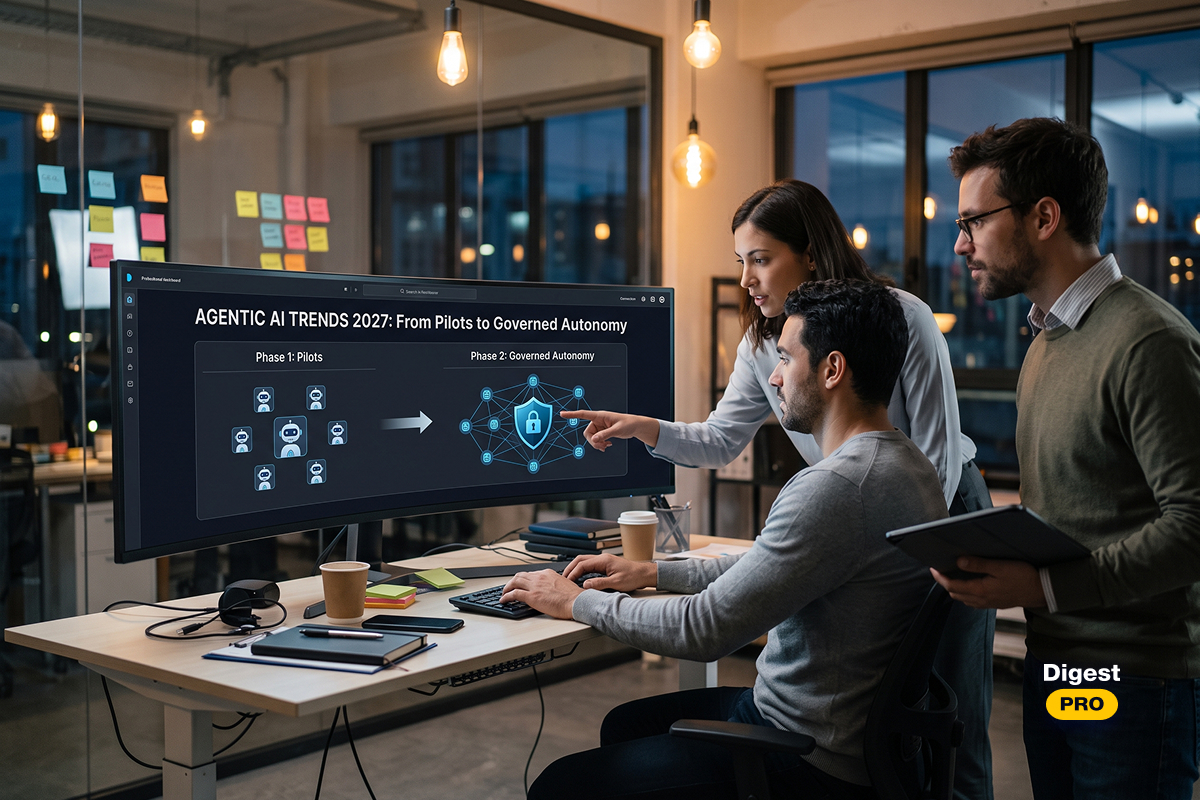

The best AI governance tools give enterprises control over AI that already moves faster than policy. IBM’s 2026 Cost of a Data Breach Report found that shadow AI was involved in 43% of the incidents it studied, more than twice the previous year’s share [1]. The same report found that 92% of organizations hit by AI-related breaches lacked proper access controls for their AI systems [1].
This document compares the top 7 AI governance tools for 2026. It discusses how each one governs AI platforms used by organizations while presenting the pricing and the shortcomings of each tool.
TL;DR
- Enterprise centered around Microsoft: Microsoft Purview.
- GRC and Privacy teams searching for a corporate governance solution: OneTrust.
- Shadow AI discovery and compliance with the EU law on AI: Holistic AI.
- Managed AI workflow and agents in automated processes: Zapier.
- Central control over employee and developer LLM access: nexos.ai.
- Production guardrails and agent monitoring: Fiddler AI.
- Lifecycle control across hundreds of AI use cases: ModelOp Center.
Our methodology
We evaluated each of the tools that help in the governance of AI based on seven parameters. These parameters distinguish the top outcomes in AI governance from simple point products. The list was guided by the advice given by Gartner. It tells buyers to emphasize having a centralized AI inventory, regulatory coverage, and data collection [2].
- Visibility: Does the tool build an inventory and find shadow AI, including third-party and embedded AI?
- Policy enforcement: Does it enforce rules at runtime and protect sensitive data?
- Monitoring: Does it offer real-time monitoring of AI behavior in production?
- Risk and compliance: Does it support AI risk management, map to the EU AI Act, NIST AI RMF, and ISO 42001, and produce audit evidence?
- Workflows: Does it handle intake, ownership, and risk tiering for new use cases?
- Agentic AI coverage: Can it discover and control agents and MCP tools?
- Fit and cost: Does it integrate with your stack, and is the pricing model clear?
We favored vendor documentation and Gartner materials over blog reviews. When a claim came only from a vendor, we marked it as vendor-reported. We then grouped tools by the job they do best, so the list of the best AI governance tools stays useful for different buyers. Pricing reflects public pages and recent price trackers checked in October 2026.
What Are AI Governance Tools?
An enterprise AI governance tool controls how an organization builds, buys, and uses AI. It tracks AI systems, assesses risk, enforces policy, and proves compliance. Gartner describes these products as one place to oversee AI assets, manage their risks, and show continuous compliance, even for third-party and embedded AI [2].
This category can be divided into three groups:
- Workflow governance tools — which manage how workers and agents use AI applications;
- Compliance tools — responsible for inventory management, risk analysis, and proof of audits;
- Observability tools — supervise AI in production and avoid unsafe results. It is a good idea to start picking the right AI governance tools by identifying what group of tools you need.
As Gartner analyst Lauren Kornutick says, “Point-in-time audits are simply not enough.” AI systems now make autonomous decisions, so oversight must run continuously, not once a quarter.
Benefits of using AI governance software
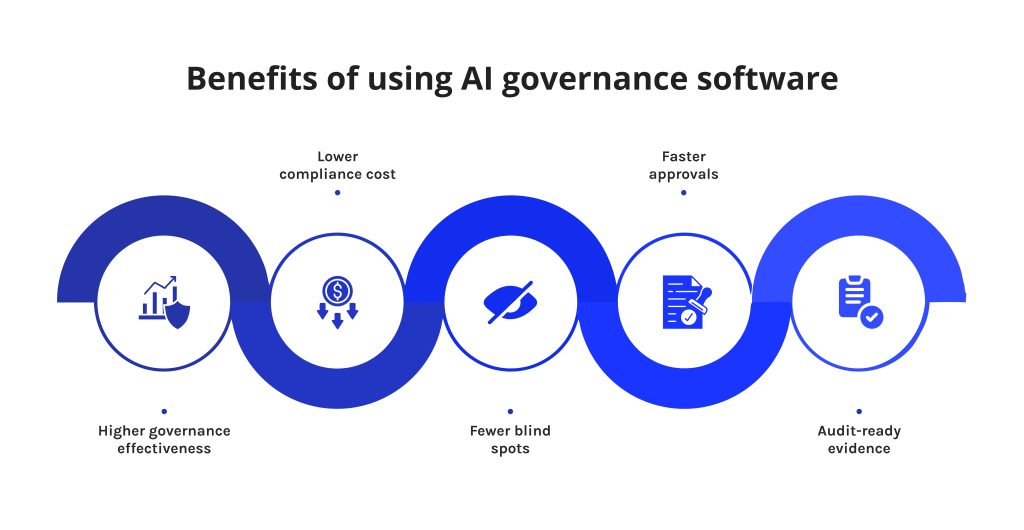
The best AI governance tools turn written policy into enforced controls. AI governance software delivers five benefits:
- Higher governance effectiveness. A Gartner survey of 360 organizations found that adopters of dedicated governance platforms were 3.4 times more likely to achieve high effectiveness [2].
- Lower compliance cost. Gartner projects that effective governance technology can reduce regulatory expenses by 20%.
- Fewer blind spots. A live AI inventory shows what runs, who owns it, and what data it touches.
- Faster approvals. Automated workflows replace email chains for new use cases.
- Audit-ready evidence. Logs and assessments exist before regulators ask.
Drawbacks of using AI governance software
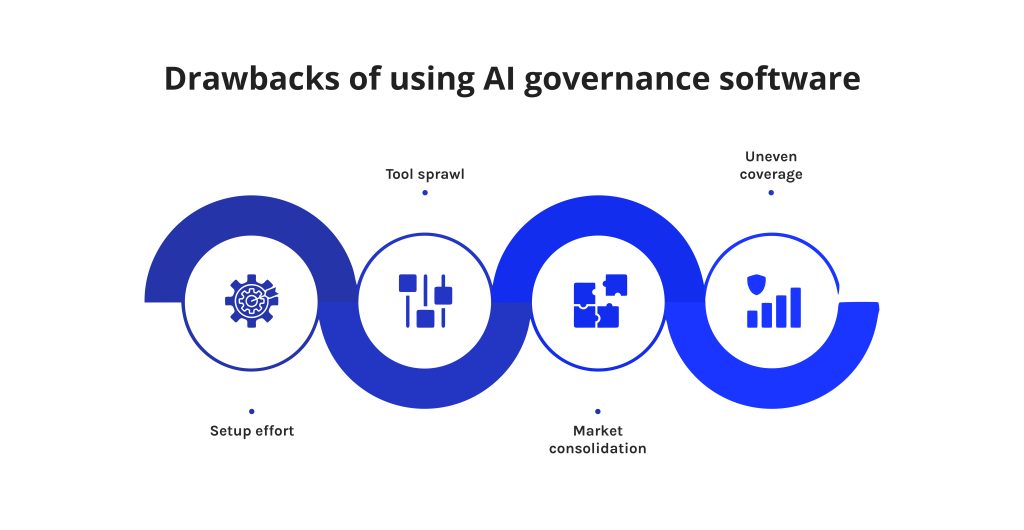
Even the best AI governance tools bring trade-offs. Plan for these four:
- Setup effort. Reviewers flag long implementation for broad products such as OneTrust and ModelOp.
- Tool sprawl. Each new product adds another system to integrate and maintain, and enterprise AI tools already multiply fast.
- Market consolidation. Gartner expects consolidation, which can bring stability but may also stifle innovation or change products.
- Uneven coverage. A tool built for traditional generative AI guardrails may not track agent actions at all.
Quick Comparison: 7 Best AI Governance Tools (Table)
The table compares the 7 best AI governance tools on focus, strength, and pricing model. Use it to screen AI governance software quickly.
| Tool | Best for | Standout strength | Pricing model |
| Zapier | Governing AI in workflows and agents | AI Guardrails, action restrictions, queryable audit trail | Free; Professional from $19.99/month (annual); Team from $69/month (annual); Enterprise custom |
| Microsoft Purview | Microsoft 365 and Azure organizations | DSPM for AI, DLP, AI compliance templates | Microsoft 365 E5$60.00 user/month, paid yearly; Per-user licensing (Microsoft 365 E5 or Purview Suite) plus pay-as-you-go meters |
| Holistic AI | Shadow AI discovery and regulatory risk | Discovery engine, Agent Graph, framework assessments | Custom quote |
| OneTrust | Privacy and GRC-led enterprises | Intake and approval workflows, asset inventory, agent detection | Custom; based on admin users and AI inventory size |
| nexos.ai | Central LLM access control | AI Gateway, company-wide guardrails, audit logs | Gateway pay-as-you-go with 5% platform fee; Enterprise custom |
| Fiddler AI | Production guardrails and observability | Free guardrails tier, agentic observability | Free guardrails; Developer at $0.002 per trace; Enterprise custom |
| ModelOp Center | Large regulated portfolios | System of record, intake-to-retirement workflows | Custom quote |
In-Depth Review: Top 7 AI governance software
These are the 7 best AI governance tools by use case. Each profile covers what the tool does, who should buy it, its strengths and limits, and its price.
Zapier
Zapier is one of the best AI governance tools for teams that build AI into daily automations. Admin rules reach workflows, agents, the SDK, and MCP connections. They cover app connections, permitted actions, and builder access. Every run lands in a queryable audit trail. It governs AI that runs through Zapier, not your whole AI estate.
Best for: operations and IT teams that let employees build AI workflows with enterprise AI tools and need guardrails around apps, actions, and models.
Pros:
- Admins can restrict actions and limit managed app connections.
- Bring-your-own-model support routes Zapier’s AI features through an existing AWS Bedrock account.
- AI Guardrails adds PII detection and prompt injection filtering inside generative AI workflows, agents, and MCP tools.
- Zapier lists SOC 2 Type II, SOC 3, GDPR, and CCPA compliance, and Enterprise accounts are opted out of model training automatically.
Cons:
- Guardrails are builder-opted, so each builder must add the guardrail step to a workflow.
- Zapier’s own guide lists the platform as not HIPAA-compliant.
Pricing: Free plan with 100 tasks per month. Professional starts at $19.99 per month billed annually, and Team starts at $69 per month billed annually. Enterprise pricing requires a quote.
Microsoft Purview

MS Purview incorporates MS’s data security platform into AI. Its DSPM solution allows administrators to monitor and manage data in a single place across their environment regardless of whether those apps are based on internal or external language models. As a result, it is one of the top AI governance solutions for MS 365 users because it brings AI control but does not add extra suppliers.
Best for: those enterprises using Microsoft’s platforms, including MS 365 and Azure, to ensure that their AI solutions comply with data security regulations.
Pros:
- The DSPM for AI facilitates the identification of unsafe requests and answers in Microsoft 365 Copilot, AI agents, and other generative AI technologies.
- Endpoint DLP rules can notify or prevent users from disclosing sensitive information using AI vendors online.
- The Compliance Manager offers advanced templates to comply with the EU AI Act, ISO/IEC 42001, ISO/IEC 23894, and NIST AI
Cons:
- Third parties need Purview’s browser extension and devices.
- The AI compliance templates are premium, so they need extra licensing.
- Total cost spans seat licenses and pay-as-you-go meters.
Pricing: Microsoft sells Purview through per-user licenses such as Microsoft 365 E5 for $60/user/month and the Purview Suite for $12/user/month, plus pay-as-you-go pricing. Each user who needs protection requires a license. Cost depends on user count and data volume.
Holistic AI

Holistic AI is a kind of AI governance software that identifies, analyzes, and controls the use of AI from the start until the completion of its life cycle. The software’s discovery mechanism goes through the cloud, code, and Software as a Service to find and identify any uncategorized AIs. The system also proceeds to match all the identified AIs to risk and compliance standards. The discovery feature is the main highlight of the software.
Best for: groups that deal with risk and compliance and require the ability to manage AI risks as well as comply with the EU AI Act.
Pros:
- The shadow AI discovery process is entirely passive, meaning there are no agents to be installed.
- Holistic AI uses a centralized registry to keep track of models, agents, datasets, and devices.
- An agent graph diagram is a representation of agents, tools, tasks, and streams of data.
- The firm also performs evaluations for the EU AI Act, NIST AI RMF, ISO 42001, and NYC Local Law 144.
- Holistic AI has the highest score (3.90) for AI Risk and Compliance among 13 vendors according to the Gartner Critical Capabilities report. Information provided by the vendor.
Cons:
- Prices are not publicly available; therefore, quotes are required for each transaction.
- This vendor has received “Challenger”, not “Leader,” as its position in the Gartner report.
Pricing: custom prices based on the size of deployment and compliance processes.
OneTrust AI Governance
OneTrust AI Governance builds on the company’s privacy and risk management software. It brings AI systems, agents, models, datasets, and vendors into one program center. Teams configure intake, approval, attestation, and sign-off workflows, then map use cases to the EU AI Act, NIST, and ISO 42001. It suits large, audit-heavy organizations.
OneTrust is listed among the leading AI governance platforms for businesses that have established their privacy protocols. The brand introduced new functionalities for agent identification and inventory management and enforcement in March 2026. Additionally, OneTrust stated that Gartner awarded it the Visionary title in the Magic Quadrant for 2026.
Best for: privacy, legal, and GRC professionals looking for an AI governance tool that meets enterprise requirements.
Pros:
- The customizable acquisition and approval process enables passing new applications through risk classification and permission obtaining.
- The common asset inventory includes the following: systems, models, agents, data sets, and vendors.
- The introduction of agent identification and enforcement features enabled the company to extend the application to operational activities.
- Pre-prepared assessment templates compliant with the EU AI Act, NIST AI RMF, and ISO 42001 are available.
Cons:
- Zapier reviews OneTrust, pointing out that the platform is too comprehensive and unclear for users.
- Teams without established AI policies can spend considerable time on setup.
- Zapier’s review calls it overkill for a team that tracks a few internal models with no regulatory exposure.
Pricing: quote-based. OneTrust states that this module is priced on admin users and the size of the AI inventory.
nexos.ai
nexos.ai controls AI access at all layers. The company’s employees and developers can gain access to over 200 different models via a single gateway — a space managed centrally by the administrator. Central administration allows users to implement organization-wide access restrictions, limited to specific roles and audited by logs.
The solution is based in Europe, which guarantees physical data storage within the EU. It is a great AI governance solution to employ for companies that need a streamlined entry point for using business-oriented AI technology.
Best for: IT and engineering teams that need one governed gateway for employee and developer LLM use.
Pros:
- There are intelligent routing features, caching, plans with a limit on spending, and the possibility to manage keys for APIs.
- Guardrails and restrictions can be set centrally in the administrator’s console and enforced promptly when accessing the browser interface or the API.
- The pricing page shows SOC 2, GDPR, ISO 27001, and ISO 42001 badges.
Cons:
- The site lists Shadow AI and MCP Gateway as coming soon.
- SSO/SAML, RBAC, audit logs, and enterprise policy enforcement require the Enterprise plan.
Pricing: the Gateway runs on pay-as-you-go with a 5% platform fee on top of provider prices. There is no monthly minimum, and the minimum top-up is $5. Enterprise and Workspace plans use custom pricing.
Fiddler AI
Fiddler AI oversees and safeguards the generative AI mechanisms and components that operate in the production environment. Its safety mechanisms carefully scan the prompts and replies for hallucinated data, harmful content, and personal and health-sensitive information leaks, prompt injections, and hacks. Its observation tool records every action of the given agent.
Fiddler provides real-time monitoring of agent-based and predictive AI solutions, so it is one of the best tools for governance of AI systems in production.
Best for: ML, platform, and security teams that run agents and predictive models in production.
Pros:
- A free tier provides real-time guardrails.
- Agentic observability ingests traces through LangGraph and OpenTelemetry.
- Enterprise deploys as SaaS, in a VPC, or on-premises.
- One platform covers agents and predictive models.
Cons:
- Zapier’s review notes that it does not generate EU AI Act documentation, risk-tiering workflows, or approval records.
- The Developer plan has no monthly trace cap, so costs are hard to forecast at high volume.
- The Developer plan runs only on Fiddler’s cloud.
Pricing: free guardrails tier, Developer at 0.002 pertrace(2 per 1,000 traces), and custom Enterprise pricing.
ModelOp Center
ModelOp Center works as an AI system of record. It routes each AI use case through intake, risk tiering, control mapping, approval, production, monitoring, and retirement. ModelOp says it also imports A2A agents and MCP tools and blocks unapproved agents at the network level. Lifecycle control is its core strength.
ModelOp is one of the best AI governance tools and an enterprise AI governance tool for large regulated organizations. The company says it is a Visionary in the 2026 Gartner Magic Quadrant and scored 3.97 out of 5 for AI Agent Governance, tied with IBM. Both claims are vendor-reported.
Best for: Fortune 500 and Global 2000 organizations that need an enterprise-level governance tool for hundreds of AI use cases and strong risk management.
Pros:
- The drag-and-drop workflow engine automates the approvals of different tiers and control mapping.
- Native integrations allow for the import of AI assets and metadata from Databricks, AWS, and Azure.
- Deployment includes on-site, private, public, or combined cloud segments.
Cons:
- Zapier’s review calls the implementation complex.
- LLM guardrails and prompt-response filtering are not its focus.
- It is not designed for teams that launch a first governance program.
- Pricing is quote-based.
Pricing: custom quotes. A listing is also available on AWS Marketplace.
How to Choose the Right AI Governance Tool
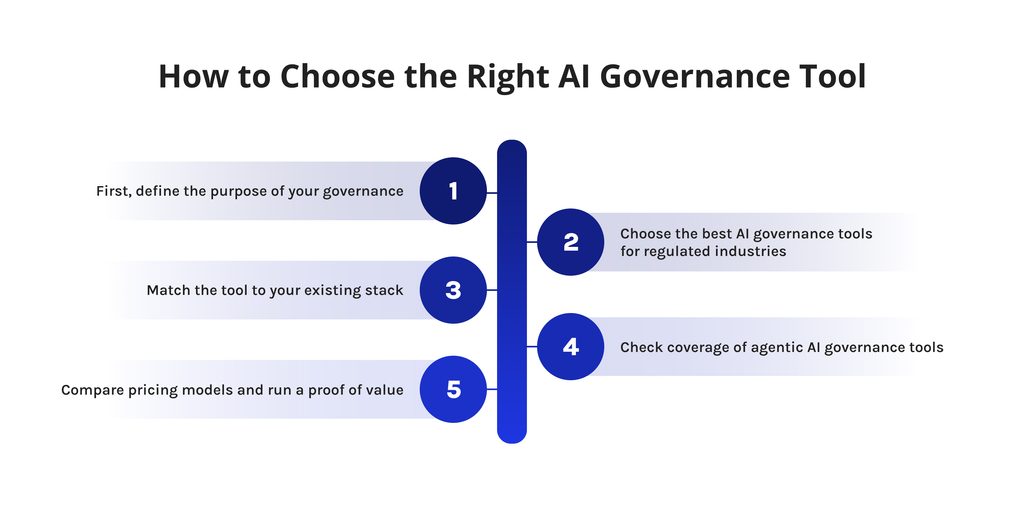
Choosing an AI governance tool for your company begins with identifying your issue rather than with figuring out which vendor is best. By following these five steps below, you will be able to select the best AI governance tool available.
First, define the purpose of your governance
Your first task is to decide which area you need assistance with. The functionality you may require includes workflow management, risk control and auditing, or monitoring in real time. It is crucial to choose a platform matching the organization’s goals now and in the future.
Choose the best AI governance tools for regulated industries
In the context of regulations, you are going to be required to supply audit, mapping, and deployment capabilities. OneTrust, Holistic AI, ModelOp, and Microsoft Purview are compliant with the EU AI Act as well as the NIST AI RMF. Besides, ModelOp and Fiddler also have the option to either keep information in private clouds or use dedicated servers for that.
Watch the regulatory calendar. EU institutions reached a provisional agreement in May 2026 that would defer stand-alone high-risk obligations to 2 December 2027. Confirm the final status with counsel before you set deadlines.
Match the tool to your existing stack
Gartner stresses that interoperability is key because the platform must integrate with your current technology. A Microsoft-centered company should test Purview first. A Databricks or AWS-heavy team should check native integrations first.
Check coverage of agentic AI governance tools
Ask each vendor how it discovers agents, controls MCP tools, and revalidates when agent behavior changes. Gartner tells buyers to look for support for multisystem agents and third-party risk management. The best AI governance tools for agentic AI differ widely on these points.
Compare pricing models and run a proof of value
Pricing for the best AI governance tools falls into four models. Fiddler and nexos.ai charge by usage. Zapier uses plans. OneTrust prices by admin users and inventory size. Holistic AI and ModelOp use quotes.
Then shortlist two or three tools and test them on one real use case. Measure time to build a full inventory, approval cycle time, and audit evidence quality.
| Scenario | Start with | Why |
| Microsoft 365 and Azure estate | Microsoft Purview | AI controls sit inside existing data security tools |
| Privacy program already on OneTrust | OneTrust | One program center for privacy and AI risk |
| Unknown shadow AI footprint | Holistic AI | Discovery engine scans cloud, code, and SaaS |
| Employees build AI automations | Zapier | Rules apply at the action, app, and model level |
| Many LLM providers, no central control | nexos.ai | One gateway, central guardrails, and audit logs |
| Agents in production | Fiddler AI | Guardrails and trace-level observability |
| Hundreds of AI use cases in regulated sectors | ModelOp Center | System of record with intake-to-retirement workflows |
Use this table to shortlist the best AI governance tools for your situation.
Must-Have Features of Top AI Governance Tools
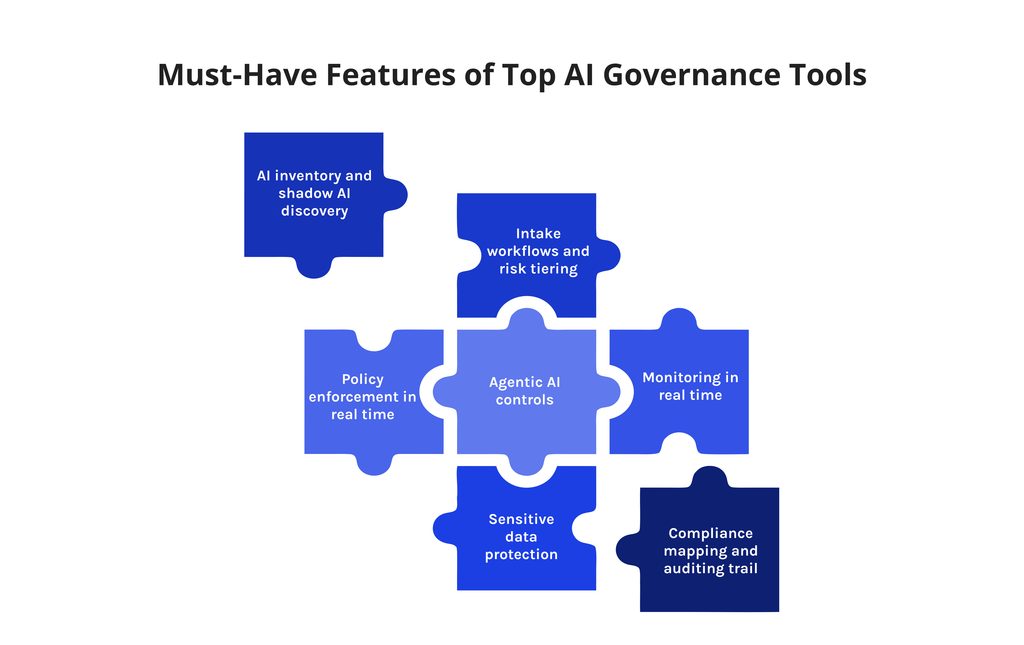
The best AI governance tools share seven capabilities. Gartner’s feature guidance and our criteria overlap on most of them.
AI inventory and shadow AI discovery
The capacity of a governance tool is contingent on what it is able to view. Hence, it is essential that there is both automatic detection of each AI agent, AI model, set of data, and vendor. Gartner classifies a centralized AI inventory as a must-have.
Intake workflows and risk tiering
Every new use case must be assigned an owner, a risk tier, and approval. Good tools have the capability of automating AI intake approvals and organizing the requests based on risk.
Policy enforcement in real time
No compliance is possible unless there is an enforcement mechanism. Therefore, according to Gartner, systems are expected to enforce policies during AI operations, flagging any anomalies and stopping misuse of AI. This enforcement should apply to both inputs and outputs of agents.
Monitoring in real time
AI models are evolving, and agents are changing their behavior. Changes need to be monitored in real time. The monitoring system has to register the onset of any issues immediately.
Compliance mapping and auditing trail
Use tools that comply with all the relevant EU regulations (e.g., EU AI Act, NIST AI RMF, ISO 42001) and are capable of collecting the evidence.
Sensitive data protection
AI tools process sensitive data in prompts, files, and outputs. Look for PII detection, redaction, labels, and DLP. Weak controls expose sensitive data to external models.
Agentic AI controls
Unlike traditional generative AI, agents act on their own. They need identity, scoped permissions, and approval gates. Check how each tool handles delegated actions and MCP tool access. Agentic AI governance tools must pass this test.
Summary
Significant AI governance tools help to implement regulations and thus provide the necessary controls. Purview acts to protect information and data in Microsoft. OneTrust and Holistic AI assist in ensuring that AI operates according to the regulations. Zapier and nexos.ai are responsible for certain use cases concerning the utilization of enterprise AI technologies. Fiddler serves to keep track of generative and agent AI systems at runtime, while ModelOp is there to monitor the whole lifecycle.
To begin with, identify what your main gap is: visibility, enforcement, or evidence. A quality AI governance tool helps close the gaps. Then, run a pilot on two or three best practices to evaluate at least one of the real use cases, keeping track of the AI risk management for each pilot.
FAQs
AI governance is the set of policies, processes, and controls that guide how an organization builds, buys, and uses AI. It covers risk assessment, accountability, regulatory compliance, and monitoring across the AI lifecycle. Teams use it to keep AI systems safe, fair, and auditable.
A tool helps to solve one problem of governance, whereas a platform covers the entire lifecycle within one system. A tool can filter input and track models. A platform includes inventory management, risk analysis, and approval regulation, as well as means for auditing.
Yes, there are free AI governance tools, but they are limited in their work. NVIDIA NeMo Guardrails provides programmable guardrails for working with LLMs. IBM AI Fairness 360 and Microsoft Fairlearn help in identifying biases.
You can initially use your existing GRC apparatus for basic operations, but start using AI governance software when you deploy multiple agents and work with more than one law regarding AI.
Costs of the best AI governance tools range from usage fees of $0.002 per trace to custom enterprise contracts. Zapier plans start at $19.99 per month on annual billing. nexos.ai charges a 5% gateway fee. OneTrust, Holistic AI, and ModelOp quote prices. Purview uses per-user licenses and Azure meters.
For example, if a bank uses an AI application, a governance process can apply rules about the intake, risk control, and approval process that must be followed. The particular feature of AI governance solutions is that they keep track of the system performance when used in practice and possess all necessary supporting documents for auditing purposes.
AI governance serves as an additional layer of risk management due to the fact that AI use is becoming commonplace. According to research done by IBM, shadow AI was discovered in 43 % of the cases analyzed in 2026. From the data received by Gartner, usage of governance platforms increases the chances of getting efficient governance by 3.4 times.
AI governance provides the framework for AI system usage, such as rights and duties, and possible ways of proving compliance, while AI security protects the AI system itself from being attacked and exploited. AI governance and AI security are similar at the level of policies and monitoring, but the majority of successful programs include both elements.
Yes, some of the best AI governance tools govern models, agents, and MCP tools in one system, but depth varies. ModelOp says it imports A2A agents and MCP tools. OneTrust says it governs agent actions and MCP environments. Test each claim in a proof of value.
Yes, most enterprises benefit from more than one, because no tool among the best AI governance tools in this review leads in every area. Gartner expects large enterprises to use ten GRC technologies by 2028. Start with one product for inventory and approvals, then add runtime controls where gaps appear.
References
Gartner. (2026, February 17). Global AI regulations fuel billion-dollar market for AI governance platforms [Press release]. https://www.gartner.com/en/newsroom/press-releases/2026-02-17-gartner-global-ai-regulations-fuel-billion-dollar-market-for-ai-governance-platforms
TechRepublic. (2026). IBM: AI-enabled data breaches cost organizations $6 million on average. https://www.techrepublic.com/article/news-ibm-ai-enabled-data-breach-costs/
Gibson Dunn. (2026). EU AI Act omnibus agreement: Postponed high-risk deadlines and other key changes. https://www.gibsondunn.com/eu-ai-act-omnibus-agreement-postponed-high-risk-deadlines-and-other-key-changes/
Microsoft. (n.d.). Learn about Data Security Posture Management (DSPM) for AI. Microsoft Learn. https://learn.microsoft.com/en-us/purview/dspm-for-ai
Microsoft. (n.d.). Build and manage assessments in Compliance Manager. Microsoft Learn. https://learn.microsoft.com/purview/compliance-manager-assessments
Microsoft. (n.d.). Microsoft Purview pricing. https://www.microsoft.com/en-us/security/microsoft-purview-pricing
OneTrust. (n.d.). OneTrust pricing and packaging. https://www.onetrust.com/enterprise-pricing/
SiliconANGLE. (2026, March 9). OneTrust expands platform with real-time AI governance and agent oversight capabilities. https://siliconangle.com/2026/03/09/onetrust-expands-platform-real-time-ai-governance-agent-oversight-capabilities/
Holistic AI. (2026). Holistic AI acknowledged as a Challenger in Gartner’s first-ever Magic Quadrant for AI Governance Platforms. https://www.holisticai.com/blog/holistic-ai-named-a-challenger-in-gartner-magic-quadrant
Holistic AI. (n.d.). 5 essential features in AI governance software. https://www.holisticai.com/blog/5-essential-features-in-ai-governance-software
ModelOp. (2026, June 22). ModelOp named a Visionary in the 2026 Gartner Magic Quadrant for AI Governance Platforms. https://www.modelop.com/blog/modelop-named-visionary-gartner-magic-quadrant-ai-governance-platforms
Agile Brand Guide. (n.d.). ModelOp transforms enterprise AI governance with launch of the first agentic AI chat interface and controls for agentic AI. https://agilebrandguide.com/modelop-transforms-enterprise-ai-governance-with-launch-of-the-first-agentic-ai-chat-interface-and-controls-for-agentic-ai/
nexos.ai. (n.d.). Pricing plans. https://nexos.ai/pricing/
nexos.ai. (n.d.). Company-wide AI guardrails for secure, unified LLMs. https://nexos.ai/features/ai-guardrails/
Zapier. (2026). The 6 best AI governance tools in 2026. https://zapier.com/blog/ai-governance-tools.md
Zapier. (n.d.). Zapier AI automation platform: Governance and control. https://zapier.com/fr/legal/automation-platform-information
Jet Admin. (2026, September 26). Zapier pricing in 2026: Plans, costs, and limits explained. https://www.jetadmin.io/blog/zapier-pricing/amp/
Dupple. (2026). 10 best AI observability tools in 2026. https://dupple.com/learn/best-ai-observability-tools
Respan. (2026). Fiddler AI alternatives. https://www.respan.ai/articles/fiddler-ai-alternatives
NVIDIA. (n.d.). NVIDIA NeMo Guardrails. https://docs.nvidia.com/nemo-guardrails/