
The biggest digital transformation challenges are rarely about technology alone. Most transformations stall because too many initiatives compete for the same people, leaders disagree on priorities, data isn’t ready for AI, and employees are asked to change faster than they can absorb. The numbers show how common this is: Gartner found that only 48% of digital initiatives meet or exceed their business outcome targets. Below are the 12 challenges that come up most often, grouped into strategy, people and technology. For each one, you’ll find the warning signs, why it happens and what to do in the next 90 days. For where budgets are heading next, see our overview of digital transformation trends.
Executive Summary
- Only 48% of digital initiatives meet or exceed their business outcome targets (Gartner).
- The challenges of digital transformation cluster in three groups: strategy, people, and technology and data.
- Unclear outcomes and too many parallel initiatives cause more stalls than technology does.
- Gartner predicts organizations will abandon 60% of AI projects unsupported by AI-ready data through 2026.
- The fastest fix is subtraction: fewer initiatives, one outcome metric each, and reviews that can stop work between budget cycles.
12 Digital Transformation Challenges (and How to Overcome Them)
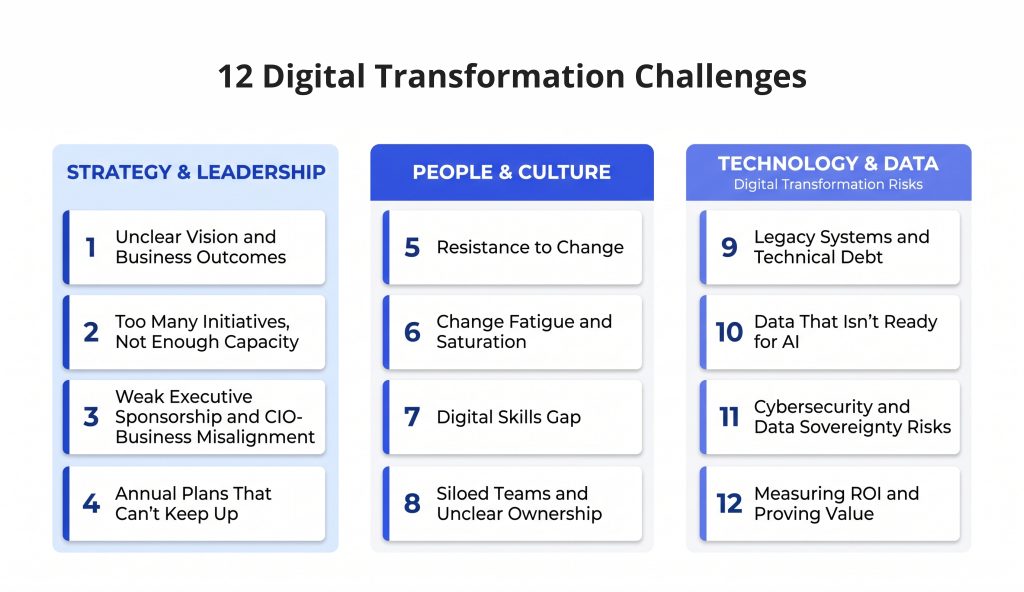
The 12 most common digital transformation challenges fall into three groups. Strategy and leadership: unclear outcomes, too many initiatives, weak sponsorship and rigid annual plans. People and culture: resistance, change fatigue, skills gaps and siloed ownership. Technology and data: legacy systems, data that isn’t AI-ready, security and sovereignty risk, and proving ROI.
Strategy and Leadership Challenges
These are the challenges to digital transformation in large enterprises that do the most damage, because they are decided before a single system is configured. Good execution cannot rescue an overloaded portfolio or a vague goal.
1. Unclear Vision and Business Outcomes
Warning signs: the program is described by the technology it deploys; steering reports track milestones, not results; two executives give different answers to “what does success look like?”
Why it happens: Transformations are often approved as platform programs (a new ERP, a cloud migration) and asked to justify themselves later. Without an agreed outcome, each team optimizes its own deliverable. Gartner’s survey of more than 3,100 CIOs and 1,100 non-IT executives (October 2024) found that only 48% of digital initiatives meet or exceed their business outcome targets.
How to overcome it:
- Write one business outcome per initiative in a sentence a CFO would accept (cost, revenue, cycle time or risk), with a baseline and a date.
- Report progress against the outcome, not against the project plan.
2. Too Many Initiatives, Not Enough Capacity
Warning signs: the same architects and data engineers sit on five or more rosters; everything is “in progress” and little finishes; start dates follow approval, not availability.
Why it happens: Each initiative is approved on its own merits, but nobody checks whether the organization has the specialist capacity to run them all at once. The result is portfolio-level multitasking: scarce experts switch between workstreams, queues form, and every initiative finishes later than it would in sequence. PMI’s Pulse of the Profession 2026 names organizational complexity (unclear governance, siloed teams, misaligned objectives) as one of three forces driving project complexity.
How to overcome it:
- Map which initiatives depend on the same scarce roles before approving anything new.
- Cap work in progress: a new initiative starts only when another finishes or pauses.
- Rank initiatives by the cost of delaying each one, not by sponsor seniority.
- Plan the portfolio around the most overloaded specialist group, the constraint that sets the pace (a core idea of the Theory of Constraints).
More in our project management trends report and in project portfolio management challenges.
3. Weak Executive Sponsorship and CIO-Business Misalignment
Warning signs: business leaders attend the kickoff, then delegate; steering committees approve scope but never make trade-offs.
Why it happens: Gartner contrasts the traditional model of IT delivery plus business “project sponsorship” with a small “Digital Vanguard” of CIOs and CxOs who co-own digital delivery. Their initiatives meet or exceed targets 71% of the time, against 48% overall. Prosci’s research agrees: projects with extremely effective sponsors are 79% likely to meet objectives, compared with 27% for extremely ineffective ones.
How to overcome it:
- Name a business co-owner who shares accountability for the outcome, not just a sponsor.
- Put the CIO and the business co-owner on the same scorecard.
- Ask sponsors for one explicit decision each month: continue, change or stop.
“To become a digital vanguard, CIOs in EMEA need to prioritize four areas – making digital platforms easy for the workforce to build digital solutions; teaching them the interdependencies between technology and business; helping business leaders become innovation leaders at digital; and expanding digital skills beyond the IT department.”
— Daniel Sanchez-Reina, VP Analyst at Gartner
4. Annual Plans That Can’t Keep Up
Warning signs: priorities shift mid-year but the roadmap doesn’t; teams work on initiatives everyone privately considers obsolete.
Why it happens: In Gartner’s 2026 CIO and Technology Executive Survey, 94% of CIOs expect major changes to their plans and outcomes within the next 24 months. Yet only 18% embrace dynamic, off-cycle reprioritization, and those who do are 24% more likely to be top performers. PMI’s 2026 research adds that only one in five practitioners currently use scenario planning.
How to overcome it:
- Run a quarterly portfolio review with the authority to stop, pause and resequence work.
- Fund persistent teams and capacity, not fixed annual project scopes.
- Prepare two or three scenarios for your biggest uncertainties; our review of scenario planning tools compares the options.
People and Culture Challenges
Technology can be bought; adoption cannot. These challenges in digital transformation decide whether a system is still used, and used well, a year after go-live.
5. Resistance to Change
Warning signs: low adoption after go-live; shadow spreadsheets and workarounds; middle managers quietly reverting to old reports.
Why it happens: People resist when the “why” is unclear or a change threatens their role or expertise. In IBM’s 2026 CEO Study (2,000 CEOs, surveyed February to April 2026), 83% said AI success depends more on people’s adoption than on technology. Prosci’s research finds that projects with excellent change management are up to 7x more likely to achieve change success.
How to overcome it:
- Explain the “why” in terms of each role’s daily work, not corporate strategy.
- Equip line managers as the primary change messengers.
- Measure adoption and proficiency, not training attendance (see our change management tools guide).
“AI is changing how work gets done, bringing people and software together in new ways, and it’s changing how people come together in the workplace. The CEOs delivering real results from AI transformation aren’t just deploying AI faster, they’re redesigning their organizations to bring together the best people with the best technology.”
— Mohamad Ali, Senior Vice President, IBM Consulting
6. Change Fatigue and Saturation
Warning signs: employees can’t name current priorities; the same teams absorb three rollouts in one quarter.
Why it happens: Change saturation is the human side of challenge 2. Each initiative is reasonable alone; together they exceed what people can absorb. PMI’s 2026 research found that four out of five complex projects experience negative fallout, including strategic drift and strained team morale, and that teams carry that strain from one project into the next.
How to overcome it:
- Build a change calendar per affected group so stacking becomes visible.
- Sequence rollouts that hit the same users instead of running them in parallel.
- Count change absorption as a capacity limit in portfolio planning.
7. Digital Skills Gap
Warning signs: critical roles stay with contractors indefinitely; new tools are used only at a basic level.
Why it happens: CEOs in IBM’s 2026 study expect 29% of employees to need reskilling for a different role and 53% to need upskilling for their current role between 2026 and 2028. Gartner’s 2025 CIO survey found only 16% of CIOs prioritize building a technology workforce beyond the IT department.
How to overcome it:
- Inventory the skills the transformation actually depends on, role by role.
- Pair every external expert with internal staff, with knowledge transfer as a contract milestone.
- Budget learning time as planned capacity, not as overtime.
8. Siloed Teams and Unclear Ownership
Warning signs: nobody owns the process after go-live; departments report conflicting metrics.
Why it happens: Projects end; processes don’t. When the project team disbands, ownership falls into the gap between functions. PMI lists siloed teams and unclear governance among the main drivers of organizational complexity. IBM’s 2026 study found that organizations that redesigned five core areas, including cross-functional collaboration, were four times more likely to have delivered on business objectives.
How to overcome it:
- Appoint a named process or product owner before go-live, not after.
- Move from temporary project teams toward persistent product teams for core capabilities.
Technology and Data Challenges: Digital Transformation Risks and Challenges
These are the most visible digital transformation risks and challenges. Most are manageable when sequenced deliberately rather than tackled all at once.
9. Legacy Systems and Technical Debt
Warning signs: every integration needs custom work; changes to core systems take months; only a handful of people understand the old code.
Why it happens: Older platforms were not built for APIs, cloud or AI workloads. In a survey of more than 500 IT decision makers commissioned by Pegasystems and conducted by Savanta (October 2025), only 9% said their digital transformation efforts had positioned them to retire or replace all legacy applications, and 29% said they were too busy fighting legacy problems to address the root cause.
How to overcome it:
- Modernize in phases around business capabilities instead of a “big bang” replacement.
- Wrap legacy systems with APIs to decouple new work from old cores.
A dedicated guide to legacy system modernization is in preparation.
10. Data That Isn’t Ready for AI
Warning signs: AI pilots stall at data preparation; each team keeps its own version of customer data.
Why it happens: AI needs data that is representative, governed and well described, which differs from what traditional data management delivers. In a Gartner survey of 1,203 data management leaders (July 2024), 63% of organizations did not have, or were unsure they had, the right data management practices for AI. Gartner predicts organizations will abandon 60% of AI projects unsupported by AI-ready data through 2026.
How to overcome it:
- Define “AI-ready” per use case rather than for all data at once.
- Fund metadata management, data observability and governance before more pilots.
- Make data readiness a gate for AI project approval.
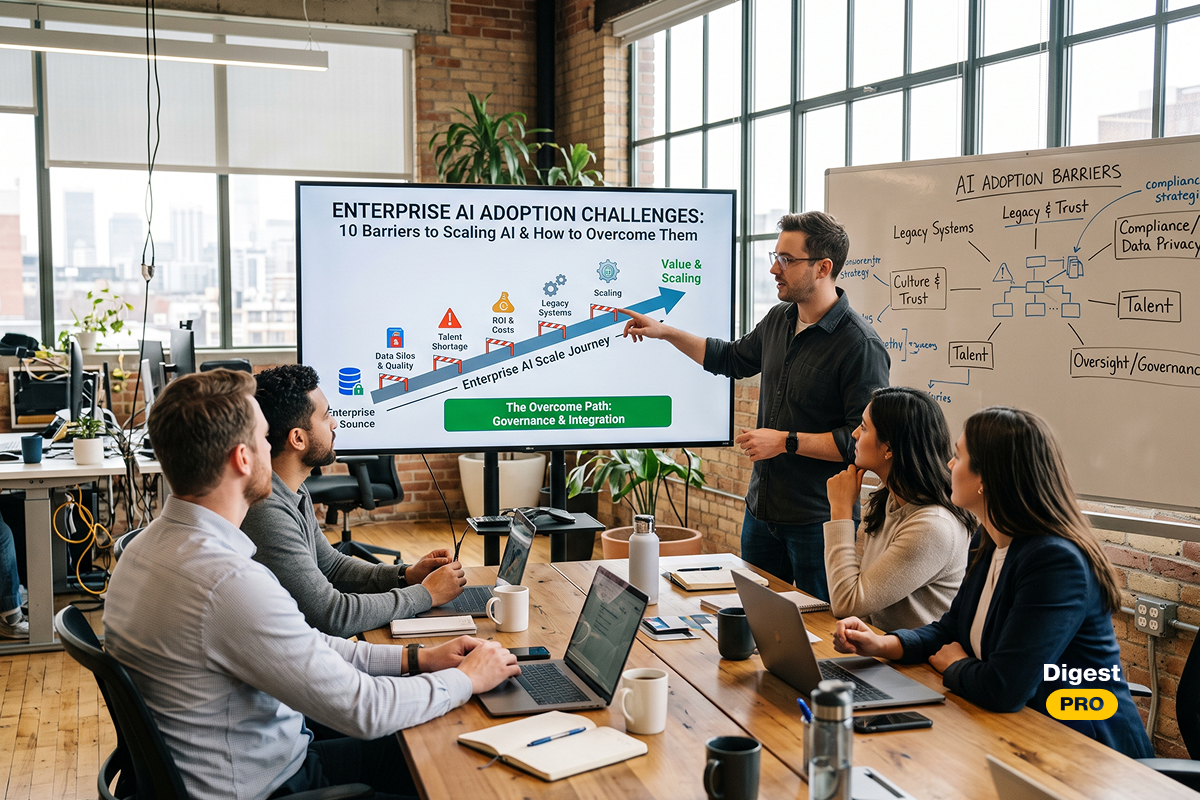
See our analysis of enterprise AI adoption barriers.
11. Cybersecurity and Data Sovereignty Risks
Warning signs: security is reviewed at the end of each project; nobody can quickly say where data is stored.
Why it happens: Every new integration widens the attack surface. Geopolitics adds a second layer: Gartner lists “geopatriation,” moving data and applications from global public clouds to sovereign, regional or on-premises options, among its top strategic technology trends for 2026. It predicts that by 2030 more than 75% of European and Middle Eastern enterprises will geopatriate virtual workloads, up from less than 5% in 2025.
How to overcome it:
- Embed security architects in initiative design, not just final review.
- Maintain a live inventory of integrations and data flows.
- Classify data by residency requirements before choosing platforms. Our cloud computing trends report covers sovereign cloud options.
12. Measuring ROI and Proving Value
Warning signs: dashboards count users and go-lives; benefits are “expected” year after year.
Why it happens: Activity metrics are easy to collect; outcome metrics need a baseline and agreement across functions. In Gartner’s CIO Agenda 2026, CIOs who relentlessly pursue financial outcomes from technology initiatives are 25% more likely to excel, yet only 33% consistently do so.
How to overcome it:
- Set a baseline before launch, not after go-live.
- Assign a finance partner to validate benefits for each major initiative.
- Review realized benefits for 12 to 18 months after delivery, not just at closure.
For AI-specific measurement, see measuring AI ROI.
Why Digital Transformations Fail: The Numbers Behind It
Most digital transformations fail because goals are vague, too many initiatives run at once, ownership is split between IT and the business, and people are asked to absorb more change than they can. Gartner data shows 48% of digital initiatives meet their targets, rising to 71% when CIOs and business leaders co-own delivery.
The best current benchmark is Gartner’s October 2024 survey: only 48% of digital initiatives meet or exceed their business outcome targets. The gap between that figure and the Digital Vanguard’s 71% suggests digital transformation failure is mostly a management problem, not a technology one.
PMI’s Pulse of the Profession 2026 (May 2026) found that 31% of complex projects fail to achieve the full scope of their intended benefits, more than twice the rate for projects overall.
What about the famous “70% fail” figure? McKinsey research has long estimated that around 70% of transformations fall short of their goals; a 2019 McKinsey interview says “roughly 70 percent fail.” That covers large organizational transformations in general, not digital programs. McKinsey’s 2018 digital transformation survey was harsher: only 16% of respondents reported improved and sustained performance. Treat both as dated history and Gartner as the current benchmark.
Digital transformation changes how work is done through technology; business transformation changes the business model itself. The business transformation challenges overlap heavily, which is why the same patterns explain why digital transformation fails so often.
How to Overcome Digital Transformation Challenges: A 90-Day Plan
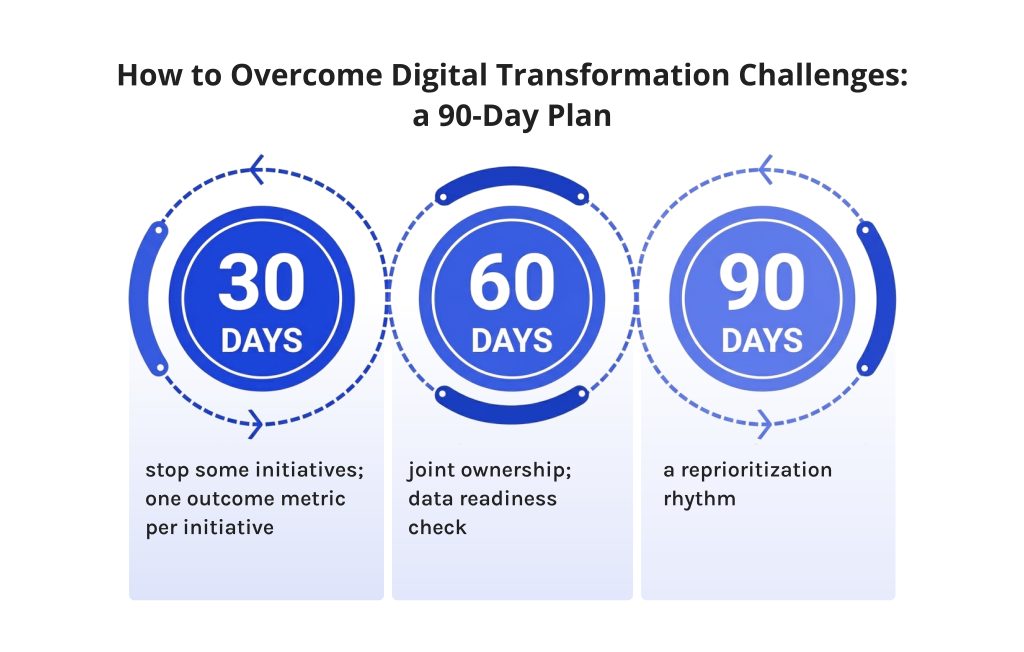
To overcome digital transformation challenges, start by subtracting. In 90 days: stop or pause the weakest initiatives, give each survivor one outcome metric, make the CIO and a business leader joint owners, check data readiness for any AI work, and set a quarterly rhythm for reprioritizing the portfolio.
Days 1 to 30: stop some initiatives. List every active initiative, the scarce roles it depends on and its expected value. Pause the bottom fifth. The released capacity usually does more for delivery speed than any new tool, because remaining work stops queuing for the same specialists.
Days 1 to 30: one outcome metric per initiative. Each survivor gets a single business metric with a baseline and target date. No metric, back to discovery.
Days 31 to 60: joint ownership. Pair each major initiative with a CIO-side lead and a business co-owner who share the metric and decision rights, the pattern Gartner observed in its Digital Vanguard.
Days 31 to 60: data readiness check. Before funding more AI work, confirm each use case has governed, representative data and a named owner.
Days 61 to 90: a reprioritization rhythm. Hold a quarterly (or monthly) portfolio review that can stop, start and resequence work based on value and available capacity. Tools help once the process exists; our guide to enterprise project management software compares platforms that support portfolio-level planning.
Diagnostic Checklist: Is Your Transformation at Risk?
Answer these 10 questions honestly. Three or more unchecked boxes indicate a transformation at risk. Five or more usually mean the portfolio, not individual projects, needs intervention first: fewer initiatives, clearer outcomes and shared IT and business ownership before any further technology spend.
- Every initiative has one measurable business outcome with a baseline and a target date.
- No scarce specialist is committed to more than two or three initiatives at once.
- New initiatives start when capacity is available, not when approved.
- Each major initiative has a business co-owner who shares accountability with IT.
- We can reprioritize, pause or stop work between annual budget cycles.
- We track adoption and proficiency after go-live, not only training completion.
- Affected teams are not absorbing more than one major change at a time.
- Every new process has a named owner after the project closes.
- AI initiatives must pass a data readiness check before funding.
- Realized benefits are reviewed with finance for at least 12 months after delivery.
Our Methodology
We reviewed primary research published between October 2024 and May 2026 from Gartner, PMI, the IBM Institute for Business Value and Prosci, plus dated McKinsey research for historical context. Each figure was checked against its original source on October 7, 2026, with sample and date noted; the one vendor-commissioned survey is labeled. The 12 challenges and 90-day plan draw on established portfolio management, Theory of Constraints and change management practice.
Key Takeaways
- Fewer than half of digital initiatives meet their business targets (Gartner, 48%).
- Strategy problems, such as unclear goals and too many initiatives, cause more stalls than technology problems.
- People challenges, such as resistance and change fatigue, need structured change management, not more communication.
- Legacy systems and data that isn’t AI-ready are now the main technical digital transformation challenges.
- The fix starts with ruthless prioritization and measuring outcomes, not activity.
References
- Gartner. “Gartner Survey Reveals That Only 48% of Digital Initiatives Meet or Exceed Their Business Outcome Targets.” October 22, 2024. https://www.gartner.com/en/newsroom/press-releases/2024-10-22-gartner-survey-reveals-that-only-48-percent-of-digital-initiatives-meet-or-exceed-their-business-outcome-targets
- Gartner. “The CIO Agenda 2026: Master Agility, Risk and Tenacity.” https://www.gartner.com/en/articles/cio-agenda
- Project Management Institute. “Why Complex Projects Fail: Best Practices Are Not Enough, System Thinking Gives Your Team the Edge.” May 12, 2026. https://www.pmi.org/about/press-media/2026/pulse-why-complex-projects-fail-best-practices-are-not-enough-system-thinking
- Prosci. “Change Management Success.” https://www.prosci.com/change-management-success
- IBM. “IBM Study: CEOs are Reshaping C-suite Roles for the AI Era.” May 4, 2026. https://newsroom.ibm.com/2026-05-04-ibm-study-ceos-are-reshaping-c-suite-roles-for-the-ai-era
- Gartner. “Lack of AI-Ready Data Puts AI Projects at Risk.” February 26, 2025. https://www.gartner.com/en/newsroom/press-releases/2025-02-26-lack-of-ai-ready-data-puts-ai-projects-at-risk
- Gartner. “Gartner Identifies the Top Strategic Technology Trends for 2026.” October 20, 2025. https://www.gartner.com/en/newsroom/press-releases/2025-10-20-gartner-identifies-the-top-strategic-technology-trends-for-2026
- Pegasystems. “Average Global Enterprise Wastes More Than $370 Million Every Year Through Technical Debt, Says Research.” October 14, 2025. https://www.pega.com/about/news/press-releases/average-global-enterprise-wastes-more-370-million-every-year-through
- McKinsey & Company. “Why do most transformations fail? A conversation with Harry Robinson.” July 10, 2019. https://www.mckinsey.com/capabilities/strategy-and-corporate-finance/our-insights/why-do-most-transformations-fail-a-conversation-with-harry-robinson
- McKinsey & Company. “Unlocking success in digital transformations.” October 29, 2018. https://www.mckinsey.com/capabilities/people-and-organization/our-insights/unlocking-success-in-digital-transformations
FAQs
The biggest challenges of digital transformation fall into three groups: strategy, people and technology. The five that cause the most stalls are unclear business outcomes, too many initiatives competing for the same specialists, weak shared ownership between IT and the business, change fatigue, and data that isn’t ready for AI.
Most fail for management reasons: vague goals, overloaded portfolios, split ownership and more change than people can absorb. Gartner found only 48% of digital initiatives meet their business targets. The often-quoted “70% fail” comes from McKinsey’s long-standing estimate for large transformations in general, so treat it as a rough historical benchmark rather than a precise current rate.
According to Gartner’s survey of more than 3,100 CIOs and 1,100 business executives (October 2024), 52% of digital initiatives do not meet or exceed their business outcome targets. That is not the same as outright failure, since many deliver partial value. Definitions vary, so compare methodologies before percentages.
Start with a 90-day reset. Pause the weakest initiatives to free scarce capacity, give each remaining initiative one measurable outcome, make the CIO and a business leader joint owners, confirm data readiness before funding AI work, and hold a quarterly portfolio review that can stop and resequence work. Most digital transformation challenges ease once fewer things run at once.
Digital transformation changes how an organization works by applying technology to processes, products and customer experience. Business transformation is broader: it can change the business model, structure or markets, with or without new technology. In practice they overlap, and both face the same core problems of unclear goals, overloaded portfolios and resistance to change.
One widely used classification names four types: process transformation (redesigning how work gets done), business model transformation (changing how value is created and captured), domain transformation (moving into new markets or industries) and cultural or organizational transformation (changing mindsets, skills and ways of working). It is a common framework, not a formal standard.