



A RAG pipeline connects a large language model to your organization’s own data, so its answers come from real documents instead of a guess. This matters more than ever: Gartner predicts that at least 30% of generative AI projects will be abandoned after proof of concept, largely due to poor data quality and unclear business value [1]. The best first step to solving the issue is a great RAG system. It bases all AI’s responses on retrievable, trustworthy information rather than on the model’s memory.
After finishing this guide, you will understand how a RAG pipeline works end to end, which components matter most, and how to decide whether to build, buy, or combine both approaches for your team.
Want more breakdowns like this one? Follow Digest.Pro on LinkedIn for weekly analysis of the AI and project management tools shaping enterprise work.
What Is RAG?
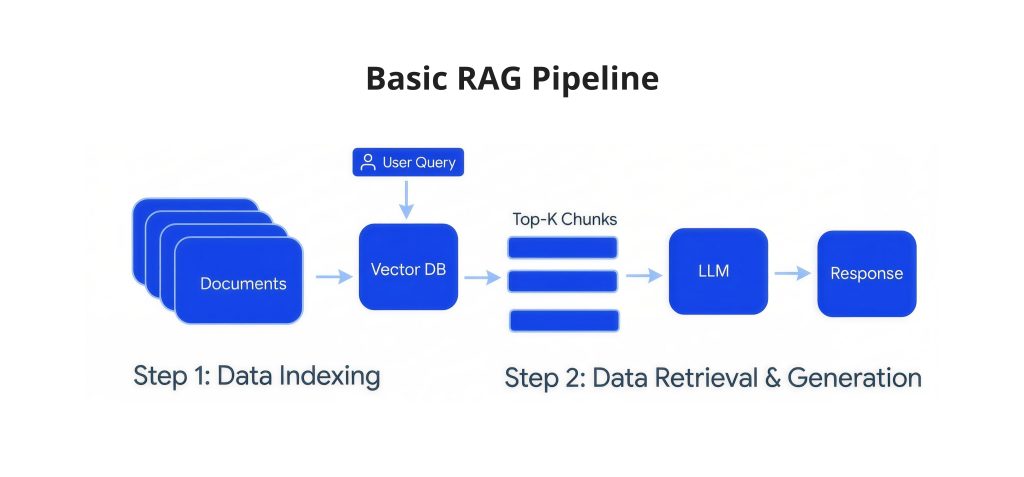
RAG, or Retrieval-augmented generation, is an artificial intelligence framework in which a language model is connected to an external information repository before answering a question, rather than relying on the knowledge gained during training. The model searches for the most relevant information and then responds based on it [2]. The first mention of this architecture belongs to the Meta researchers, then called Facebook AI Research, in a paper from NeurIPS 2020, who merged a pre-trained model with a vector index of outside documents [3].
A RAG model works differently from a standard generative AI system. A standard model draws only on facts baked into its parameters at training time. A RAG model adds a live retrieval step, so it pulls in external knowledge that changes daily, such as pricing sheets and policy updates, without retraining anything.
Retraining a language model is slow and expensive. Updating the knowledge base behind a RAG pipeline takes minutes, not months, which is the entire economic case for retrieval-augmented generation over fine-tuning.
How Does a RAG Pipeline Work?
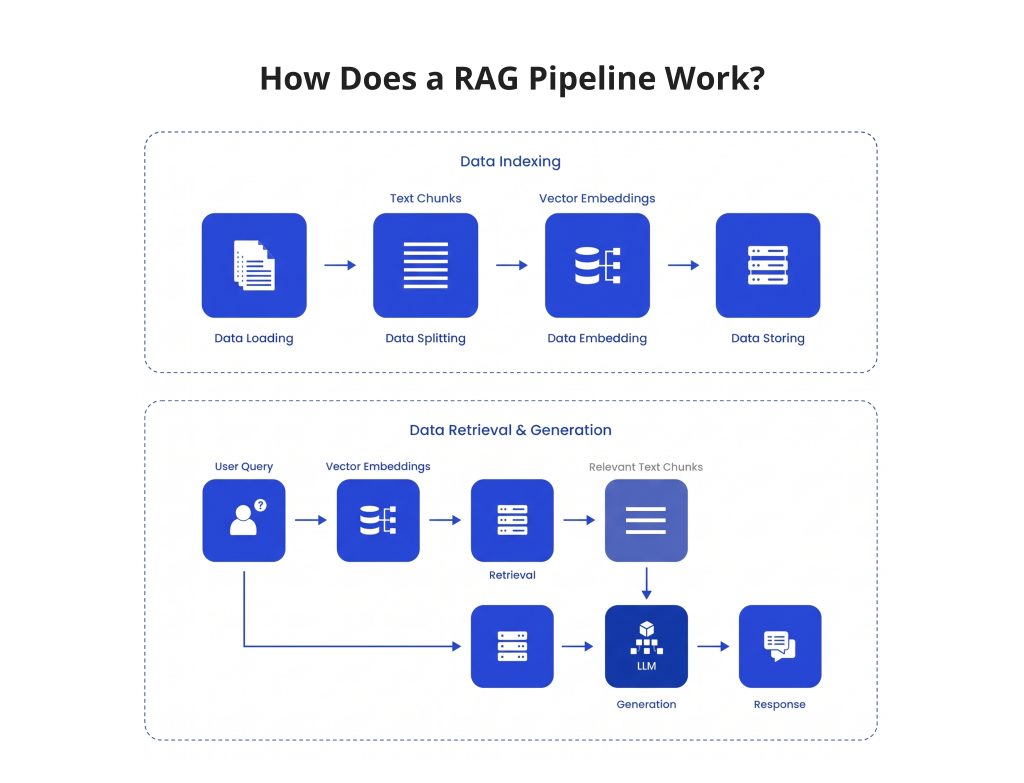
A RAG pipeline runs in two connected phases: indexing, which happens ahead of time, and retrieval-and-generation, which runs live for every query.
Indexing phase
- Source documents come in from wikis, PDFs, CRMs, and ticketing systems.
- Each document is split into smaller chunks, so data retrieval works with precise passages instead of entire files.
- An embedding model converts each chunk into a vector that represents its meaning.
- A vector database stores those vectors, ready for fast similarity search.
Retrieval and generation phase
- A user submits a question.
- The system converts that question into a vector, using the same embedding model.
- The retrieval part performs similarity analysis and produces the most appropriate piece of information.
- The input to the model is the question and the chunks of previously retrieved information that serve as context, and the output is the response based on that context.
The two-step process makes a common RAG pipeline different from the trivial chatbot. While a regular chatbot is incapable of responding to questions connected with materials it has never encountered before, the RAG system is capable of identifying where every piece of information comes from.
What Challenges Does the RAG Approach Solve?
Generic generative AI has three limitations: it can create false facts, it works based on outdated data, and the AI system is unable to see the proprietary information of organizations. The RAG AI pipeline can overcome all three by referring to current, factual reports.
The scale of the problem is well documented. Enterprise AI still struggles to prove its value. A 2025 MIT study found that 95% of enterprise generative AI pilots failed to deliver measurable financial returns, largely because tools were never connected to the organization’s actual data [4]. A RAG pipeline targets that gap directly, connecting a general-purpose model to unstructured data sources it was never trained on.
Knowledge access is the other half of the problem. McKinsey Global Institute research found that employees spend close to a fifth of the workweek searching for internal information [5]. Strong retrieval mechanisms turn that search time into a single natural-language question, answered with a citation.
Rita Sallam, Distinguished VP Analyst at Gartner, named the underlying cause directly: “After last year’s hype, executives are impatient to see returns on GenAI investments, yet organizations are struggling to prove and realize value” [1]. Grounding output in external knowledge is one of the few fixes that addresses data quality, cost, and trust together.
Key Components of a RAG Pipeline
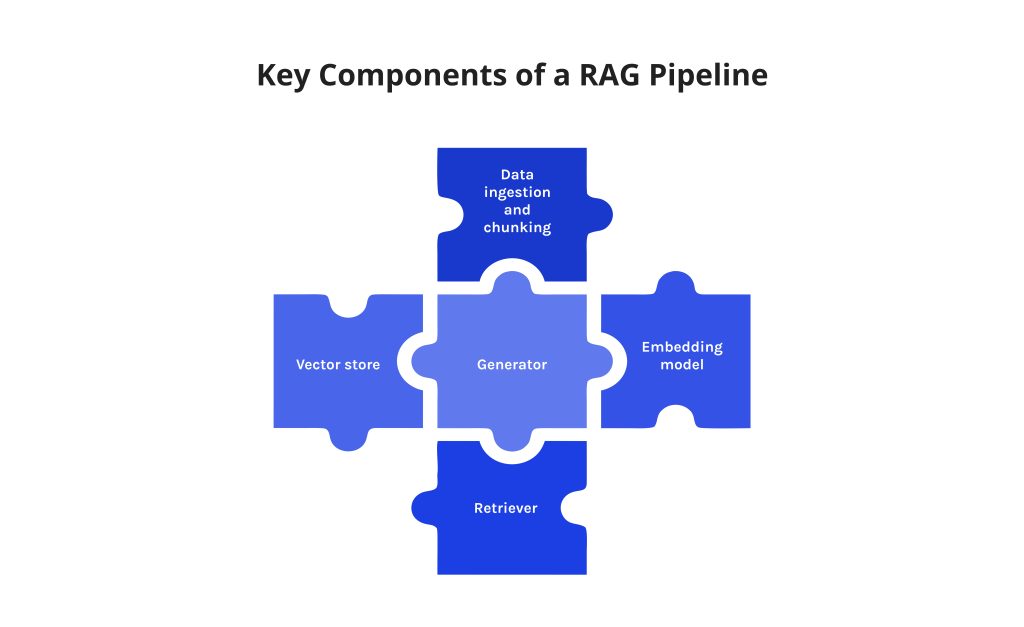
The core components of RAG pipeline design fall into five categories, and each has a direct effect on answer quality:
- Data ingestion and chunking. Pulls in unstructured data sources, such as PDFs and transcripts, and splits them into retrieval-sized passages.
- Embedding model. Converts chunks and queries into vectors that capture meaning, not just keywords.
- Vector store. Holds vectors and runs similarity searches across millions of chunks; Pinecone, Weaviate, and Qdrant are common choices.
- Retriever. Executes the search and, in advanced setups, reranks results before they reach the model.
- Generator. The LLM that produces the final answer from the query plus retrieved context.
| Component | Common tools | What it controls |
| Orchestration | LangChain, LlamaIndex, Haystack | How chunking, retrieval, and generation connect |
| Vector store | Pinecone, Weaviate, Qdrant | Retrieval speed and accuracy at scale |
| Embeddings | OpenAI, Cohere, and open-source models | How well-meaning is captured |
| Document parsing | LlamaParse, Unstructured.io | Accuracy on tables, PDFs, scans |
Every retrieval-augmented generation pipeline lives or dies on retrieval quality, no matter which framework orchestrates it. Our editorial team tested a basic RAG pipeline built with a LangChain RAG pipeline setup and a Pinecone index, and weak retrieval mechanisms, not the model, were the first place accuracy broke down. Poor chunking produced confident, wrong answers. RAG pipeline development starts with the data, not the model — that finding shapes how we brief every AI RAG pipeline project now.
The best RAG pipeline tools split into two camps: full-control frameworks like LangChain and LlamaIndex and managed RAG pipeline tools that trade some control for speed. Teams building an open-source RAG pipeline from scratch typically start with LangChain for flexibility or LlamaIndex for document-heavy retrieval.
Benefits of RAG Pipelines
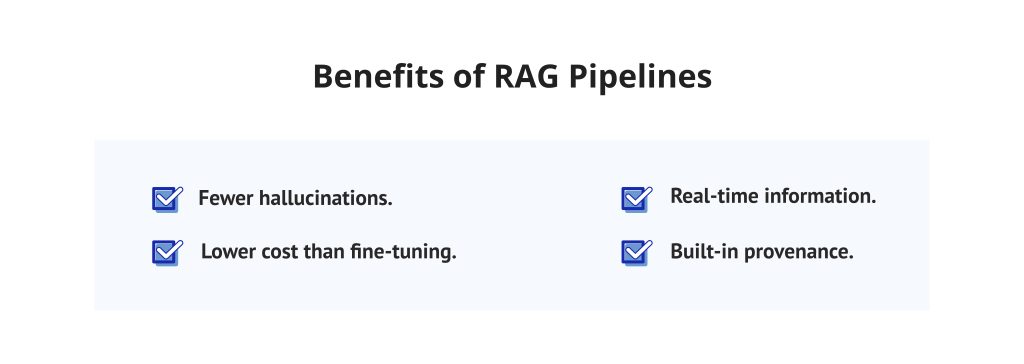
A RAG pipeline delivers more accurate, current, and auditable output than a standalone model. The benefits fall into four measurable areas:
- Fewer hallucinations. Answers are grounded in retrieved text, so the system can cite its source.
- Lower cost than fine-tuning. Updating a knowledge base costs a fraction of retraining a model.
- Real-time information. New documents or policies become available the moment the pipeline indexes them.
- Built-in provenance. Every answer can point back to the exact chunk it came from.
An enterprise RAG pipeline also solves a governance problem fine-tuning cannot: access control. Retrieval happens at query time, so permissions apply per user, and an employee only retrieves documents they are already cleared to see.
Drawbacks of RAG Pipelines
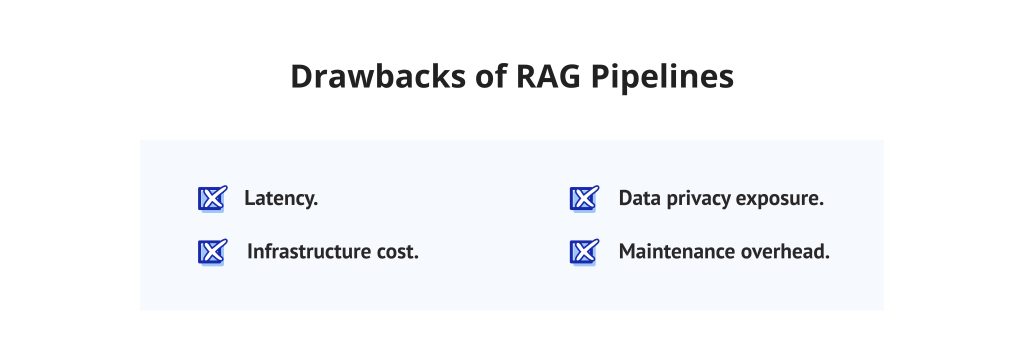
This architecture is not a universal fix, and it introduces its own failure points. Retrieval quality caps answer quality: a weak retriever hands the generator a bad foundation to build a confident answer on.
- Latency. Each query adds an extra retrieval step compared with a direct model call.
- Infrastructure cost. A vector store, an embedding pipeline, and ongoing reindexing carry real operating costs at scale.
- Data privacy exposure. Indexing sensitive documents creates a new attack surface; weak access controls at the retrieval layer can leak information the model was never trained on.
- Maintenance overhead. Source documents change, so the index needs a refresh process, or answers quietly go stale.
Data privacy deserves particular attention in regulated industries. A RAG database mixing public and confidential content without row-level permissions can expose one department’s records to another’s. Data privacy controls belong at the retrieval layer, not as an afterthought.
How to Build and Deploy a RAG Pipeline?
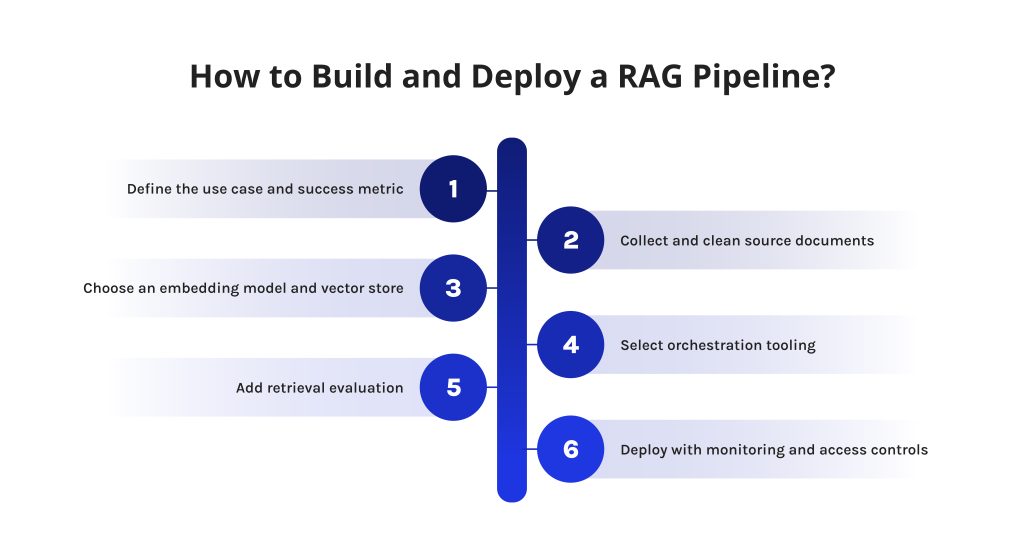
RAG pipeline development follows a repeatable sequence once you understand the core components of RAG pipeline architecture. Building a custom RAG pipeline becomes a sequencing problem, not a mystery — whether the target is a local RAG pipeline for one team or a company-wide rollout.
- Define the use case and success metric. Support deflection, internal search, and contract analysis, each of which needs different chunking choices.
- Collect and clean source documents. Retrieval quality depends more on this step than on model choice.
- Choose an embedding model and vector store. Match the choice to data volume, latency, and budget.
- Select orchestration tooling. An open-source RAG pipeline gives full control; a managed option trades control for speed.
- Add retrieval evaluation. Measure precision and recall on real questions before shipping.
- Deploy with monitoring and access controls, then track answer quality as documents change.
Teams that need RAG pipeline orchestration across many data sources typically add reranking and query rewriting before context reaches the generator. This is how a single-pass RAG pipeline implementation grows into next-generation RAG pipelines built for ambiguous, multi-part questions.
Conclusion
A RAG pipeline provides generative AI with something it is unable to deliver on its own— verifiable access to up-to-date, organization-specific information. While it is not going to resolve any data strategy issues on its own and will incur some real infrastructure costs, RAG nonetheless is still the most suitable technology for any use case involving accuracy and citations, which is why most organizations that deploy production language models rely on RAG.
Start small, regardless of whether you opt for a managed system or develop a bespoke RAG pipeline—index one well-defined source of information, check accuracy of information retrieval, and expand as soon as the pipeline has been verified by original users.
Want more breakdowns like this one? Follow Digest.Pro on LinkedIn for weekly analysis of the AI and project management tools shaping enterprise work.
FAQs
RAG refers to the retrieval-augmented generation technique, which enables large language models (LLMs) to retrieve outside data before producing an answer. Rather than only using a model’s previous training data, LLMs tap a database of relevant sources and information as the basis of the answer. The retrieved data ensures up-to-date information is used in the answer.
ChatGPT is not a RAG system by default, since its base responses come from trained parameters alone. It can act as part of a RAG pipeline when connected to browsing, file uploads, or custom GPTs that retrieve documents first. Many teams pair it with a separate retrieval layer to build a full system.
Start by collecting and chunking your source documents, then choose an embedding model and a vector store to hold them. Connect an orchestration framework such as LangChain or LlamaIndex to handle retrieval, and pair it with a model to generate answers. Test accuracy on real questions before adding reranking.
RAG remains the standard architecture for grounding AI output in enterprise data, even as context windows grow larger. Bigger context windows reduce the need for retrieval in a few narrow cases, but they do not solve access control, cost, or real-time updates the way a RAG pipeline does.
The retrieval strategy determines the quality of the answers produced because the generator uses everything it receives without exceptions. Dense (semantic) retrieval subjects passages to a semantic check, while sparse (keyword) retrieval searches for exact terms. Hybrid retrieval blends both retrieval types to achieve good results.
Grounding is the broader goal of anchoring AI output in real, verifiable data. RAG is one technique for achieving it. Other grounding methods connect a model directly to live APIs or databases without a retrieval and chunking step, which is why RAG remains the default for unstructured documents.
Yes, compared with fine-tuning a model on the same data. Fine-tuning requires retraining and revalidating a model every time information changes, while a RAG pipeline only requires updating the indexed documents. The main ongoing costs are vector storage, embedding generation, and extra compute per query.
A RAG pipeline runs in two phases: indexing and retrieval-generation. Indexing happens ahead of time and covers document collection, chunking, and embedding. Retrieval-generation runs live for every query and covers converting the question to a vector, searching the database, and generating the answer.
RAG grounds a single model response in retrieved data. An agent is a system that plans multi-step tasks, calls tools, and makes decisions across several actions. An AI agent often uses RAG as one tool among several, calling it whenever a task requires looking something up.
Create a test dataset that contains real questions with exact answers and then evaluate retrieval efficiency and accuracy. Confirm whether the model accesses the necessary data first and foremost, as incorrect information will result in a wrong answer, even if the model’s output appears accurate. The evaluation should be conducted every time chunking or embedding is altered.
References
https://aws.amazon.com/what-is/retrieval-augmented-generation
https://arxiv.org/abs/2005.11401
https://fortune.com/2025/08/18/mit-report-95-percent-generative-ai-pilots-at-companies-failing-cfo
Amazon Web Services. (n.d.). What is RAG (Retrieval-Augmented Generation)? Retrieved September 2026, from https://aws.amazon.com/what-is/retrieval-augmented-generation
Couchbase & UserEvidence. (2026). The state of enterprise AI development: Implementation insights & architectural realities. Couchbase. https://info.couchbase.com/rs/302-GJY-034/images/The%20State%20of%20Enterprise%20AI%20Development.pdf
Deloitte AI Institute. (2026). The state of AI in the enterprise 2026. Deloitte. https://www.deloitte.com/ie/en/issues/generative-ai/state-of-ai-in-enterprise.html
Estrada, S. (2025, August 18). MIT report: 95% of generative AI pilots at companies are failing. Fortune. https://fortune.com/2025/08/18/mit-report-95-percent-generative-ai-pilots-at-companies-failing-cfo
Google Cloud. (n.d.). Retrieval-augmented generation (RAG). Retrieved September 2026, from https://cloud.google.com/use-cases/retrieval-augmented-generation
IBM Developer. (n.d.). RAG: Improve the quality of LLM-generated responses. Retrieved September 2026, from https://developer.ibm.com/technologies/rag/blogs/
McKinsey & Company. (2012). The social economy: Unlocking value and productivity through social technologies. McKinsey Global Institute. https://www.mckinsey.com/industries/technology-media-and-telecommunications/our-insights/the-social-economy
McKinsey & Company. (2024, October 30). What is retrieval-augmented generation (RAG)? https://www.mckinsey.com/featured-insights/mckinsey-explainers/what-is-retrieval-augmented-generation-rag
NVIDIA. (n.d.). What is retrieval-augmented generation? NVIDIA Blog. Retrieved September 2026, from https://blogs.nvidia.com/blog/what-is-retrieval-augmented-generation/