
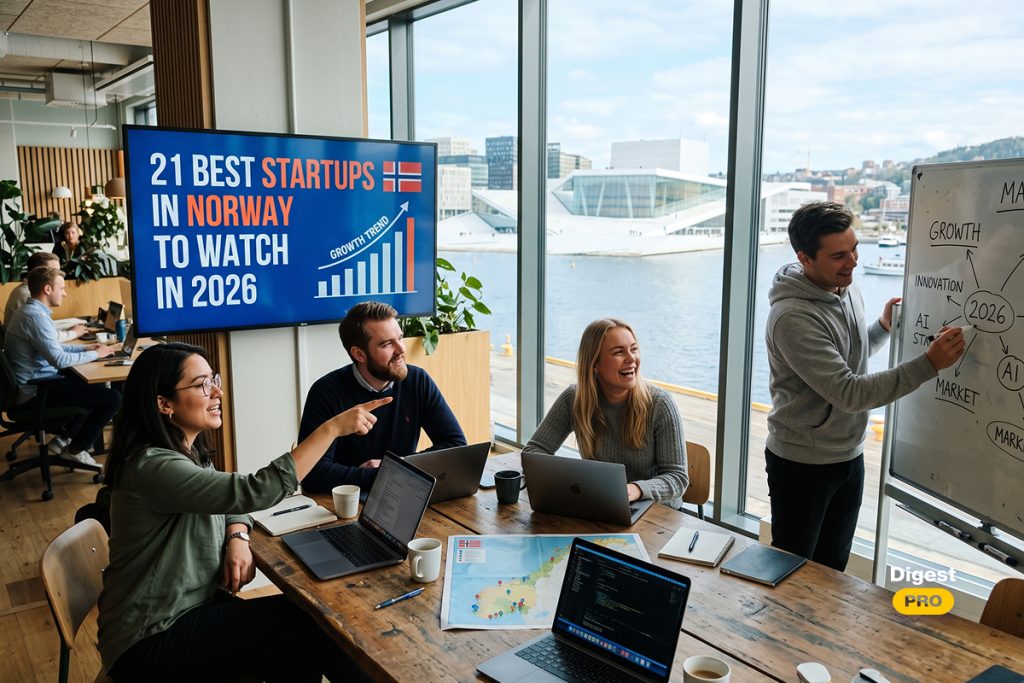
Norway has amassed wealth from oil and shipping and is working to transform its wealth into technology. The total amount of money raised by Norwegian startups across more than 19,000 businesses amounts to roughly $44 billion (Tracxn), and there are 5 known unicorns in the country along with a blossoming secondary wave of AI, robotics, and climate tech initiatives. The 21 promising startups in Norway to watch in 2026 are ranked in this report with the help of distinguished unicorns and promising scaleups.
Oslo remains the center of gravity for startups in Norway, hosting close to 2,000 startups and 200 scaleups (Dealroom). Bergen tech startups specialize in subsea engineering and semiconductors (Seedtable), and the Trondheim tech ecosystem runs on NTNU’s robotics and AI pipeline (NTNU). Norway increasingly stands out among Nordic tech startups for deep engineering rather than consumer apps.
Digest.Pro tracks the Nordic startup scene every week. Follow us on LinkedIn for funding alerts and founder interviews before they hit the mainstream press.
Key takeaways
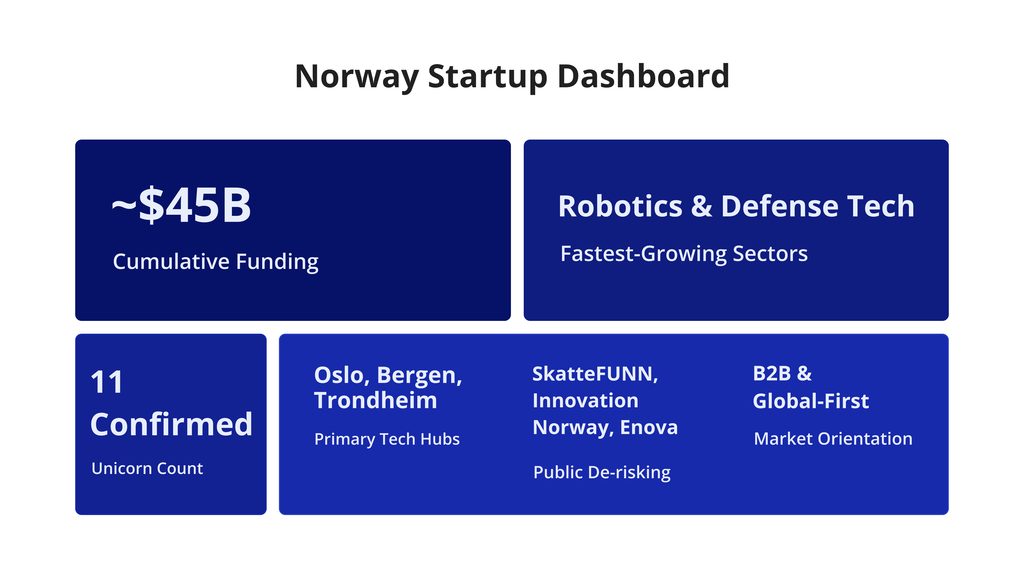
- Norway’s five Norwegian unicorns span industrial software, robotics, grocery delivery, print-on-demand, and edtech; two changed ownership structure in the past three years.
- Robotics and defense tech are among the fastest-growing startups in Norway right now, led by 1X, Sonair, and Six Robotics.
- SkatteFUNN, Innovation Norway, and Enova cut early R&D risk substantially, which is why so many Norwegian startups reach Series A with public co-investors already on the cap table.
- Fintech startups in Norway and Norwegian unicorns alike lean toward B2B models rather than consumer payments, in contrast to Sweden.
- A domestic market of 5.6 million people pushes every Norwegian entrepreneur toward international expansion from day one [5].
This guide will help you separate confirmed unicorns from rising scaleups and see where Norway’s energy, maritime, and industrial strengths are creating durable advantages for 2026.
Our methodology: How we evaluated and ranked these startups?
We created the list based on direct resources: press releases of startups, databases of funding deals (such as Dealroom, PitchBook, and Tracxn), subsidies awarded by Enova and Innovation Norway, and comments from company founders and investors. We checked every valuation against 2 other sources and updated a few instances of common misclassification of “unicorn status” that are still mentioned in the media with regard to companies that have been acquired by private equity.
We ranked companies against four criteria: capital raised and investor quality, commercial traction, sector significance, and momentum over the past 12 months. We excluded companies that are Norwegian only by a single investor’s address, and flagged the one company on this list, Kure Cells, whose primary coverage describes it as US-founded despite appearing in Norwegian biotech investor portfolios.
Top 5 Unicorn Startups in Norway for 2026
These are the five companies that reached, or nearly reached, a $1 billion valuation. Norwegian unicorns cluster around industrial software and consumer platforms rather than pure fintech startups in Norway, which sets the country apart from Sweden’s payments-heavy unicorn class.
1. Cognite

Cognite has designed a DataOps and AI platform for industries in the fields of manufacturing and energy to synthesize operations and sensor information. The company achieved unicorn status in 2021, making it Norway’s top-ever industrial software firm.
- Industry: Industrial software / AI
- Location: Oslo
- Money raised: ~$150M Series B [6]; acquired by Schneider Electric for $3.1B cash, June 2026 [7]
- Why watch in 2026: The Schneider acquisition is one of the largest exits in Norwegian tech history. How Cognite is absorbed into the AVEVA business will set the benchmark for what a Norwegian industrial software exit looks like.
2. AutoStore
AutoStore manufactures warehouse robots that operate based on cubes and do not require people to operate them. The company was the first to attain unicorn status in 2019 and later became the most significant IPO in Norway for the last 20 years.
- Industry: Warehouse robotics
- Location: Nedre Vats
- Money raised: Public since 2021 (Oslo Stock Exchange); ~$6B market cap, ~$676M trailing revenue [9]
- Why watch in 2026: With approximately 1950 autosystems operating in about 60 countries, including Puma and Ikea, AutoStore is expected to provide the first proof of whether Norway is capable of competing for shares in the market alongside new players using cheaper types of automation.
3. Oda
Oda provides online grocery delivery services in Finland, Germany, and Norway. It started operating under the name of Kolonial in 2013 and changed it in 2021. Now the company accounts for approximately 70% of Norway’s online grocery market [10].
- Industry: Online grocery / e-commerce
- Location: Oslo
- Money raised: $473M across five rounds; peak ~$1B valuation (2021), reset to $353M in a 2022 down round [11]
- Why watch in 2026: Oda is the cautionary tale on this list. Its recovery, or failure to recover, is the best available read on whether European grocery-tech economics work at all post-pandemic.
4. Gelato

Gelato is the leader in the area of the print-on-demand business. The company operates in over 30 countries across the world, and this offers it the chance to reduce shipping distances and waste. They became the unicorns of August 2021 [12].
- Industry: Print-on-demand / manufacturing network
- Location: Oslo
- Money raised: $269M total; $240M round led by Insight Partners and SoftBank Vision Fund 2 (2021) [13]
- Why watch in 2026: Gelato is the only one of five unicorns to remain private and independent with no exit or down round. Its distributed manufacturing model gives it an advantage in the setting of tariff fluctuations and the reshoring phenomenon.
5. Kahoot!

Kahoot! has transformed classroom tests into a worldwide gaming platform that is extensively utilized in schools and corporate training. It originated from NTNU research project in Trondheim.
- Industry: Edtech
- Location: Oslo (NTNU / Trondheim origins)
- Money raised: Previously public; taken private at ~$1.7B by a Goldman Sachs Asset Management-led consortium with KIRKBI and General Atlantic, closing in early 2024 [14]
- Why watch in 2026: Currently, Kahoot! has been owned by private equity for two years and serves as an example of the ability of private equity to reignite growth within Norwegian consumer software firms and whether it will return to the market.
| Company | Sector | Peak Valuation | Current Status (2026) |
| Cognite | Industrial DataOps / AI | $3.1B | Acquired by Schneider Electric |
| AutoStore | Warehouse robotics | $12.4B (2021 IPO) | Public, ~$6B market cap |
| Oda | Online grocery | ~$1B (2021) | Private, valuation reset to $353M |
| Gelato | Print-on-demand | $1.05B | Private, still independent |
| Kahoot! | Edtech | ~$1.7B | Private, PE-owned |
In building this table, our team found that these five Norwegian unicorns aged very differently: one acquisition, one public listing, one down round, one private-equity buyout, and a single company that stayed independent throughout.
Digest.Pro’s editors track deals like these first. Subscribe on LinkedIn so you don’t miss the next Norwegian exit.
16 Best Startups in Norway for 2026
Beyond the unicorns, a wider set of early-stage startups in Norway is building real commercial traction across robotics, AI, energy, and biotech. These are 16 more of the best startups in Norway to watch in 2026 by headcount and funding velocity.
1. 1X

1X builds humanoid robots, including the NEO home assistant designed to fold laundry, vacuum, and handle basic chores. Founded in Moss as Halodi Robotics, it has moved its primary headquarters to Palo Alto while keeping its Norwegian operations.
- Industry: Humanoid robotics / AI
- Location: Moss, Norway (HQ now Palo Alto)
- Money raised: Backed by the OpenAI Startup Fund; reportedly seeking $1B at a $10B valuation [15]
- Why watch in 2026: The recent establishment of a manufacturing plant in Hayward, California, will enable production of 100,000 devices annually by 2027. And in just five days after launch, the company received 10,000 pre-orders, which shows that this is the first practical experience in using humanoid robots for household needs.
2. Sonair

Sonair is the first company to produce ADAR — a 3D ultrasonic sensor for robots, which has been certified for safety. The sensors of the company have met the international standards ISO 13849 and IEC 61508.
- Industry: Robotics sensors / deeptech
- Location: Oslo
- Money raised: ~$12M total [16]
- Why watch in 2026: The company has eliminated the issue that hindered collaboration between humans and the robots in the factory and warehouse work by inventing their sensor to be used in the robots.
3. Lace Lithography

Lace Lithography is working on the development of a chip-making technology that utilizes the atomic beam of helium rather than light and produces ten times smaller resolutions than conventional lithography technologies.
- Industry: Semiconductor equipment / deeptech
- Location: Bergen
- Money raised: $60M+ total [17]
- Why watch in 2026: European sovereign-chip funding is expanding fast, and Lace is Norway’s only credible entrant in lithography. A pilot fabrication tool is targeted for roughly 2029.
4. Cardboard

Cardboard is a SaaS spend-management platform that lets companies buy software without sharing company credit cards, centralizing subscription data and cutting shadow IT. Its founding team came out of Otovo and Oda.
- Industry: Fintech / SaaS spend management
- Location: Oslo
- Money raised: €1.9M seed [18]
- Why watch in 2026: It is expanding into Sweden and the UK this year. SaaS sprawl and AI tool proliferation are making shadow IT a board-level cost problem, which is directly in Cardboard’s market.
5. Noteless

Noteless is an artificial intelligence medical documentation tool that listens in on doctor-patient meetings and makes medical notes automatically. It has come to the stage of national adoption in just two years.
- Industry: AI healthtech
- Location: Oslo
- Money raised: €3.5M seed (November 2025, led by Redstone) [19]
- Why watch in 2026: More than one-fourth of Norway’s GPs use it already, and it processes over one hundred thousand appointments each week in seven countries. This means that Noteless has the most impressive adoption curve for each dollar invested in it, as it’s already worth €3.5m.
6. LH2 Shipping
Designers and operators of liquid hydrogen cargo vessels, LH2 Shipping has established itself as the project leader for MF Hydra in Norway, which was the world’s first hydrogen ferry.
- Industry: Hydrogen / maritime
- Location: Bergen
- Money raised: NOK 800M+ (~$79M) in Enova grants across six planned vessels [20]
- Why watch in 2026: Its ships are moving from grant approvals into actual shipbuilding contracts. This is the clearest test of whether hydrogen works commercially in short-sea shipping.
7. Riff (Databutton )

Riff offers technology enabling non-developers to create software without advanced programming skills. The company was founded by three former employees of Cognite.
- Industry: AI development tools
- Location: Oslo
- Money raised: $21M+ total; $16M Series A led by Northzone [21]
- Why watch in 2026: Its customers include Twilio and Cognite, making it one of the few coding tools with real-world brands.
8. Hystar

The company produces PEM electrolyzers for hydrogen production that use membranes that are around 90 percent thinner than traditional versions, used to improve output per unit. The company has already introduced its first production systems.
- Industry: Green hydrogen / energy tech
- Location: Oslo
- Money raised: $36M+ Series C (2025), plus a €26M EU Innovation Fund grant [22]
- Why watch in 2026: The company hopes to increase its capacity threefold from 1.5 GW to 4.5 GW per year by 2031. The next 18 months will be the defining moment for many electrolyzer manufacturers in Europe.
9. Whereby

Whereby provides video calls through web-based technology, eliminating the need for app installations. This was established as appear.in within Telenor’s incubator and has now been taken over by Videonor and renamed.
- Industry: SaaS / video conferencing
- Location: Oslo
- Money raised: $12M Series A (2021, led by Point Nine Capital) [23]
- Why watch in 2026: Data hosted in the EU and GDPR compliant ensures that it meets both the requirements of being GDPR compliant as well as aids vendors in breaking into new markets in Europe.
10. Two.inc

Two.inc has developed a B2B payment system that provides the buy-now-pay-later option instantly for businesses and processes transactions in less than a second. This technology uses AI and has served over 200 companies across Europe and the US.
- Industry: B2B fintech / payments
- Location: Oslo (distributed team across 15 countries)
- Money raised: €40M+ total; €13M round July 2025; backed by Sequoia Capital and Antler [24]
- Why watch in 2026: B2B BNPL is consolidating fast, and Two.inc has Sequoia backing plus genuine merchant scale. It is Norway’s most credible candidate to produce a fintech unicorn.
11. Calluna Pharma

Calluna Pharma is a company made to manufacture innovative pharmaceuticals that target chronic inflammation and fiber production through interference with immune systems. The company came into existence in 2023 as a result of the merger between Oxitope Pharma and Arxx Therapeutics.
- Industry: Biotech / immunology
- Location: Oslo
- Money raised: €75M Series A led by Forbion; also backed by Sarsia, p53, and Investinor [25]
- Why watch in 2026: Their candidate CAL101 has successfully passed the first phase of clinical trials with regard to its safety. The company has raised €75M for its first-level financing, which is unusually big for Norway and shows that investors trust the firm.
12. Six Robotics
The company manufactures software for autonomous drones and units so they can coordinate while working in an environment full of dangers. This software was co-founded with the Norwegian army and the NFFI organization.
- Industry: Defense tech / autonomous systems
- Location: Oslo
- Money raised: €12M in the first institutional round, June 2026, led by DTCP Defence [26]
- Why watch in 2026: The company started with five employees and received financing from friends before attracting institutional investments. The project is now implemented in some European armies.
13. Ofiniti

Ofiniti runs a digital platform for maritime fuel bunkering, replacing paper-based delivery documentation with real-time order management and compliance tracking. It was spun out of classification society DNV in 2024.
- Industry: Maritime software
- Location: Oslo
- Money raised: $6.8M growth funding, March 2026, and $9M total funding [27]
- Why watch in 2026: Ofiniti already controls about 40% of the digital bunkering market in Singapore, and over 25,000 bunker operations were processed in the year 2025. Tightening regulations with respect to fuel documentation will force companies to switch to digital solutions.
14. Flocean
Flocean produces low-carbon drinking water using natural pressure at 400–600 meters of ocean depth, avoiding the brine discharge and coastal footprint of conventional desalination. It is a spin-out of FSubsea.
- Industry: Water tech / climate
- Location: Oslo
- Money raised: $22.5M Series A (extended November 2025, with Xylem joining as strategic investor) [28]
- Why watch in 2026: Flocean One, its first commercial demonstrator, launches at Mongstad this year. It was named a TIME Best Invention of 2025, and Xylem’s involvement gives it a direct industrial distribution path.
15. SportAI

SportAI utilizes computer vision to assess sports skills in tennis, golf, and padel through simple videos while providing feedback that was previously available to professional athletes only. Their technique is universal and can work with any video source, such as phones, court cameras, and live broadcasts.
- Industry: Sports tech / computer vision
- Location: Oslo
- Money raised: $3M oversubscribed round, November 2025 [29]
- Why watch in 2026: Backers include chess champion Magnus Carlsen and tennis star Casper Ruud, giving it unusual distribution leverage in racket sports for a company this early.
16. Kure Cells
Kure Cells manufactures the technology that produces CAR-T cells in the shortest time possible and reduces the production time from weeks to a day. Their leading product, UF-KURE19 has shown 88% complete response rate in the experiment with lymphomas.
- Industry: Biotech / cell therapy
- Location: Appears in Norwegian biotech investor portfolios, but most primary press describes the company as US-founded and expanding into Saudi Arabia
- Money raised: $10M pre-Series A, October 2025, led by Saudi Aramco’s Wa’ed Ventures
- Why watch in 2026: Manufacturing time is the core cost driver blocking CAR-T from reaching wider patient populations. Note the location caveat above before presenting this as a Norwegian company.
Government Support Programs
Public funding explains much of why early-stage startups in Norway can afford years of R&D before their first commercial contract, and why so many Norwegian startups list a government fund among their first investors. Three programs matter most for tech companies in Oslo and beyond.
Innovation Norway
Innovation Norway provides a Start-up Grant 1, which takes care of up to 100% of early-stage expenses with a maximum of NOK 150,000. Moreover, another Grant called Start-up Grant 2 covers up to 50% of development-stage expenses with a maximum of NOK 1 million. In addition, large innovation and commercialization grants can range from NOK 500,000 to NOK 50 million and go further for scale-up and internationalization projects.
SkatteFUNN
SkatteFUNN is a rights-based R&D tax credit: any company that meets the criteria is entitled to a deduction, currently around 19–20% of eligible R&D costs for SMEs, capped at NOK 25 million in annual project costs. Companies do not compete for it; they simply qualify.
Enova
Enova, owned by Norway’s Ministry of Climate and Environment, funds late-stage technology development and market introduction for climate and energy tech startups in Norway. Its pilot and demonstration grants typically cover 25–50% of project costs for technologies at TRL 5 and above. LH2 Shipping alone has drawn more than NOK 800 million from Enova across six hydrogen vessel projects, showing how far this scheme now reaches into shipbuilding, not just renewable power.
Want more coverage like this on major startups in Norway? Follow Digest.Pro on LinkedIn for weekly funding roundups.
Summary
Norway’s startup scene has progressed past the early “oil money meets software” era. The existence of unicorn companies in Norway proves that any country can create truly global companies, with the help of industrial software, robotics, and consumer platforms, all of which are undergoing ownership changes through acquisitions, IPOs, and private-equity buyouts. The 16 promising Norwegian startups presented in this entry are located in the fields of robotics, artificial intelligence, hydrogen, and biotechnology, and signal that a new age is coming in the state.
Investments in deep-tech in Europe have reached $20.3 billion, which is 32% of the total investment volume in Europe. The consulting company McKinsey states that the group of 13 states, including Norway, has a big potential to generate up to 1 trillion dollars in industry value and create one million new jobs by 2030. The future of Norway’s business looks very promising because of its strong resources in the sectors of energy, shipbuilding, and industrial engineering.
As far as Norwegian startups are concerned in 2026, it is possible that we shall see humanoid robots and hydrogen ships first, but the next unicorn may come from any sector.
FAQs
Foreigner or a foreign company can set up an Aksjeselskap (AS) limited company in Norway with the help of the Brønnøysund Register Centre. It is required to have a business address in Norway and a temporary D-number for someone who does not have a national ID. Additionally, it is required to have a minimum share capital of NOK 30,000, which is transferred before the registration process itself (Aiderlegal, 2026).
Digital filings through Altinn are typically processed within a few days to two weeks. A realistic end-to-end timeline for a foreign founder is 2–4 weeks, since a Norwegian business bank account and know-your-customer checks usually take longer than registration itself.
The best-performing industries are industrial software, energy and hydrogen technologies, maritime and ocean technology, robots, and healthtech. There has been a lot of oil and gas engineering work done in Norway for many years, and this has inspired startup companies in Norway that work in the fields of hydrogen, subsea technology, and industrial software. Some of those companies have Norwegian tech companies among their first clients, such as Equinor and Aker.
Survival rate differs a lot by sector and is not recorded uniformly in various countries. Thus, the authentic 5-year figures regarding Norway are not published regularly. Based on the startup failure research globally, many startups survive for five years on end, especially Norwegian deeptech startups that receive funding in the form of grants.
Startuplab, a notable Norwegian startup accelerator, has operations in both Oslo and Bergen. Katapult Ocean is also a notable brand of a startup accelerator in Norway that has invested in climate and ocean technologies. The organization has made over 100 investments in the field.
Salaries of senior developers in Norway are estimated to be around 27% higher than the average across Europe and the UK. The average total package of a software engineer is around NOK 750,000–930,000 a year, which is equal to the living expenditures in Norway and the demand for software engineers.
Yes, as far as their operational media is concerned. Most technology firms in the country function in English as their medium of inner communication, and the command of English is essentially universal among the local workers. However, certain official governmental papers, including board resolutions, still need to be issued in Norway or translated by a certified translator, which is why the founders prefer to have a lawyer or accountant who speaks Norwegian on retainer.
Norwegian business culture is characterized by a flat hierarchical structure, direct communication, and making decisions by consensus rather than by imposition from above. It is important to be punctual in holding meetings and to respect the time of others.
The size of the Norwegian market is relatively small — only 5.6 million people — and it is also too narrow to be sustainable for most plans of the companies. The local investors want to see a clear-cut international development plan from the very first stage, which is why Norwegian companies, including Oda and Two.inc, start designing their product for Sweden, Germany, or the USA within a couple of years, just as the general situation is typical for Nordic startup companies.
Innovation-oriented companies may be granted grants called Start-up Grant 1, up to 100% covering their expenses to develop an idea by means of investigation of the market (up to 150 000 NOK), and Start-up Grant 2, up to 50% covering their costs for manufacturing a prototype of their product (up to 1 million NOK).
References
References
- TechCrunch. (2021, April 7). Norway’s Kolonial rebrands as Oda, bags $265M on a $900M valuation to grow its online grocery delivery business in Europe. https://techcrunch.com/2021/04/07/norways-kolonial-rebrands-as-oda-bags-265m-on-a-900m-valuation-to-grow-its-online-grocery-delivery-business-in-europe/
- Silicon Canals. (2023, July 14). Oslo-based Kahoot! acquired in a €1.5B deal by Goldman Sachs, Lego group and others. https://siliconcanals.com/kahoot-acquired-in-1-5b-deal/
- Tech Funding News. (2026, May 1). Norway’s 1X opens California factory to build 100,000 humanoid robots by 2027. https://techfundingnews.com/openai-backed-1x-first-us-humanoid-factory-sold-out-production/
- EU-Startups. (2026, March 24). Norway’s Lace Lithography lands €34.5 million to extend Moore’s Law by replacing light with atoms. https://www.eu-startups.com/2026/03/norways-lace-lithography-lands-e34-5-million-to-extend-moores-law-by-replacing-light-with-atoms/
- EU-Startups. (2025, November 27). Norwegian HealthTech startup Noteless raises €3.5 million to tackle doctor burnout. https://www.eu-startups.com/2025/11/norwegian-healthtech-startup-noteless-raises-e3-5-million-to-tackle-doctor-burnout/
- https://www.worldometers.info/world-population/norway-population/
- https://www.cognite.com/en/company/newsroom/cognite-secures-150-million-investment-from-tcv-to-acceleratedigitalization-of-global-industries
- Cognite. (2026, June 30). Schneider Electric announces agreement to acquire Cognite, unlocking a new level of strategic intelligence for Industrial AI. https://www.cognite.com/en/company/newsroom/schneider-electric-announces-agreement-to-acquire-cognite
- https://en.wikipedia.org/wiki/AutoStore
- https://finance.yahoo.com/quote/AUTO.OL/
- https://techcrunch.com/2021/04/07/norways-kolonial-rebrands-as-oda-bags-265m-on-a-900m-valuation-to-grow-its-online-grocery-delivery-business-in-europe/
- https://tracxn.com/d/companies/oda/__gi2loHtLWoet1R5uk5aJvMEnS-rkKga0psi9zHe4m_E#about-the-company
- https://www.businessinsider.com/pitch-deck-gelato-240-million-print-on-demand-softbank-2021-8
- https://tracxn.com/d/companies/gelato/__mHb49n83JsYi0RVuVcLNmbETuYnwhSqhrfPmmNPDxHo
- https://seedtable.com/exits/kahoot
- https://www.theinformation.com/articles/humanoid-robot-developer-1x-targets-1-billion-new-funding
- https://en.wikipedia.org/wiki/Sonair_(technology_firm)
- https://www.linkedin.com/posts/bengaluru-based-startup-agnit-semiconductors-share-7439303869035257856-ISlf/
- https://www.thesaasnews.com/news/cardboard-raises-1-9-million-in-seed-round/
- https://www.thesaasnews.com/news/noteless-raises-3-5-million-seed-round/
- https://www.lh2shipping.no/news/lh2-shipping-secures-support-for-vessels-five-and-six
- https://tracxn.com/d/companies/databutton/__2cT5nhyKwWvZvXZokxZZnFuk1_4UYnu6a2QZcEbuXhw/funding-and-investors
- https://www.globalhydrogenreview.com/hydrogen/14052025/hystar-raises-36-million-to-accelerate-commercial-growth/
- https://techcrunch.com/2021/03/17/whereby-which-allows-more-collaboration-over-video-calls-raises-12m-from-point-nine-and-20-angels/
- https://www.papermark.com/customers/two-inc
- https://forbion.com/news-insights/news/forbion-announces-75-million-eur-series-a-financing-in-calluna-pharma/
- https://sixrobotics.com/news/six-robotics-raises-%E2%82%AC12-million-to-scale-autonomy-for-unmanned-systems
- https://smartmaritimenetwork.com/2026/03/18/ofiniti-raises-6-8m-to-scale-digital-bunkering-platform/
- https://arcticstartup.com/flocean-raises-22-5m-series-a/
- https://sportai.com/news/backed-by-global-tennis-star-casper-ruud-sportai-raises-3m-in-oversubscribed-round