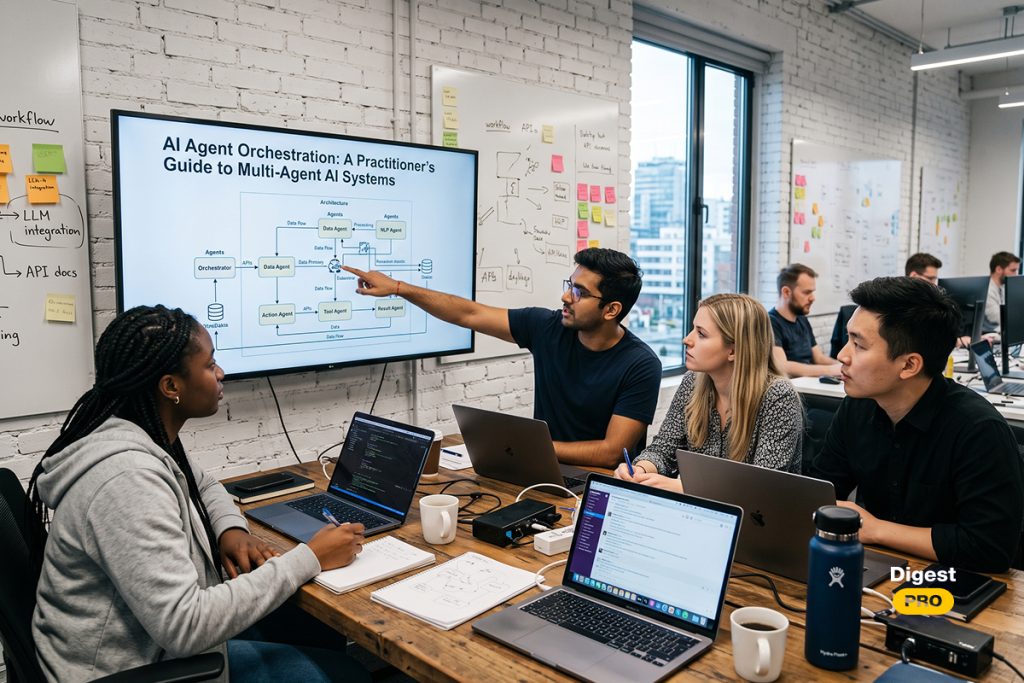
Gartner expects 40% of enterprise applications to carry task-specific AI agents by the end of 2026, up from under 5% in 2025 [1]. That is not a slow rollout. That is a technology moving from pilot to default in a single budget cycle.
But embedding an agent is the easy part. AI agent orchestration — coordinating multiple agents so they act as one reliable system — is where most enterprise programs stall. Deloitte found that only 11% of organizations have agentic AI in production, even though 38% have piloted it [2]. That gap is orchestration.
This guide shows how AI agent orchestration actually works, which patterns hold up in production, where frameworks end and platforms begin, and what breaks when nobody plans for it.
Key takeaways
- AI agent orchestration combines several agents — routing, state, memory, tool calls, and guardrails — leading them to act as a unified system and not merely a bunch of isolated scripts.
- By the close of 2026, up to 40% of enterprise software will include task-focused AI agents compared to under 5% of software in 2025 — Gartner [1].
- There are 4 fundamental patterns, covering nearly all workflows — sequential, parallel, hierarchical (supervisor/router), and human-in-the-loop — however, almost every production system usually incorporates at least two of them.
- Frameworks and platforms solve different problems. LangGraph, CrewAI, and AutoGen are code libraries you build on; platforms like EpicStaff ship a running system with a visual layer and built-in state management.
- Only 11% of organizations run agentic AI in production, even though 38% have piloted it — the gap is orchestration, not model capability (Deloitte Insights) [2].
- Over 40% of agentic AI projects will be canceled by 2027, mainly due to cost overruns, unclear ROI, and weak risk controls — not poor model performance (Gartner) [3].
For more guides like this on enterprise AI infrastructure, follow Digest.Pro on LinkedIn.
What is AI agent orchestration?
AI agent orchestration is the layer that decides which agent acts, in what order, with what context, and what happens when something goes wrong. It sits above the individual agents and below the business process — the conductor, not the musicians. Each agent is skilled alone, but the system only works when timing, hand-offs, and scope are controlled centrally.
AI agent orchestration handles four jobs at once: routing a task to the right specialized agent, passing state and memory between agents, calling external tools and APIs, and logging every decision for review. A single agent that drafts an email is useful. A system where one agent qualifies a lead, a second prices the deal, and a third drafts the contract — with no dropped context — is orchestration.
Multi-agent orchestration becomes necessary once a workflow needs more than one kind of judgment. A support ticket requiring classification, a policy lookup, and a refund decision is three narrow jobs stitched together. Without an orchestration layer, teams glue agents together with brittle scripts. With one, the same jobs run as a governed, observable pipeline.
Read more: Quick Guide to Agentic Workflow: What It Is, Why Use It, and How to Build
Why does AI agent orchestration matter for enterprises in 2026?
2026 is the year multi-agent systems became a budget line, not a research topic. Gartner’s best-case projection puts agentic AI at roughly 30% of enterprise application software revenue by 2035 — over $450 billion, up from 2% in 2025 [1]. That growth curve won’t tolerate ad hoc coordination between agents.
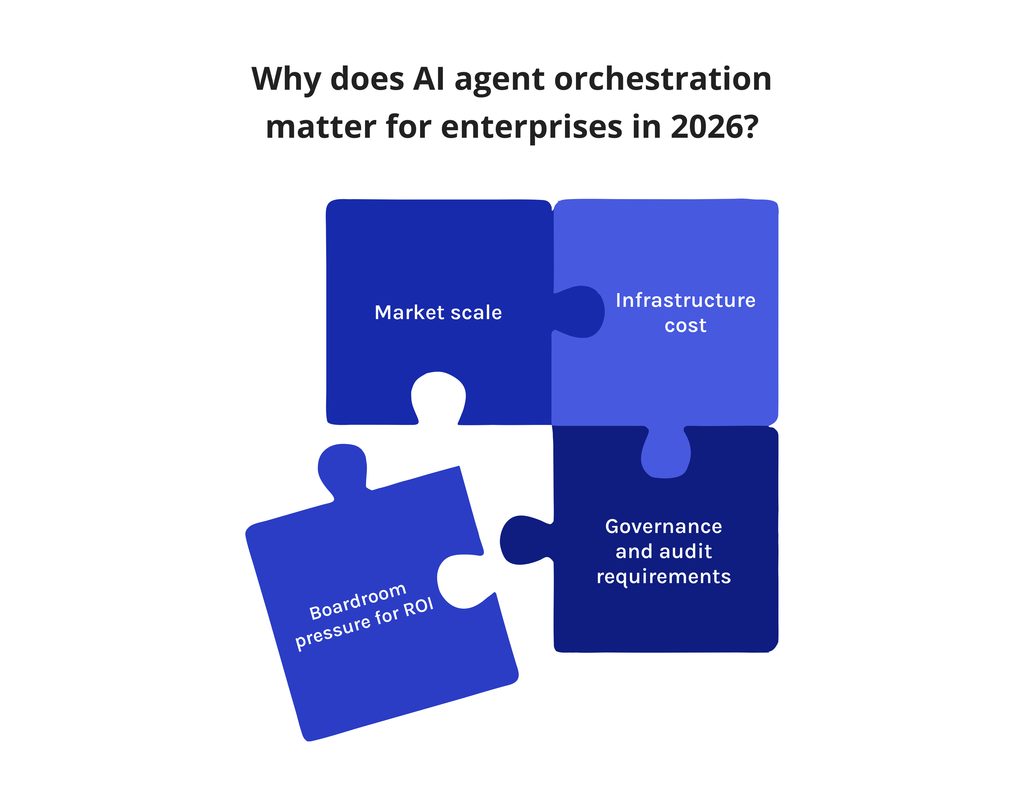
Four forces are pushing AI agent orchestration onto the enterprise roadmap right now:
- Market scale. Enterprise adoption is compounding fast enough that manual, script-based coordination between agents breaks down within a year or two of launch.
- Infrastructure cost. McKinsey projects IT infrastructure costs will rise two to three times by 2030 as agentic workloads scale, while budgets stay largely flat (McKinsey & Company, 2026) [4]. Enterprises need an AI agent orchestration architecture that uses agents efficiently — routing simple requests to lightweight agents and reserving expensive reasoning for steps that need it.
- Boardroom pressure for ROI. Jakob Freund, co-founder and CEO of orchestration platform Camunda, put it plainly: “Boards are asking for ROI from AI,” while most teams still point to pilots (Camunda, 2026) [5]. The organizations closing that gap treat orchestration as core infrastructure, not something bolted onto a proof of concept.
- Governance and audit requirements. As agents gain autonomy, every step shifts from deterministic to autonomous and needs an audit trail. An AI agent orchestration platform that logs routing decisions is what lets a compliance officer sign off instead of blocking the workflow.
How does AI agent orchestration work?
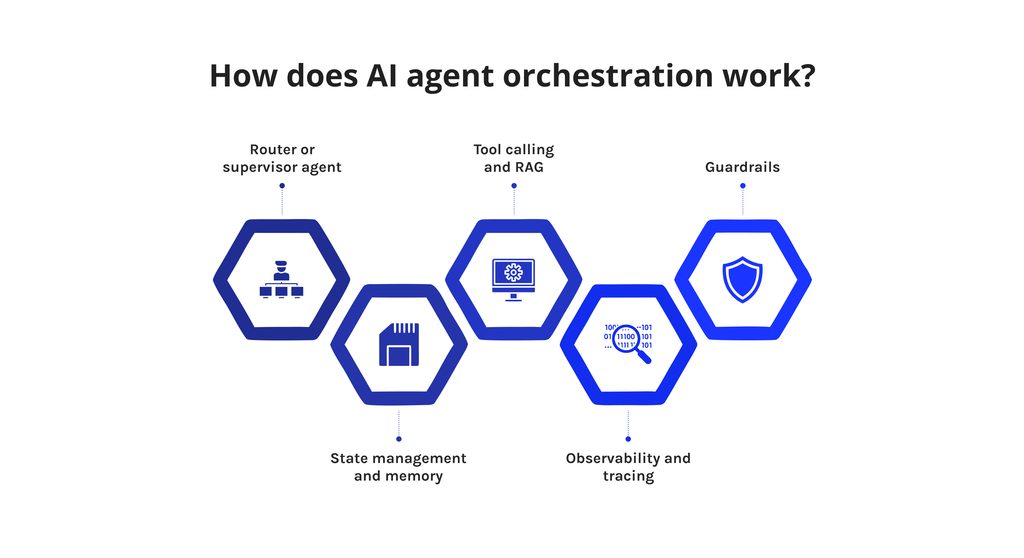
Every orchestration system runs the same loop: receive a task, decide who handles it, execute, capture the result, and decide the next step. Five components make that loop reliable at scale.
- Router or supervisor agent — the traffic controller. Reads the request, classifies it, and hands it to the right agent.
- State management and memory — state tracks the current workflow step; memory persists facts across sessions. Losing state between hand-offs is the top cause of repeated or contradictory agent output.
- Tool calling and RAG — agents act through tool calls: an API hit, a database query, a file write. RAG gives an agent facts from a knowledge base exactly when it needs them.
- Observability and tracing — log every routing decision and tool call. Without it, a failure three agents deep is nearly impossible to diagnose.
- Guardrails — checks that stop an agent from acting outside its scope: a spending cap, an approved tool list, and a rule blocking irreversible actions without sign-off.
Most orchestration engines model the workflow as a directed acyclic graph, or DAG — steps flow forward, branches are allowed, but the graph never loops back into infinite recursion. That structure is what lets an engineer look at a diagram and know the workflow terminates.
Orchestration frameworks vs. platforms
This is where comparisons get sloppy. LangGraph, CrewAI, and AutoGen (now AG2) are frameworks — Python libraries that developers import into their own codebase, giving primitives like graphs, roles, and conversational loops. You still build the surrounding application and most operational tooling yourself.
An AI agent orchestration platform, by contrast, ships as a running system with a visual layer and built-in state persistence. EpicStaff is a self-hosted example: a source-available platform with a drag-and-drop editor over a Django backend, where operations teams edit a workflow without touching Python, while engineers keep a code layer for complex logic.
Neither category is inherently better. A framework gives more control at the cost of engineering time; a platform gets a working system in front of business users faster, at the cost of adopting its operational model.
| Tool | Category | Deployment | Visual builder | Best fit |
| LangGraph | Framework (library) | You host it | No (code-first) | Fine-grained state control and auditability |
| CrewAI | Framework (library) | You host it | No (code-first) | Fast prototyping of role-based agent teams |
| AutoGen / AG2 | Framework (library) | You host it | No (code-first) | Research and iterative multi-agent debate |
| n8n | Platform | Self-hosted or cloud | Yes | AI agents layered onto workflow automation |
| EpicStaff | Platform | Self-hosted | Yes | Ops teams owning flows, with a Python layer for engineers |
In our review of documentation, repositories, and public demos, the pattern held: frameworks win on flexibility; platforms win on time-to-first-working-workflow for teams without a dedicated orchestration engineering function.
Read more: AI Agent Assist: What It Is and Why You Need It in 2026?
Core AI agent orchestration patterns
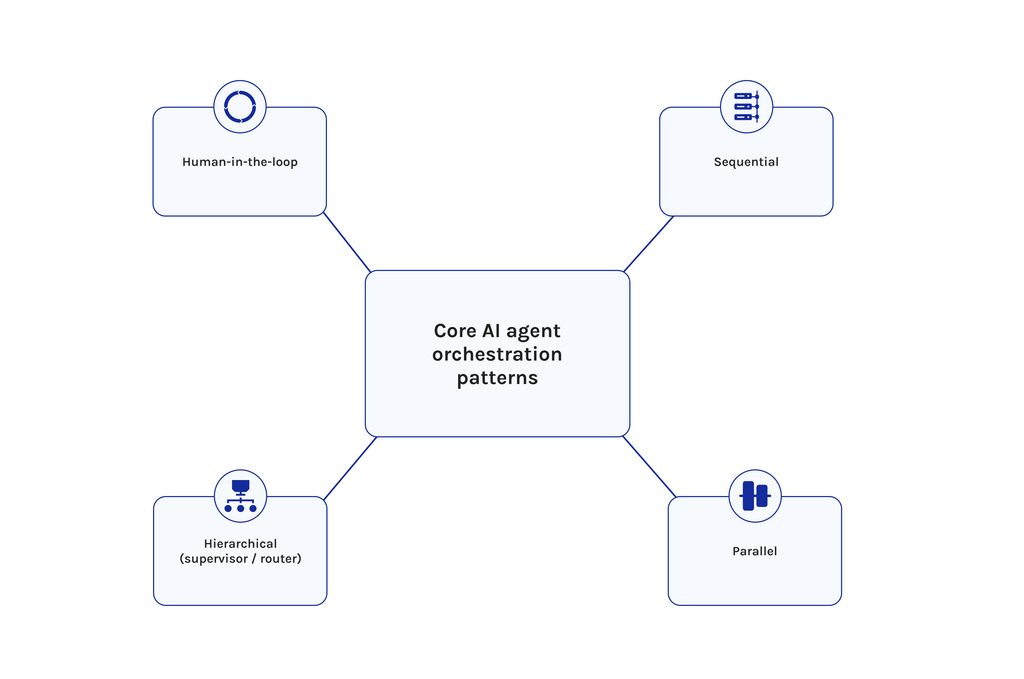
Every production system is built from a small set of coordination patterns. Most real workflows combine two or three.
Sequential
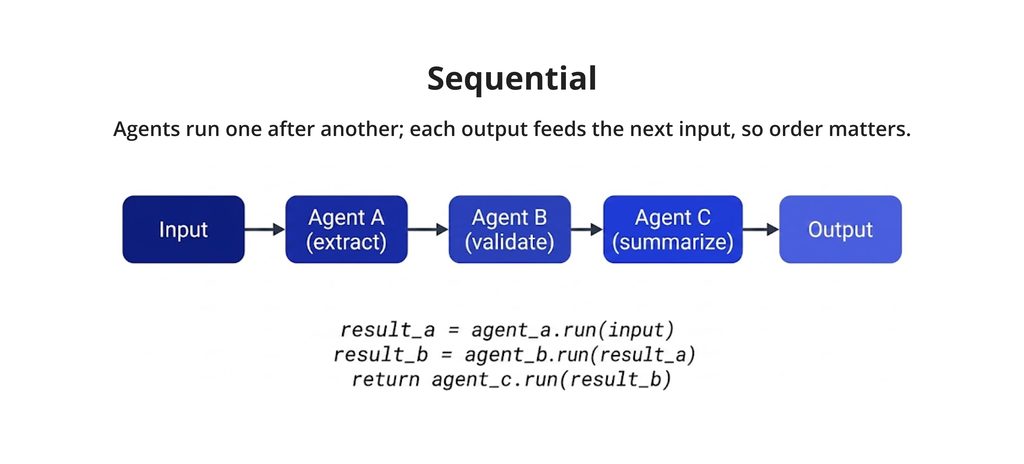
Agents run one after another; each output feeds the next input, so order matters.
Input → Agent A (extract) → Agent B (validate) → Agent C (summarize) → Output
result_a = agent_a.run(input)
result_b = agent_b.run(result_a)
return agent_c.run(result_b)
This is the right default for workflows with a clear order — intake, then validation, then summary — and the easiest pattern to debug, since a failure always has one predecessor step to inspect.
Parallel
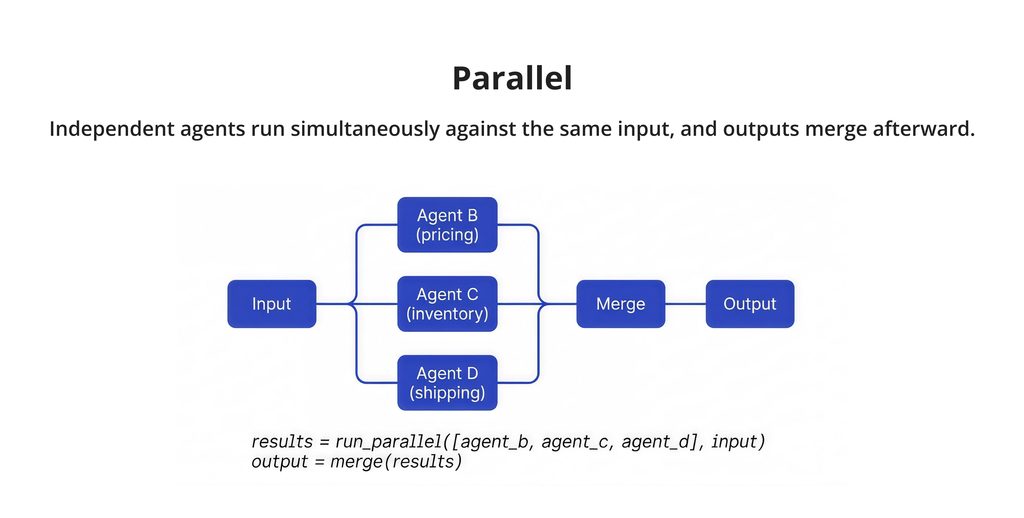
Independent agents run simultaneously against the same input, and outputs merge afterward.
┌── Agent B (pricing) ──┐
Input ───────┼── Agent C (inventory)─┼──── Merge → Output
└── Agent D (shipping) ─┘
results = run_parallel([agent_b, agent_c, agent_d], input)
output = merge(results)
Parallel execution cuts latency on workflows with independent sub-questions — price, stock, and shipping cost for an order. The trade-off: a slow agent in the group holds up the whole batch.
Hierarchical (supervisor / router)
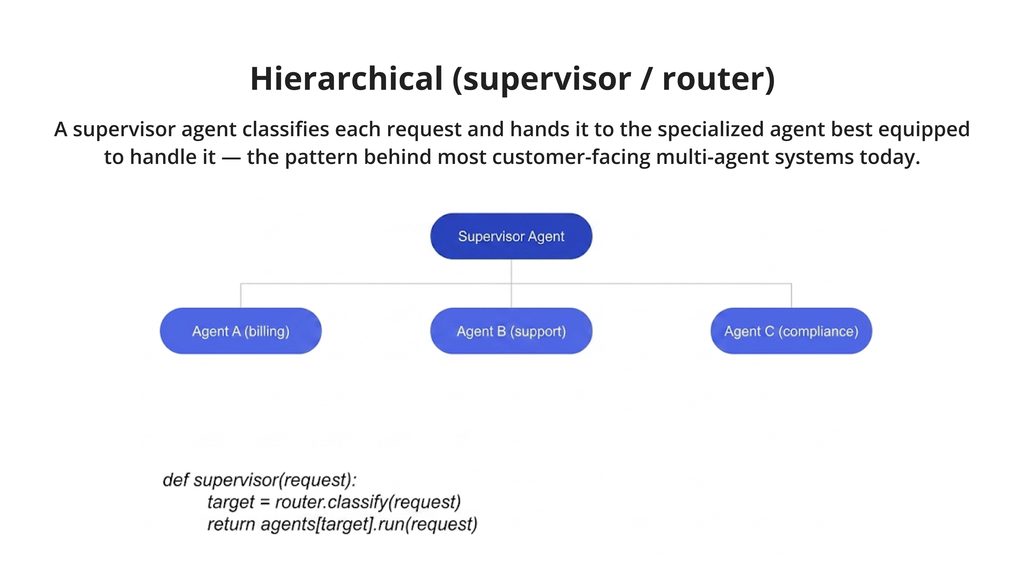
A supervisor agent classifies each request and hands it to the specialized agent best equipped to handle it — the pattern behind most customer-facing multi-agent systems today.
Supervisor Agent
/ | \
Agent A Agent B Agent C
(billing) (support) (compliance)
def supervisor(request):
target = router.classify(request)
return agents[target].run(request)
Hierarchical orchestration scales well: add a new specialized agent without touching the others; just teach the router when to call it. It’s also the pattern most compatible with agent-to-agent (A2A) protocols, where each agent may live behind a different vendor’s API.
Human-in-the-loop
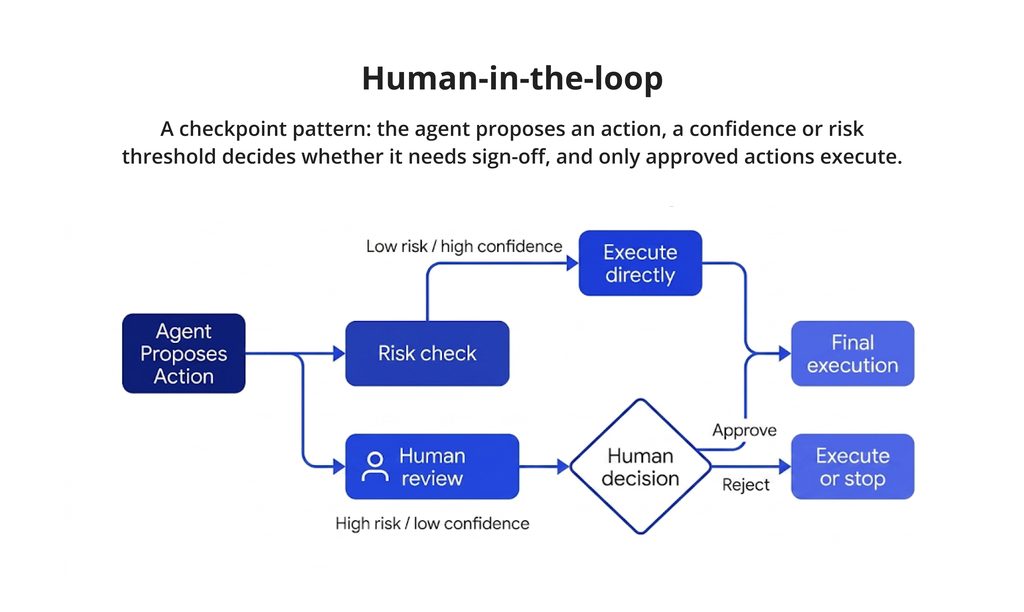
A checkpoint pattern: the agent proposes an action, a confidence or risk threshold decides whether it needs sign-off, and only approved actions execute.
Agent proposes action → Risk check
├─ Low risk / high confidence → Execute directly
└─ High risk / low confidence → Human review → Approve/Reject → Execute or stop
Common challenges in AI agent orchestration
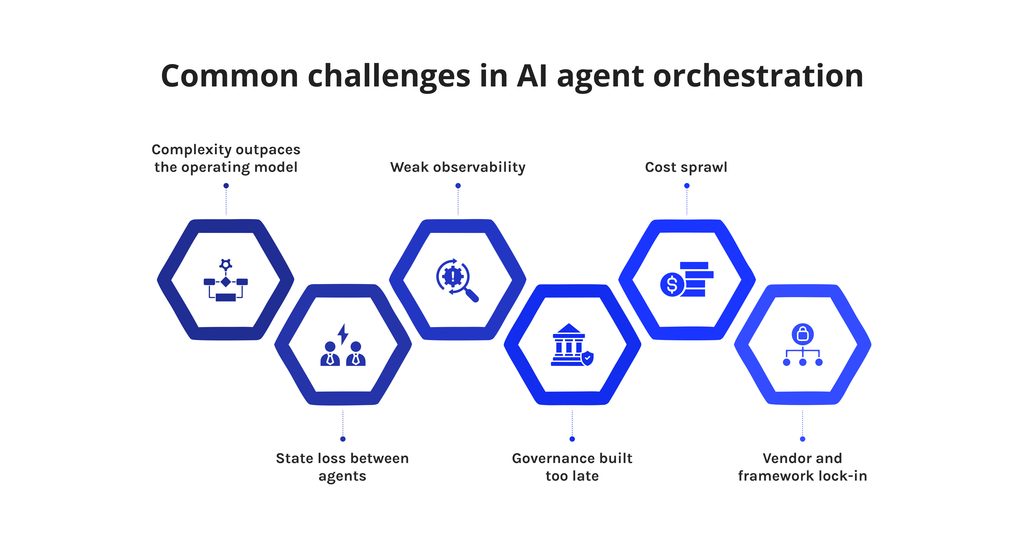
The technology mostly works; the failures are structural. Gartner predicts over 40% of agentic AI projects will be canceled by the end of 2027, citing escalating costs, unclear business value, and inadequate risk controls — not model performance [3]. Recurring AI agent orchestration challenges:
- Complexity outpaces the operating model — a fourth and fifth agent multiplies possible hand-off failures, not just adds to them.
- State loss between agents — without a shared view of what already happened, systems repeat steps or contradict themselves.
- Weak observability — teams that skip tracing learn about failures from customers, not dashboards.
- Governance built too late — guardrails retrofitted onto a live system are far more disruptive than guardrails designed in from the start.
- Cost sprawl — without per-agent token budgets, a cheap-looking demo can post real overruns under production traffic.
- Vendor and framework lock-in — a framework choice is typically a two- to three-year commitment, since migration means re-validating every hand-off.
How to implement orchestration in production
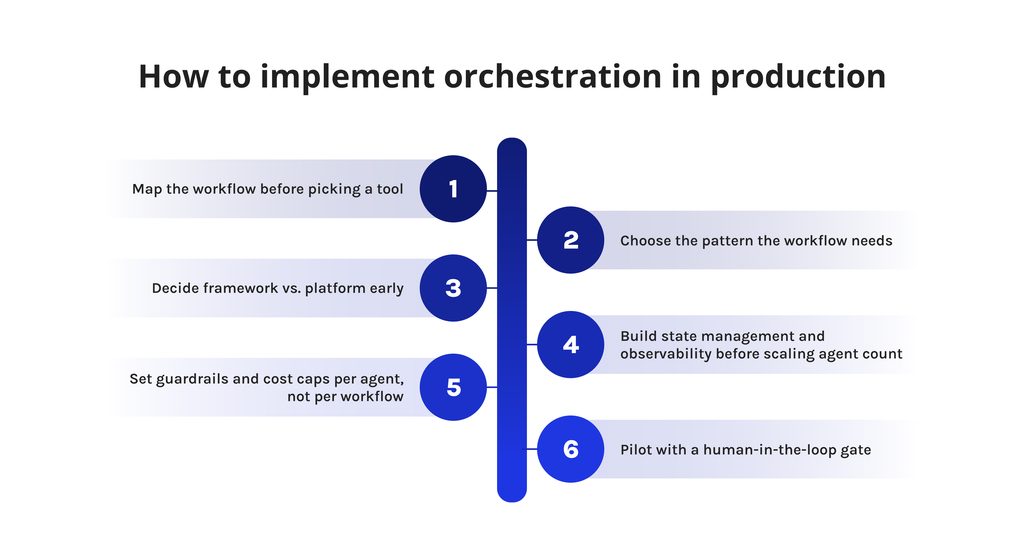
A demo is a weekend project. A production-grade AI agent orchestration system takes a deliberate sequence.
- Map the workflow before picking a tool. Teams that reverse-engineer a workflow around a framework end up rebuilding it later.
- Choose the pattern the workflow needs — most production systems land on a hybrid, a hierarchical supervisor delegating to a sequential pipeline.
- Decide framework vs. platform early. Full control and bandwidth → a framework like LangGraph. Business users need to edit the workflow → a visual platform.
- Build state management and observability before scaling agent count — retrofitting tracing onto five agents is far harder than building it in at two.
- Set guardrails and cost caps per agent, not per workflow, so one runaway agent can’t consume a disproportionate token budget.
- Pilot with a human-in-the-loop gate, then loosen it selectively for action types the agent has proven reliable on.__
Our methodology: we score orchestration tools on deployment model, integration depth (including native Model Context Protocol support), state and memory architecture, governance tooling, and total cost of ownership once engineering time is included — the same lens we’d recommend before a procurement conversation starts.
A self-hosted option worth knowing: if your workflow needs to stay inside your own infrastructure for regulatory or data-residency reasons, EpicStaff is worth a look — a source-available, self-hosted platform with a visual editor that ops teams can edit directly, a Python layer for engineers, native MCP connections, and an audit trail tied to a named principal for every decision. It won’t replace a deep framework for teams building every primitive themselves, but for a business that wants operations staff to own workflow logic without writing code, it’s a reasonable starting point — the source is open on GitHub.
Summary
AI agent orchestration is the coordination layer that turns individually capable agents into a system a business can rely on. The job never changes: route the task, manage state and memory, call the right tools, log every decision, and gate the risky ones through a human.
The pattern you choose should follow the shape of the workflow. The choice between a coding framework and a visual platform should follow who on your team will maintain it six months from now. Get those two decisions right, and the rest is disciplined execution, not guesswork.
Want more guides like this on enterprise AI infrastructure? Follow Digest.Pro on LinkedIn for the next one.
Read more: 10 Best AI Project Management Tools in 2026: Benefits, Key Features, and How to Choose
FAQs
LangGraph, CrewAI, and AutoGen (AG2) are the three most adopted open-source options in 2026, using graph-based, role-based, and conversational coordination, respectively.
It is impossible to determine an absolute answer, as it relies on the capabilities of a particular development team. If you prefer a code-based framework, you can go for LangGraph, which offers maximum control over the entire organization of workflows. However, if you are looking for a simple visual platform and do not want your operations team to write complicated code, opt for EpicStaff.
Each type of AI agent is described by some key features such as reflexes, behavior models, goals, values, learning principles, hierarchy, and cooperation among agents (DigitalOcean, n.d.).
The four core patterns are sequential, parallel, hierarchical (supervisor/router), and human-in-the-loop. Most production systems combine at least two, commonly a hierarchical supervisor delegating to a sequential pipeline.
A router or supervisor component classifies each task and assigns it to the right agent. State management carries context between agents, while a DAG-based execution model keeps the workflow moving forward without unintended loops.
By decoupling agents behind clear interfaces, new agents can be added without modifying existing ones. Shared state stores and centralized observability keep the system stable as agent count grows.
They enforce consistent hand-offs, trace every decision, and apply guardrails before an agent acts — turning unpredictable behavior into a workflow that fails visibly instead of silently.
Without a coordination layer, race conditions and contradictory outputs become common — one agent can overwrite context another still needs. A state management layer sequences access and gives every agent a consistent view of the current step.
State loss between agents, weak observability, guardrails added too late, and cost sprawl from uncapped usage. Gartner attributes most agentic AI project cancellations to cost, unclear value, and weak risk controls — not model capability.
LangGraph, CrewAI, AutoGen (AG2), the OpenAI Agents SDK, Google’s Agent Development Kit (ADK), n8n, and EpicStaff. The first five are primarily code-first frameworks; n8n and EpicStaff are visual platforms built for a lower engineering barrier to entry.
References
https://www.mckinsey.com/capabilities/mckinsey-technology/our-insights/reimagining-tech-infrastructure-for-and-with-agentic-ai
https://camunda.com/press-releases/camundacon-2026-brings-the-global-orchestration-community-together-to-break-through-the-automation-ceiling/