
Every missed customer query costs money. Every undertrained agent costs more. And every second your team spends hunting for an answer is a second your customer is losing patience.
AI agent assist is the technology that fixes all three problems at once. It delivers real-time AI-powered guidance directly to human agents during live interactions — reducing handle time, eliminating knowledge gaps, and enabling your team to scale without proportional growth in headcount.
“In many fields, this [pursuit of generating novel research directions] presents a breadth and depth conundrum, since it is challenging to navigate the rapid growth in the rate of scientific publications while integrating insights from unfamiliar domains.”
— Juraj Gottweis & Vivek Natarajan, Google Research (2025) %9115%93
According to Gartner, conversational AI deployments in contact centers are projected to reduce agent labor costs by $80 billion globally by 2026 [1]. Organizations already deploying agent assist AI are seeing measurable returns. Those still evaluating their options are falling behind.
Key Takeaways:
- AI agents assist software human agents (while they’re on the phone or using any customer communication method) with access to real-time, AI-generated recommendations during the call for the purpose of assisting those customers and completing their inquiries without having to replace human agents.
- The modern agent assist platform has shown an AHT reduction of 20%-40% and has increased the FCR rate by 25%-30% during the same time period.
- AI agents differ from fully automating functions by enabling full human control and taking away from the human agent to keep them busy with endless repetitive tasks to complete on a day-to-day basis to handle their job responsibilities efficiently.
- Agent assist platforms integrate across voice, chat, email, and text channels while providing seamless connection to respective CRM systems.
This document should help explain to you what agent assist is, what agent assist platforms provide, which types of industries are most recognizable for the return on investment, and how to select the best solution for your organization.
Read more: AI Sales Coach: The Future of Scalable Sales Performance
What is AI Agent Assist?
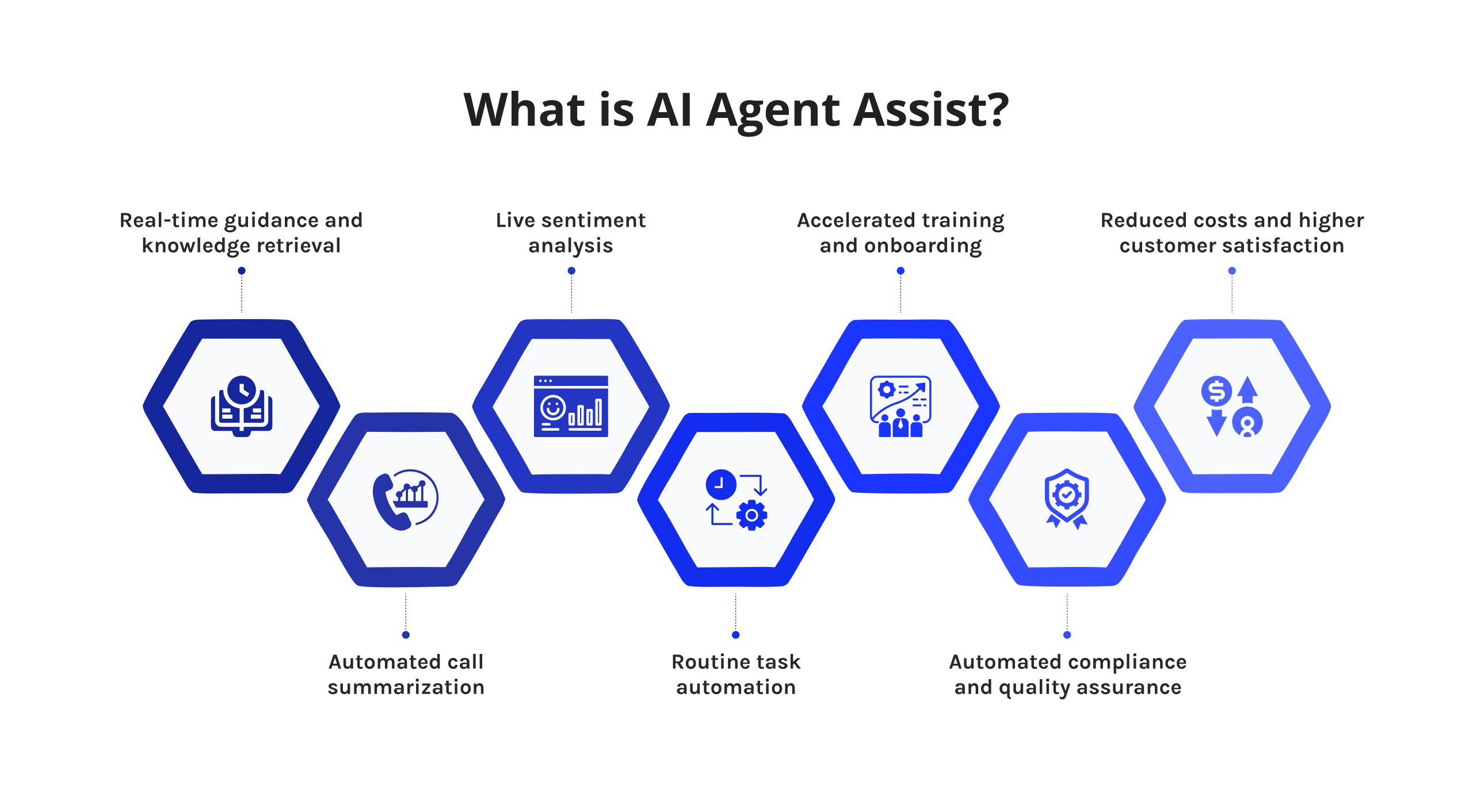
AI agent assist is a technology layer that sits between your communication channels and your agent interface. It analyzes live conversations in real time, identifies customer intent, and pushes relevant knowledge, suggested responses, and automated workflow actions directly to the agent’s screen — all without interrupting the interaction.
An architectural understanding of AI assists in improving decision-making when evaluating potential vendors. Simply put, your AI assistant is not a robot chat (chatbot), a virtual agent (helpdesk), or simply a knowledge base—your AI assistant is a highly intelligent co-pilot to your human support personnel.
The Evolution From Traditional Support to AI-Augmented Agents
Traditional contact center support depended entirely on agent memory and manual system navigation. Agents toggled between the CRM, knowledge base, ticketing tool, and chat window — simultaneously. The cognitive load was significant, and the margin for error was high.
The first wave of assistance tools introduced basic scripting and rule-based suggestions. The second wave brought machine learning models that predicted agent needs based on interaction patterns. In 2026, the third wave is here: agentic AI-powered platforms that process intent, sentiment, and context simultaneously, delivering intelligent guidance in under a second.
The result is a new standard for support operations — not agents replaced by AI, but agents amplified by it.
Agent Assist Paradigm and Architecture
The architecture of a modern AI agent assist platform intercepts the live conversation stream, processes it through natural language processing (NLP) and large language model (LLM) layers, and returns structured recommendations to the agent UI in real time.
The assistance connect layer between AI and human agents is what defines the architecture’s practical value. It links live conversation signals to enterprise knowledge, CRM data, and workflow triggers — forming a closed-loop intelligence system that improves with every interaction.
Core Components of a Modern Agent Assist System
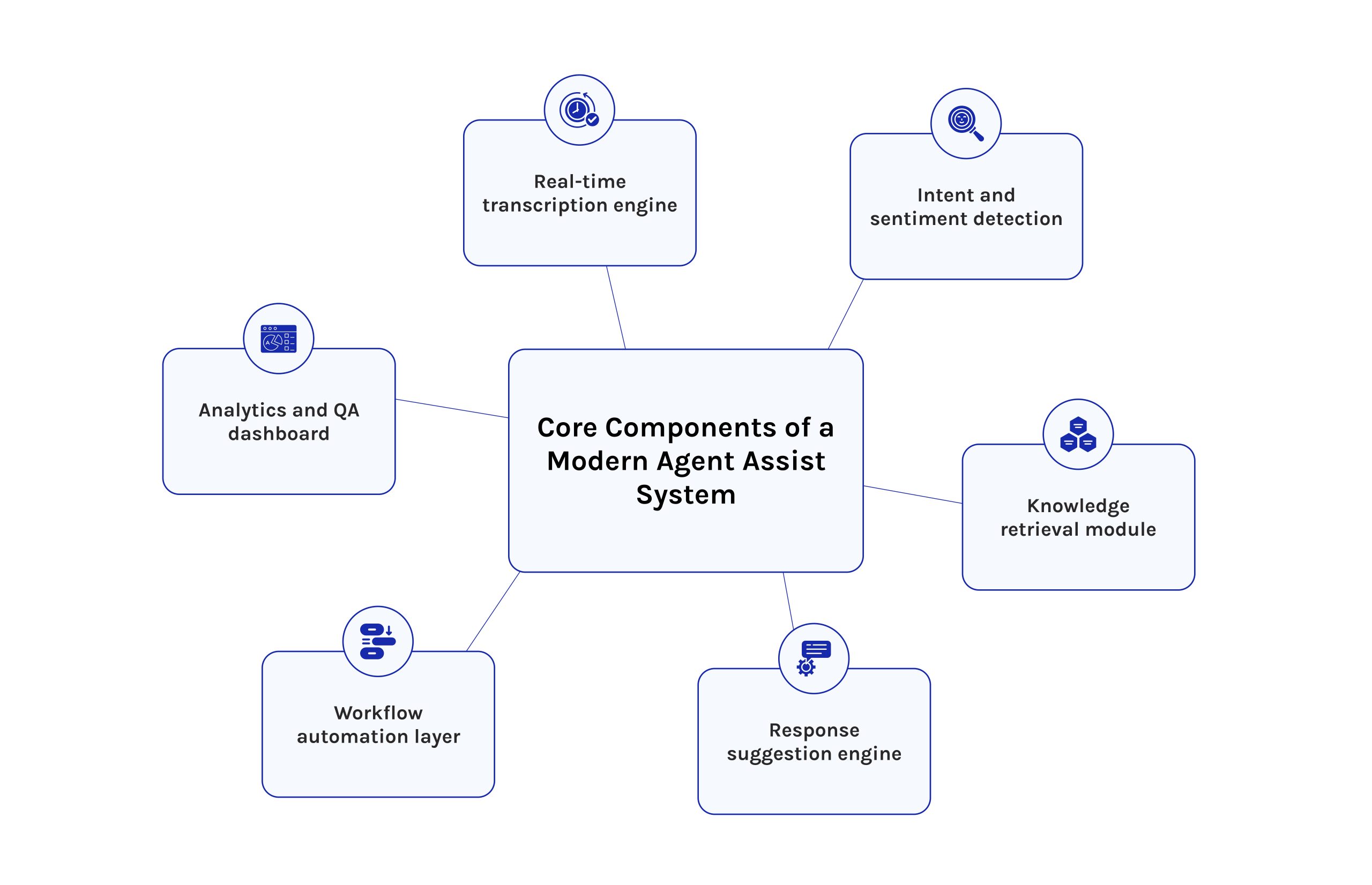
A complete AI agent assist software stack includes the following:
- Real-time transcription engine — converts voice and text to structured data for analysis
- Intent and sentiment detection — identifies what the customer needs and how they feel about it
- Knowledge retrieval module — surfaces relevant articles, policies, and procedures automatically
- Response suggestion engine — generates next-best-action prompts and reply drafts
- Workflow automation layer — triggers case creation, escalation routing, or follow-up scheduling
- Analytics and QA dashboard — tracks AHT, CSAT, FCR, and coaching metrics at the agent level
How Agent Assist Differs From Full Automation
This distinction is critical for operations and C-level leaders building a contact center AI strategy. Full automation — chatbots and virtual agents — handles interactions end-to-end without human input. AI agent assist keeps the human in the loop.
Where full automation fits best is in routine tasks — handling password resets, tracking orders, and answering basic questions. Yet complexity demands support tools instead, stepping in when decisions carry weight or emotions run deep.
Across numerous corporate setups, automation manages initial inquiries while layered support boosts advanced-stage staff effectiveness through intelligent guidance systems. Though separate in function, these levels operate in sequence, where bot-driven resolution precedes specialist involvement enhanced by real-time suggestions.
Core Features to Expect From Agent Assist Software
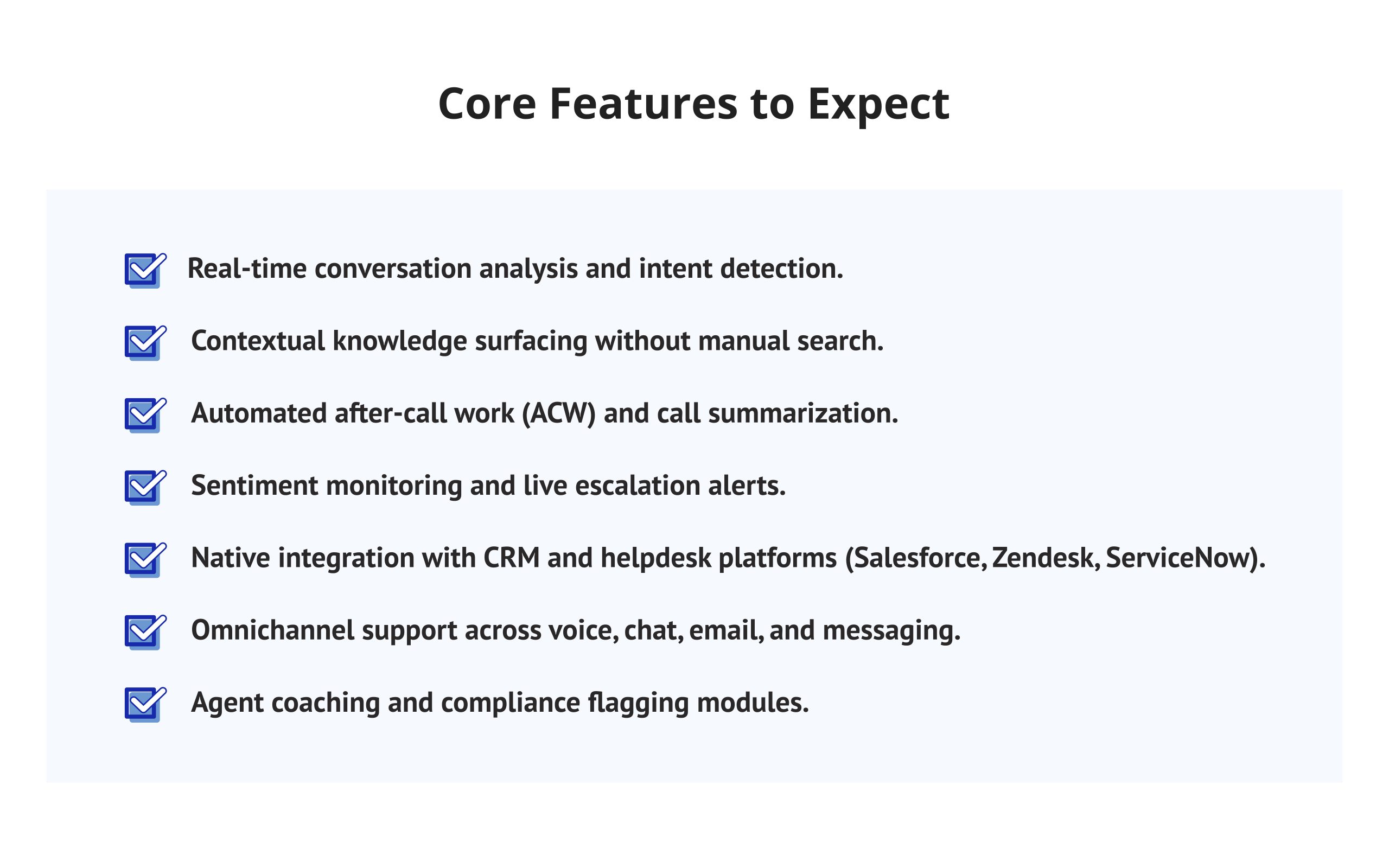
When evaluating AI agent assist technology, prioritize these capabilities:
- Real-time conversation analysis and intent detection
- Contextual knowledge surfacing without manual search
- Automated after-call work (ACW) and call summarization
- Sentiment monitoring and live escalation alerts
- Native integration with CRM and helpdesk platforms (Salesforce, Zendesk, ServiceNow)
- Omnichannel support across voice, chat, email, and messaging
- Agent coaching and compliance flagging modules
Data Integration, Compliance, and Privacy
Enterprise-grade AI agent assist platforms connect to CRM records, product databases, interaction history, and internal knowledge bases simultaneously. This multi-source ingestion requires robust data governance.
Start by checking if suppliers provide access based on roles, full-chain encryption, and tracking logs, while holding valid certifications for GDPR, HIPAA, and SOC 2 Type II. When it comes to fields like finance or medical care, meeting those standards isn’t up for debate — it’s required without exception.
AI is reshaping customer operations faster than most teams can track. Digest.Pro breaks down the tools, trends, and research that matter — so your team spends less time searching and more time acting on what’s already been filtered for relevance. Follow Digest.Pro and get a weekly brief delivered straight to your feed.
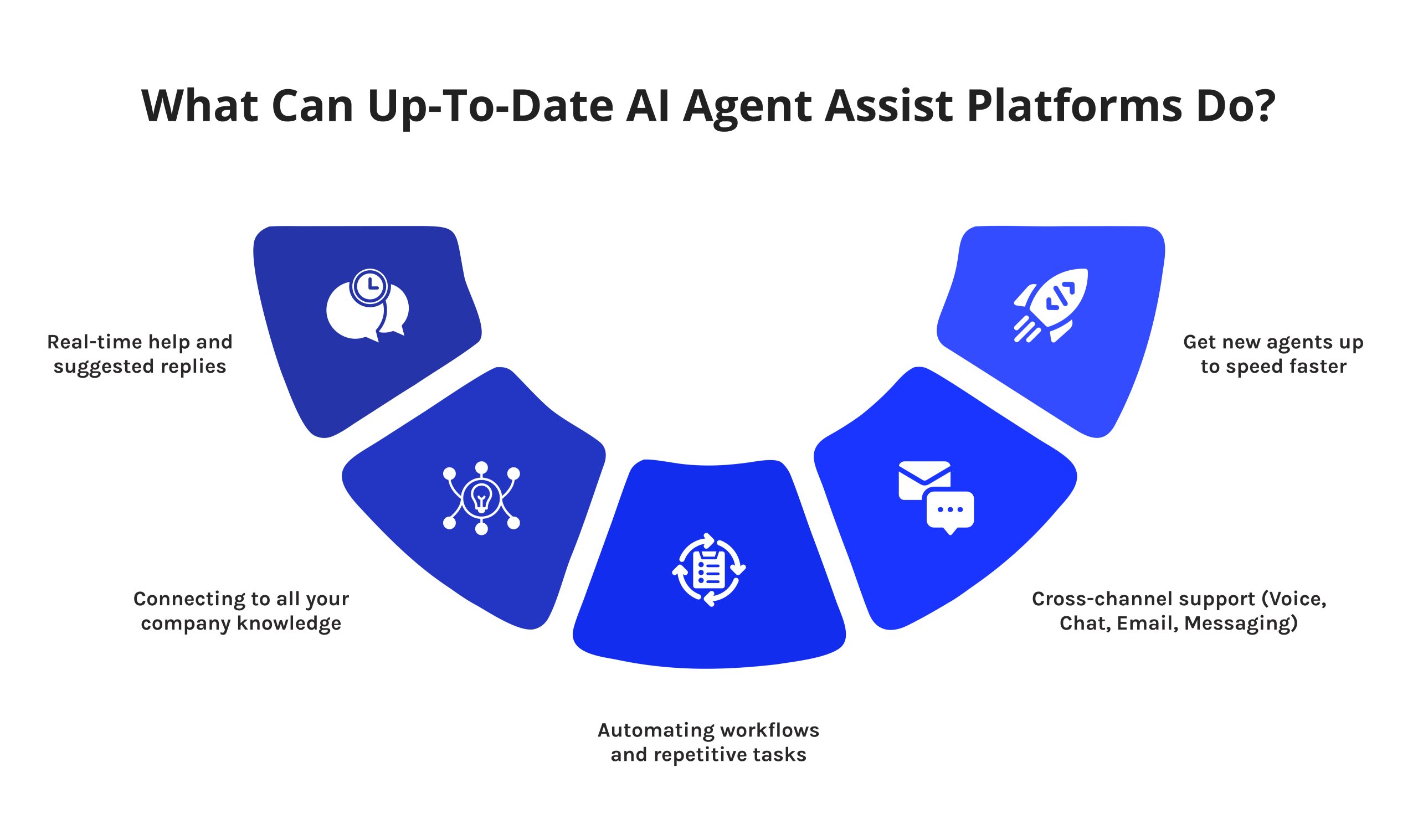
What Can Up-To-Date AI Agent Assist Platforms Do?
“Beyond standard literature review, summarization and ‘deep research’ tools, the AI co-scientist system is intended to uncover new, original knowledge and to formulate demonstrably novel research hypotheses and proposals, building upon prior evidence and tailored to specific research objectives.”
— Juraj Gottweis, Google Fellow, and Vivek Natarajan, Research Lead, Google (2025) %9115%93
Real-time Help and Suggested Replies
The most immediate value of AI agent assistance is speed. During a live interaction, the platform analyzes what the customer says and instantly suggests the best response, relevant policy, or recommended next action.
This eliminates the time agents spend searching knowledge bases mid-conversation. It also eliminates the inconsistency that arises when ten agents give ten different answers to the same question.
Connecting to All Your Company Knowledge
An agent assist bot is only as useful as the knowledge it can access. Leading platforms use GenAI data fusion to synthesize information from CRM notes, product documentation, previous case history, live inventory systems, and internal wikis — presenting a single, coherent recommendation rather than a list of search results.
Agents no longer need to know where the answer lives. The system finds it, interprets it, and delivers it in actionable form.
Automating Workflows and Repetitive Tasks
Post-call documentation is one of the highest hidden costs in contact center operations. Agent assist AI platforms automate this entirely — generating call summaries, updating CRM fields, and triggering follow-up tasks without agent input.
Beyond documentation, platforms automate order lookups, appointment scheduling, refund approvals, and ticket routing — all during the live interaction.
Cross-Channel Support (Voice, Chat, Email, Messaging)
Customers interact across every channel — WhatsApp, email, live chat, and phone — often within the same service journey. Agent assist software with voice AI ensures real-time guidance is consistent across all of them.
The voice AI service provides transcribing of the audio and analysis of tone and sentiment during the phone call, all in real-time, and delivers the results to the agent’s screen while not interrupting the conversation. The Genesys and Google agent assist are both evolving core-business capabilities to provide omnichannel agents equally with the benefit of AI support, regardless of whether the customer is calling, chatting, or emailing.
Get New Agents Up to Speed Faster
The average time to full proficiency for a new contact center agent ranges from 3 to 6 months. AI agent assist for service desk environments compresses this window significantly by giving new agents access to the same institutional knowledge as your most experienced team members — from day one.
Observe AI agent assist capabilities, for instance, include in-call compliance coaching that flags when agents miss required disclosures or deviate from scripted workflows — providing real-time correction without supervisor intervention. This transforms onboarding from a months-long process into a week-by-week progression toward competency.
Making smart decisions about AI tools requires staying current with the platforms, research, and case studies that actually matter. Digest.Pro curates the most important developments in enterprise AI and automation into a clean weekly brief — built for busy professionals who need signal, not noise. Subscribe to Digest.pro and keep your team informed.
Read more: Top 5 MS Project Alternatives Compared
Benefits of Using AI Agent Assist
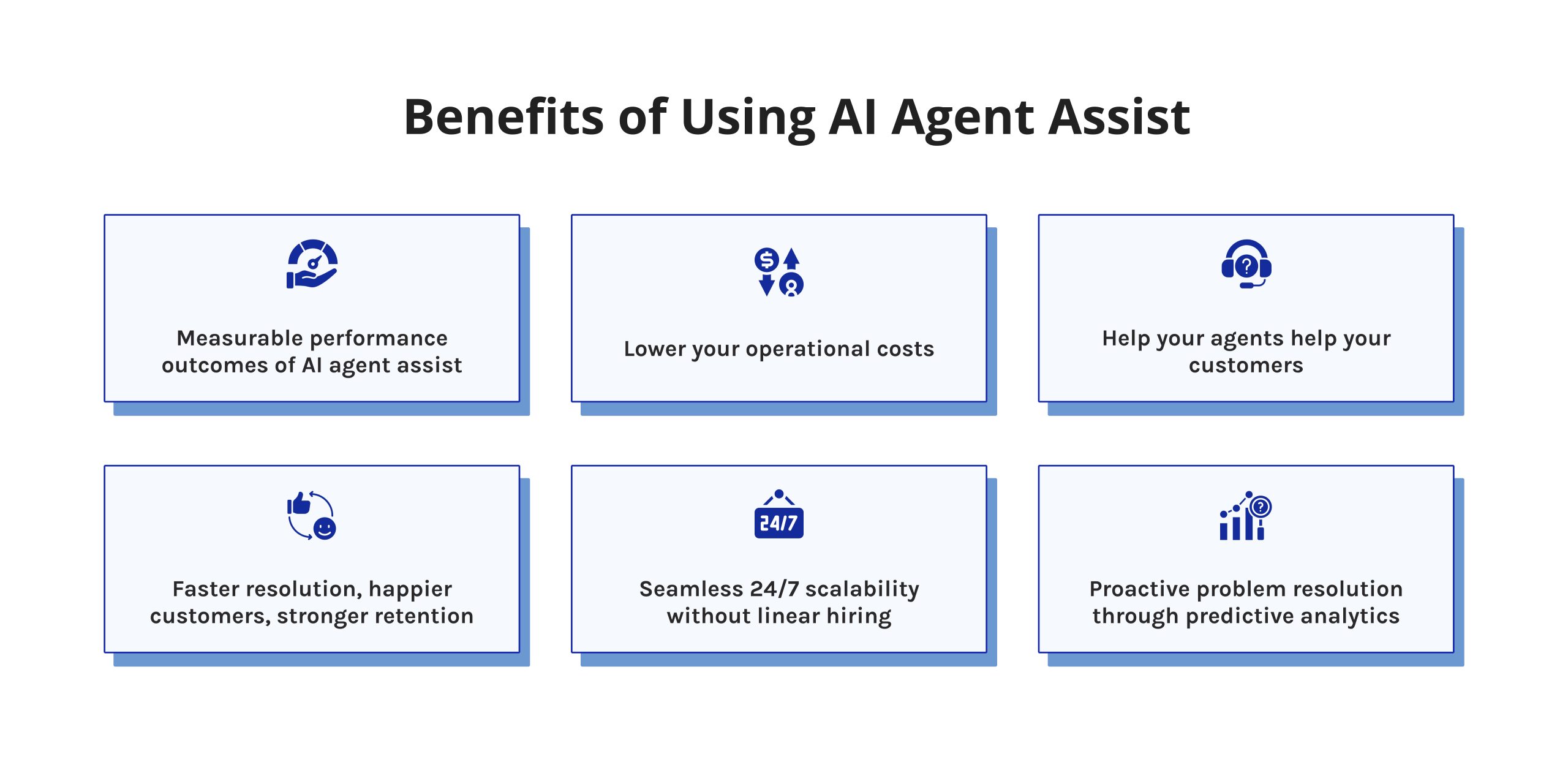
Measurable Performance Outcomes of AI Agent Assist
Key Metrics: AHT, CSAT, FCR, ROI, Cost Per Contact
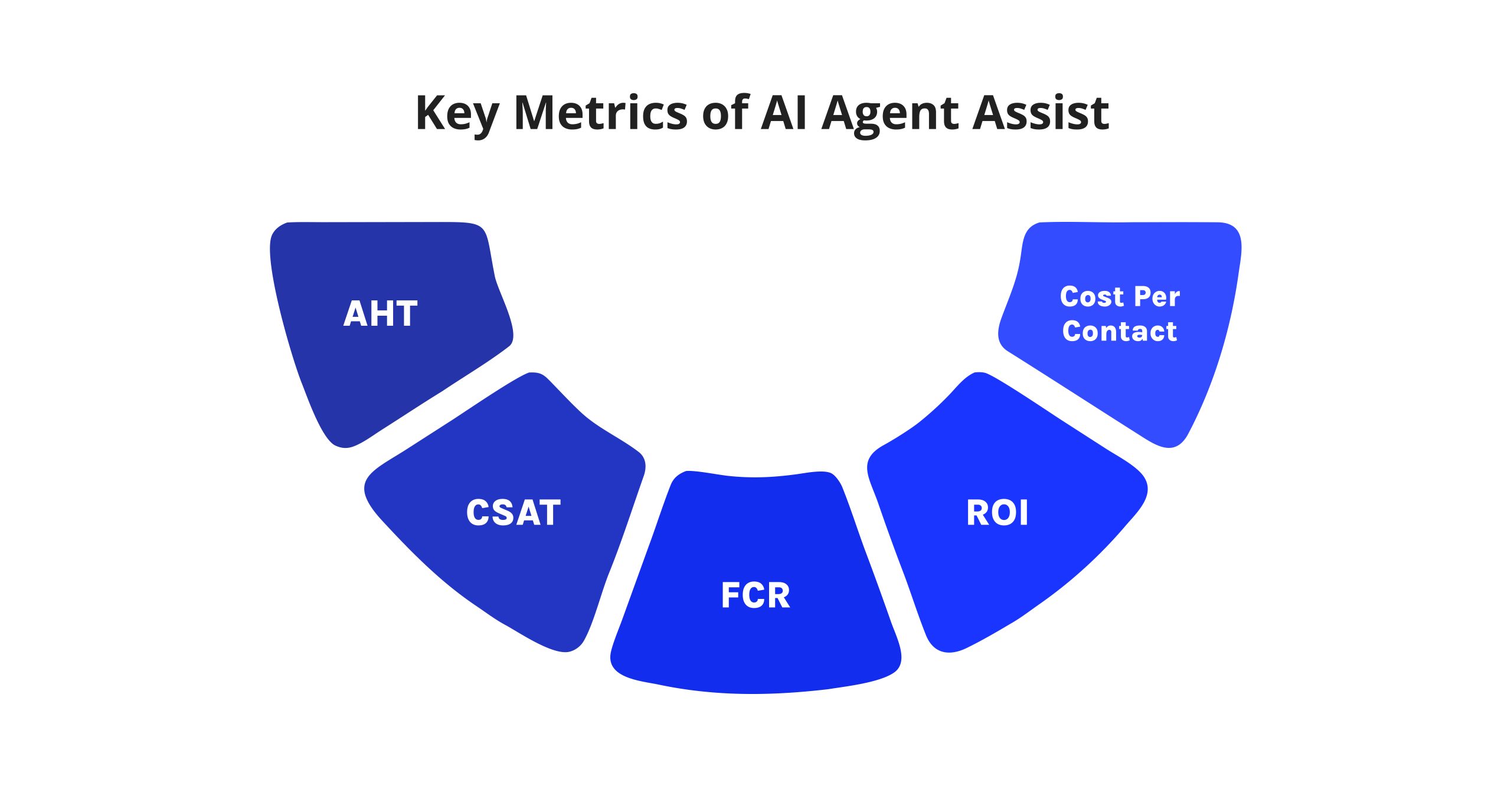
Organizations that deploy AI agent assistance consistently report improvements across five core performance metrics. The table below reflects ranges reported across deployments by Gartner, Forrester, and McKinsey:
|
Metric |
Typical Improvement |
|
Average Handle Time (AHT) |
20–40% reduction |
|
Customer Satisfaction (CSAT) |
+10–20 points |
|
First Contact Resolution (FCR) |
+15–25% improvement |
|
Cost Per Contact |
15–30% reduction |
|
ROI Positive Timeline |
6–12 months post-deployment |
These ranges are not theoretical projections. They reflect measured outcomes from enterprise deployments where AI agent assist has been integrated into agent desktops, knowledge bases, and workflow tools across multiple industries.
Though seemingly subtle, the difference shows up clearly in annual results: contact centers using AI‑assisted agents routinely achieve double‑digit reductions in AHT and cost per contact, while maintaining or improving CSAT and FCR [12,13,14].
Lower Your Operational Costs
Contact center labor represents 60-70% of total operational costs in most service organizations. AI agent assists reduce the per-contact cost by compressing handle time, cutting post-call work, and reducing escalation rates.
The cost savings compound at scale. An organization handling 500,000 interactions per month that reduces AHT by even 3 minutes per contact saves thousands of agent-hours monthly — with no reduction in service quality.
Help Your Agents Help Your Customers
Agent burnout is a quantifiable business risk. When agents are overwhelmed by information overload and unrealistic handle time targets, attrition rises — and replacement costs average 30-50% of annual salary per agent. Agent assist removes the friction that drives burnout.
Agents who use AI assistance consistently report higher job satisfaction. They spend less time searching and more time solving. That shift — from information retrieval to problem resolution — is what retains top performers and reduces costly turnover.
Faster Resolution, Happier Customers, Stronger Retention
Speed and accuracy are the two variables that most directly drive customer satisfaction scores. An AI agent assists both simultaneously. Customers receive faster answers. Agents deliver more accurate ones.
Customer loyalty tends to rise when service issues are settled quickly during the initial interaction, according to McKinsey data from 2023. Where turnover is common—telecom or software subscriptions, for instance—a small edge in resolution speed often leads to noticeable financial gains. Though seemingly subtle, the difference shows up clearly in annual results [25].
Seamless 24/7 Scalability Without Linear Hiring
When call volumes rise, staffing traditionally rises too. Yet artificial intelligence changes this link entirely.
Each agent handles more work, so companies manage increased demand without adding staff at the same rate. Especially useful when activity surges — seasonal changes, new products, periods of fast growth — times when customer contact rises quicker than recruitment can keep up.
Proactive Problem Resolution Through Predictive Analytics
Advanced AI agent assist platforms don’t just react — they predict. By analyzing historical interaction patterns, product data, and sentiment trends, these systems identify which customers are likely to experience problems before they contact support.
Proactive outreach, triggered automatically by the platform, resolves issues before they become complaints. This capability is becoming standard in enterprise agent assist software — and represents a meaningful competitive advantage for organizations that deploy it early.
Industry Applications and Use Cases
Retail & E-commerce
Beginning with routine tasks, retail contact centers handle numerous questions about orders, returns, and shipping issues. When a query arrives, artificial intelligence displays current order details instantly. Instead of manual steps, refund and exchange processes proceed automatically. Following issue closure, tailored suggestions appear—sometimes for replacements, sometimes for continued service. Resolution speed improves under this flow. Over time, each customer contributes more value.
FinTech
It must be followed without exception within finance. Assistance from artificial intelligence helps staff adhere to mandated dialogue, identifies possible lapses as they occur, and then fills mandatory notices automatically. Systems built for digital finance settings include tools that detect deception — signaling unusual activity during conversations well ahead of any need for intervention.
Healthcare
Every interaction begins with coordination. Through secure systems, staff manage visits, respond to billing questions, follow medical screening steps, and address personal health matters carefully. Tools that comply with privacy rules pull relevant care data, check benefits instantly, and fill slots automatically — lessening the paperwork burden while shaping smoother experiences across each stage of contact.
Insurance
Insurance agents managing claims, policy renewals, and coverage inquiries benefit directly from AI-powered knowledge retrieval and guided resolution workflows. Agent assist reduces errors in policy quotation, ensures consistent coverage explanations across all agents, and automates documentation — cutting claim processing time and improving auditability.
Telecom & SaaS Support
Telecom and SaaS companies face high-volume, technically complex support requests from users with low tolerance for slow resolution. Nbsp agent assist capabilities—including diagnostic workflow automation, product knowledge integration, and guided troubleshooting — enable agents to resolve technical issues faster, reducing escalation rates and improving FCR without increasing headcount.
Senior leaders responsible for AI strategy need more than vendor marketing — they need independent, rigorous analysis of what’s actually working. Digest.Pro delivers exactly that. From platform comparisons to deployment case studies, the Digest.Pro gives operations and technology leaders the intelligence to make confident decisions. Subscribe to the Digest.Pro.
Read more: AI Agent Orchestration for Complex Workflows: Everything You Need to Know
How to Pick the Right AI Agent Assist Provider
Platform vs Integrated Layer
The first architectural decision: standalone platform or integrated module?
Standalone AI agent assist platforms deliver deeper AI capabilities and faster time-to-value. Integrated modules bolt onto existing CCaaS infrastructure (Genesys, Salesforce Service Cloud, Zendesk) and preserve your current technology investment.
For organizations with mature existing infrastructure, an integrated layer is often the faster path. For those building from a greenfield position, a dedicated platform gives greater flexibility and AI depth. Neither is universally correct — the right choice depends on your existing stack, roadmap, and internal IT resources.
Security and Testing Considerations
Enterprise deployments require thorough security validation before contract signature. Verify the following from every prospective vendor:
- SOC 2 Type II certification status and audit history
- GDPR, HIPAA, and regional data residency compliance
- Penetration testing frequency and vulnerability disclosure policy
- Data retention and deletion policies post-contract
- Model explainability — can the vendor demonstrate how recommendations are generated?
Security gaps discovered post-deployment are far more costly than a rigorous pre-purchase evaluation.
Hybrid AI Architectures
Some top artificial intelligence support systems by 2026 will rely on mixed designs. Where strict rules manage high-compliance processes, generated responses take charge of fluid information tasks. Precision emerges alongside flexibility, not instead of it. Balance comes not from one method alone but from how they shift roles.
Occasionally, raw generative artificial intelligence operates unrestrained. That brings chances of false outputs — especially concerning medicine, money-related operations, or law-based environments. Some suppliers provide adjustable certainty limits. These influence whether automated input appears immediately or if a person steps in. Decisions about output timing shifts are based on set boundaries.
Key Questions to Ask Before Buying
Before buying, consider these essential queries.
How does the system handle requests beyond its scope or those marked with uncertain accuracy? When confidence levels fall below the threshold, responses are set aside rather than delivered. A separate path manages topics outside defined boundaries. Unclear inputs get reviewed under adjusted rules. Responses shift depending on whether limits apply. Direction changes if uncertainty rises during processing.
How long might it take to see results, given our company’s scale and how we reach customers?
What path does the AI model follow when learning grows inside the organization?
How deeply do the integration services connect under the standard offering?
What steps are taken to maintain correct predictions by watching changes in model behavior over time?
Is it possible to carry out a trial investigation?
Should a company answer each question adequately, advancement in assessment becomes reasonable. When clarity is avoided, closer examination follows instead.
Summary
This is not an area requiring a future state investment anymore. In 2026, you need this capability to be in place already if you plan to compete on customer service quality, efficiency, and agent performance.
The best solutions involve real-time knowledge discovery, workflow automation, omnichannel capability, and predictive analytics, all in one product offering. Selecting a standalone product vs. a layer to integrate into your existing architecture will depend on the current state of your infrastructure.
It is easy to see the value here in terms of reduced AHT and cost per contact, quicker agent onboarding, CSAT scores, and scale without having to increase headcount proportionally. Organizations that adopt AI agent assistance now will start building on their advantages. Those who hold off will lose their edge.
If this guide helped you think more clearly about AI agent assist, Digest.Pro publishes the same quality of analysis every week — covering enterprise AI, automation platforms, and the decisions that actually move the needle for operations leaders. Subscribe at Digest.Pro and make every week’s reading count.
Read more: Best AI Project Management Tools in 2026: Benefits, Key Features, and How to Choose
Our Methodology
The analysis and recommendations in this article are based on a structured evaluation framework applied to publicly available vendor documentation, independent analyst research, and platform capability assessments as of Q2 2026.
Criteria used to evaluate AI agent assist software and technologies included the following:
- Operational Efficiency – proven capability to lower AHT, ACW, and cost per contact at an enterprise level through published case studies or research reports.
- Artificial Intelligence Functionality – extent of NLP abilities, intent detection accuracy, generative responses, hallucination controls, and model explainability.
- Integration Ecosystem – wide availability of native CRM, CCaaS, and channel integrations, along with API quality for custom implementations.
- Compliance and Security — compliance with SOC 2 Type II standards, GDPR, HIPAA, data governance procedures, and audit logging features.
- Scalability – reliable performance in high-volume, multi-channel situations, along with enterprise-level use cases provided.
- Time-to-Value — average time to implement, ease of onboarding, and availability of PoC deployments.
- Vendor Viability – recognition in Gartner Magic Quadrant or Forrester Wave reports, verifiable client success stories, and experience with deployments in production.
No vendor was compensated for inclusion or consideration in this article. All assessments reflect independent editorial judgment based on publicly available information.
Frequently Asked Questions
Among top choices by 2026, Google CCAI stands out alongside Genesys Agent Assist. Salesforce brings Einstein for Service into play, where workflows demand integration depth. Then there is IBM Watson Assistant, operating with structured logic across complex systems. Observe.AI enters the field, focusing on voice analytics precision. Selection shifts based on current CRM infrastructure in place. Channel variety matters just as much during evaluation phases. Compliance demands shape feasibility under regional policies. Internal tech readiness often tilts decisions toward one platform over another.
Most enterprise-grade agent assist software integrates natively with Salesforce, Microsoft Dynamics 365, HubSpot, ServiceNow, and Zendesk. Look for bidirectional sync that updates CRM records automatically during and after each interaction — not just one-way data reads.
With real-time answer suggestions, support grows stronger. Post-call tasks are handled automatically, reducing delays. Knowledge queries no longer require manual effort due to streamlined access. Compliance issues appear instantly, allowing immediate attention. Faster resolutions follow naturally from these changes. Mistakes by agents occur less often. Customer satisfaction rises, clearly shown through recorded results.
Beginning with live dialogue input, analysis occurs instantly through natural language processing combined with adaptive algorithms. Customer purpose and emotional tone emerge as key data points during ongoing exchanges. Relevant support documents appear automatically on the interface alongside suggested responses. These outputs reach the agent continuously, synchronized precisely with active discussions. Interruption remains absent throughout the entire process.
Over time, shifts in offerings, regulations, or how people speak cause performance to fade. When learning happens regularly, systems stay close to present realities. Accuracy in proposals grows when updates occur without pause. Drift fades when fresh data flows in often. Guidance remains useful only if it reflects now, not before.
The timing of most setups ranges from six to sixteen weeks, shaped by how complex integrations are, the volume of existing knowledge material, and regulatory needs. When using cloud-based systems that already include ready-made links to customer relationship tools, deployment tends to move more quickly compared to individually built alternatives. Ahead of launch, allow four weeks dedicated to preparing information and connecting systems together.
One kind of AI agent acts solely on present input, without memory. Following that, some keep track of prior events using a model of their environment. What comes next is behavior shaped by targets — steps chosen to meet specific aims. Then there are those comparing results, picking paths based on which delivers the highest advantage. Over time, certain systems grow more capable due to the exposure and outcomes they encounter.
A practical example: a customer calls a bank to dispute a charge. As the agent answers, the AI agent assist platform automatically retrieves the customer’s account history, surfaces the relevant dispute policy, and suggests a step-by-step resolution workflow — all before the agent has finished their opening greeting. The agent resolves the issue in under four minutes with zero manual searching.
Enterprise AI agent assist platforms operate within defined permission boundaries set by your IT and security teams. They connect to authorized business systems through governed API integrations — not direct account access. For consumer-facing AI agents, review OAuth permission scopes carefully before granting access to sensitive accounts, and use platforms that support granular permission revocation.
Yes. Multi-agent architectures — where specialized AI agents collaborate on complex tasks — are an active capability in leading agentic AI-powered platforms. One agent retrieves data, another analyzes it, and a third executes an action, all coordinated by an orchestration layer. This capability is increasingly available in enterprise-grade platforms and represents the next major evolution in intelligent automation.
References
- Gartner (2022). “Gartner Predicts Conversational AI Will Reduce Contact Center Agent Labor Costs by $80 Billion in 2026.”
- McKinsey & Company. (2023). The economic potential of generative AI: The next productivity frontier. McKinsey Global Institute. Retrieved from https://www.mckinsey.com/capabilities/mckinsey-digital/our-insights/the-economic-potential-of-generative-ai
- IBM Institute for Business Value. (2023). CEO Study: Own your impact — Practical AI strategies for accelerating impact. IBM Corporation. Retrieved from https://www.ibm.com/thought-leadership/institute-business-value/en-us/c-suite-study/ceo
- Salesforce Research. (2024). State of Service, Sixth Edition. Salesforce, Inc. Retrieved from https://www.salesforce.com/resources/research-reports/state-of-service/
- Forrester Consulting. (2023). The Forrester Wave™: Conversation Automation Solutions for B2C, Q3 2023. Forrester Research, Inc. Retrieved from https://www.forrester.com/report/the-forrester-wave-conversation-automation-solutions-for-b2c
- Google Cloud. (2024). Agent Assist overview. Google LLC. Retrieved from https://cloud.google.com/agent-assist/docs/overview
- Genesys. (2023). The State of Customer Experience. Genesys Telecommunications Laboratories, Inc. Retrieved from https://www.genesys.com/resources/cx-state-of-customer-experience
- Accenture. (2024). Reinventing customer service with generative AI. Accenture Research. Retrieved from https://www.accenture.com/us-en/insights/artificial-intelligence/generative-ai-customer-service
- Russell, S., & Norvig, P. (2020). Artificial Intelligence: A Modern Approach (4th ed.). Pearson Education. [Standard reference taxonomy for AI agent types]
- MIT Sloan Management Review & Deloitte Insights. (2023). Scaling AI in the enterprise: Findings from a global survey. MIT Sloan Management Review. Retrieved from https://sloanreview.mit.edu/projects/advancing-artificial-intelligence/
- Calabrio. (2023). The State of the Contact Center 2023. Calabrio, Inc. Retrieved from https://www.calabrio.com/resources/state-of-the-contact-center/
- Gartner, “AI‑Driven Customer Service and Contact Center Transformation” (select analyst notes and market guides on AI‑assisted agents and conversational AI, 2023–2025). Gartner, Inc.
- McKinsey & Company, “AI‑Assisted Service Centers: Operational and Financial Impact” (case studies and ROI analyses of AI‑augmented contact centers, 2023–2024). McKinsey.
- Forrester, “AI‑Augmented Agents and Customer Service Automation” (research reports summarizing AHT, CSAT, FCR, and cost‑per‑contact metrics from live deployments, 2023–2025). Forrester Research.
- Google Research. Accelerating scientific breakthroughs with an AI co-scientist. (n.d.). https://research.google/blog/accelerating-scientific-breakthroughs-with-an-ai-co-scientist/