

Even today, phone support is one of the costliest yet most popular channels of corporate customer support. However, most call centers use the same outdated menu structure where customers get stuck trying to find a solution to their problem without connecting calls. This is where the AI IVR comes into play.
The combination of speech recognition, natural language processing, and conversational AI allows your AI IVR system to process the request of the caller and solve the issue right away without connecting the customer to an operator.
According to Gartner, conversational AI has already become the driver behind reducing the global cost of contact center labor by $80 billion by 2026. The mentioned cost-saving is not something that will happen in the future – it happens right now [1].
Key Takeaways:
- AI IVRs offer a better way to handle inbound calls through a more intelligent dialogue solution with natural language understanding and real-time resolution.
- The ability to successfully deploy your solution will depend on clearly defined use cases, a deep level of integration into your existing systems, completion of testing for accuracy before launching, and an appropriate data-handling architecture that is compliant with data-handling regulations.
This report will provide you with a complete understanding of what AI IVR is, how it works, where it produces the most business value, and how to select the right solution for your organization in 2026.
What Is AI IVR?
AI IVR, or artificial intelligence interactive voice response, refers to an automated phone call handling system based on artificial intelligence that helps the system comprehend the request made by the user in a natural form and react to it in real-time. As opposed to the traditional IVR systems, it does not make the users go through a numeric menu.
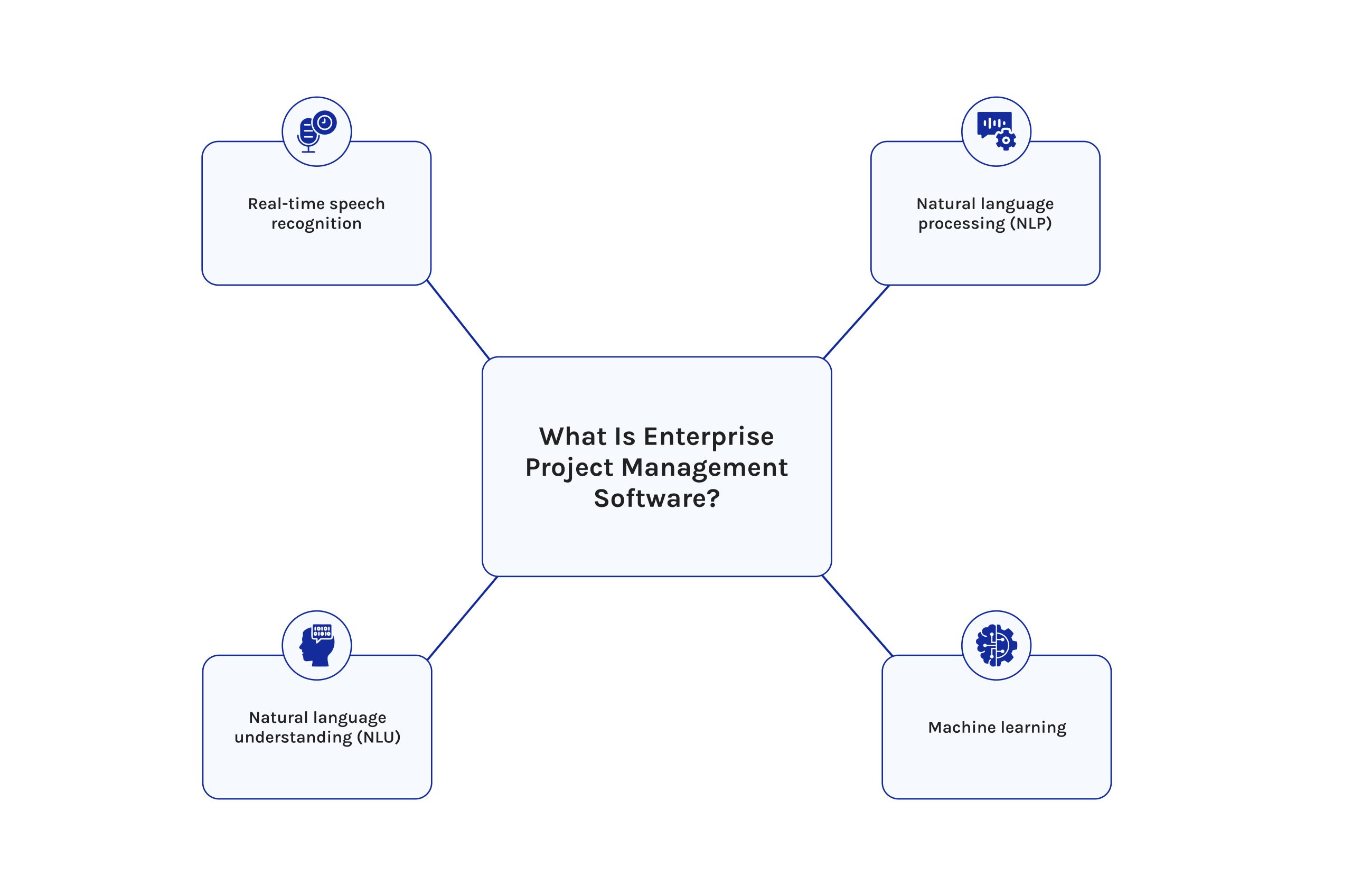
A modern deployment of this kind combines four core technologies:
- Real-time speech recognition — transcribing what was said (speech) into a digital version for reading/use by a computer within milliseconds of what was said.
- Natural language processing (NLP) — Identifying the content, context, and key entities of the caller’s spoken words through natural language processing
- Natural language understanding (NLU) — determines what the caller actually wants, not just what words they used
- Machine learning — continuously improves accuracy and response quality based on interaction data.
The result is an automated voice response system that holds genuine, context-aware conversations, completes transactions end-to-end, and routes intelligently to a live agent when necessary — with full call context passed along.
Legacy menu-driven voice systems were designed around system logic, not human communication. AI-based IVR inverts that model entirely. Powered by natural language processing and machine learning, the system adapts to the caller — not the other way around.
Read more: What is Knowledge Assist and How Does it Work?
How Do AI-Powered IVR Systems Work?
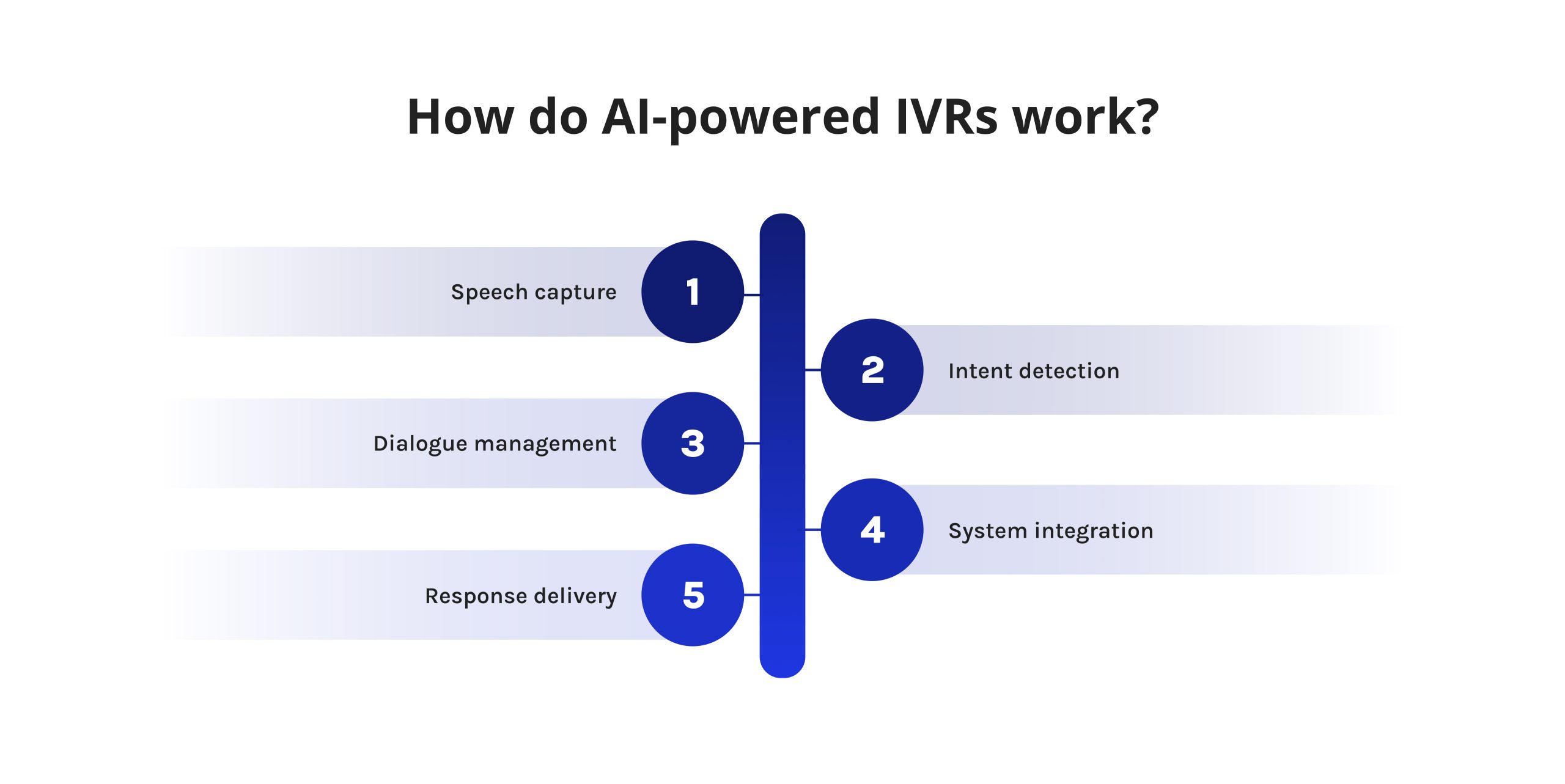
Understanding the technical architecture of an AI IVR platform helps organizations ask sharper questions during vendor evaluation. Here is how a modern system processes a call from start to finish.
Step 1 — Speech capture. The caller speaks freely. Real-time speech recognition converts their words into machine-readable text with latency typically under 300 milliseconds in leading enterprise systems.
Step 2 — Intent detection. Natural language processing (NLP) parses the transcription for meaning, entities, and context. Natural language understanding (NLU) then classifies the caller’s intent—for example, “check my account balance” or “dispute a charge on my statement.”
Step 3 — Dialogue management. The conversational AI IVR engine determines the next action: ask a clarifying question, retrieve live data from a connected system, or execute a transaction without further input.
Step 4 — System integration. The solution queries back-end systems in real time — CRM, ERP, order management, ticketing, or payment processors — to retrieve or update the data the caller needs.
Step 5 — Response delivery. The system delivers a response via high-quality text-to-speech synthesis and either completes the interaction or transfers the caller with full session context and a pre-populated agent summary.
The entire cycle happens in seconds. The caller never navigates a menu. They state what they need, and the system responds. That fundamental shift — from caller-adapts-to-system to system-adapts-to-caller — is what separates AI-powered interactive voice response from its legacy predecessors.
What Are the Benefits of AI-Powered IVR Systems?
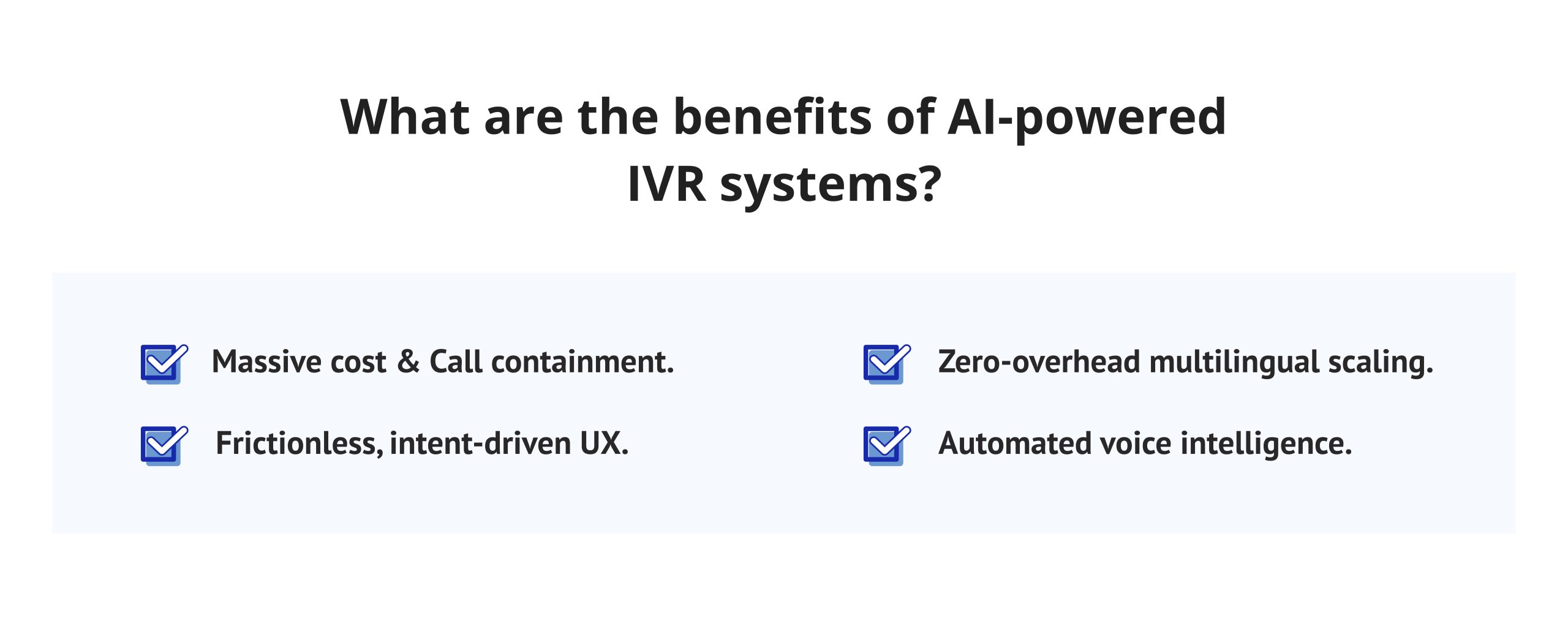
Organizations deploying this technology consistently report improvements across cost structure, customer experience metrics, and operational efficiency. Here are the four highest-impact advantages of AI-based IVR.
Massive Cost & Call Containment
Every call fully resolved by automation — without escalation to a live agent — reduces cost directly. Gartner [3] benchmarks the median cost of a self-service contact at $1.84, compared to $13.50 for an agent-assisted interaction. That is a 7x cost differential on every contained call.
Well-configured AI-powered IVR solutions handling well-defined call types consistently achieve containment rates of 40–70% [4]. For high-volume contact centers processing thousands of daily interactions, even a 10-percentage-point improvement in containment generates millions in annual savings. Additionally, McKinsey reports that AI deployments reduce total interaction volume by 40–50% as customers receive faster resolutions and generate fewer repeat contacts [5].
Frictionless, Intent-Driven UX
Traditional IVR frustrates callers because it forces them to translate their actual problem into a structured menu choice — a translation that frequently fails. Conversational AI IVR removes that friction entirely. Callers describe their issue naturally, the system identifies their intent, and it responds within seconds.
This model directly reduces average handle time (AHT), eliminates misrouting, and increases first-call resolution (FCR). All three metrics are strong predictors of CSAT and Net Promoter Score (NPS) — the KPIs most contact center leaders are measured against.
Editorial note: During our evaluation of enterprise AI-powered voice automation deployments, the platforms that achieved the highest containment rates were not necessarily those with the most sophisticated AI models. They were the ones with the most tightly scoped and thoroughly tested conversation designs. Architecture matters, but design execution matters more.
Zero-Overhead Multilingual Scaling
Adding multilingual support to a legacy menu-driven system means recording separate voice prompts and building parallel menu trees for every language — expensive, slow, and fragile when products or policies change. AI-based IVR eliminates all of that overhead.
AI voice agents built on modern natural language models support dozens of languages natively. They detect a caller’s preferred language automatically and can switch mid-conversation without disrupting the interaction. For global enterprises, this makes scaling customer support across geographies dramatically faster and more cost-efficient — without localization bottlenecks.
Automated Voice Intelligence
The technology generates structured data from every call: intent distribution, resolution status, escalation triggers, sentiment patterns, repeat-call rates, and peak-period demand curves. This is automated voice intelligence that most contact centers lack entirely with traditional setups.
That data feeds continuous improvement cycles. AI IVR testing software can simulate thousands of call scenarios to identify weak points before they reach live customers. Over time, a well-maintained system becomes measurably more accurate — and its improvement rate compounds as the interaction dataset grows.
Stay ahead of enterprise AI. Digest.Pro delivers independent, research-backed analysis on AI automation, contact center technology, and enterprise software strategy — written specifically for C-level executives, CTOs, and senior operations leaders. Subscribe to Digest.Pro to read expert insights before your competitors act on them.
What Are the Limitations of AI-Powered IVR Systems?
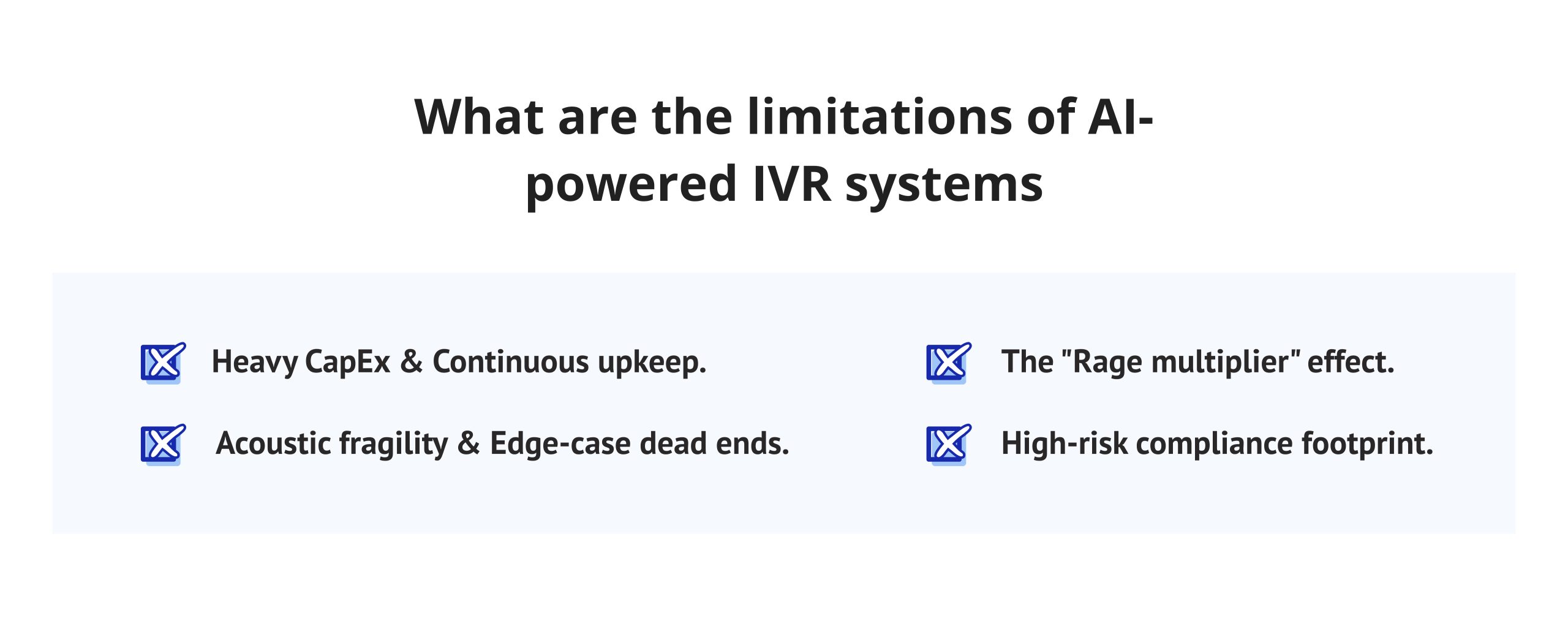
The technology is definitely beneficial, but there’s no such thing as a perfect enterprise contact center technology solution, and it’s important to know its limitations to prepare for realistic project planning and potential risks.
Heavy CapEx & Continuous Upkeep
An enterprise-level solution with artificial intelligence IVR capabilities requires considerable upfront expenditures. Apart from the cost of platform licenses or API usage, there’s a need to allocate funds for implementation, designing, and training of conversational models.
AI models degrade over time as products, policies, and customer language evolve. Without a formal retraining cadence, accuracy declines—and a poorly performing AI IVR service produces worse customer outcomes than a well-designed traditional system. Budget for ongoing maintenance as a fixed operational cost, not a one-time project expense.
Acoustic Fragility & Edge-Case Dead Ends
The efficiency of real-time speech recognition drops off in challenging circumstances like excessive ambient noise, bad-quality cellular lines, strong accents, or calls placed by people who speak in non-native languages. Under conditions when call quality cannot be ensured, speech recognition accuracy may become poor enough to result in multiple misinterpretations during the same session.
Edge cases also create risk. Unusual requests, multi-intent queries, or emotionally complex situations can produce conversational dead ends where the system cannot proceed but also lacks a clean escalation path. These moments cause disproportionate damage to customer trust.
The “Rage Multiplier” Effect
When an AI IVR system fails to understand a caller and loops them back to the same misunderstood prompt, frustration compounds rapidly. Practitioners in contact center design commonly describe this pattern as the “rage multiplier”: a system failure that converts a neutral customer into an actively dissatisfied one—before they ever reach a human agent.
The mitigation is well understood: design explicit, immediate escalation paths at every failure point. Achieving this requires careful conversation architecture and comprehensive testing before any live deployment. Organizations that skip rigorous pre-launch validation consistently report this outcome.
High-Risk Compliance Footprint
These systems deal with personal information at an enterprise scale – full names, account numbers, credit card numbers, medical records, and, in certain implementations, voice biometric records. This entails direct exposure to GDPR, HIPAA, PCI-DSS, and industry-specific regulations.
Voice biometrics and call recording functionality imply extra compliance factors such as proper consent management and audit trails. Companies operating in the regulated industries need to make sure that the system they choose meets all compliance needs upfront, and not after the first compliance audit.
Read more: AI Agent Assist: What It Is and Why You Need It in 2026?
What Are the Use Cases of AI-Powered IVR Systems?
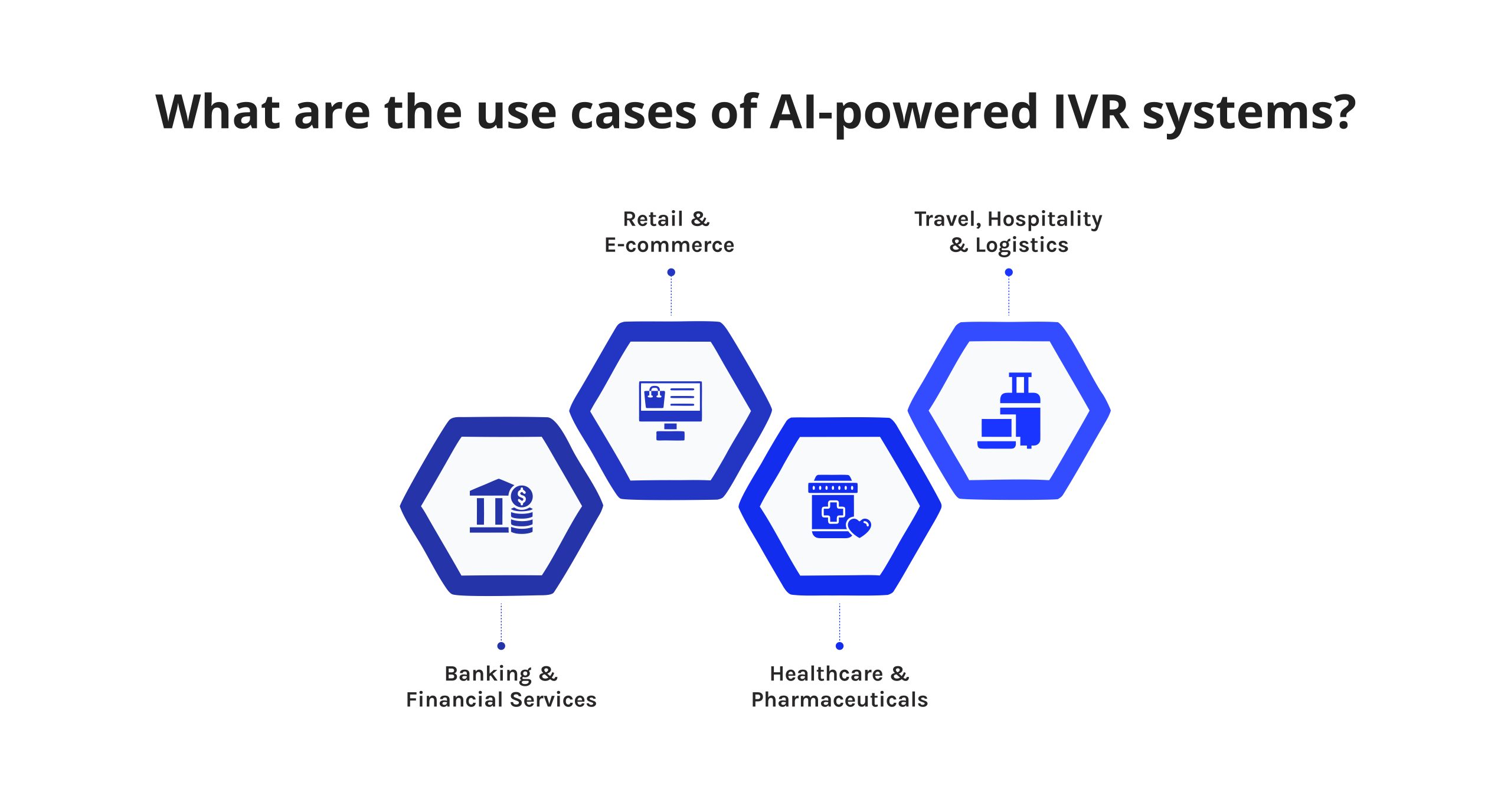
AI-enabled IVR offers the best value in scenarios with high call volumes and frequent simple questions. The following are the four industries where the application provides maximum impact on businesses.
Banking & Financial Services
In the finance industry, the interactive voice response contact center processes some of the largest numbers of calls in all industries. These include balance inquiries, transaction histories, due dates for payments, confirmations of any detected fraud, PIN change requests, and identification verification. Automated handling of these interactions end-to-end reduces agent load and eliminates wait times for the queries that represent the majority of daily call volume.
AI voice agents also power outbound notification campaigns — fraud alerts, payment reminders, and appointment confirmations — at scale, with no incremental staffing requirement. For banks processing millions of customer interactions monthly, this dual inbound-outbound capability creates substantial operational leverage.
Retail & E-commerce
Order tracking, return initiation, product availability queries, promotional inquiries, and loyalty point lookups are the backbone of retail customer service volume. A well-configured platform handles all of these autonomously — using real-time speech recognition to capture intent and integrating directly with order management, CRM, and logistics systems to deliver accurate responses within seconds.
During peak demand periods — major holidays, flash sales, and product launches — the system absorbs volume spikes without queue expansion. This elasticity is a critical advantage precisely when customer patience is at its lowest and agent capacity is most stretched.
Healthcare & Pharmaceuticals
Healthcare providers and pharmaceutical companies use conversational AI IVR to automate appointment scheduling, prescription refill reminders, test result notifications, insurance verification, and pre-visit intake collection. These applications reduce administrative burden significantly while maintaining care continuity and patient communication quality.
HIPAA-compliant platforms handle these interactions securely, with patient consent mechanisms and appropriate data handling protocols built in from the outset — not added as an afterthought after deployment.
Travel, Hospitality & Logistics
Flight status inquiries, travel booking changes, check-ins at hotels, upgrading requests, and shipment status questions are frequent and relatively simple tasks to be automated. The top IVR companies in the travel and logistics sectors have reported containment levels of above 60 percent in these types of calls [7].
This is because such containment helps reserve agents for complicated booking issues, customer retention cases, and itinerary changes.
Read more: AI Agent Orchestration for Complex Workflows: Everything You Need to Know
How to Choose the Perfect AI IVR System for Your Company?
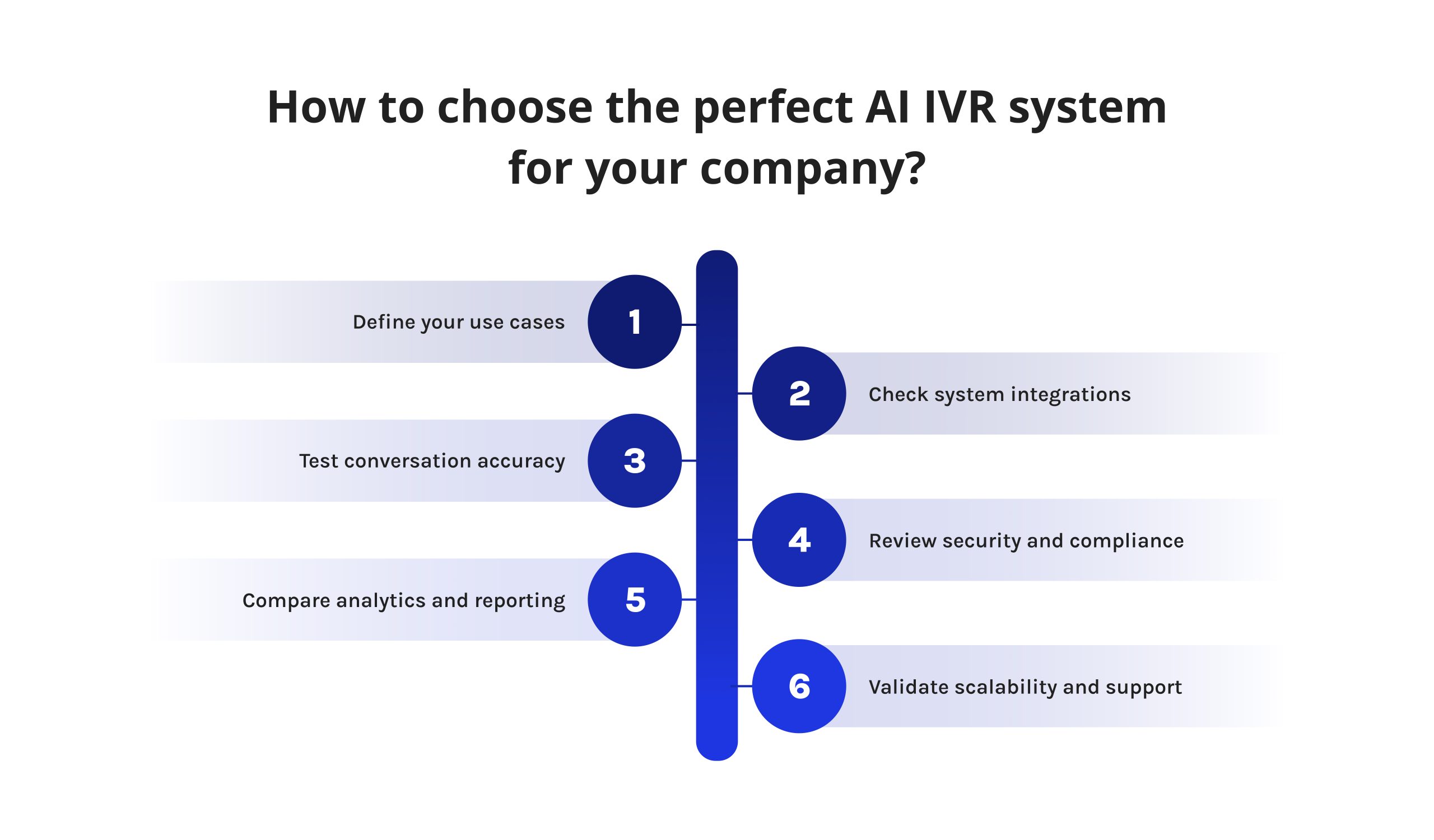
Our Methodology: The Digest.Pro editorial team assessed leading AI IVR solutions against six criteria applied consistently across all platform reviews — including vendor demos, reference customer interviews, and live deployment case analysis. The framework below reflects the factors that most reliably separate high-performing deployments from problematic ones.
-
Define Your Use Cases
Start by building an explicit map of the call types you want to automate before evaluating any platform. Quantify current call volume, average handle time, and containment rate by call category. This baseline makes it possible to model realistic ROI projections and set testable accuracy benchmarks for each vendor you assess.
Organizations that skip this step consistently underestimate the complexity of their actual call mix — and overestimate how quickly a vendor’s out-of-the-box model will handle it.
-
Check System Integrations
An automated call response system delivers value only when it can access the live data callers need. Verify that shortlisted vendors include native connectors for your CRM, ERP, order management platform, ticketing system, and any back-end application your agents currently access during live calls. Pre-built connectors reduce integration timelines significantly. Custom API development adds both cost and delivery risk.
-
Test Conversation Accuracy
AI IVR testing software allows simulation of thousands of realistic call scenarios before a single real caller is affected. During evaluation, run structured accuracy tests across your highest-volume call categories. Specifically test edge cases, accented speech, multi-intent queries, and noisy audio conditions.
Request vendor-provided accuracy benchmarks — then validate them independently against your actual call data. A vendor claiming 95% intent recognition on a controlled test set may perform significantly lower on your real call mix. This gap is one of the most common sources of post-deployment disappointment.
-
Review Security and Compliance
Make sure that the AI IVR system is compatible with all the regulations you must comply with: GDPR, HIPAA, PCI-DSS, or others, depending on the particular business vertical. Ensure that there is call data encryption while in transit and at rest; consent management, call recording storage and deletion options, and data localization choices.
Request the necessary compliance documents, reviewed by your own legal and security departments, prior to signing any contracts. Do not take oral guarantees of vendors’ representatives at face value.
-
Compare Analytics and Reporting
The best AI-powered interactive voice response platforms expose granular analytics: intent distribution by call type, containment rate trends, escalation trigger patterns, caller sentiment signals, resolution outcomes, and first-call resolution rates by query category.
This data is essential for continuous improvement after launch. Assess whether the platform’s native reporting meets your operational and executive requirements — or whether you will need custom integrations with your BI stack.
-
Validate Scalability and Support
A platform that handles your current call volume well may not sustain that performance during peak periods or rapid business growth. Test load capacity explicitly during vendor evaluation and request documented SLA commitments for uptime and peak-period performance.
Also evaluate the vendor’s post-deployment support model: conversation design support, model retraining cadence, incident response SLAs, and access to technical account management. Support quality varies considerably across vendors in the AI IVR platform market, and it matters more than most buyers anticipate at the time of purchase.
Making enterprise AI technology decisions in 2026? Digest.Pro publishes independent analysis on AI platforms, automation technology, and digital transformation strategy — written for CTOs, COOs, and senior project leaders who need reliable intelligence, not vendor marketing. Subscribe to Digest.Pro for the insight that drives better decisions.
Conclusion
AI IVR is a tangible step forward from its conventional counterparts in the world of IVR technology. Used effectively, it will address more contacts, do so more cheaply on a large scale, and provide customer experiences that surpass the capabilities of even the most inflexible IVR menu system.
The challenges are significant — high initial costs of investment, acoustic limitations of the technology, issues around regulation and compliance, and the increasing cost of errors that will cause frustration for the caller before they get to talk to a human. But careful planning in its deployment will yield positive returns for any business.
The question for most enterprise leaders in 2026 is no longer whether to adopt AI IVR. It is when and how to execute the deployment in a way that delivers on the technology’s genuine potential.
Read more: AI Sales Coach: The Future of Scalable Sales Performance
Frequently Asked Questions About AI IVR
IVR stands for Interactive Voice Response. It is a telephone automation system that interacts with callers through voice or keypad input, then routes calls or resolves queries without human agent involvement. Modern AI IVR extends this with natural language understanding, real-time speech recognition, and conversational AI — enabling open-ended spoken interactions rather than structured menus.
Agentic AI IVR is an advanced architecture in which the system autonomously executes multi-step tasks to fully resolve a caller’s request — querying live data, completing transactions, updating records, and confirming outcomes — without human intervention at any point. Unlike standard conversational AI IVR, agentic systems handle complex, multi-turn interactions entirely end-to-end. They represent the current frontier of AI voice automation for enterprise contact centers.
No. IVR and chatbots are entirely different technologies meant to work in different communication channels. While IVRs run over telephony, chatbots operate in a digital environment like website chat, SMS, messaging apps, and social media. The two are capable of being run on Artificial Intelligence (AI), but some of the unified platforms provide a consistent natural language experience across both platforms.
Yes. Both traditional and AI-powered IVR are forms of automated call handling. Traditional systems automate structured menu navigation using DTMF (touch-tone) signals. AI IVR adds real-time speech recognition, natural language processing, and machine learning to automate open-ended, conversational interactions — handling a far broader range of caller intents than touch-tone systems can reach.
The best AI IVR software will depend on industry type, call volumes, and other criteria. In 2026, among leading enterprise systems, Google Cloud CCAI, Microsoft Nuance, Amazon Connect, Genesys Cloud, and Telnyx would be among the most competitive options. Analyze them against the six-factor analysis described in the “How to Choose” section of this article, not just feature comparison sheets.
The four types of AI, as categorized in computer science, are:
(1) reactive machines — rule-based systems with no memory or learning capability;
(2) limited memory AI — systems that learn from historical data, the category that encompasses most AI IVR platforms today;
(3) theory of mind AI — systems that model human emotions and social context, still largely in research;
(4) self-aware AI — theoretical and not yet realized in practice.
AI IVR improves customer experience by resolving calls faster and removing the friction of numeric menu navigation. It reduces costs by increasing self-service containment rates — fewer calls reach live agents. Gartner benchmarks self-service contacts at $1.84 per interaction versus $13.50 for agent-assisted contacts [3]. McKinsey reports that AI deployments reduce total customer service interaction volume by 40–50% as faster resolutions eliminate repeat calls [5]. Both effects compound directly into operating cost reduction.
There are four core steps to implementing the technology:
(1) identify the particular calls that should be automated, complete with volume and handle time benchmarks;
(2) select the platform based on back-end capabilities and regulatory compliance features;
(3) design and thoroughly test the call flows before launch;
(4) monitor performance continuously after launch and retrain the model as products, policies, and calls change.
Most enterprise implementations go from vendor selection to full launch within 90-180 days of planning.
The key challenges are: Initial high cost of implementation, reduced performance in bad acoustic environments, failure to handle edge cases, regulatory compliance challenges in regulated industries, and compounding caller frustration when it doesn’t work. Most of these risks are mitigated before they reach real customers through rigorous testing, a clearly designed escalation path at every failure point, and a formal post-launch monitoring cadence.
Traditional IVR systems navigate callers through static numeric menus by pressing keypad buttons. AI IVR removes this constraint – callers speak naturally, and the system identifies their intent and responds accordingly – resulting in significantly higher call containment rates, lower per-contact costs, and measurably better customer satisfaction scores in the process.
References
- Gartner. “Gartner Predicts Conversational AI Will Reduce Contact Center Agent Labor Costs by $80 Billion in 2026.” Gartner, 31 Aug. 2022, www.gartner.com/en/newsroom/press-releases/2022-08-31-gartner-predicts-conversational-ai-will-reduce-contac . Accessed 1 July 2026.
- Padala, Suresh. “AI-Powered Intelligent IVR in Healthcare.” International Journal of Artificial Intelligence, Data Science, and Machine Learning 5.1 (2024): 186-191.
- Moncus, J.J. “Benchmarks to Assess Your Customer Service Costs.” Gartner, 1 Feb. 2024, www.gartner.com/en/documents/5164231 . Accessed 1 July 2026.
- Kontes, Chris. “KPIs for Voice AI Agents in Contact Centers: 17 Metrics.” Balto, 29 Apr. 2024, www.balto.ai/blog/kpis-for-voice-ai-agents-in-contact-centers/ . Accessed 1 July 2026.
- McKinsey & Company. “The Economic Potential of Generative AI: The Next Productivity Frontier.” McKinsey & Company, 14 June 2023, www.mckinsey.com/capabilities/tech-and-ai/our-insights/the-economic-potential-of-generative-ai-the-next-productivity-frontier . Accessed 1 July 2026.
- Amazon Web Services. “Amazon Connect Customers.” Amazon Web Services, aws.amazon.com/ru/products/connect/customer/customers/ . Accessed 1 July 2026.
- Elme, Liisalotte, et al. “Immersive virtual reality in STEM: is IVR an effective learning medium and does adding self-explanation after a lesson improve learning outcomes?.” Educational technology research and development 70.5 (2022): 1601-1626.
- Anyreach Roundtable. “Conversational AI for Customer Service: Guide for 2025.” Anyreach, blog.anyreach.ai/conversational-ai-for-customer-service/ . Accessed 1 July 2026.
- CloudTalk. “8 Best IVR Service Providers for Businesses in 2026.” CloudTalk, 23 June 2026, www.cloudtalk.io/blog/ivr-software/ . Accessed 1 July 2026.
- Cognigy. “What Is Conversational IVR.” Cognigy, www.cognigy.com/glossary/what-is-conversational-ivr . Accessed 1 July 2026.
- NICE. “What is Contact Center IVR?” NICE, www.nice.com/glossary/what-is-contact-center-ivr . Accessed 1 July 2026.
- RingCentral. “What is Conversational IVR? 2026 Benefits, Workflow, and ROI.” RingCentral, www.ringcentral.com/contact-center/interactive-voice-response.html . Accessed 1 July 2026.