
Pangyo Techno Valley now contains more than 1,300 technology-related businesses in Seoul [1], which together produce more than $90 billion in revenue in 2021 [2]. This alone shows that the startup ecosystem in Korea is not an emerging market but a maturing market. It is a mature one, backed by deep capital, world-class engineering talent, and a government actively funding its own AI chip sovereign strategy.
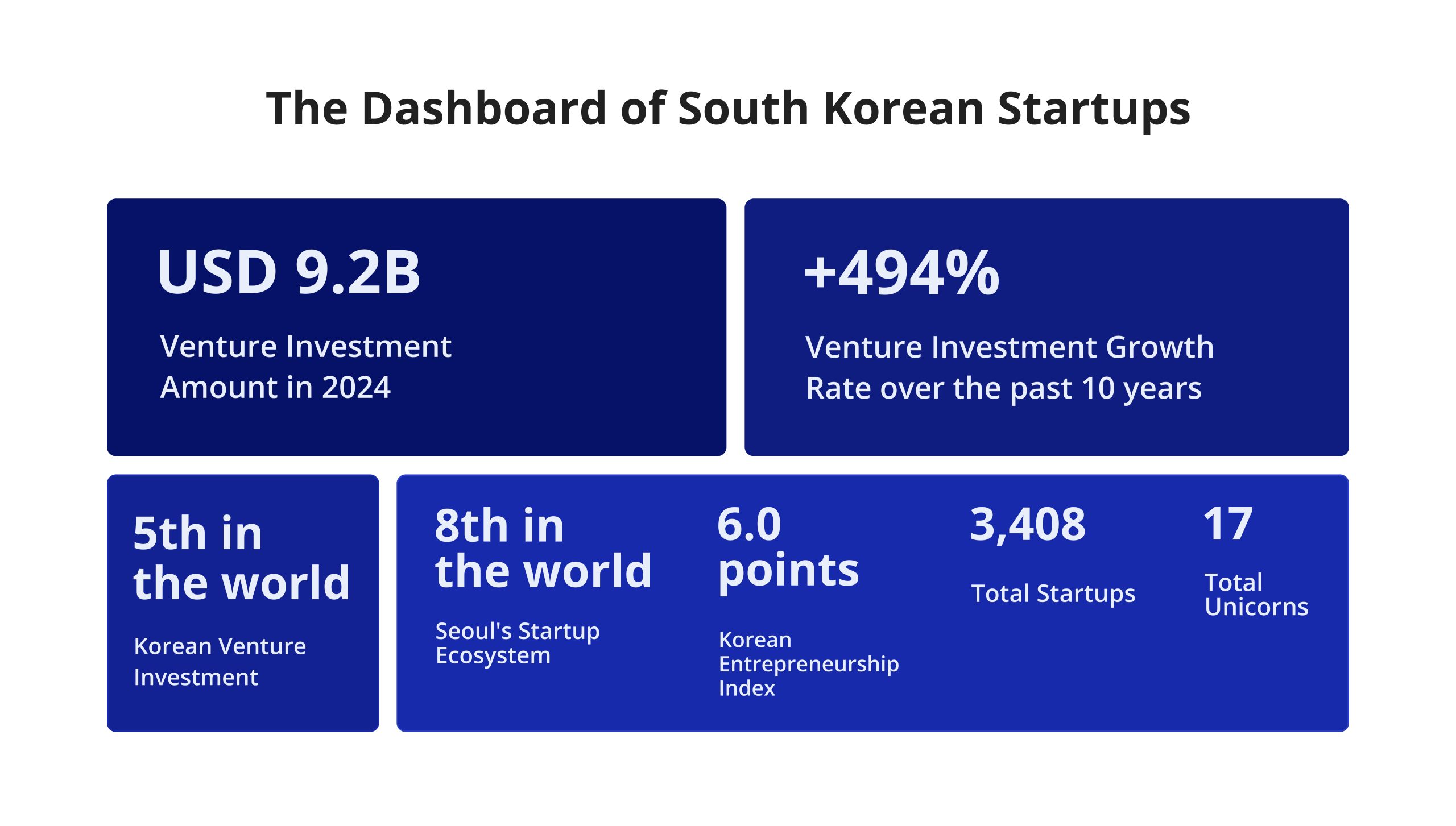
According to Startup Genome’s 2025 Global Ranking, startups in Korea have collectively raised over $110 billion in total funding [3]. South Korea now counts 33 unicorns — a figure that keeps rising [4].
What is driving this momentum? Driven by artificial intelligence alongside advanced technologies, progress gains speed — Korean ventures focused on hardware and generative models draw outsized funding, along with international focus. Yet broader currents run beneath: leaders emerge just as clearly in financial super-platforms, digital play experiences, interactive media systems, and even electric storage cells.
Key Takeaways:
- According to Startup Genome, Seoul had the eighth-best startup ecosystem in the world with approximately $116 billion in value and 33 active unicorns (as of early 2026) [4].
- The amount of capital influx into Korean AI startups (especially for those developing semiconductors) is unparalleled since the start of 2023. For example, Rebellions raised a total of $850 million and was valued at $2.34 billion in March of 2023 [5] .
- South Korea’s government invested approximately $2.6 billion in startup support in 2026 [20], offering foreign founders structured pathways through programs like the K-Startup Grand Challenge and OASIS.
This guide presents a confirmed, evidence-based review of 14 standout startups in Korea today — detailing their products, funding levels, and relevance by 2026. Included is a structured summary of the national startup landscape and state initiatives accessible to international entrepreneurs, along with responses to frequently posed queries on launching ventures in South Korea.
Deep Dive into the Korean Startup Ecosystem
Below you will find profiles of the leading Korean startups specializing in artificial intelligence, fintech, gaming, deep technology, and entertainment. All the entries are based on verified funding numbers, product information, and news from companies themselves.
Editorial note: The research of our team involved cross-checking information from company disclosures, press releases, Tracxn, PitchBook, and Crunchbase. Where official numbers differed across sources, the most recently published data were used. None of the figures provided in this article were estimated or extrapolated without explicit notice.
1. Rebellions
Founded in 2020, Rebellions designs neural processing units (NPUs) engineered for AI inference at data center scale. The company positions itself as a domestic challenger to Nvidia’s dominance in AI compute infrastructure.
- Industry: AI Semiconductor (NPU Design)
- Location: Seongnam
- Founded: 2020
- Series: Series D
- Funding Rounds: 6
- Money Raised: $861M [6]
Why watch in 2026:
- CB Insights ranked Rebellions 2nd worldwide in AI inference performance under its Mosaic Score benchmark
- The vLLM, PyTorch, Hugging Face, and OpenShift use the Rebel100™ NPU; the chiplet technology makes great use of the popular open-source software for training AI and machine learning (ML) models.
- The company has a broad international audience across 7 countries, including the US, UK, and Singapore.
“AI is now measured by its ability to operate in the real world – at scale, under power constraints, and with clear economic return.”
Sunghyun Park, Co-Founder and CEO of Rebellions %9121%93.
2. HAEGIN
Founded in Seoul, HAEGIN creates mobile games with a focus on interactive experiences. Its most recognized title, Play Together, functions as a digital environment where players engage through customizable avatars. Mini-games form part of the structure, alongside simulated daily activities. Interaction happens across varied scenarios, shaped by user choices. Virtual living unfolds gradually, influenced by participation. Social dynamics play a central role throughout the system.
- Industry: Mobile Gaming / Social Metaverse
- Location: Seoul
- Founded: 2017
- Series: Series B
- Funding Rounds: 2
- Money Raised: $101M total [7]
Why watch in 2026:
- Play Together ranks 2nd most-played metaverse game in Asia and the US (Sensor Tower), behind only Roblox [24].
- 130M+ global downloads and 4M+ daily active users since the April 2021 launch.
3. FuriosaAI
FuriosaAI creates specialized processors that handle artificial intelligence tasks using minimal electricity within large-scale server facilities. Initiated by June Paik in 2017, the enterprise emerged as a response to the excessive power demands of conventional graphics units. While others pursued raw speed, its path turned toward efficiency through custom-designed neural processing hardware. Over time, this direction gained traction among operators prioritizing long-term operational balance over short bursts of performance.
- Industry: AI Semiconductor (AI Accelerator Chips)
- Location: Seoul
- Founded: 2017
- Series: Series C (Bridge)
- Funding Rounds: 5 [8]
- Money Raised: $246M total
Why watch in 2026:
- RNGD (“Renegade”) chip achieves 2.25x better LLM inference performance per watt versus traditional GPUs — validated by LG AI Research for its EXAONE enterprise model [25]
- Reportedly rejected an $800M acquisition offer from Meta Platforms in early 2025, choosing independence [26].
- Korea Development Bank, Kakao Investment, and IBK, among 40+ institutional investors.
4. MUSINSA

MUSINSA operates South Korea’s largest online fashion marketplace, allowing millions of shoppers to browse thousands of local and international branded products via a hybrid e-commerce/branding discovery platform.
- Industry: Fashion E-Commerce
- Location: Seoul
- Founded: 2001
- Series: Series C
- Funding Rounds: 3
- Money Raised: $474M [9]
- Post Money Valuation: $2.4B (Jul 19, 2023) [9]
Why watch in 2026:
- South Korea’s #1 online fashion platform by traffic, brand count, and GMV [27].
- Backed by Sequoia Capital — one of the few Korean consumer internet unicorns with top-tier US venture validation [28].
- Serves as the primary commercial launchpad for Korean streetwear brands targeting global markets
- Active expansion into Southeast Asia and Japan, riding sustained global demand for Korean fashion culture
5. MOLOCO

MOLOCO was founded in Silicon Valley by Ikkjin Ahn, who used to be a machine learning engineer at Google and YouTube. It applies operational machine learning techniques in order to help mobile apps, e-commerce, and streaming businesses monetize their first-party data.
- Industry: Ad Tech / Machine Learning
- Location: Redwood City, California, USA (Korean-founded)
- Founded: 2013
- Series: Series D
- Funding Rounds: 5
- Money Raised: $200M total [10]
Why watch in 2026:
- Expanding from mobile into connected TV (CTV) advertising — materially growing the total addressable market
- First Korean Silicon Valley-based unicorn ($1.5B valuation, 2021) [29]; Nasdaq IPO remains a stated strategic goal
“We aim to create a world where a greater variety of platforms and sellers can grow together through our AI engine, fostering broader diversity and sustainable growth.” [22].
Ahn Ikk-jin, CEO and co-founder of Moloco.
Stay ahead of the most important moves in B2B technology. Digest.Pro curates the market intelligence, funding data, and executive insights that decision-makers actually use. Subscribe today to get the best of Korean tech and global startup news in your feed.
6. Toss
Under the name Toss, operated by Viva Republica, this app leads South Korea’s fintech space. Within one mobile interface, financial services like money transfers between individuals appear alongside digital banking features. Securities trading joins these offerings through seamless integration. Insurance options complete the suite, presented uniformly across the platform.
- Industry: Fintech / Digital Banking
- Location: Seoul
- Founded: 2011
- Series: Series G
- Funding Rounds: 10
- Money Raised: $1.25B total [11]
Why watch in 2026:
- 30M+ registered users in South Korea; the largest financial app in the country by active user count [31].
- Planning a 2026 US IPO targeting $10B+ valuation (according to Reuters, [30]), which would raise up to $3 billion and make Toss Korea’s most visible fintech export
- Fully integrated ecosystem — Toss Bank, Toss Securities, Toss Payments, and Toss Insurance — built on a single consumer-facing app
7. Yanolja
Yanolja began in Korea as an affordable stay reservation tool evolved gradually. Expansion followed through integration of transport options alongside existing bookings. A shift toward comprehensive solutions emerged over time. Cloud systems for international lodging businesses became part of the suite eventually. Growth unfolded without sudden leaps, yet reach extended steadily.
- Industry: Travel & Hospitality Technology
- Location: Seoul
- Founded: 2005
- Series: Series E
- Funding Rounds: 4
- Money Raised: $1.94B total [12]
- Post Money Valuation: $9B as on Jul 15, 2021
Why watch in 2026:
- Cloud-based hospitality SaaS expanding across Southeast Asia, the Middle East, and Europe
- AI-powered travel personalization deployed across both B2C booking and B2B software products
- SoftBank Vision Fund backing provides capital runway and global network access for overseas scaling
8. BIGC
BIGC operates the world’s first all-in-one digital venue — an integrated platform for connecting artists and fans through AI-powered live streaming, ticketing, fan interaction tools, video OTT, commerce, and data analytics. It started with K-pop and has since expanded to J-pop, international artists, and global festival IPs.
- Industry: Entertainment Technology (Digital Venue / K-pop)
- Location: Seoul
- Founded: 2021
- Series: Series A
- Funding Rounds: 2
- Money Raised: $23.2M total [13]
Why watch in 2026:
- Platform active in 224 countries with 1.1 million members, 80% of whom are international fans — Yahoo Finance [32].
- Unique all-in-one model (ticketing + streaming + commerce + analytics) creates strong platform lock-in for artists and labels
- 130+ active partner teams, including major K-pop acts, Korean media groups, and global festival IPs
“This investment goes beyond funding—it marks the starting point for realizing BIGC’s vision of becoming the ‘Global No.1 in Entertainment Tech’ that unites artists and fans around the world,”
Mihee Kim, CEO, BIGC
9. SK On
Founded through separation from SK Innovation in 2021, SK On operates solely within the electric vehicle battery sector. While focused on innovation, its core work involves creating dense lithium-ion cell designs alongside full pack integration. Major automotive manufacturers globally receive supply support due to consistent output quality. Though rooted in industrial scale, advancement stems largely from material efficiency and structural refinement.
- Industry: EV Battery / Energy Storage Systems
- Location: Seoul
- Founded: 2021 (spun off from SK Innovation)
- Series: Series E
- Funding Rounds: 5
- Money Raised: $1.73B total [14]
Why watch in 2026:
- Key OEM supplier to Ford (USA), Volkswagen (Europe), and Hyundai — blue-chip customer base across three major markets
- Manufacturing facilities in Georgia, USA, and Senica, Slovakia — positioned directly inside Western EV demand corridors
- Battery technology is core to Korea’s national energy policy and the global automotive electrification wave
10. Bithumb

Bithumb ranks among South Korea’s earliest major platforms for digital currencies. Its presence spans years within a nation highly engaged in blockchain activity. Services include immediate trades alongside long-term asset commitments. Users range from individual investors to established financial entities. Operations support various forms of digital value exchange. The marketplace it serves remains intensely active globally. Institutional participation exists alongside personal account holders. Features extend beyond simple transactions into broader resource management.
- Industry: Cryptocurrency Exchange
- Location: Seoul
- Founded: 2013
- Series: Acquired
- Funding Rounds: 1
- Money Raised: $200M [15]
Why watch in 2026:
- Recovered from near-single-digit market share to consistently holding ~25% of South Korean crypto trading volumes [33].
- IPO in active preparation — among the first in Asia to attempt a public listing as a standalone crypto exchange
- South Korea’s retail crypto participation rate is among the highest globally, giving Bithumb a structurally large and engaged user base.
- Improving domestic regulatory clarity in 2025-2026 creates a favorable window for listing.
11. Upstage
Founded in 2020, Upstage began with AI experts who were once at Kakao and NAVER. Its focus lies in creating large language models tailored for business needs. Centered on the Solar LLM series, the company builds document intelligence systems. These tools emerge from a foundation designed for real-world applications.
- Industry: Generative AI / Large Language Models (LLM)
- Location: San Jose, California [16]
- Founded: 2020
- Series: Series C
- Funding Rounds: 6
- Money Raised: $285M [15]
Why watch in 2026:
- Among global artificial intelligence systems, Solar Pro 2, equipped with 31 billion parameters, holds a position within the leading ten. This model stands as South Korea’s sole large language system featured in the 2025 evaluations by Artificial Analysis [34].
- Partnerships with Sendbird, Intel, LG Electronics, Polaris Office, and Qualcomm support enterprise revenue
12. Sendbird
Founded in 2013, Sendbird emerged through John Kim alongside engineers aiming to streamline live interaction systems. Cloud-powered tools form their core – messaging APIs and chat software kits appear next, followed by voice plus video functions. Global businesses access these features as part of their daily operations. Development roots trace back to practical solutions, not theoretical models. Infrastructure complexity fades where integration matters most.
- Industry: Messaging API / AI Customer Experience Platform
- Location: San Mateo, California, USA (Korean-founded); Seoul R&D office
- Founded: 2013
- Series: Series C
- Funding Rounds: 5
- Money Raised: $218M total [17]
Why watch in 2026:
- Infrastructure supporting 300 million monthly user interactions for over 4,000 enterprise clients such as Reddit, Hinge, Paytm, and Delivery Hero [35]
- Since 2021, valued at $1.05B dollars [36]. $40M in annual recurring revenue by 2024 [37]. Growth continues, observed each year without interruption
- Actively integrating generative AI into its product suite — the chatbot product incorporates Upstage’s Solar LLM.
- Backed by Tiger Global, SoftBank Vision Fund 2, and ICONIQ Capital [38]
13. WRTN
Beginning in 2021 as a hub for chatbot integration, WRTN Technologies shifted focus toward dynamic storytelling driven by artificial intelligence. Narratives unfold instantly across its systems — textual, visual, and auditory — shaped by decisions users make along the way. Immersion emerges through responsive content that adapts, moment by moment, without preset paths. User influence guides outcomes, while technology handles generation behind the scenes. What results is engagement built on spontaneity rather than scripts.
- Industry: Generative AI / AI Entertainment
- Location: Seoul, South Korea
- Founded: 2021
- Series: Series B
- Funding Rounds: 4
- Money Raised: $104M total [18]
Why watch in 2026:
- Reached $70M in annualized revenue by the end of 2025 — despite launching commercially only in late 2024 (Reuters, [39])
- Users spend an average of 2 hours per day on the platform (comparable to Netflix and YouTube engagement); paying users show 70%+ retention [40].
- US market launch planned for mid-2026; IPO in South Korea or the US targeted for 2028
- Differentiates from companion chatbot competitors (e.g., Character.AI) with a narrative-first model — “users are the protagonist, not the audience”
14. Nota

Founded in 2015 at KAIST, Nota AI — developed by Nota Inc. — focuses on streamlining artificial intelligence models. Efficiency becomes possible through reduced computing demands, thanks to its core expertise in compression and performance tuning. Because of minimized processing needs, integration into edge equipment is feasible even under tight hardware limits. Industrial setups benefit similarly when handling complex tasks without additional power requirements.
- Industry: Edge AI / AI Model Optimization
- Location: Seoul
- Founded: 2015
- Series: Public
- Funding Rounds: 6
- Money Raised: $63.1M [19]
Why watch in 2026:
- First AI model optimization company listed on KOSDAQ [41]; market cap reached ~$511M within 3 trading days of debut [42]
- NetsPresso® automates AI model pruning, quantization, and compression — critical infrastructure for Physical AI, robotics, and edge deployment.
- Technology partnerships with NVIDIA, Samsung, Qualcomm, Arm, and Sony validate industrial-grade credibility.
Digest.Pro is the B2B publication for executives who need more signal and less noise. Our editorial team tracks the most important developments in enterprise technology, startup ecosystems, and emerging markets — including the Korean startup ecosystem’s fastest-moving companies. Subscribe to Digest.Pro and stay a step ahead.
Comparison Table: Top Korean Startups at a Glance
|
Startup |
Industry |
Founded |
Stage |
Key Strength |
|
Rebellions |
AI Semiconductor |
2020 |
Series D |
Ranked #2 globally in AI inference performance (CB Insights Mosaic); $2.34B valuation |
|
HAEGIN |
Mobile Gaming |
2017 |
Series B |
Play Together: 130M+ downloads, #2 metaverse game globally after Roblox |
|
FuriosaAI |
AI Semiconductor |
2017 |
Series C |
RNGD chip delivers 2.25x better LLM inference performance per watt vs. GPUs |
|
MUSINSA |
Fashion E-Commerce |
2001 |
Series C |
South Korea’s #1 online fashion platform; backed by Sequoia Capital |
|
MOLOCO |
Ad Tech / ML |
2013 |
Series C |
$200M ARR; processes 6M+ ad auction requests per second via machine learning |
|
Toss |
Fintech |
2013 |
Series G |
20M+ users; first quarterly profit Q3 2024; US IPO targeting $10B+ valuation |
|
Yanolja |
Travel Tech |
2005 |
Series E |
~$9B valuation; SoftBank Vision Fund-backed; B2B hospitality SaaS going global |
|
BIGC |
Entertainment Tech |
2021 |
Series A |
224-country reach; 48% average quarterly growth over 6 consecutive quarters |
|
SK on |
EV Battery |
2021 |
Series E |
$5.6B raised — largest-funded startup in Korea; OEM supplier to Ford, VW, Hyundai |
|
Bithumb |
Crypto Exchange |
2013 |
Acquired |
~25% of Korean crypto trading volume; KOSDAQ IPO in active preparation |
|
Upstage |
Generative AI / LLM |
2020 |
Series C |
Solar Pro 2: only Korean LLM in the global top 10 (Artificial Analysis, 2025) |
|
Sendbird |
Messaging API |
2013 |
Series C |
300M monthly users; $1B+ unicorn; expanding into AI-powered customer experience |
|
Wrtn Technologies |
AI Entertainment |
2021 |
Series B |
$70M ARR in first commercial year; 70%+ paying user retention rate |
|
Nota AI |
Edge AI / Model Optimization |
2015 |
Public |
First AI optimization company listed on KOSDAQ; partners: NVIDIA, Qualcomm, Arm, Sony |
Quick Overview: Korean Startup Industry in 2026
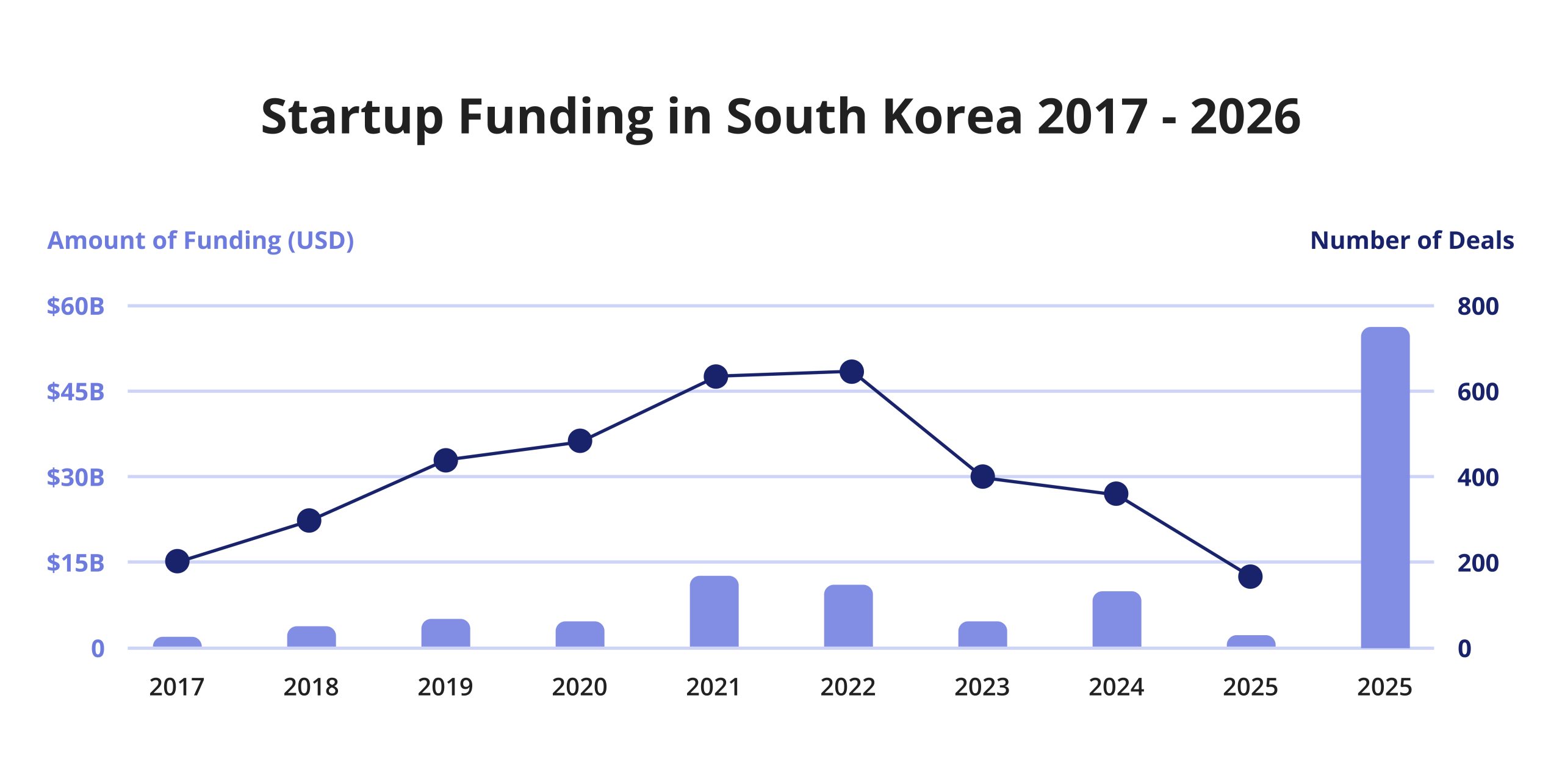
By 2026, Korea’s ecosystem of new companies will have reached a high level of innovation and competitiveness — among the best in the world. According to StartUp Genome, Korea is ranked 8th in the world for startup ecosystems overall (no. 1 in knowledge accumulation; no. 5 in funding strength) [4]. Approximately $133 billion in total value is estimated to be invested in Korea’s startup ecosystem (along with 33 active unicorn companies as of early 2026).
Top sectors for trending startups in Korea in 2026:
- AI semiconductors and inference hardware (Rebellions, FuriosaAI)
- Generative AI and large language models (Upstage, Wrtn)
- Fintech and digital banking (Toss)
- Mobile gaming and metaverse platforms (HAEGIN)
- EV batteries and energy technology (SK on)
- Entertainment and creator economy tech (BIGC)
The biggest Korean companies — Samsung, SK, Hyundai, Kakao, Naver — actively invest in and acquire Korean tech startups, creating a rich M&A exit environment. Seoul accounts for roughly 75–80% of all startup funding in the country. Gangnam, Mapo-gu, and Pangyo Techno Valley are the three primary geographic clusters for South Korean tech companies building at scale.
Which Government Support Programs Are Available for Startups in South Korea?
As a leader when it comes to investment into developing an innovative startup ecosystem, the Korean government has committed approximately $2.6 billion USD to support Korean startups beyond 2026 through their Ministry of SMEs and Startups [43]. There are multiple programs available from the Korean government to assist with startup funding, with different eligibility requirements based on the stage of the business and the founder’s profile.
K-Startup Grand Challenge
The K-Startup Grand Challenge (KSGC) is Korea’s flagship inbound acceleration program. Run by the Ministry of SMEs and Startups together with KISED since 2016, the program operates out of Pangyo Techno Valley. The 2025 edition attracted 2,626 applications from 97 countries, making it one of the world’s most competitive government-backed startup programs [44].
KSGC 2026 consists of three stages from July 2026 to April 2027. It will offer financial aid worth ₩950 million in an equity-free way, visa assistance, PoC project implementation with 20+ Korean conglomerates, and a demo day platform on COMEUP 2026. Sixty percent of the previous cohort members were able to get additional funding or collaboration with Koreans within 18 months [45].
This program targets all non-Korean companies that were founded less than seven years ago (10 years for deep tech). It is one of the most accessible Korean incubators for global startups anywhere in Asia.
OASIS Program
OASIS (Overall Assistance for Startup Immigration System) provides a structured, points-based pathway for foreign startups in Korea seeking both startup support and a D-8-4 entrepreneur visa. Participants earn points through courses covering intellectual property, business registration, mentoring, and investor pitching.
Global Startup Commercialization Support Program
This program targets foreign tech-based startups focused on commercializing and growing in Korea. It offers business model pivoting support, acceleration, mentoring, and product development funding — averaging around KRW 50 million (max KRW 80 million) — across a 10-month period [46].
Up to 15 foreign-founded startups are selected per cohort. Post-program, participants receive continued support through Korea’s Global Startup Centers. It is a practical option for global startups that have a defined product but need local adaptation to capture Korean enterprise demand.
The numbers above shift fast. New unicorn rounds close, sector rankings change, and capital flows follow policy decisions made weeks earlier. Digest.Pro tracks these moves as they happen — delivering curated market intelligence on Korean tech and global startup ecosystems directly to the feeds of executives who act on it. Subscribe and stay one step ahead of the market.
Methodology: How We Ranked the Top Korean Startups
Our editorial team applied the following evaluation criteria to produce this list of Korean startups. The goal was objectivity, verifiability, and relevance for C-level executives and PMO audiences.
- Funding Trends and Valuation
We specifically focused on companies that exhibited significant momentum via funding rounds, IPO plans, or a clear trajectory to or beyond a unicorn. We used data from Tracxn, PitchBook, Crunchbase, and the respective company’s announcement for verification purposes. - Product Innovation & Technological Differentiation
Our experts evaluated whether the core product of a company truly solved an existing gap in the market with a technologically defendable approach. For Korean AI startups, this entailed assessing chip architecture, benchmarking models, and examples of adoption by enterprises. Our team didn’t base the assessment on companies purely on press narratives. - International Expansion Potential
Companies working on international expansion plans, and not just serving the domestic Korean market, were considered more favorably. This was measured by the percentage of revenues earned internationally, foreign offices, and international partnerships. - Relevance of the Sector in 2026
We looked at emerging startups in South Korea in 2026 that fit the current trends: investments in AI semiconductors, commercialization of generative AI, growth of fintech, and internationalization of entertainment technologies. - Leadership Experience & Founder Background
We evaluated whether the leadership had the required experience in scaling a company and raising money on capital markets. - Data Verifiability
We excluded any company where key claims could not be verified through at least two independent public sources. Every figure in this article traces back to an identifiable and dated source.
Summary
The South Korean startup ecosystem has evolved into an established, heavily capitalized, and ambitious global innovation center.
This growing trend within the South Korean startup ecosystem will likely continue as the top Korean startups continue to share three commonalities: they all demonstrate technical depth, have a clear path to generating revenue, and are globally minded.
Rebellions and FuriosaAI are building chip architectures that can challenge Nvidia. WRTN and Upstage are racing to commercialize generative AI at scale. Toss is targeting a US IPO that would make it South Korea’s most visible fintech export. BIGC is turning K-pop fandom into a global entertainment infrastructure play.
The government’s sustained commitment—over $10 billion deployed in five years and $2.6 billion budgeted for 2026 [20] — is creating structural infrastructure for emerging startups in South Korea in 2026 to scale. Due to South Korea’s government grants for startups opportunities like K-Startup Grand Challenge & OASIS, startups from all over the world can build in Korea instead of just competing against Korean companies.
For executives looking to keep tabs on Korean tech (modeled after your company’s industry), investors interested in the next wave of unicorns in Korea by 2026, or founders that want to enter this market, the startups listed above are the clearest indicators as to where this ecosystem is headed.
If you want concise, reliable analysis of the B2B technology and startup market developments that actually matter — without sifting through noise — Digest.Pro is built for that. Join the community of C-level readers and project leaders who rely on Digest.Pro for weekly business technology intelligence. Subscribe here.
FAQs
Some of the most successful startups in Korea by both valuation and impact as of 2026 include Toss (fintech with a target of $10 billion+ U.S. IPO), Yanolja (travel technology with a projected valuation of ~$9 billion), Rebellions (AI chips estimated at $2.34 billion), and MUSINSA (fashion e-commerce valuation approximation at ~$2.4 billion). In terms of global reach, MOLOCO and Sendbird, which collectively have over 300 million people using their messaging API monthly, were both founders’ first Korean unicorns and are also two of the most successful examples of a Korean startup.
There are essentially three main structural challenges that South Korean startups face.
- First, there is a very low 5-year business survival rate, with only 33.8 percent of companies that were started five years ago remaining in commercial operation after five years.
- The second challenge is capital concentration because the majority of investment dollars are flowing into the AI and late-stage markets; as a result, early-stage company founders frequently find it difficult to secure adequate funding.
- The third major challenge for companies trying to build in the fintech and healthcare marketplace is regulatory rigidity, which can delay the companies’ time-to-market.
- Lastly, language and professional network barriers also create significant friction for foreign startups looking to enter the Korean marketplace.
To find B2B customers online, startups in Korea use Korean-language search engine optimization for Google and Naver. In addition, many of those companies will use LinkedIn to reach out to potential customers in the global market. Finally, many tech startups also participate in industry events such as the COMEUP festival to network and connect with potential customers.
Seoul has four main advantages as a leader in the Korean technology startup ecosystem.
- First, it has one of the world’s fastest and most broadly available internet and 5G infrastructure networks.
- Second, it has a large pool of educated engineering talent.
- Third, a deep manufacturing supply-chain network provided by Korea’s chaebol companies favors rapid access to enterprise customers.
- Fourth, the startup ecosystem is located within a small geographic area, making it easier to connect with other people in the startup community. According to the Startup Genome, Seoul ranks #1 in the world when it comes to knowledge accumulation.
Some of the major South Korea’s government grants for startups include the K-Startup Grand Challenge (maximum amount of approx. 950 million won, no equity), the OASIS Program (80 million won and free visas for D-8-4), and the Global Startup Commercialization Support Program (80 million won max over a 10-month period). South Korea’s Ministry of SMEs and Startups will spend around 2.6 billion dollars on supporting the establishment of new businesses in the next financial year, 2026. The Pre-Unicorn Special Guarantee Program has available guarantees of max 20 billion won for eligible companies.
Currently trending sectors for Korean startups in 2026 include AI Semiconductor (Rebellions/FuriosaAI), Generative AI and LLMs (Upstage/Wrtn), FinTech and Digital Banking (TOSS), EV Batteries (SK on), and Entertainment Technology (BIGC/HAEGIN). As per K-Nevada’s national sovereign AI chip strategy, Korean deep tech startups for semiconductor design were the largest insertion of private investment capital.
The short answer is no. The law in South Korea does not require that foreign entrepreneurs legally have a South Korean co-founder to build a business in South Korea. That being said, having a South Korean co-founder or a business partner enormously speeds up many things, including network access, language navigation, and building relationships with chaebol investors and enterprise buyers. The K-Startup Grand Challenge and OASIS are both designed specifically to provide support to entirely foreign-led teams.
Foreign entrepreneurs have a number of options available for entering South Korea as entrepreneurs. One such way is through the D-8-4S Special Startup Visa (which started in November 2024), which is based on innovation potential and business feasibility instead of rigid educational qualifications. The OASIS Points Program is also a structured pathway to obtain an alternative to the D-8-4 Entrepreneur Visa. Either option requires the incorporation of a Korean company (at least 10 million KRW in starting capital). Additionally, the K-Tech Pass, which will become available from 2025, provides high-skilled STEM talent with accelerated visas and fast tracks to F-2 residency after one year.
South Korea’s Silicon Valley is Pangyo Techno Valley, located in Seongnam and positioned near the capital city, Seoul. This area is home to 1,300+ tech companies, including KRAFTON and Kakao Games, which generated over $90 billion of revenue in 2016 alone. The Gangnam and Mapo-gu (Digital Media City) districts of Seoul are also significant locations for startups backed by venture capital and are both at the Series A level or higher.
The greatest government assistance for early-stage founding entrepreneurs is available for those looking to build out their infrastructure. Assistance in the form of office space, visa assistance, and early-stage capital ($50–100 million KRW) is available. However, research shows that the majority of Korea’s unicorns, such as Toss, Yanolja, and MUSINSA, were initiated before the government began forming its active ecosystem from approximately 2014 to 2016. Thus, it appears that commercial traction, not public funding, produces the best results. While grants from the government provide meaningful financial support for companies, they cannot substitute for achieving product-market fit.
References
- https://en.wikipedia.org/wiki/Pangyo_Techno_Valley
- https://www.koreaherald.com/article/3040421
- https://startupgenome.com/ecosystems/seoul
- https://tracxn.com/d/unicorns/unicorns-in-south-korea/__us6kb0pJxXgamA9AipJbdHh7DP6AZ-jAWckbXbAmAhQ#t-33-ably
- https://udit.co/blog/rebellions-400-million-pre-ipo-korean-inference-chip
- https://tracxn.com/d/companies/rebellions/__5viBhIY_rDVgwz-cDgalkEjgIhmXGAvjBqS7A1fksNk#about-the-company
- https://tracxn.com/d/companies/haegin/__5NpKrH-uObdUnjguWF1AsfoQjahAUlsaUa9T9f1QlpI#about-the-company
- https://tracxn.com/d/companies/furiosa/__tFTTOfxePcPYSYPNbdoonjdVoaXEQN6MzT7sI_tvxzo#about-the-compan
- https://tracxn.com/d/companies/musinsa/__kv7hSI8HXRu4t-n3LC89OyIVh7eBli2oV89DWoWmap8#about-the-company
- https://tracxn.com/d/companies/moloco/__M1nPynPtg3BaL6CBRI36dMxROlan8YGwYMiAqLdqttY#about-the-company
- https://tracxn.com/d/companies/toss/__L4nmdlNfXlN5xztJtfBQULb9EEcB-MYhiizixc9Yc-k#about-the-company
- https://tracxn.com/d/companies/yanolja/__Hbs-fd3MjHpgDOJ0pejUnRwngqkEHEPuc1oYycF9UPM#about-the-company
- https://tracxn.com/d/companies/bigc/__I7gPJ4bO5ztMnYL9Rv8lyUb5IOP9Nh2E3_GUdGeglyw
- https://tracxn.com/d/companies/sk-on/__9l6Y5XGIYX1J83dOjFxWqbLQDVKpUJ_tQD7-Q6UQLfA#about-the-company
- https://tracxn.com/d/companies/upstage/__HMMkSnLoAC5p6k296JFyOj82uDADOeQKdwuKJskGmcE#about-the-company
- https://www.linkedin.com/company/upstageai/about/
- https://tracxn.com/d/companies/sendbird/__Rze4oL3zTjeyKPX388oVGjjkXKGcTPW3Pv9Ff1R0vPU#about-the-company
- https://tracxn.com/d/companies/wrtn/__y4pbrriWZ2H8LvYJLvnsEpZM5s3V9QBzJIYq7-crnqg#about-the-company
- https://tracxn.com/d/companies/nota/__gvgRE0we6GwDmCHj28otqXoF-pOl7AEPWDcaKYJtiJE#about-the-company
- https://www.startcompanykorea.com/posts/korea-startup-ecosystem-2026-government-support-foreign-founders/
- https://rebellions.ai/newsroom/rebellions-closes-400-million-pre-ipo-and-launches-rebelrack-and-rebelpod-to-accelerate-global-expansion/
- https://www.koreaherald.com/article/10508103
- https://www.globenewswire.com/news-release/2025/08/27/3139957/0/en/bigc-raises-14m-to-fuel-global-expansion-of-its-all-in-one-digital-venue-platform.html
- https://www.kedglobal.com/metaverse/newsView/ked202212200017
- https://gamesbeat.com/lg-ai-research-taps-furiosaai-to-get-2-25x-better-llm-inference-performance-vs-gpus/
- https://www.bloomberg.com/news/articles/2025-03-24/ai-chip-startup-furiosaai-rejects-meta-s-800-million-offer
- https://www.kedglobal.com/korean-startups/newsView/ked202103160014
- https://www.linkedin.com/posts/dklee0127_musinsa-%EB%AC%B4%EC%8B%A0%EC%82%AC-is-a-10b-korean-fashion-commerce-activity-7417383386538852354-gjKd/
- https://www.kedglobal.com/startups/newsView/ked202108190001
- https://www.reuters.com/world/asia-pacific/south-korean-finance-app-toss-plans-2026-us-listing-with-over-10-billion-2025-07-24/
- https://biz.chosun.com/en/en-finance/2025/08/06/XXAK2WNBFBF7JM4D6FZF7DWFTU/
- https://finance.yahoo.com/news/bigc-raises-14m-fuel-global-120000384.html
- https://www.binance.com/en/square/post/24483644377937
- https://www.upstage.ai/news/solar-pro-2
- https://sendbird.com/blog/introducing-sendbird-uikit-get-chat-running-in-minutes
- https://swellpulse.ai/companies/sendbird
- https://oztalking.com/en/issues/salesforce-5t-acquisition
- https://globalventuring.com/blog/2021/04/07/sendbird-evolves-into-unicorn/
- https://www.reuters.com/world/asia-pacific/south-korea-ai-startup-wrtn-aims-enter-us-market-targets-ipo-early-2028-2026-02-10/
- https://medium.com/illumination/the-100m-loneliness-engine-how-seouls-wrtn-just-exposed-silicon-valley-s-ai-retention-lie-309ccadb9e67
- https://www.prnewswire.com/ae/news-releases/nota-ai-lists-on-kosdaq-embarking-on-global-expansion-in-ai-model-compression-and-optimization-302602055.html
- https://koreatechdesk.com/nota-ai-kosdaq-ipo-global-ai-optimization-pioneer
- https://www.startcompanykorea.com/posts/korea-startup-ecosystem-2026-government-support-foreign-founders/#record-breaking-budget-allocation
- https://www.accessnewswire.com/newsroom/en/business-and-professional-services/k-startup-grand-challenge-2025-demo-day-showcases-global-startup-1119587
- https://www.businesswire.com/news/home/20260604794426/en/K-Startup-Grand-Challenge-2026-Koreas-Full-Cycle-Launchpad-for-Global-Startups
- https://www.startup-korea.com/programs/2026-global-startup-commercialization-support-program