

Firms undertake scores of initiatives simultaneously but fail to demonstrate any strategic gains. Each project gets delivered on schedule and under budget, but all of them together have not taken the firm anywhere. This is the issue that program management aims to address.
Program management involves the coordination of several interrelated projects to ensure that the value added by the combination is much higher than that which can be achieved by any one project alone. Research conducted by PMI states that companies that rely on proven methods of project management lose 28 times less money compared to companies that lack these approaches (PMI / CIO, 2017) [1]. In 2026, when strategic complexity continues to increase and there is more focus than ever before on return on investment, managing programs has become a crucial organizational skill.
The purpose of this guide is to give you a complete understanding of what program management is, what sets it apart from project management, what tools facilitate it, and what practices make good program managers.
Key Takeaways
- Program management is the combined management of multiple, related activities so as to produce a successful outcome that no one of those activities can succeed on its own.
- The program manager is responsible for managing dependent projects, aligning collective resources, managing stakeholder expectations, and ensuring benefits are realized at a strategic level.
- Program management and project management are different, though there is a relationship between the two. Program management is the ongoing nature of a set of related projects, while project management is a temporary and limited-scope effort.
- Organizations with established and effective program management capabilities are significantly more likely than other organizations to achieve their strategic goals in a timely manner and within the defined constraints of the budget.
- With the influx of technology-driven transformations becoming a top priority for many businesses, IT program management has developed into one of the fastest-growing areas of focus among organizations around the world.
What Is Program Management? Definition, Scope, and Business Value
Program management is a centralized and coordinated way to manage a group of related projects or activities that support an organization’s strategic goals and provide benefits to the organization as a whole. A program is distinct from a large project; a program consists of a structured set of interconnected (interdependent) projects that, when combined, have outcomes that none of the individual efforts could have produced by themselves.
Program management encompasses not only delivery but also connectivity between the daily operation of projects with long-term (strategic) considerations. Program management integrates the resources, budget, schedule, and stakeholder expectations of all the individual projects to manage them as one entity instead of treating them as separate, independent pieces of a puzzle.
The core value of a program management function is that it allows an executive team to clearly establish a correlation between their investment and the end result (strategic outcome) of that investment. Program management reduces the duplication of effort, prevents the misallocation of resources, and facilitates the organization in deriving the intended result (benefit) from its budgeting. Without program management, large organizations would continue to replicate their errors without taking advantage of the economies and efficiencies of scale available through the effective execution of the program management function.
Read more: Top 5 MS Project Alternatives Compared
What Does a Program Manager Do?
What is a program manager’s role? The program manager is responsible for the entire implementation of the program. This involves coordinating multiple project managers, managing project dependencies, and aligning the results of the program to the strategy of the organization.
This position encompasses seven critical responsibilities, including:
- Program strategic roadmap ownership – converting the organizational strategy into a well-defined program roadmap that includes milestones, dependencies, and measurable results
- Cross-project dependency management – managing and resolving dependencies across multiple projects within the program prior to causing project delays
- Cross-project risk and issue escalation – elevating cross-project risks to executive sponsors with resolutions and addressing unresolved issues with resolution suggestions
- Program budget and benefit tracking – tracking program-level budgets and benefit realization against baselines at different points in the execution phase
- Consistent stakeholder communication – providing clear and regular updates to the executive sponsor, project managers, and business owners across the program
- Dynamic scope management – altering program scope according to changing organizational strategic needs or priorities while ensuring that benefit realization goals remain constant
- Measurable business value delivery – delivering measurable results from the program that justify their worth over merely completing deliverables
The difference between a program manager and a project manager is one of orientation. A project manager delivers outputs: a product, a system, or a deliverable. A program manager delivers business value. Both roles are essential. Neither replaces the other.
Program Management Frameworks and Core Principles
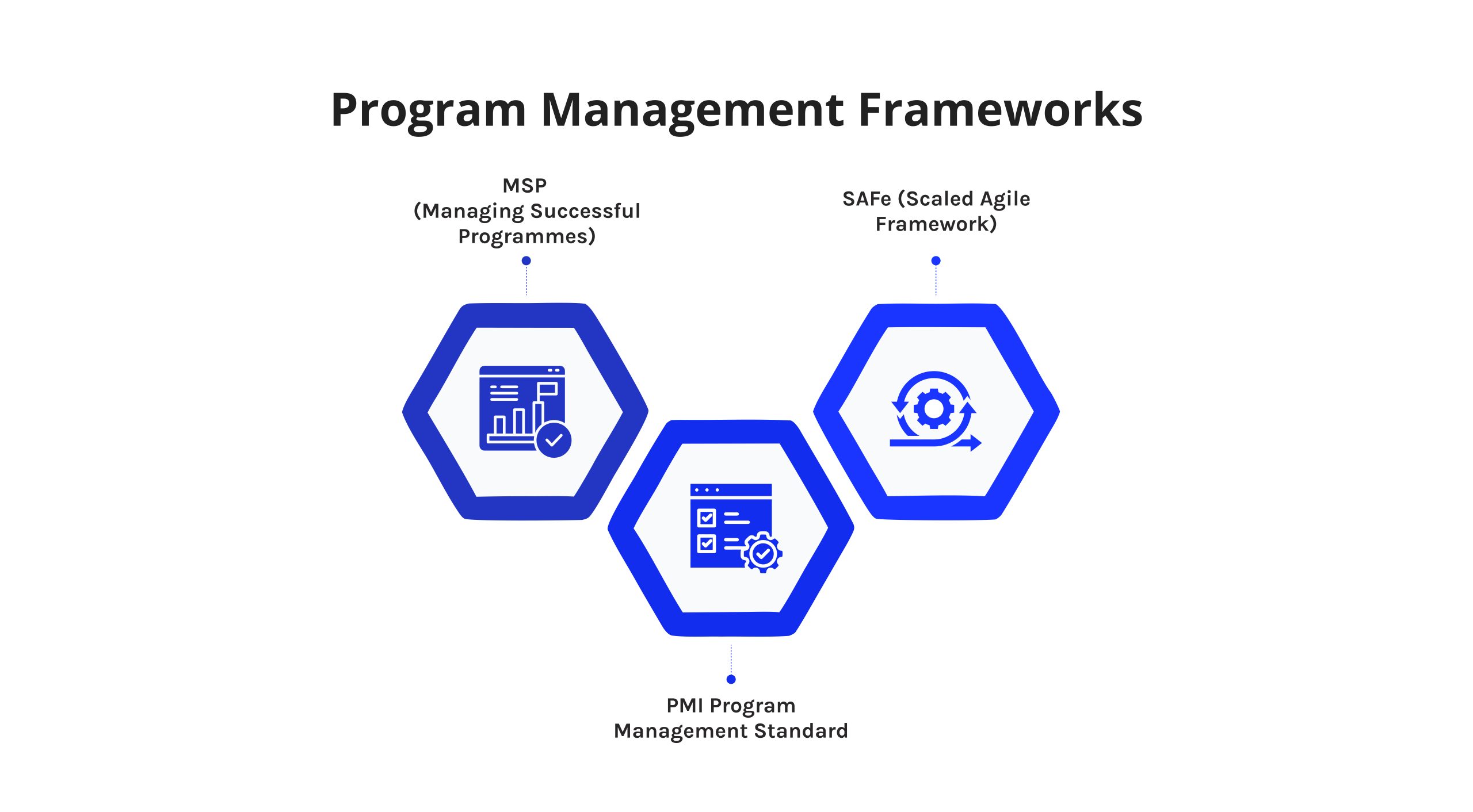
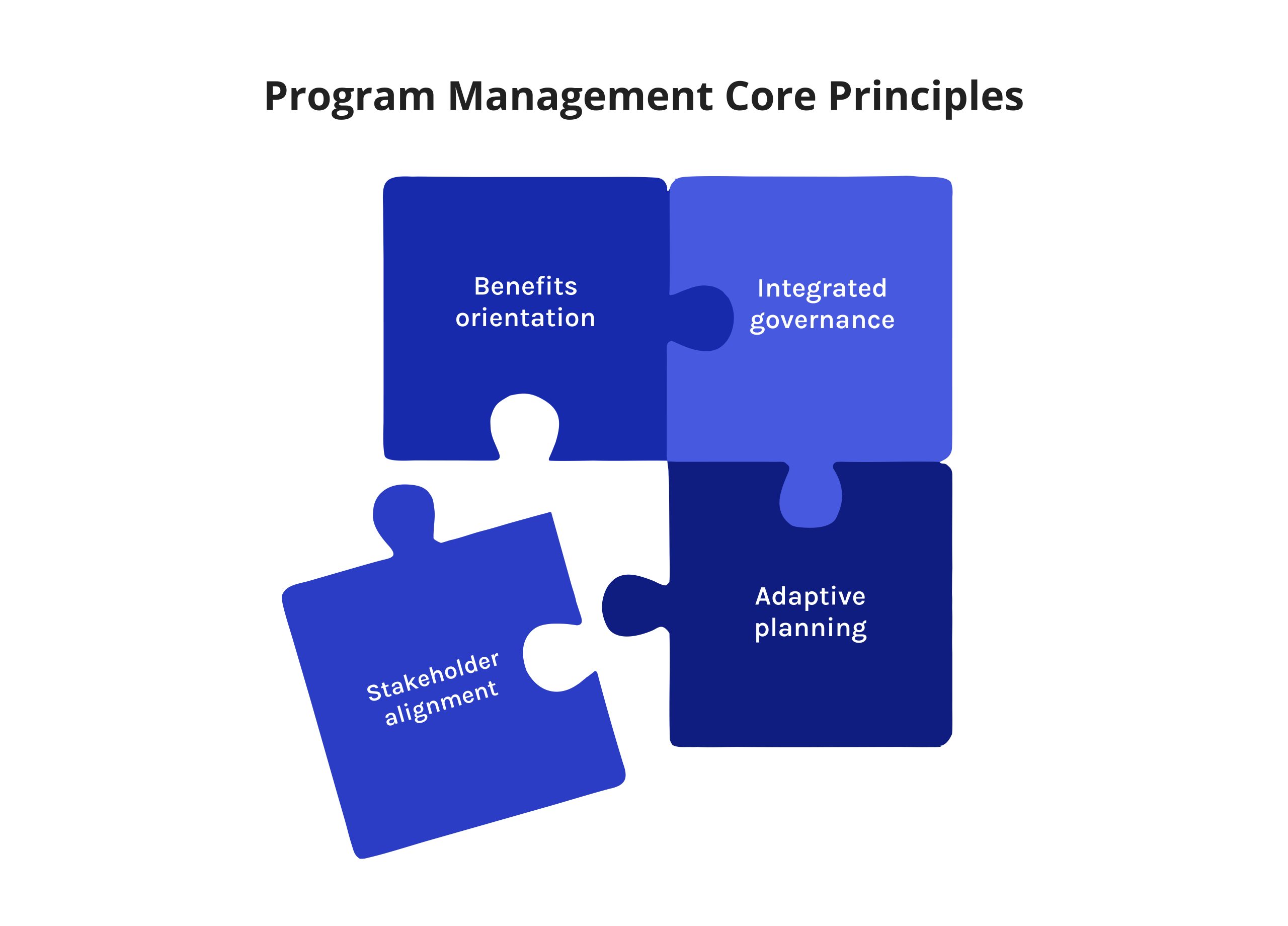
A framework for developing and implementing projects that use a program management system is fundamentally formed from the underlying program management principles and frameworks; as such, these program management principles and frameworks provide a foundation for providing a repeatable and consistent (i.e., “sustainable”) method of executing programs. Organizations typically use an existing framework and then adapt it to their organizational context. There are three popular program management frameworks, and there are four core principles associated with these program management frameworks.
Program Management Frameworks
- MSP (Managing Successful Programmes) – Originally developed in the United Kingdom, this framework is widely used in the public sector and large enterprises to carry out business transformations. In this framework, programs are structured around a blueprint (the target or intended final product), a benefits realization plan, and a governing structure based on three roles: Senior Responsible Owner (SRO), Program Manager, and Business Change Manager. The MSP framework is very effective for programs that are heavily dependent upon change occurring and where it is critical that an appropriate level of support is gained from stakeholders and that the organization is ready for the changes to take place, as well as delivering a successful program.
- PMI – Program Management Standard (4th edition) – The PMI Standard for program management is a globally-recognized and principles-based framework to organize and structure for program execution. The PMI Standard organizes program management into three performance domains: Benefits Management, Stakeholder Engagement, and Program Governance. The PMI Standard does not dictate how to accomplish the program management function; it provides a principles-based foundation that can be adapted to a variety of industries, program types, and organizational structures. All organizations pursuing PgMP certification will align with this standard.
- SAFe is an approach to program management that can work successfully in pursuing Agile and hybrid methods across many organizations through the implementation of a Program Increment (PI) planning model. The way SAFe works at the program level is through Agile Release Trains (ARTs), which consist of cross-functional teams that have one program backlog and delivery cadence. The situations where SAFe is most effective are usually within IT development and product development areas where speed, iteration, and continuous delivery of products are a strategic priority. The Release Train Engineer (RTE) is the program manager in most Agile contexts.
Program Management Core Principles
-
Benefits orientation
Every decision within a program — from resource allocation to scope changes — should be evaluated against its impact on the program’s intended benefits. Benefits orientation keeps programs focused on business outcomes rather than activity completion.
- Integrated governance
Programs span multiple projects, teams, and often multiple business units. Integrated governance establishes a unified decision-making structure that maintains accountability, manages escalations, and ensures consistency across the full program’s bureaucratic overhead at the project level without creating
- Stakeholder alignment
Program success depends on sustained support from sponsors, business owners, and delivery teams over a multi-year horizon. Stakeholder alignment is an active, ongoing discipline, not a one-time communication exercise at program launch.
- Adaptive planning
Programs operate in environments that change. Strategic priorities shift, markets move, and new information emerges. Adaptive planning means maintaining a structured program roadmap while building in mechanisms to reassess, reprioritize, and adjust without losing control of benefits delivery.
Read more: AI in Project Management: Benefits, Use Cases & Trends [2026]
The Program Management Lifecycle: Phases and Processes
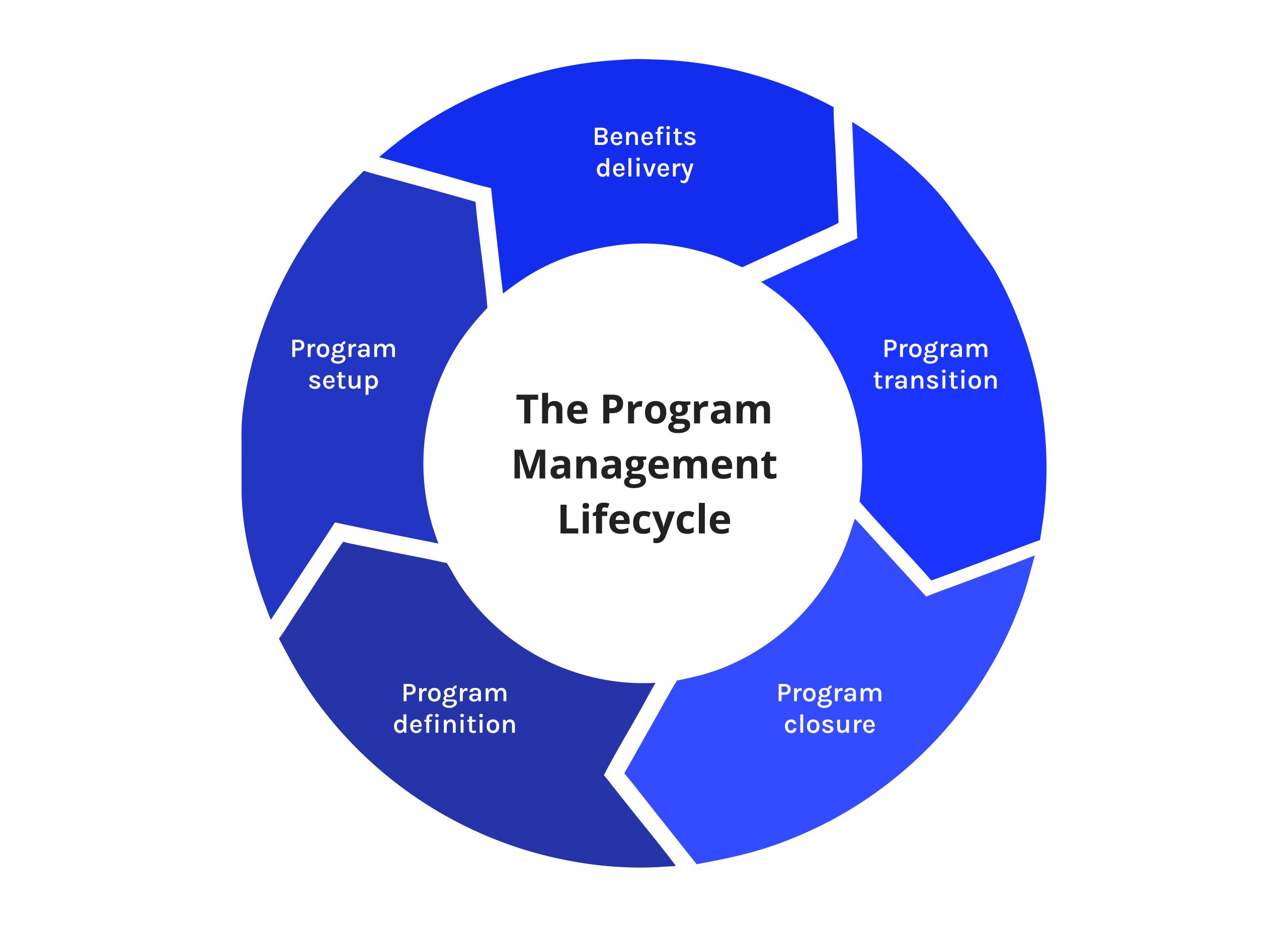
The program management lifecycle structures how a program moves from idea to delivered value. Most frameworks describe five core phases:
- Program definition — establishing program vision, goals, governance, and the business case
- Program setup — structuring the program, assigning roles, and creating the foundational plans
- Delivery of program benefits — executing projects, managing interdependencies, and actively tracking benefits realization
- Transition — handing over program outputs to operational teams or the business
- Program closure — reviewing outcomes, capturing lessons learned, and formally closing the program
Each phase includes structured decision gates. These checkpoints ensure the program remains viable and continues to justify its investment. Without this structure, programs can continue long after their strategic rationale has expired.
Program Management vs. Project Management: Key Differences Explained
Still, the line between program management and project management often blurs despite expertise on both sides. How clearly these roles differ influences team design, resource distribution, task oversight, and outcome tracking.
|
Dimension |
Project Management |
Program Management |
|
Scope |
Single project |
Multiple related projects |
|
Focus |
Deliverables and outputs |
Benefits and strategic outcomes |
|
Duration |
Temporary, defined end date |
Ongoing, often multi-year |
|
Success metric |
On time, on budget, on scope |
Benefits realized, strategy advanced |
|
Primary role |
Project manager |
Program manager |
Project vs. program management is not a hierarchy — it is a distinction in purpose. Projects deliver outputs; programs deliver transformation. The difference between a program manager and a project manager is not seniority but orientation.
Organizations that manage programs without a dedicated program management function consistently see misaligned priorities, duplicated resources, and fragmented reporting. PMI data shows that organizations undervaluing structured management approaches report 67% higher project failure rates (PMI, 2020) [2]. This is a measurable business cost, not an abstract governance concern.
Program and project management together form the delivery backbone of any strategy-driven organization.
Stay current on program management, organizational strategy, and enterprise technology. Subscribe to Digest.Pro on LinkedIn — a trusted resource for C-suite leaders, CFOs, and operations professionals navigating complex organizational decisions.
Must-Have Features in Program Management Software
Program management software connects the operational layer of execution to the strategic layer of business planning. The right program management tools give program managers real-time visibility, resource control, and decision support across all projects simultaneously.
Essential features to look for in any program management software include:
- Multi-project dashboard — a consolidated view of all projects, statuses, milestones, and dependencies in one place
- Resource management and capacity planning — allocation and workload forecasting across the full program
- Real-time bottleneck detection — early identification of risks before they cascade across interdependent projects
- Scenario planning (What-if analysis) — the ability to model decisions and test outcomes before committing
- Benefits tracking — monitoring whether actual program outcomes match expected business value
- Executive reporting — Reports reach executives through automated systems, tailored by responsibility level. Sponsor updates emerge without manual input, shaped for decision-makers. Information flows adjust based on position, avoiding uniform formats. Senior figures receive structured summaries, generated without intervention. Output aligns with the authority tier, bypassing generic templates
- Integration capabilities — connectivity with existing enterprise systems and data sources
These capabilities give program managers the intelligence to manage complex interdependencies, prevent resource conflicts, and make confident decisions backed by real-time data.
Read more: 15 Best Product Roadmap Tools for Stakeholder Alignment in 2026
Program management doesn’t operate in a vacuum — it sits at the intersection of strategy, operations, and technology. At Digest.Pro, we cover exactly that intersection: practical insights for business leaders making high-stakes decisions about how work gets done. Subscribe to stay ahead.
How Program Management Fits Into Organizational Structure
Between project work and high-level planning, program management finds its place within typical company frameworks. Above the single initiatives, it functions yet remains under the umbrella of broader decision-making layers. Strategic directions emerge at the top, shaped by senior leaders who define funding paths. Coordination across efforts becomes possible here, without stepping into daily operations.
It is common for a program management office to oversee how programs are delivered throughout an organization. Standards, structures for oversight, and tools come from the PMO to enable steady performance. Evidence shows entities using a PMO tend to complete initiatives on schedule and within financial limits far more frequently than counterparts lacking such support (PMI, 2020) [2].
IT program management is a particularly established discipline. In technology-intensive organizations, an IT program manager coordinates multiple technology initiatives — infrastructure upgrades, software rollouts, and digital transformation programs — under a single program umbrella. This prevents technical debt, reduces duplicated effort, and ensures coherent delivery across the technology landscape.
Project portfolio management sits one level above program management. A portfolio encompasses all programs and projects an organization runs, managed for strategic balance and investment return. Program management focuses on benefit delivery within a defined set of related projects. Portfolio management optimizes investment across all of them.
Understanding where program management fits in this structure helps CEOs, CFOs, and business analysts set clear expectations for accountability, reporting lines, and decision-making authority.
Read more: 11 Best AI Agents for Project Management: Tools, Trends & Examples (2026)
What Makes Program Management Effective? Best Practices and Success Traits
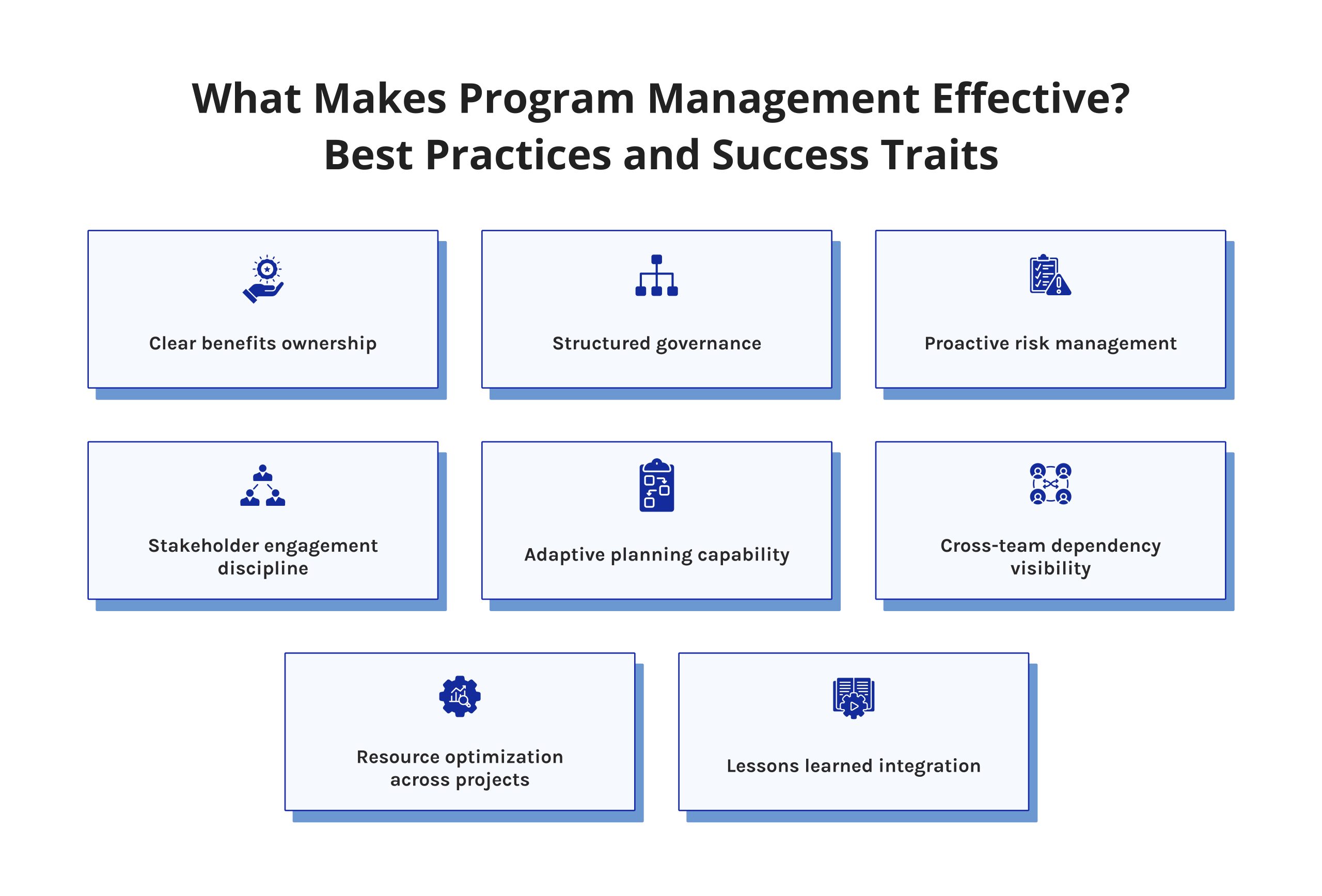
Effective program management is built on a set of repeatable practices. High-performing organizations apply them consistently — and it shows in their results.
- Align programs to strategy from day one.
Every program needs a clear line of sight to a strategic objective. If the program cannot be connected to a defined business goal, its funding decision should be revisited. Strategy alignment is not an administrative step; it is the foundation of program legitimacy.
- Invest in benefits management.
Defining expected benefits upfront and tracking their realization throughout execution separates program management from project oversight. Organizations that prioritize power skills are approximately three times more likely to achieve high benefits realization management maturity — the number one driver of project and program success (PMI, Pulse of the Profession, 2023) [4].
- Build strong governance structures.
Program governance defines who makes decisions, at what level, and based on what criteria. Without clear governance, programs slow down under political friction and ambiguous accountability. Governance is what keeps programs moving when they encounter resistance.
- Manage resources at the program level.
Resource contention across projects is one of the most common reasons programs fail. Program managers need visibility into all shared resources and the authority to resolve conflicts proactively. Reactive resource management — waiting until a conflict surfaces — is too late in a multi-project environment.
- Communicate consistently with stakeholders.
Program managers who keep stakeholders informed reduce resistance and build the trust needed to make difficult decisions quickly. Consistent reporting is not overhead; it is a risk management tool.
- Use the right program management tools.
Data-driven decision-making requires reliable, real-time program data. The best program management software tools automate reporting, surface risks early, and enable scenario planning — removing guesswork from complex, interdependent decisions.
Conclusion
To sum up, program management translates an organization’s strategy into actual results. It achieves this by combining related projects, using shared resources, managing the expectations of stakeholders, and creating business value that is larger than would be created by the individual projects.
With business environments becoming increasingly complex in 2026, there will be increasing pressures on executives to deliver a return on their investments. As such, program management will become a key differentiator for organizations; program managers who are knowledgeable of both their programs’ strategic goals and their operational realities and utilize the appropriate software to support both will typically be more successful in defining and delivering transformation on time and within scope.
The difference between the programs that are managed well compared to those that are managed independently is significant: money wasted, missed milestones, and unfulfilled strategy.
Want practical, expert analysis on program management, project portfolio management, and enterprise operations?
Subscribe to Digest.Pro and stay ahead of the decisions that drive business performance.
FAQs
Program management is the coordinated management of a group of related projects and activities to achieve strategic business outcomes that individual projects cannot deliver on their own. It connects project execution to organizational strategy and focuses on benefits realization across the full program lifecycle.
A program is a structured group of related projects managed together to deliver benefits and strategic outcomes that could not be achieved by managing them independently. Programs are typically multi-year, strategic in scope, and governed by a dedicated program manager and program governance structure.
The main elements of managing a program are:
- Benefits management — Tracking how well a benefit is being achieved and developing a system to measure the success of that benefit.
- Stakeholder engagement — Managing how well the program is communicated, managed, and communicated to all parties involved.
- Program governance — A method for establishing how decisions are made and what level of project oversight is needed throughout the course of the program.
A good software tool for managing programs needs to include multi-project dashboards, resource capacity planning, real-time identification of risks and bottlenecks, and what-if scenario analysis. Some of the most commonly used software tools in large organizations are Epicflow (an AI-based multi-project resource management tool), Microsoft Project, Smartsheet, and Planview.
A program management office is the organizational entity that provides governance, standardization, process, and tools necessary to ensure consistent program and project execution across the organization. In other words, it serves as an organizational function responsible for program management.
Program Manager is a highly experienced person who handles the entire process of program delivery from start to finish. A program manager will be responsible for managing several project managers, handling interdependency between different projects, and managing benefits realization for the program.
The following are the top three skills that one should possess to be an effective Program Manager:
- Strategic thinking – making decisions based on the impact of the program outcome on business strategy and being flexible about changes
- Stakeholder management – handling stakeholder expectations and the complexities involved in organizations
- Benefits realization management – delivering benefits from the program for business success
Where several linked efforts run at once, results improve under coordinated oversight. Such conditions appear often in banking, medicine, military technology, digital systems, public works, and state operations. When change spreads across an entire field — driven by new rules, tools, or processes — the approach brings a clear advantage. Organized direction helps maintain alignment without adding complexity. Sectors reinventing core functions find stability through consistent methods. Multiple moving parts respond better when guided as a whole. Value grows where timing, resources, and goals must align across projects.
Effective program management requires abilities such as aligning work with strategy, tracking realized benefits, involving stakeholders from various teams, handling risks spread over several initiatives, using resources wisely, shaping oversight structures, and making decisions grounded in evidence.
The most recognized certifications in program management include:
- PgMP (Program Management Professional) — from PMI; globally recognized as the leading credential for program managers
- PMP (Project Management Professional) — from PMI; foundational credential for project and program management professionals
- MSP (Managing Successful Programmes) — from AXELOS; widely recognized in Europe and the public sector
- PMI-ACP — for program managers operating in Agile or hybrid environments