Every second an agent spends searching for an answer is a second the customer waits. In high-volume contact centers, IT help desks, and financial advisory teams, that delay compounds — and the cost is real.
Knowledge Assist is the technology built to solve exactly that problem. It uses artificial intelligence to deliver accurate, context-aware answers to employees in real time — automatically, during a live interaction, without requiring manual search.
The business case is clear. According to Gartner, conversational AI deployments will reduce contact center agent labor costs by $80 billion by 2026 [1].
Key Takeaways:
- The knowledge assist function makes use of artificial intelligence and natural language processing to pull up the right answer at the right time, in real time, when working directly with the customer or colleague.
- Embedding knowledge assist in processes can result in lower average handle times, higher resolution rates at the point of contact, and increased customer satisfaction ratings.
- Whether it be from IT support centers, human resources departments, investment advisers, or health care providers, knowledge assistance applications cater to varied organizational contexts — all yielding tangible returns on investment.
This guide explains what knowledge assist is, how it works technically, where it integrates, what business benefits it delivers, and how it compares to a traditional AI agent — so you can evaluate the right solution with confidence.
What is Knowledge Assist?
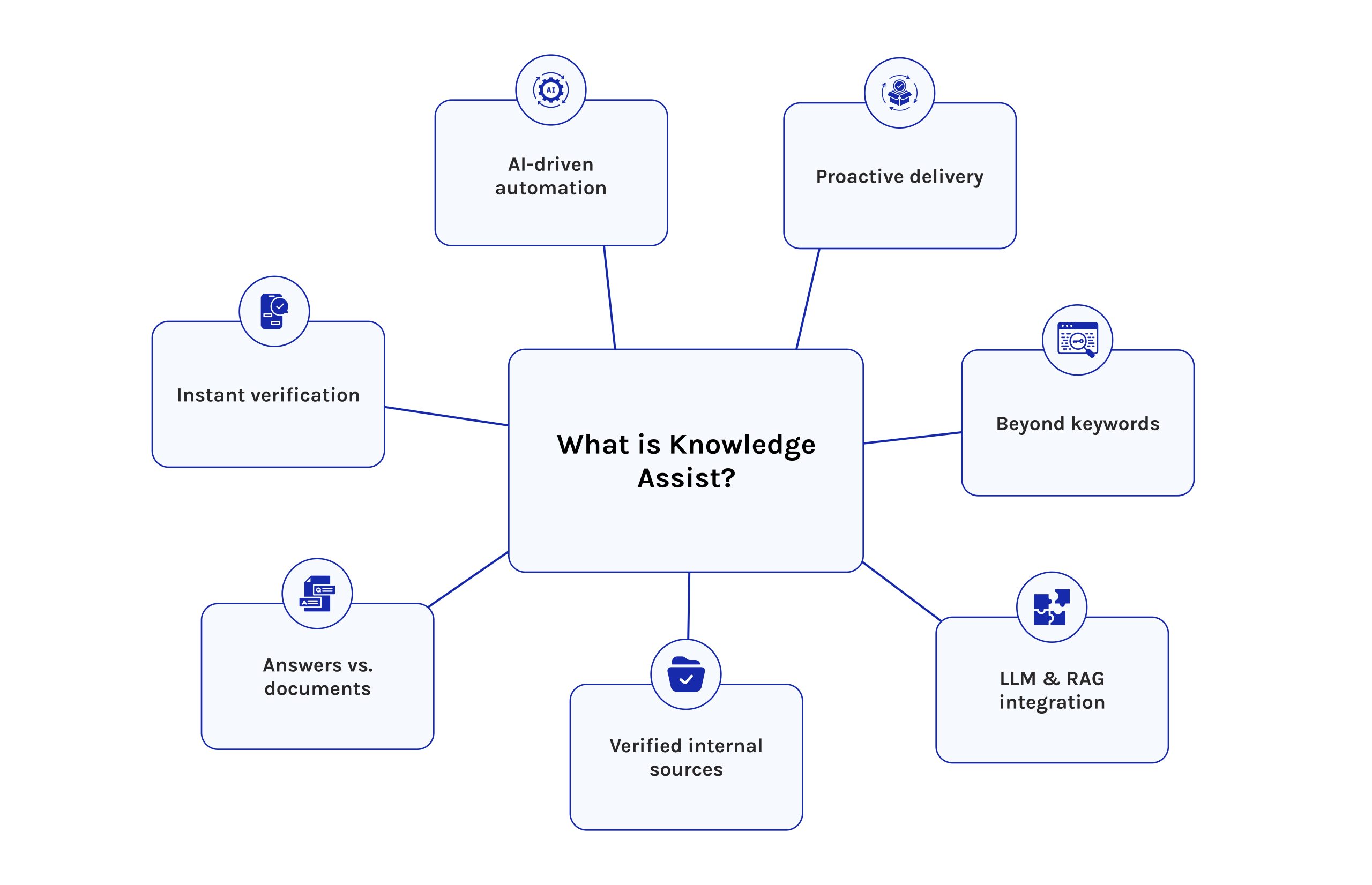
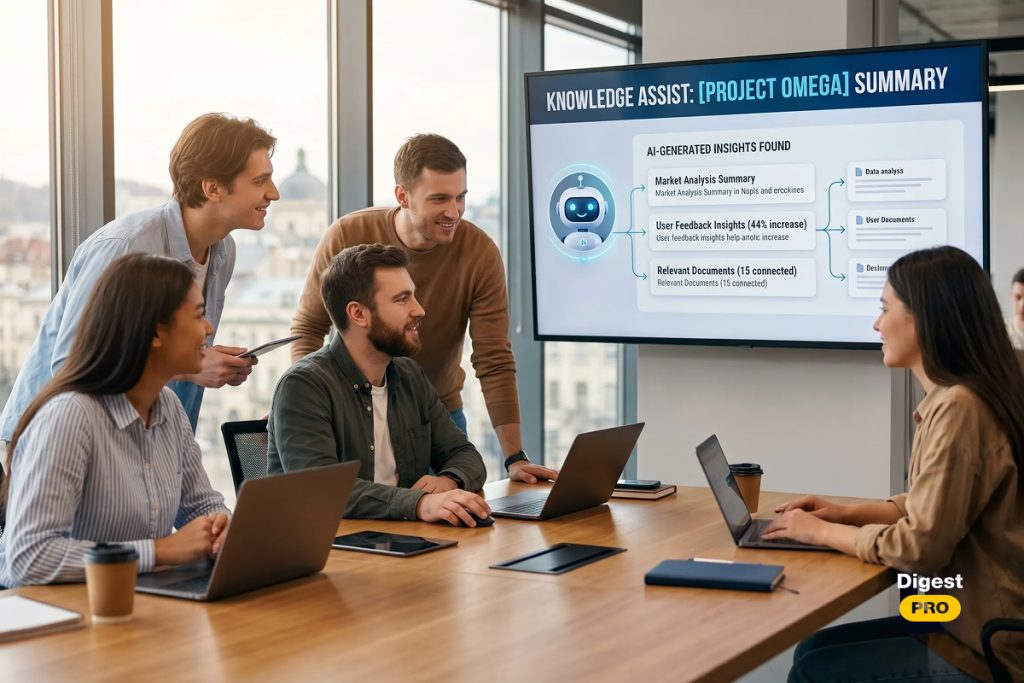
Knowledge Assist is an AI-driven system that automatically retrieves and surfaces relevant information to agents or employees during an active conversation or task. Rather than requiring users to query a knowledge base manually, the system monitors the interaction, identifies the underlying question, and delivers the best available answer directly into the agent’s interface — in seconds.
Recent advancements in knowledge assistance technology are moving past normal keyword searching and utilizing LLMs and retrieval-augmented generation to understand conversational context when generating accurate responses from within an organization’s own verified documents, policies, or product information.
Envision this type of technology as an exceptionally capable AI knowledge assistant that is continuously available in the background, always aware of the current context, and delivers an accurate, referenced answer to the agent’s questions without delay.
The distinction from a traditional search tool is fundamental. A search tool returns documents. A knowledge assist system returns answers — and tells you exactly where they came from.
Read more: Top 5 MS Project Alternatives Compared
How Does Knowledge Assist Work?
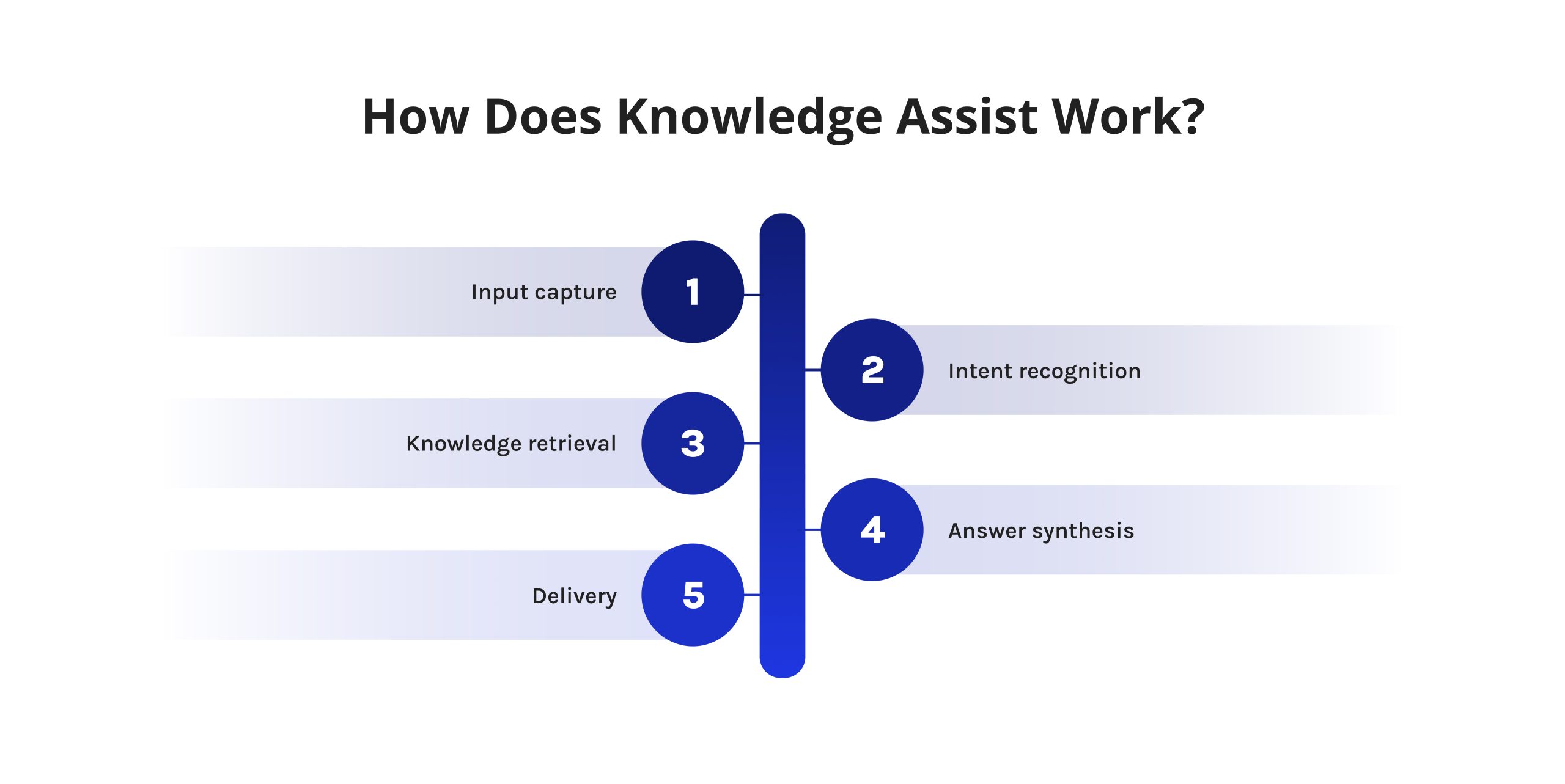
Knowledge Assist operates through a multi-step, background AI pipeline during a live interaction.
- Input capture — At the point of input capture, the system captures data either from chat transcripts, voice-to-text conversion, or typed queries in real-time.
- Intent recognition — Following the input capture, natural language processing (NLP) will determine what the user or agent is actually asking (this is not only based on the actual words typed).
- Knowledge retrieval — The AI searches connected sources: internal knowledge bases, CRM records, policy documents, and product manuals.
- Answer synthesis — Using retrieval-augmented generation (RAG), the system composes a clear, cited response from verified internal content — not from general internet training data.
- Delivery — The answer appears in the agent’s interface alongside the source document, typically within two to three seconds.
This pipeline eliminates the manual lookup step entirely.
According to a landmark 2023 study by Stanford University’s Digital Economy Lab and MIT titled “Generative AI at Work,” researchers analyzed a Fortune 500 company with 5,000 customer service agents using AI assistance. The deployment resulted in measurable improvements: 14% increase in issue resolution per hour, 9% reduction in handling time, and 25% decrease in agent escalation requests [2].
“Many organizations are challenged by agent staff shortages and the need to curtail labor expenses, which can represent up to 95% of contact center costs. Conversational AI makes agents more efficient and effective while also improving the customer experience.”
— Daniel O’Connell, VP Analyst, Gartner (2022) [1].
These outcomes are not projections. AI agent assistance tools are producing measurable efficiency gains in enterprise environments today.
Editorial note: Our editorial team evaluated several knowledge assist platforms over a six-week period, including live demos and test deployments in contact center and IT environments. The most significant differentiators we observed were response latency (anything above three seconds visibly disrupted interaction flow), source attribution quality (some platforms surfaced full documents without highlighting the relevant excerpt, requiring agents to read entire pages to find the answer), and depth of out-of-the-box integrations with Salesforce and ServiceNow. These criteria directly shaped the feature priorities listed below.
How is Knowledge Assist Integrated Into Existing Workflows?
Integration complexity is a genuine concern for enterprise teams. Fortunately, most knowledge assistant platforms are designed to sit on top of your existing stack — augmenting it, not replacing it.
Common integration points include:
- CRM platforms (Salesforce, HubSpot, Microsoft Dynamics)
- Help desk and ticketing systems (ServiceNow, Zendesk, Jira)
- Communication tools (Microsoft Teams, Slack, contact center telephony platforms)
- Document repositories (SharePoint, Confluence, Google Drive)
Most platforms connect via REST APIs or pre-built connectors. The system operates as an intelligence overlay — reading the active conversation and injecting relevant content into the agent’s workspace without disrupting the primary interface.
The integration of conversational AI into workflows does not require replacing existing tools. Agents interact with a familiar interface that now includes an additional panel surfacing real-time guidance. This reduces adoption friction significantly. Typical deployment timelines for a standard integration range from four to eight weeks, depending on knowledge base complexity and the number of connected systems.
The technologies reshaping B2B operations are moving fast. Digest.Pro covers AI systems, enterprise tools, and strategic insights built for C-level executives, PMO leaders, and operations teams. Subscribe to stay ahead of what matters.
Read more: AI Agent Orchestration for Complex Workflows: Everything You Need to Know
What are the Benefits of Knowledge Assist?
Deploying a knowledge assist platform delivers measurable impact across three layers of the organization:
For agents and employees:
- Faster access to accurate, source-referenced answers
- Reduced cognitive load during complex or compliance-sensitive interactions
- Shorter ramp-up time for new hires — answers are built into the workflow, not stored in colleagues’ heads
- Greater confidence in responses, reducing hesitation and second-guessing
For organizations:
- Lower average handle time (AHT) in contact center operations
- Improved first-contact resolution (FCR) rates
- Reduced dependency on senior staff for escalation handling
- Consistent, policy-aligned responses across all agents and shifts
For customers:
- Faster issue resolution with fewer hold periods
- Higher accuracy of information received
- Improved overall customer experience across all service channels
AI knowledge assistance is not only a productivity tool — it is a competitive differentiator in markets where service speed and accuracy directly influence customer retention. An AI-driven knowledge base that stays current and accurate gives every agent on your team the equivalent of your best expert standing beside them on every call.
What are the Key Features to Look for in a Knowledge Assist Platform?
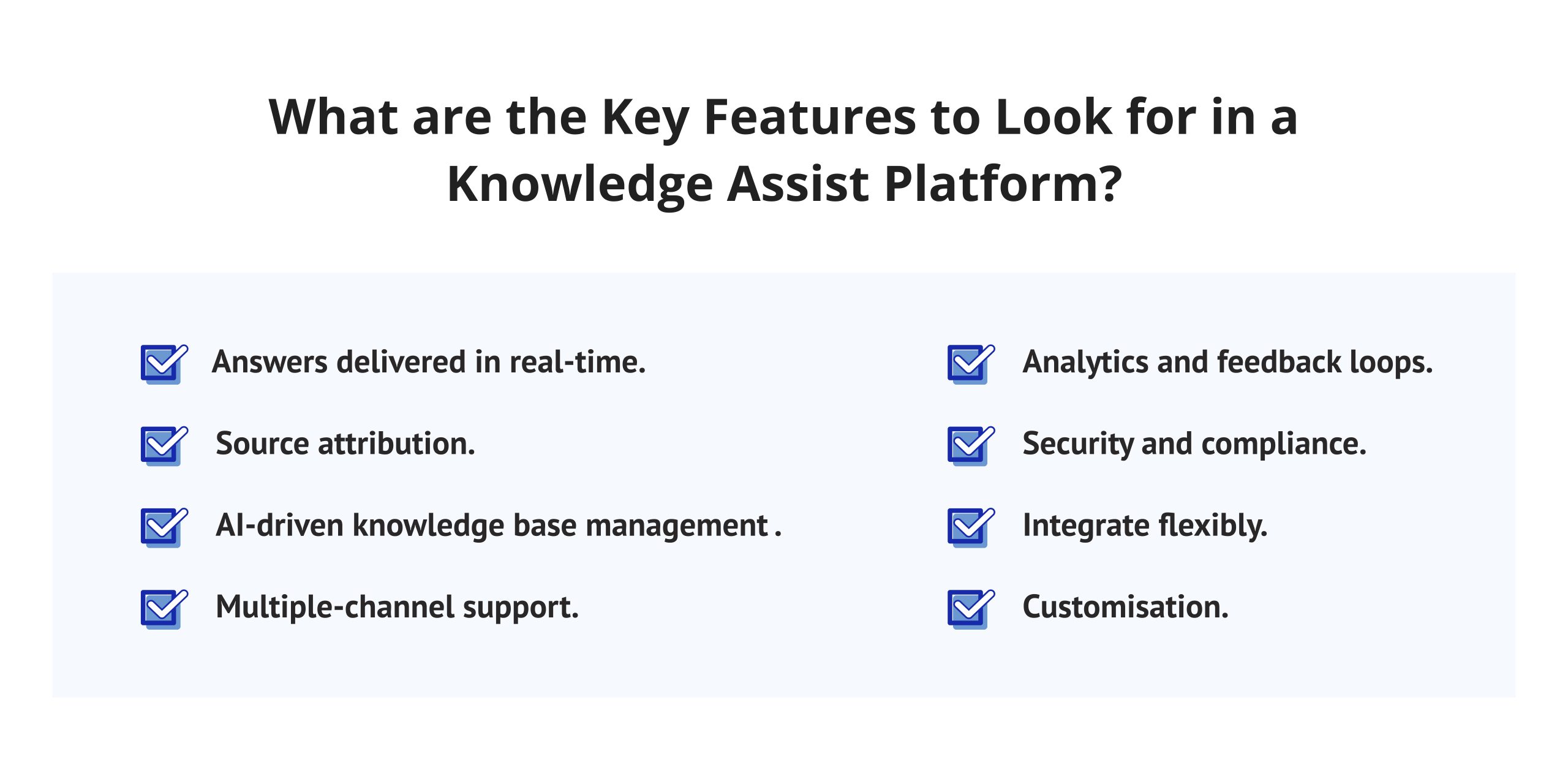
Knowledge assistance tools can vary significantly across providers, so when assessing solutions, some of the capabilities you should be evaluating include the following:
- Answers delivered in real-time — When an agent interacts with a customer in a live setting, their request for an answer should return within that same transaction. A latency period of three (3) to five (5) seconds or more can negatively impact the customer experience. The solution must deliver answers in real-time in order for you to evaluate the other features of the solution.
- Source attribution — Each answer provided to an agent must have a link back to the original source document providing the basis for that answer. This is important to eliminate misinformation and provide agents with confidence in the answer being provided, as well as ensuring an audit trail for compliance.
- AI-driven knowledge base management — Look for solutions that will provide automated processes to identify outdated content and/or content that requires updating and provide suggested improvements for both of those items. Automating these tasks will significantly reduce the amount of time required by your content team to maintain the knowledge base.
- Multiple-channel support — Global enterprise staff provides services to customers via voice, chat, email, and digital channels concurrently, so a knowledge assist solution must have the ability to provide all of those types of channel support via a single configuration.
- Analytics and feedback loops — Your knowledge assist solution should provide you with robust reporting on both the accuracy of the answers provided, agent use and adoption of the system, and whether an answer remains unresolved. Without those analytics and feedback loops, agencies will not be able to continue to improve their knowledge assistance solution.
- Security and compliance — You must have security and compliance based on specific industry-related laws and regulations such as HIPAA and GDPR, and regulated industries such as banking. Role-Based Access Control, data encryption
- Integrate flexibly — Use an API-first architecture to integrate the tool seamlessly with your existing CRM, helpdesk, or communication tool without heavy IT customization.
- Customisation — Essential for the ability to adjust AI responses to your specific terminology, products, and workflow. A generic model will generate generic responses, which is not acceptable at an enterprise level.
Read more: AI Sales Coach: The Future of Scalable Sales Performance
Who Uses Knowledge Assist?: Use Cases
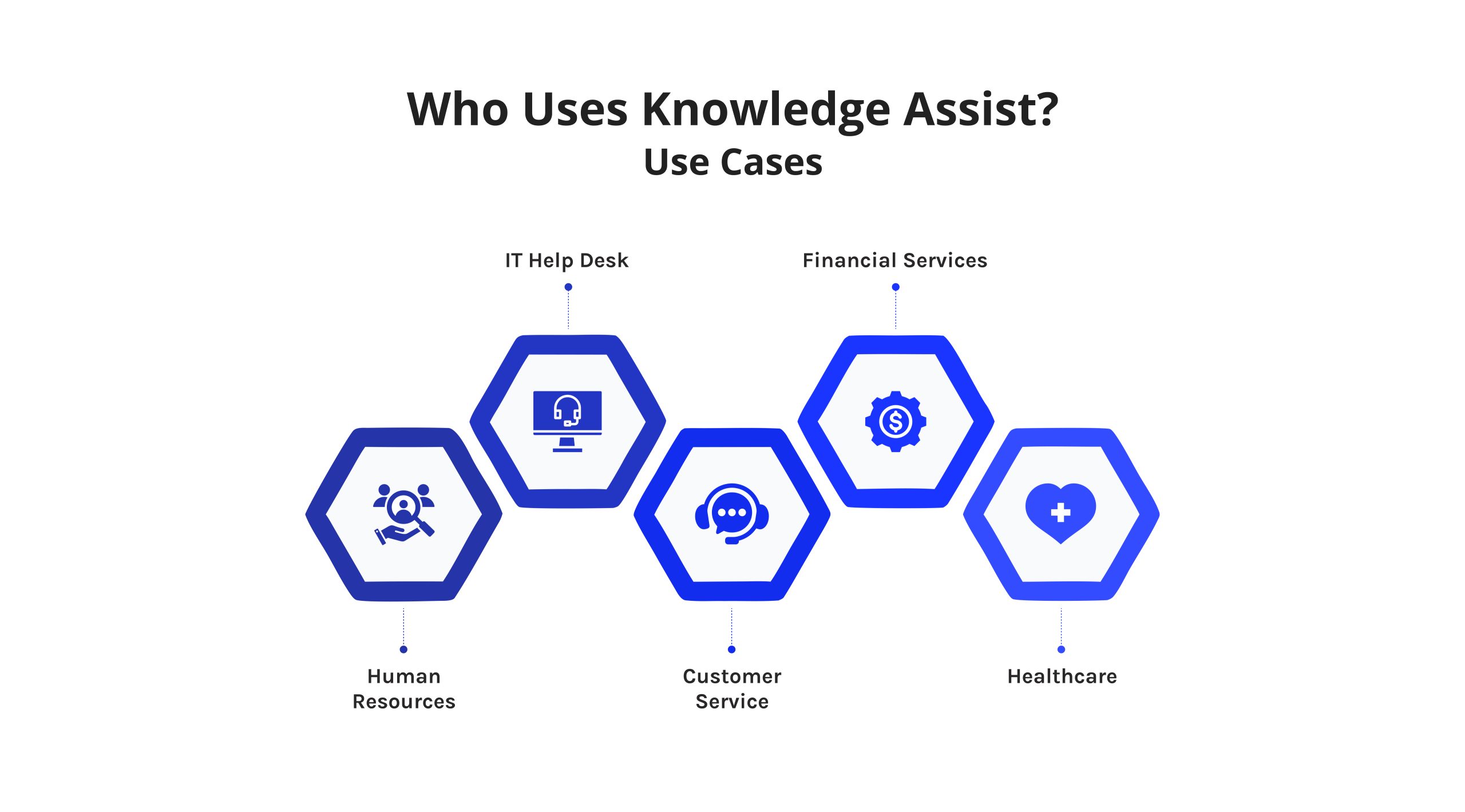
Human Resources
HR teams handle hundreds of repetitive employee questions daily — about benefits, leave entitlements, onboarding processes, and compliance requirements. An AI knowledge assistant surfaces accurate, policy-aligned answers instantly through a self-service portal or HR chatbot, freeing HR professionals for higher-value work.
Key benefits:
- Consistent, policy-aligned answers to common queries across all employee touchpoints
- Significantly reduced inbound email and call volume to the HR team
- Faster onboarding support for new hires
- Audit-ready documentation of all responses for compliance review
IT Help Desk
The IT help desk environment is fast-paced and involves many repeat inquiries. The use of knowledge assistants can make Level 1 help desk agents capable of solving most inquiries related to common issues such as passwords, VPN issues, software malfunctions, etc., even before escalating them to Level 2 support.
Key benefits:
- Shorter mean time to resolution (MTTR) for common incidents
- Fewer unnecessary escalations to senior engineers
- Better capture and distribution of expert knowledge across the team
- Consistent audit trails and documentation
Customer Service
Customer service is where knowledge assistance delivers its most visible ROI. Agents in a contact center navigate thousands of product variations, policy updates, and compliance requirements simultaneously. AI-powered knowledge assistant tools reduce cognitive load by surfacing the correct answer during a live call or chat—without putting customers on hold to search for it.
Verizon’s Knowledge Assist, for example, is purpose-built for contact center environments. It delivers real-time guidance to agents based on live customer queries — enabling faster, more accurate support at scale.
Key benefits for customer service:
- Reduced AHT and hold time across all channels
- Higher FCR rates, reducing repeat contact and customer frustration
- More consistent service quality regardless of agent experience level
- Measurable improvement in CSAT and NPS scores
Financial Services
In financial services, accuracy is a compliance obligation. AI systems trained on verified financial content deliver compliant, audit-ready responses — reducing regulatory risk and improving advisor performance during complex client consultations.
Key benefits:
- Compliance-aligned responses for regulated products and required disclosures
- Faster product and policy lookup during live client calls
- Reduced regulatory exposure from outdated or inaccurate guidance
Healthcare
Healthcare organizations utilize knowledge assistance to support their clinical staff, administrative staff, and patient-facing roles. This allows for instant access to clinical guidelines, billing codes, and appointment protocols that are fully traceable.
Key benefits:
- Rapid retrieval of clinical or administrative information without interrupting care delivery
- Reduced documentation burden on clinical staff
- Improved patient experience through faster, more accurate responses
- HIPAA-compliant information access and access control
AI systems are fundamentally changing how enterprises capture, distribute, and use institutional knowledge. Digest.Pro tracks this shift with expert analysis built for operational leaders and decision-makers. Subscribe to receive our latest coverage.
Read more: Product Portfolio Management Tools: Complete Guide to Choosing the Best Solution in 2026
Know the Difference: Agent vs. Knowledge Assistant
These two terms appear frequently in vendor materials and are often used interchangeably — but they describe distinct capabilities. Understanding the difference matters when selecting tools for your organization.
|
Dimension |
AI Agent |
Knowledge Assistant |
|
Primary function |
Takes autonomous action on behalf of users |
Retrieves and surfaces information to support users |
|
Decision-making |
Plans and executes multi-step tasks independently |
Provides answers; does not act without human review |
|
System access |
Deep access — can update records, trigger workflows |
Read-level access to knowledge repositories |
|
Best use case |
Task automation, process orchestration |
Real-time answer delivery during live interactions |
|
Human oversight |
Lower — can operate with limited supervision |
Higher — agent reviews information before using it |
As Posh.ai notes in its analysis of agent assist versus knowledge assistant, an AI agent can do things, while a knowledge assistant knows things. For most organizations beginning their AI adoption journey, the knowledge assistant approach is the lower-risk, higher-adoption starting point. It reduces errors, builds user trust, and operates within clearly defined, auditable boundaries.
That said, conversational AI systems are beginning to converge. Generative knowledge assistant platforms increasingly incorporate light agentic capabilities — such as pre-filling forms or auto-tagging support tickets — while keeping a human in the loop. The right choice for your organization depends on your current operational maturity, risk tolerance, and compliance obligations — not on which approach sounds more advanced.
Summary
Knowledge assist performs the basic function of creating a connection between the different organizational knowledge areas established in your organization, as well as creating an opportunity for those knowledge areas to be accessed by agents when they need it. In order to effectively utilize this tool, organizations must identify a problem that they would like to solve; they must have a clean and current knowledge base; and they must select a solution that can be successfully integrated into the technology already in use. The technology itself is mature; the competitive advantage is awarded to those teams who implement it well and continue to maintain it over time.
FAQs
Knowledge Assist is an AI-powered system that automatically retrieves and delivers accurate, context-aware information to agents or employees during a live interaction. It uses natural language processing and retrieval-augmented generation to match real-time queries with verified content from a company’s internal documentation — without requiring manual search.
The activation process depends on your platform. Most knowledge assist tools require an administrator to connect the system to your knowledge base, configure user permissions, and enable the real-time overlay within your agent interface. Consult the documentation for your specific provider — whether Verizon Knowledge Assist, IBM Watson Assistant, or another platform — for step-by-step setup instructions.
The best AI knowledge assistant depends on your industry, use case, and existing technology stack. IBM Watson Assistant, Salesforce Einstein, and Google CCA are among the most widely adopted in enterprise environments. For contact center-specific deployments, Verizon Knowledge Assist offers tighter agent-facing workflow integration.
Yes. Tools such as Google Gemini, Microsoft Copilot, and ChatGPT (free tier) offer general AI assistant functionality. However, these are not purpose-built knowledge assist systems — they do not connect to your internal knowledge base, enforce source attribution, or provide enterprise compliance controls. For operational deployments, dedicated platforms are recommended.
Some platforms offer free tiers — including Notion AI and Confluence with basic AI capabilities — suitable for small teams evaluating the concept. Enterprise-grade knowledge assistant tools with real-time retrieval, multi-channel support, analytics, and compliance controls typically require a paid subscription or enterprise license.
Knowledge assist tools improve customer support by giving agents instant access to accurate, verified answers during live interactions. This reduces average handle time, eliminates hold time for information lookup, raises first-contact resolution rates, and creates a more consistent customer experience across all agents and service channels.
A traditional knowledge base is a static repository that agents must search manually — often across multiple disconnected systems. Knowledge Assist is dynamic: it monitors the active conversation in real time, identifies the information needed, and automatically pushes the most relevant, cited content into the agent’s workspace without interrupting the workflow.
A standard knowledge assist system includes the following:
- A connected knowledge repository (internal documents, FAQs, product manuals, policies)
- An NLP engine for real-time intent recognition
- A retrieval layer — typically RAG-based — for accurate, source-specific document matching
- A delivery interface embedded in the agent’s primary workspace
- An analytics and feedback module for continuous quality improvement
Hallucination prevention in AI knowledge assistant deployments relies on retrieval-augmented generation, which grounds every response in source-referenced documents rather than relying on the model’s general training data. Source attribution — displaying the origin document alongside each answer — allows agents to verify responses before use. Regular auditing and updating of the underlying knowledge base further reduces inaccuracy risk over time.
Evaluate an AI knowledge assistant system using a structured set of metrics:
- Answer accuracy rate — manual review of sampled responses checked against source documents
- First-contact resolution rate — did the agent resolve the issue using the assistant’s suggestion?
- Agent adoption rate — are agents actively using suggestions rather than bypassing the system?
- Customer satisfaction scores — track CSAT and NPS before and after deployment to measure impact
- Knowledge gap rate — how frequently does the system fail to return a relevant result?
Establishing a regular feedback loop between frontline agents and the knowledge management team is essential for sustaining answer quality at scale.
References
- Gartner. (2022, August 31). Gartner Predicts Conversational AI Will Reduce Contact Center Agent Labor Costs by $80 Billion in 2026. Gartner Newsroom. https://www.gartner.com/en/newsroom/press-releases/2022-08-31-gartner-predicts-conversational-ai-will-reduce-contac
- Erik Brynjolfsson, Danielle Li, Lindsey Raymond, Generative AI at Work, The Quarterly Journal of Economics, Volume 140, Issue 2, May 2025, Pages 889–942, https://doi.org/10.1093/qje/qjae044
- Brynjolfsson, E., Li, D., & Raymond, L. R. (2023). Generative AI at Work. National Bureau of Economic Research Working Paper No. 31161. https://www.nber.org/papers/w31161
- McKinsey & Company. (2023). The Economic Potential of Generative AI: The Next Productivity Frontier. McKinsey Global Institute. https://www.mckinsey.com/capabilities/mckinsey-digital/our-insights/the-economic-potential-of-generative-ai-the-next-productivity-frontier
- McKinsey & Company. (2024). Getting Started with Gen AI in Customer Care. McKinsey Operations Practice. https://www.mckinsey.com/capabilities/operations/our-insights/gen-ai-in-customer-care-early-successes-and-challenges
- McKinsey & Company. (2023). The State of AI in 2023: Generative AI’s Breakout Year. McKinsey Global Institute. https://www.mckinsey.com/capabilities/quantumblack/our-insights/the-state-of-ai-in-2023-generative-ais-breakout-year
- IBM. (2024). What Is Agent Assist? IBM Think Blog. https://www.ibm.com/think/topics/agent-assist
- Lewis, P., Perez, E., Piktus, A., Petroni, F., Karpukhin, V., Goyal, N., … & Kiela, D. (2020). Retrieval-Augmented Generation for Knowledge-Intensive NLP Tasks. Advances in Neural Information Processing Systems (NeurIPS), 33. https://arxiv.org/abs/2005.11401
- Vaswani, A., Shazeer, N., Parmar, N., Uszkoreit, J., Jones, L., Gomez, A. N., … & Polosukhin, I. (2017). Attention Is All You Need. Advances in Neural Information Processing Systems (NeurIPS), 30. https://arxiv.org/abs/1706.03762
- Verizon Business. (2024). Knowledge Assist — Contact Center CX Solutions. https://www.verizon.com/business/en-au/products/contact-center-cx-solutions/customer-engagement/knowledge-assist/
- Posh.ai. (2024). Agent Assist vs. Knowledge Assistant: What’s the Difference? https://www.posh.ai/blog/agent-assist-vs-knowledge-assistant
- NIST. (2023). Artificial Intelligence Risk Management Framework (AI RMF 1.0). National Institute of Standards and Technology. https://doi.org/10.6028/NIST.AI.100-1
- Chui, M., Roberts, R., Zemmel, R., Yee, L., Smaje, K., Hazan, E., Sukharevsky, A., & Singla, A. (2023). The economic potential of generative AI: The next productivity frontier. McKinsey & Company. https://www.mckinsey.com/capabilities/tech-and-ai/our-insights/the-economic-potential-of-generative-ai-the-next-productivity-frontier