

Several cities around the world can be classified as ‘heavyweight,’ but Singapore is definitely one of those exceptional cities that punch above their weight. It occupies a small land area of 744 km², but it has established itself as one of the leading global hubs for startups.
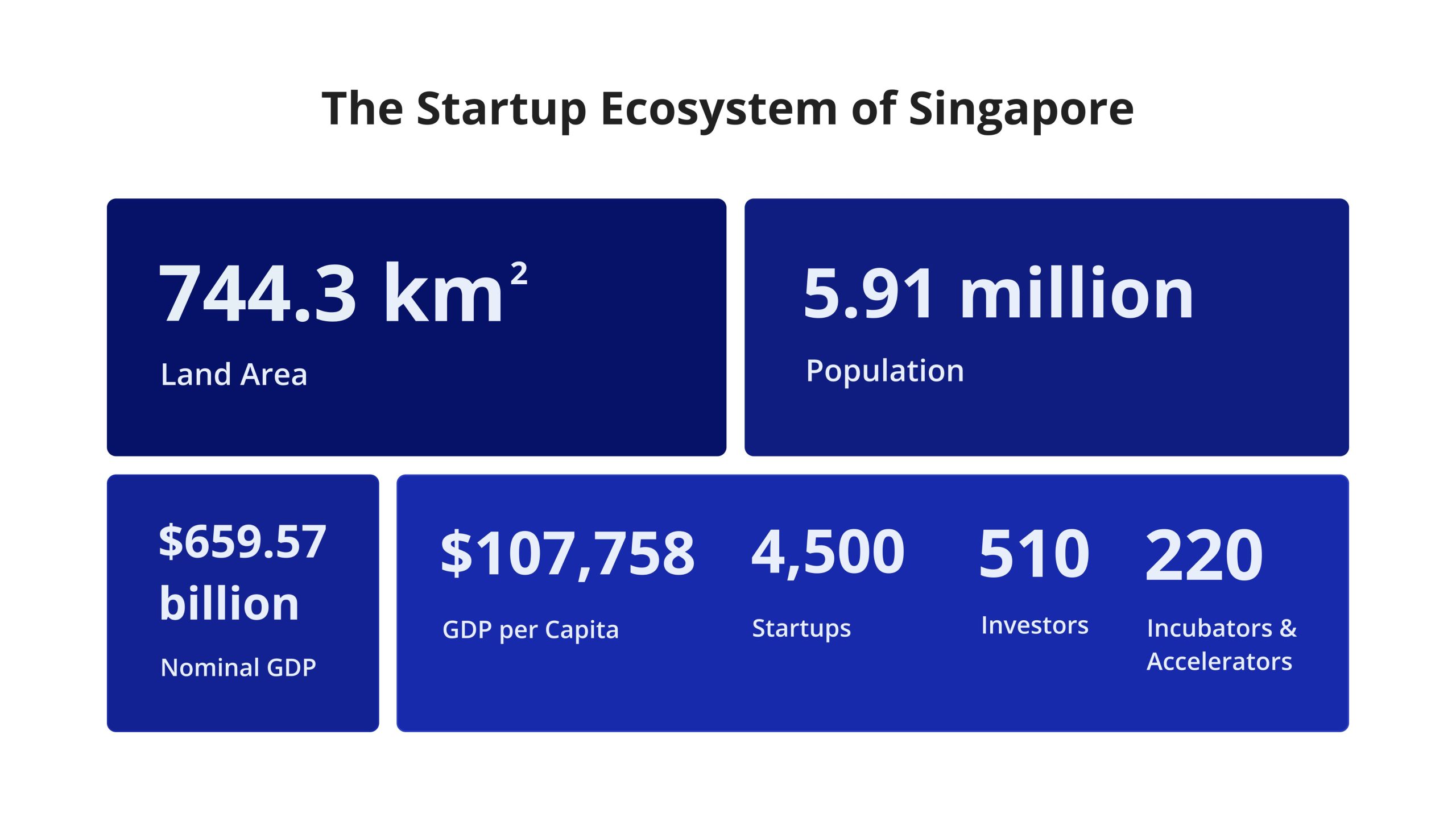
Source: Startup SG. URL: https://www.startupsg.gov.sg/
According to Startup Genome’s ‘Global Startup Ecosystem Report 2025,‘ Singapore ranked 9th and is now ranked among the top ten startup ecosystems worldwide [1]! As of 2026, according to Tracxn, Singapore was estimated to have over 50,000 businesses operating in the city-state, with over 36 known companies being ‘unicorns’ [2].
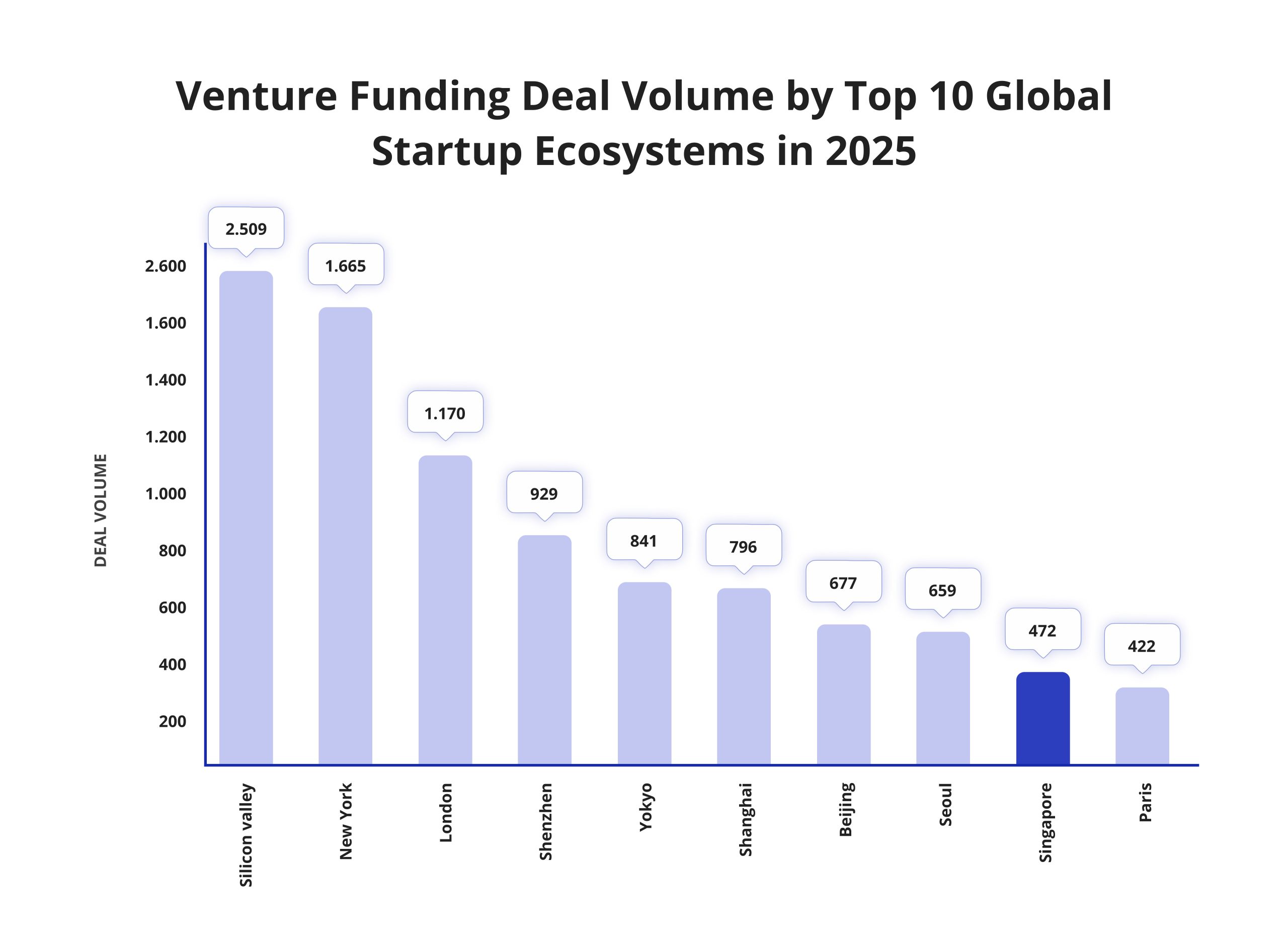
Source: EY Parthenon, Singapore Venture Funding Landscape 2025 Full Year Report https://www.startupsg.gov.sg/public/inline-images/Singapore%20Venture%20Funding%20Lands
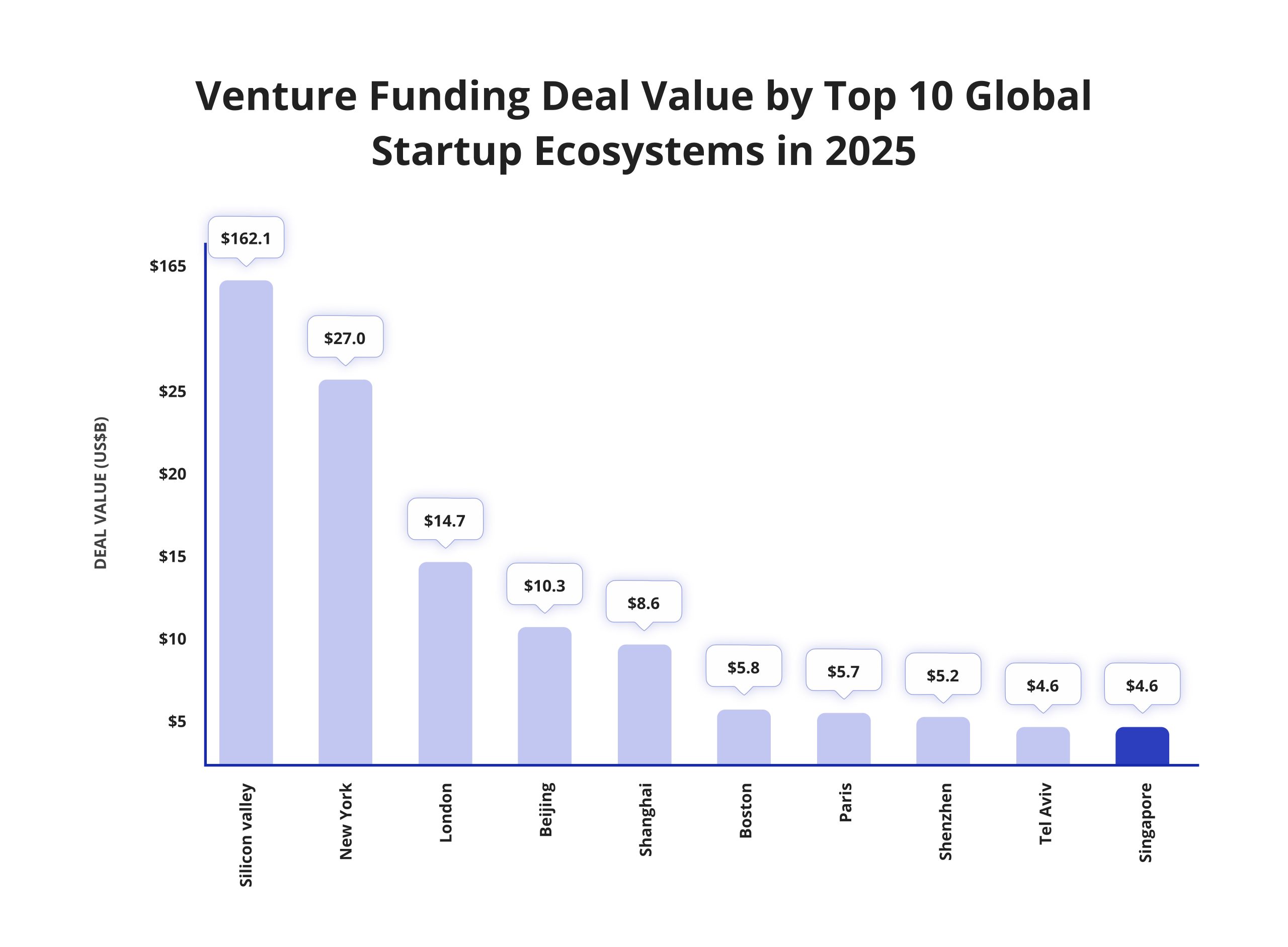
Source: EY Parthenon, Singapore Venture Funding Landscape 2025 Full Year Report https://www.startupsg.gov.sg/public/inline-images/Singapore%20Venture%20Funding%20Lands
Additionally, many of the best-performing startups coming out of Singapore are not solely local but also provide cross-country solutions related to payment systems, distribution of insurance, providing technology solutions through data, and helping to develop sustainable food sources.
Key Takeaways:
- Singapore takes third place among the ten most successful startup ecosystems in Asia (Startup Genome, 2025), with $170 billion total funding and a total of 1,233 acquisitions (Tracxn) [1,2].
- Fintech leads the way: it made up 84% in the first 9 months of 2025 of Southeast Asia FinTech venture investment (AsiaTechDaily), and four of the 12 firms featured in this list operate in cross-border payments [3].
- Singapore’s unicorn startups now cover fintech, insurtech, AI, and deep tech — with Budget 2026’s S$1 billion Startup SG Equity injection indicating that the government is fully backing their growth (The Business Times) [4].
This guide will help you identify the most influential Singapore-based companies of 2026, understand what is driving their growth, and evaluate which sectors are building the sharpest competitive edge in Southeast Asia.
Read more: Top 26 Startups in Canada to Watch in 2026
Singaporean Startup Ecosystem: A Deep Dive
“Singapore captured approximately 92% of Southeast Asia’s total startup funding in H1 2025 and 88% of fintech funding.” — blog.mean.ceo, Global Startup Funding Statistics by Region, 2026 [5].
Singapore’s leading startups today operate in sectors ranging from embedded insurance to blockchain analytics, from fractional investing to cell-based seafood. Below is our deep dive into the 12 most notable startup companies in Singapore right now.
Singapore’s startup scene moves fast. Digest.Pro tracks every major funding round, founder story, and market shift around the world — so you don’t have to chase the news yourself. Subscribe to our LinkedIn and get the week’s most important startup intelligence in your inbox every Monday.
1. Airwallex

Airwallex is a global payment and financial service provider that allows modern businesses to manage their cross-border transactions from one integrated platform. They have a range of services for businesses at all levels. Airwallex is looking to provide businesses with a modern alternative to the outdated banking infrastructure that has existed for many years.
“Legacy providers are fundamentally incompatible with how modern businesses operate, and our investors understand that we’re pulling ahead in the race to define this category. We’re building a modern alternative, a single platform that powers global banking, payments, billing, treasury, and spend on top of proprietary financial infrastructure. ” — Jack Zhang for FinTech Global [6].
Jack Zhang, Co-founder and CEO of Airwallex
- Industry: FinTech / Global Payments / Financial Infrastructure
- Founded: 2015
- Series: G
- Funding Rounds: 14
- Money Raised: ~$1.58B [7]
Why Watch in 2026:
Annualized transaction volume doubled year-on-year to $235 billion; ~50% of its 200,000+ customers use multiple products, and the company is building AI financial agents to automate entire finance departments. A committed $1 billion+ US investment (2026–2029) makes this one of the most aggressive global expansion bets in fintech right now.
2. Bitget

Bitget is an exchange that offers trading, derivatives, copy trading, Earn products, and a Web3 wallet. Based in Singapore, the company has recorded 125 million registered users as of 2025 and operates a protection fund worth above $716 million — meant to secure users against extreme conditions in the market.
- Industry: Cryptocurrency Exchange / Web3 / DeFi
- Founded: 2018
- Series: B
- Funding Rounds: 3
- Money Raised: $20M (equity); Protection Fund: $716M+ [8]
Why Watch in 2026:
Bitget processes over $8 billion in daily trading volume with MAS-compliant KYC and AML infrastructure. Its 1,300+ supported coins at a 0.01% spot fee — among the lowest in the market — make it the most competitive regulated crypto venue based in Singapore.
3. bolttech

As an embedded global insurance service, bolttech connects over 700 distribution partners with over 230 insurance carriers worldwide in over 30 countries. Via technology, bolttech’s partners are able to incorporate their customers’ customer journeys into their insurance products while also seamlessly providing a uniform experience. In addition to bolting on various devices, the combination of travel and life insurance will help to fulfill a demand for both personalization and context-based insurance.
- Industry: InsurTech / Embedded Insurance
- Founded: 2020
- Series: C
- Funding Rounds: 9
- Money Raised: ~$640M total [9]
Why Watch in 2026:
bolttech closed its Series C at $147M in June 2025 at a $2.1B unicorn valuation and launched a joint venture with Sumitomo Corporation to expand embedded insurance programs across Asia. Its December 2024 acquisition of CPP India signals continued geographic expansion into one of the world’s largest insurance markets.
4. Cococart

Cococart operates as a straightforward e-commerce solution designed for simplicity. Without requiring coding skills, it enables small enterprises to open digital storefronts effortlessly. Orders come through smoothly, and payment handling stays integrated, while customer rewards function reliably.
- Industry: E-Commerce / SME Tech / No-Code Tools
- Founded: 2020
- Series: Seed
- Funding Rounds: 2
- Money Raised: $4.32M [10]
Why Watch in 2026:
Cococart operates in over eighty nations, serving more than forty thousand companies. Supported by investors such as Y Combinator, its presence grows quickly through regions like Southeast Asia and Australia. The solution stands apart in markets where small enterprises seek simple tools for trade. Performance in the Philippines adds weight to its expanding reach.
Read more: 25 Leading Estonian Startups to Watch in 2026
5. Friz

Friz is a Singapore-based fintech startup that provides credit lines, working capital loans, and corporate cards specifically designed for freelancers, gig workers, and self-employed professionals. Traditional banks rarely serve this segment effectively. Friz uses data and artificial intelligence to assess creditworthiness based on invoice and income history rather than traditional collateral.
- Industry: FinTech / Gig Economy Finance / Credit
- Founded: 2020
- Series: Seed
- Funding Rounds: 2
- Money Raised: $1.5M [11]
Why Watch in 2026:
Powered by Y Combinator and Funding Societies, Friz seeks to capitalize on the estimated 29 million-plus gig workers in Southeast Asia who remain overlooked by traditional financial institutions. Friz’s AI-powered credit evaluation algorithm, powered by invoice and income data, will offer the company an inherent advantage when the gig economy in the region matures.
Enjoying this breakdown of the top startups in Singapore in 2026? Subscribe to Digest.Pro on LinkedIn — our weekly newsletter delivering expert analysis of Southeast Asia’s most innovative companies, funding rounds, and emerging technology trends. Used by founders, investors, and business leaders across the region.
6. Funding Societies

This is Southeast Asia’s leading SME digital financing platform operating under the brand name ‘Modalku’ in Indonesia. Established in 2015 by two graduates from Harvard Business School, Funding Societies provides AI-backed short-term loans, invoice financing, and B2B payments for SMBs in Singapore, Indonesia, Malaysia, Thailand, and Vietnam.
- Industry: FinTech / SME Lending / Alternative Finance
- Founded: 2015
- Series: D
- Funding Rounds: 20
- Money Raised: $242M+ [12]
Why Watch in 2026:
Disbursing over $3 billion through 5 million+ transactions to 100,000+ SMEs, Funding Societies stands tall as the biggest alternative lender in Southeast Asia, supported by SoftBank Vision Fund 2, SMBC, and Peak XV Partners. Its collaboration with Airwallex in 2026 on mortgage-backed business loans will expand the company’s reach beyond financing.
7. Nansen
Nansen is a blockchain analytics platform that gives crypto investors and institutional traders real-time on-chain intelligence. It labels over 300 million wallet addresses across 12+ blockchains — including Ethereum, BNB Chain, and Base — allowing users to track smart money flows, detect emerging token trends, and monitor exchange inflows and outflows. Its tools include Smart Alerts, Token God Mode, and NFT Paradise dashboards.
- Industry: Crypto Analytics / Blockchain Intelligence / Web3
- Founded: 2020
- Series: B
- Funding Rounds: 3
- Money Raised: $88.2M [13]
Why Watch in 2026:
In late 2025, Nansen pivoted toward Joint Venture Protocols — co-creating tokenized on-chain products with partner ecosystems — with the first JVP expected this year. Backed by a16z, Accel, Tiger Global, and GIC, this strategic shift extends Nansen’s value well beyond analytics into on-chain product infrastructure.
Read more: Top 21 Most Promising Startups in Japan in 2026
8. Spenmo

Editorial note: Spenmo officially ceased operations on August 14, 2025. We include it here because its journey — from Y Combinator-backed seed startup to $500M-valued Series B company to shutdown — is an instructive case study in the pressures facing Singapore’s B2B fintech sector. Understanding why notable Singaporean startup companies fail is as important as celebrating those that succeed.
Once based in Singapore, Spenmo provided tools for business spending oversight — corporate cards formed one part, and automatic invoice handling another. Approval sequences linked to financial checks appeared next in its lineup, followed by smooth record alignment for accountants. Operating mainly in Southeast Asia, the system supported finance groups inside thousands of firms.
- Industry: FinTech / B2B Payments / Expense Management
- Founded: 2020
- Series: B
- Funding Rounds: 3
- Money Raised: $121M [14]
Why it Matters:
Spenmo’s path from a $500M Series B valuation to shutdown illustrates the unit economics and compliance challenges that B2B fintech platforms face in fragmented Southeast Asian markets. A rebranding to Summit in 2024 and layoffs in June 2025 preceded its August closure — a critical case study for anyone building in the regional expense management space.
9. Thunes

Thunes is an infrastructure company that enables cross-border payments to function by connecting banks, digital wallets, and mobile money companies in over 130 different countries, 80 different currencies, and 550 direct integrations.
Thunes enables companies to move money behind the scenes and provides services to companies such as Uber, Deliveroo, Grab, and WeChat. In April 2025, a $150M Series D pushed it into unicorn territory.
- Industry: FinTech / Cross-Border Payments Infrastructure
- Founded: 2016 (spun out from DT One/TransferTo)
- Series: D
- Funding Rounds: 5
- Money Raised: $362M total [15]
Why Watch in 2026:
Now profitable with a $150M revenue run-rate, Thunes joined the unicorn club in April 2025 and is securing US operating licenses across all 50 states. Its proprietary SmartX Treasury and Fortress Compliance platforms provide risk management and AML infrastructure that differentiate it from commodity payment networks.
10. Gotrade

Fractional ownership access defines Gotrade, operating across 150 nations since its inception in 2019 in Singapore. Trading U.S.-listed equities and exchange-traded funds begins at one dollar, without transaction charges attached. Non-American individual investors previously faced obstacles — costly trade executions stood in their way. Minimum deposit demands once limited participation. Those thresholds no longer apply here.
- Industry: FinTech / Wealthtech / Retail Investing
- Founded: 2020
- Series: A
- Funding Rounds: 2
- Money Raised: $22.5M [16]
Why Watch in 2026:
Gotrade has achieved 500,000-plus users within 140-plus countries while spending no money on advertising and has recently integrated US options trading through a partnership with Alpaca. With participation by retail investors growing in Southeast Asia (Indonesia alone is forecasted to have 17 million investors by 2025), Gotrade is well-positioned to grab a share of the next big wave of the market via its commission-free and mobile-centric business model.
11. PatSnap

R&D teams, IP departments, and business strategists may browse patents, scientific literature, litigation records, and competitor technology landscapes with the aid of PatSnap, an AI-powered connected innovation intelligence platform. It was established in Singapore in 2007 and, following its $300M Series E in March 2021, which valued it at $1B+, became the city-state’s first domestic unicorn in intellectual property intelligence. Tesla, NASA, Siemens, Dyson, Xiaomi, and Spotify are among the clients.
- Industry: AI / IP Intelligence / Legal Tech / R&D Analytics
- Founded: 2007
- Series: E
- Funding Rounds: 6
- Money Raised: $352M+
- Valuation: $1B+ (unicorn since 2021) [17]
Why Watch in 2026:
PatSnap continues to grow its client base (over 12,000 clients) and expand its biopharma intelligence suite. The biopharma vertical represents a highly attractive, growing vertical, with significant competitive advantages associated with PatSnap’s chemical structure searching capabilities and the integration of clinical trial data. PatSnap is backed by leading investors such as SoftBank Vision Fund II and Tencent and is Singapore’s leading provider of AI-supported IP intelligence solutions.
Read more: 5 Best Startups in Hungary to Watch in 2026
12. Shiok Meats (now part of UMAMI Bioworks)

From Singapore, a startup began shaping lab-grown seafood through cellular science — no fishing required. Stem cells transformed into shrimp, lobster, and crab were grown outside living creatures. Two scientists launched the effort in 2018: one trained in nuclear medicine and the other in molecular biology.
- Industry: FoodTech / Cultivated Seafood / Alternative Protein
- Founded: 2018
- Series: A
- Funding Rounds: 6
- Money Raised: $30.7M [18]
Why Watch in 2026:
The UMAMI Bioworks merger consolidates Singapore’s cell-based seafood IP and accelerates commercialization under a single, better-capitalized entity. Singapore’s “30 by 30” food security strategy continues to provide direct regulatory and grant support — making this combined entity the region’s clearest bet on scalable cultivated seafood.
Stay ahead of the fastest-growing Singaporean startups. Digest.Pro tracks Southeast Asia’s innovation economy week by week — from funding rounds to product launches to regulatory shifts. Follow us on LinkedIn and get the stories that matter to business leaders in the region.
Quick Overview: Singaporean Startup Industry in 2026
|
Company |
Sector |
Stage |
Total Raised |
Status |
|
Airwallex |
Payments / FinTech |
Series G |
~$1.58B |
Active (unicorn, $8B) |
|
Bitget |
Crypto Exchange |
Series B |
$20M equity |
Active |
|
bolttech |
InsurTech |
Series C |
~$690M |
Active (unicorn, $2.1B) |
|
Cococart |
E-Commerce / SME |
Seed |
$4.32M |
Active |
|
Friz |
FinTech / Gig Economy |
Seed |
$1.5M |
Active |
|
Funding Societies |
SME Lending |
Series D |
$242M+ |
Active |
|
Nansen |
Blockchain Analytics |
Series B |
$88.2M |
Active |
|
Spenmo |
B2B Payments |
Series B |
$121M |
Ceased ops (Aug 2025) |
|
Thunes |
Cross-Border Payments |
Series D |
$362M |
Active (unicorn) |
|
Gotrade |
Wealthtech |
Series A |
$22.5M |
Active |
|
PatSnap |
AI / IP Intelligence |
Series E |
$352M+ |
Active (unicorn, $1B+) |
|
Shiok Meats |
FoodTech / Alt-Protein |
Series A |
$30.7M |
Merged (UMAMI Bioworks) |
Sector distribution: Among the twelve firms, seven operate within fintech or closely related financial fields.
Stage distribution: 3 confirmed unicorns on this list (Airwallex, bolttech, Thunes) and one long-standing unicorn (PatSnap). Three companies are early-stage seed plays. This range reflects Singapore’s startup ecosystem maturity — it supports the full company lifecycle, from first-check seed to billion-dollar exits.
Read more: Top 8 AI Startups in Czech Republic to Watch in 2026
Methodology: How We Ranked the Top Singaporean Startups
Our editorial team evaluated companies across six criteria to compile this list:
- Innovation and technological differentiation. We assessed whether each company is solving its problem through proprietary technology, AI, or unique data assets — not simply repackaging an existing model. Nansen’s 300M+ wallet label database and PatSnap’s AI patent intelligence engine are examples of high-differentiation approaches.
- Beginning with financial backing, attention shifts to both the amount secured and the timing of the most recent funding. Noteworthy too is who leads investment rounds — reputation matters. Data sources were matched carefully: Tracxn offered one layer and Crunchbase another, while PitchBook filled gaps, all verified against official statements issued directly by firms.
- Size of opportunity shapes growth paths. Firms were selected based on reach beyond national borders, focusing on those already engaging regional demand. Expansion is more sustainable when the initial design includes diverse geographies. The most resilient ventures from Singapore target consumers across Southeast Asia or worldwide, rarely limiting focus to local conditions alone.
- Revenue momentum and business model health. Where available, we considered revenue run-rate, profitability signals, and unit economics. Airwallex’s 90% ARR growth and Thunes’s positive EBITDA are concrete markers of operational health.
- Ecosystem and strategic significance. We asked: would removing this company from Singapore’s startup ecosystem leave a meaningful gap? PatSnap, Funding Societies, and bolttech all occupy positions in their respective markets that would be difficult for competitors to fill quickly.
- Transparency and factual accuracy. We did not include companies where claimed metrics or funding could not be independently verified. Spenmo is included with its current status accurately stated. Companies with contested or unverifiable valuations are presented with those caveats.
Two companies on this list — Spenmo and Shiok Meats — have materially changed status since being recognized as notable startups in Singapore. We include them because understanding the full picture of startup companies in Singapore means accounting for outcomes across the spectrum, not only the success stories.
Summary
Among the globe’s leading startup hubs, Singapore stands out due to deliberate policies, clear regulations, and strategic state investment, alongside an entrepreneurial mindset aimed beyond borders. In 2026, top ventures based there set their sights far wider than home — growth begins locally, yet targets international reach from the outset.
Among those listed, twelve stand apart due to their technological focus within Singapore’s evolving landscape. Airwallex and Thunes operate primarily in payment systems, forming foundational layers. In contrast, bolttech integrates insurance directly into digital platforms. Blockchain analysis appears through Nansen, while Bitget contributes related data tools. PatSnap applies artificial intelligence to research insights. For small enterprises, capital access comes via Funding Societies alongside Friz. Gotrade enables individual market participation in equities. Online commerce gains support from Cococart’s operational resources. Finally, novel food development emerges with Shiok Meats together with UMAMI Bioworks.
Among the quartet listed, Airwallex, Thunes, and bolttech attained verified unicorn standing beyond 2021. This suggests ongoing momentum in Singapore’s path to high-value startup emergence despite constrained international investment conditions.
Backed by long-term funding, regulatory updates on blockchain licenses shape opportunities. Not just policy but regional consumer shifts matter too — rising incomes across Southeast Asia boost appetite for online finance tools. This convergence strengthens Singapore’s position quietly. Beyond capital flows, evolving habits support tech ventures differently now. Decision-makers observing Asia find value here consistently. The state’s multi-year research budget runs deep, influencing outcomes slowly. One factor alone does not explain momentum; alignment between institutions and market needs does.
The companies shaping Southeast Asia’s next decade are being built right now. Digest.Pro is where investors, operators, and founders go to stay one step ahead — with data-driven breakdowns of the region’s fastest-growing startups, delivered weekly. Join the community →
Read more: 12 Tech Startups in Romania to Watch in 2026
FAQs
Early on, support arrives via Enterprise Singapore’s primary funding paths — one aids startup formation financially and guides development, while another targets tech advancement needing deeper investment. Recently, an extra billion dollars entered the equity framework, widening access beyond initial phases into expanding ventures. Those seeking assistance submit requests online using a central entry point designated for public financial aid programs. To qualify generally, businesses must be registered locally with significant national ownership stakes held by residents. Funding levels differ across initiatives, reflecting varied objectives tied to innovation timelines. Decisions follow submission reviews conducted under structured assessment rules.
The most direct routes are Antler’s Singapore cohorts — built specifically to match co-founders before company formation — and NUS Enterprise’s founder-matching events. Domain-specific communities work better than general meetups: fintech founders cluster around the MAS FinTech Festival, while deep tech founders connect through A*STAR and NUS spinout networks. LinkedIn and the Startup SG platform are also effective for cold outreach.
One finds that incorporation in Singapore typically spans one to three business days through ACRA, demanding at least a single director residing locally. Should the company operate within controlled domains — such as payments, credit services, digital tokens, or coverage arrangements — further approval by MAS becomes necessary. Despite such requirements, real-world trials before full authorization are allowed under a framework managed by MAS. Protection of brand identifiers begins promptly upon registration with IPOS. Patent documentation appears advisable during the initial year following conceptual design work.
Among fields gaining traction through 2026, fintech stands out, focused on payment systems and integrated financial services. Following closely, artificial intelligence, together with business software solutions, sees rising interest across regions. Web-based decentralized platforms alongside digital property models also draw attention steadily. Environmental technologies, along with advanced scientific innovations, form another focal point.
Top options consist of Antler — focusing on team formation before company launch — alongside BLOCK71, supported by NUS Enterprise. Plug and Play operates in Singapore with a broad reach, while Founders Factory Asia tailors support differently. In sectors rooted in advanced science, Xora Innovation stands apart through focused alignment. Financial technology ventures often enter through MAS’s Global FinTech Hackcelerator, structured specifically for that domain. Incubation within academia appears at NUS Enterprise, extends into NTU’s framework, and also surfaces via SMU’s Innovation Alliance.
With over 510 active investors, Singapore draws support from international venture capital firms such as Sequoia — now Peak XV — a16z, and Tiger Global, alongside national entities like Temasek, GIC, and EDBI. When seeking early funding, founders often approach Antler, Iterative, or the Southeast Asia initiative of 500 Global. Beyond the seed stage, regional leadership comes from Vertex Ventures SE Asia, Wavemaker Partners, and Openspace during Series A rounds and later phases. Public-sector involvement appears via Startup SG Equity, which links entrepreneurs with private backers approved by the Monetary Authority of Singapore.
Held each year, the Singapore FinTech Festival draws more attendees than any other event of its kind globally, becoming a key moment to connect with finance-focused backers. While smaller in scale, Echelon Asia and TechCrunch Battlefield APAC bring together investors interested in diverse industries beyond just banking. Locations such as BLOCK71 offer regular face-to-face networking, functioning as daily meeting points for new collaborations. JTC LaunchPad serves a similar role, supporting ongoing engagement through physical proximity and shared workspace environments.
Airwallex stands nearest to an initial public offering, having reached $1 billion in annualized revenue by October 2025; expansion efforts now center on the United States, a region often linked with late-stage private growth. Following behind, Thunes — profitable and valued at over one billion since April 2025 — and PatSnap, which achieved unicorn status back in 2021, appear positioned for future listings, although timing suggests delays of roughly eighteen to twenty-four months may occur. Despite differing timelines, each maintains a trajectory that hints at eventual market entry under public terms.
Stability in governance defines Singapore, where English serves as the main tongue for commerce. With a corporate levy set at 17 percent, it links to more than forty accords avoiding duplicate taxes. This sits inside a marketplace reaching nearly 680 million individuals. Financial experimentation across borders finds grounding here, aided by a regulatory trial space shaped by MAS. Licensing for digital assets moves ahead with clear direction, setting conditions others follow. Backing from state-linked investors like Temasek and GIC brings durable funding, rare elsewhere in scale and patience. Few regions align such elements with equal measure.
The EntrePass serves foreign founders launching ventures there. This permit targets those establishing businesses locally. Qualifying means securing funding from approved investors on the island. Another route involves affiliation with institutions holding intellectual property rights. Validation by government bodies like Enterprise Singapore also counts toward eligibility. High-potential status confirmed by national agencies may suffice under certain conditions. Co-founders moving together might consider the Employment Pass instead. That option applies when incorporation is complete and operations are active. Evidence of real market engagement supports such applications. Salary benchmarks for these passes have risen steadily over time. Updated criteria appear regularly in Ministry of Manpower publications. Checking official sources ensures alignment with present standards.
References
- Startup Genome. (2025). Global Startup Ecosystem Report 2025. https://startupgenome.com/contents/report/gser-2025_4786.pdf
- Tracxn. (2026, June). Unicorn startups in Singapore (Jun, 2026) https://tracxn.com/d/unicorns/unicorns-in-singapore/__SNCx2XH4A3PyUUpzsO6Km33mdnfH2qjmssPST8BbiLk
- AsiaTechDaily (22 Oct 2025). Southeast Asia’s Fintech Slowdown Is Real — and Tracxn Data Shows Singapore Winning the Long Game.https://asiatechdaily.com/southeast-asias-fintech-slowdown-is-real-and-tracxn-data-shows-singapore-winning-the-long-game/
- The Business Times, “Budget 2026: Singapore to support startups with S$1 billion top-up for Startup SG Equity” (Feb 12, 2026) URL: https://www.businesstimes.com.sg/singapore/budget-2026-singapore-support-startups-s1-billion-top-startup-sg-equity
- blog.mean.ceo, Global Startup Funding Statistics by Region, 2026. URL: https://blog.mean.ceo/global-startup-funding-statistics-by-region/
- FinTech Global – Airwallex $330M Series G Announcement URL: https://fintech.global/2025/12/08/airwallex-lands-330m-to-boost-ai-finance-platform/
- Tracxn (2026). Airwallex – Company Profile. https://tracxn.com/d/companies/airwallex/__HQdqbiykwN5BhCLMrbSdADoXy0WKLkxtYt6T6LJwgd8#about-the-company
- Tracxn (2026). Bitget – Company Profile. https://tracxn.com/d/companies/bitget/__PclDubLoWz9AxGMIEfHOtd7RDfCxQE-VAfEtS1xHu5E#about-the-company
- Tracxn (2026). Bolttech – Company Profile. https://tracxn.com/d/companies/bolttech/__yAPOMD2zi91d5klAXGHMieuYrjPw6LTbG8LLUC-c5uc#about-the-company
- Tracxn (2026). Cococart – Company Profile. https://tracxn.com/d/companies/cococart/__SmJWM4oRE0gv5CuwjHRDFVM12fAQ1R7-2RHmc_0eh7w#about-the-company
- Tracxn (2026). Friz – Company Profile. https://tracxn.com/d/companies/friz/__90RVXyTq6-tojxPnxr37S8L24RMfF5toGXCFFfNt4ck#about-the-company
- Tracxn (2026). Funding Societies – Company Profile. https://tracxn.com/d/companies/funding-societies/__tEWNtyRDkmKNGhgKe2IvKAPoL66gxgXG8g5xAPTS1Q0#about-the-company
- Tracxn (2026). Nansen – Company Profile. https://tracxn.com/d/companies/nansen/__FA9R_pki8MCVhFkAzKsMr0So32X7Il6iNWtbNLWTVn4#about-the-company
- Tracxn (2026). Spenmo – Company Profile. https://tracxn.com/d/companies/spenmo/__5mxDNmpKmn2sPzcce6OqEQm-spfZeoQ-BNiduH3s0Yg#about-the-company
- Tracxn (2026). Thunes – Company Profile. https://tracxn.com/d/companies/thunes/__EaTdR41SdUGEJKfPbM7tLJFtGBZoA63xGSyCt2emYJ0#about-the-company
- Tracxn (2026). GoTrade – Company Profile. https://tracxn.com/d/companies/gotrade/__oXy4CcGXJRxphKM9AgTrH5TzEdO0SAJnxGgwnpAlB_Y#about-the-company
- Tracxn (2026). PatSnap – Company Profile. https://tracxn.com/d/companies/patsnap/__dlFkWomU_xRZFHl7elXrqZ05LgPq7Eq5K33DTmXR6Ic#about-the-company
- Tracxn (2026). Shiok Meats – Company Profile. https://tracxn.com/d/companies/shiok-meats/__6gzaCz7EoK8SqOIaZfm4SgMl3KDOGAt9DndxQPn0a6s#about-the-company
- Pangarkar, Nitin, and Paul Vandenberg. Singapore’s Ecosystem for Technology Startups and Lessons for Its Neighbors. Manila, Philippines: Asian Development Bank, 2022.
- Pangarkar, Nitin, and Jie Wu. “Alliance formation, partner diversity, and performance of Singapore startups.” Asia Pacific Journal of Management 30.3 (2013): 791-807.
- Menkhoff, Thomas, and Hans-Dieter Evers. “Singapore: From Knowledge City to Start-Up ‘Hub’.” Living in Smart Cities: Innovation and Sustainability (2017): 327.
- Mangunsong, Nathaniel, and Aryo Pradhana Putrasatriyo. “Structuring Start-Up Investment in Indonesia: The Phenomenon of Singapore Holding Company.” Journal of Financial Sector Law & Policy 1.1 (2025): 1-33.
- Rudolph, Jürgen, et al., eds. Entrepreneurship in Singapore: Case Studies, History and Ecosystem. Taylor & Francis, 2025.
- Klemm, Michael, et al. “Inside Singapore’s entrepreneurial ecosystem: Government, capital, multiple stakeholders, and education.” Entrepreneurship in Singapore. Routledge, 2026. 42-66.
- Goode, Kayla, Heeu Millie Kim, and Melissa Deng. “Examining Singapore’s AI progress.” Center for Security and Emerging Technology 19 (2023).