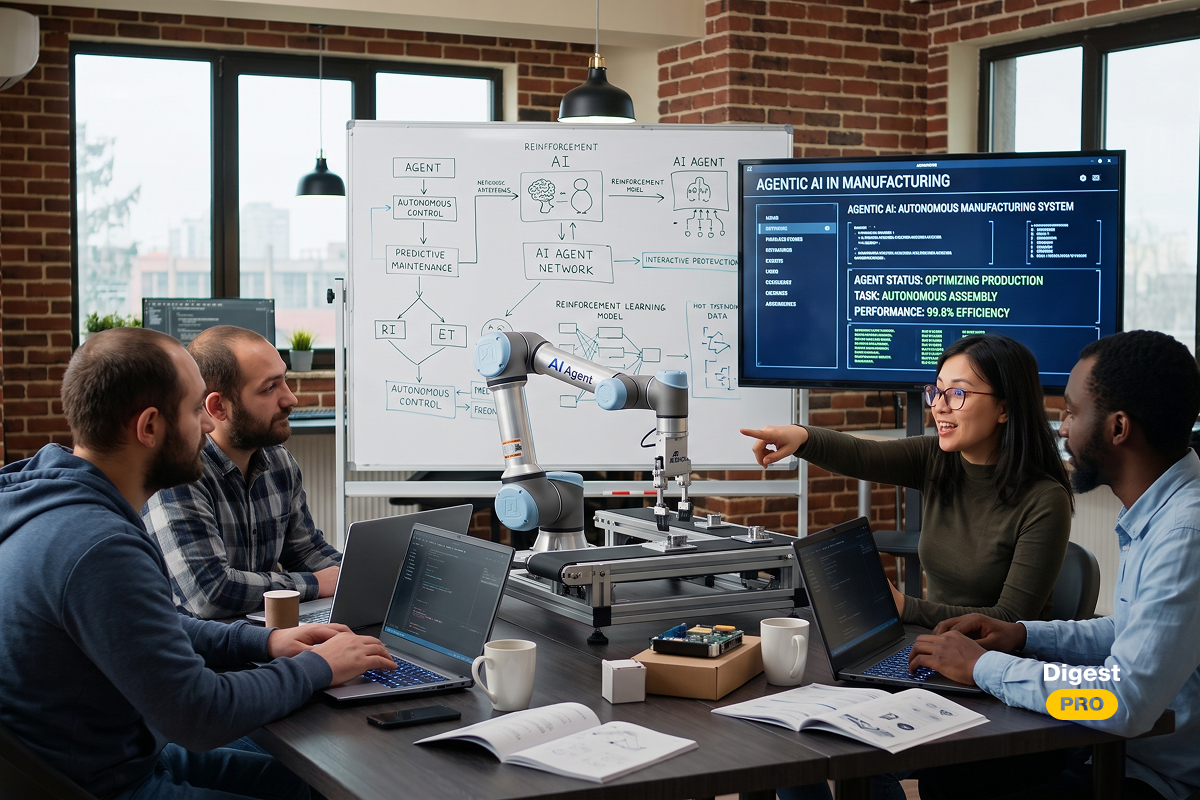
Gartner expects 40% of enterprise applications to embed task-specific AI agents by the end of 2026, up from under 5% in 2025 (Gartner, 2025).
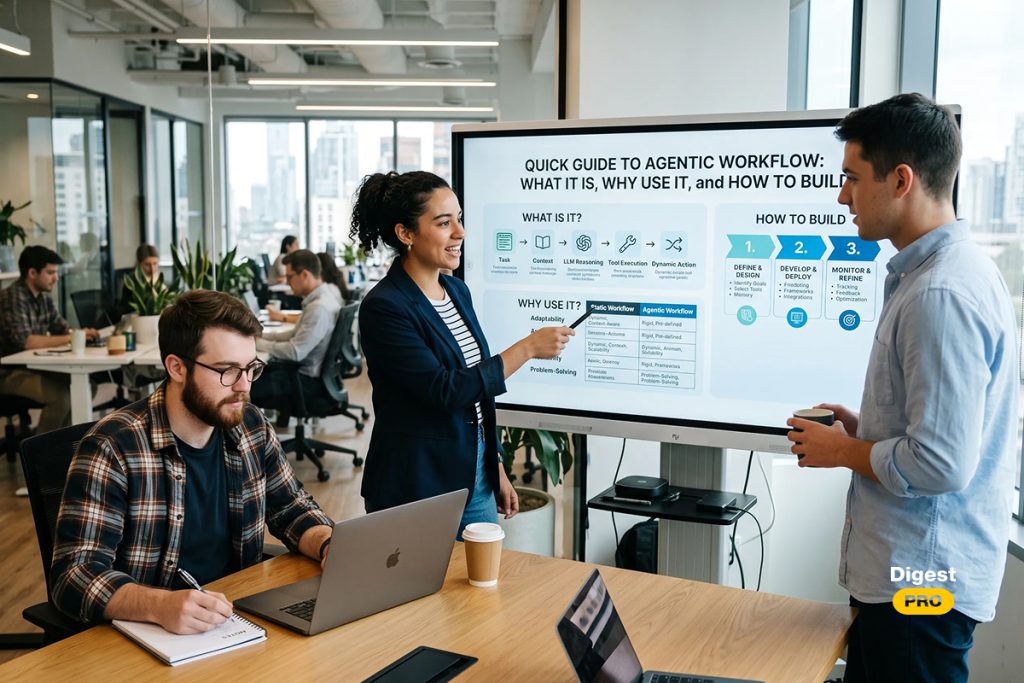
Its basis is one key concept: the agentic workflow. In theory, it breaks down the target task into actions, makes an agent develop and follow a series of actions, and adjusts the plan when something changes. Unlike a simple prompt-response, the procedure is active right after its first result is completed — experimenting with tools in use, analyzing outcomes, and starting the process all over again when one of the actions fails.
Although each system presented in this guide is based on the application of large language models, the model itself represents only one element of the AI agent stack; the entire orchestration defines whether the result can be put into practice. After finishing this guide, you will know how to scope a production-ready agentic workflow and avoid the failure modes that get most agentic AI projects canceled.
Follow Digest.Pro on LinkedIn for weekly breakdowns of how enterprise teams ship agentic workflows.
What Is an Agentic Workflow?
An agentic workflow is an automated or AI-based process in which an AI agent acts, plans, and modifies its actions in a series of steps until the desired outcome is achieved, with no human intervention. An agent uses the tools available to it during the process and makes decisions based on outputs received at each step of the process.
Agentic Workflow vs. Traditional Automation vs. a Single Agent
Traditional automation, a single AI agent, and an agentic workflow solve different problems. Confusing them is the fastest way to overbuild or underbuild a system.
|
Dimension |
Traditional automation (RPA/scripts) |
Single AI agent |
Agentic workflow |
|
Decision logic |
Fixed rules, no reasoning |
One model reasons over one turn. |
Reasoning repeats across steps, revised as it goes. |
|
Handles novel input |
No — breaks on exceptions |
Partially — no persistent plan |
Yes — replans around failures. |
|
Tool use |
Pre-wired, single-purpose |
Optional, ad hoc |
Structured, often multi-agent |
|
Memory |
None beyond stored variables |
Short-term memory, single session |
Short-term memory in-loop, long-term memory across runs |
|
Best fit |
Stable, high-volume, rule-based tasks |
Single-turn Q&A or drafting |
Multi-step, judgment-heavy processes |
Traditional automation is cheap and predictable, but it cannot adapt once the input changes shape. A single agent adapts within one turn but forgets everything once the session ends. An agentic AI workflow keeps a plan alive across many turns, uses short-term memory to track the current task, and calls on long-term memory to recall what worked in past runs.
What Are the Main Benefits of Agentic Workflows?
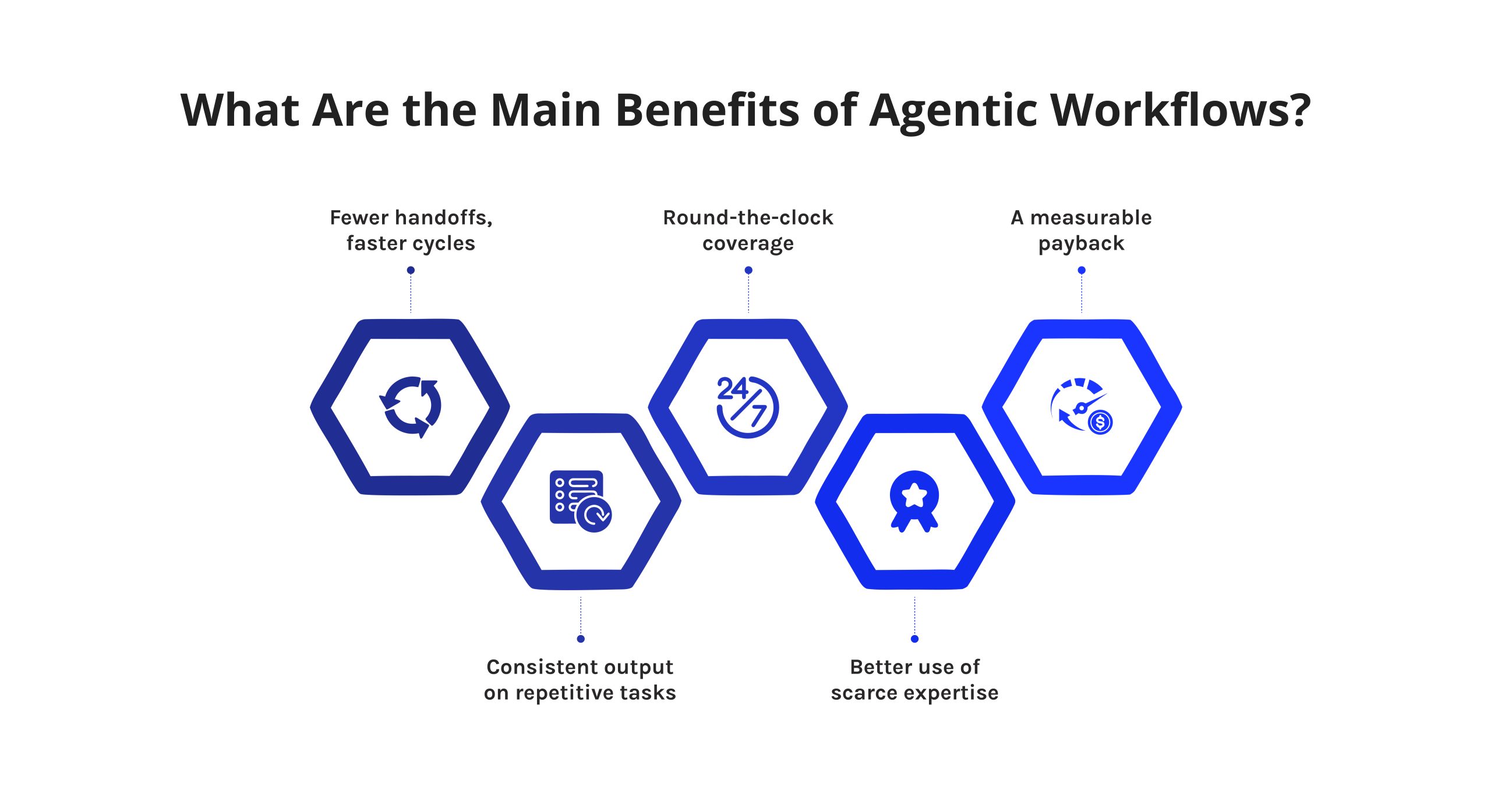
Agentic workflows compress work that used to move through a chain of manual handoffs into one continuous, monitored process. The benefits show up first in speed, then in consistency, then in scale.
- Fewer handoffs, faster cycles. Removing the wait between manual steps is where most early time savings in an AI agent workflow come from, especially on document- and data-heavy tasks.
- Consistent output on repetitive tasks. This kind of workflow applies the same policy check and format every time, cutting the variance that comes from different people handling similar repetitive tasks differently.
- Round-the-clock coverage. Klarna’s AI assistant handled 2.3 million conversations in its first month and cut resolution time from 11 minutes to under 2 minutes (Klarna, 2024).
- Better use of scarce expertise. Routing routine cases into one frees specialists for judgment calls that still need a human.
- A measurable payback. Enterprises running agentic workflows report high or very high time savings in most deployments, with narrow, well-scoped agents paying back fastest (CrewAI, 2026).
This pattern holds across the agentic AI workflows documented in this guide: the win comes from handling the routine share of the work without human intervention, not from removing humans from the process.
What Are the Core Patterns of Agentic Workflows?
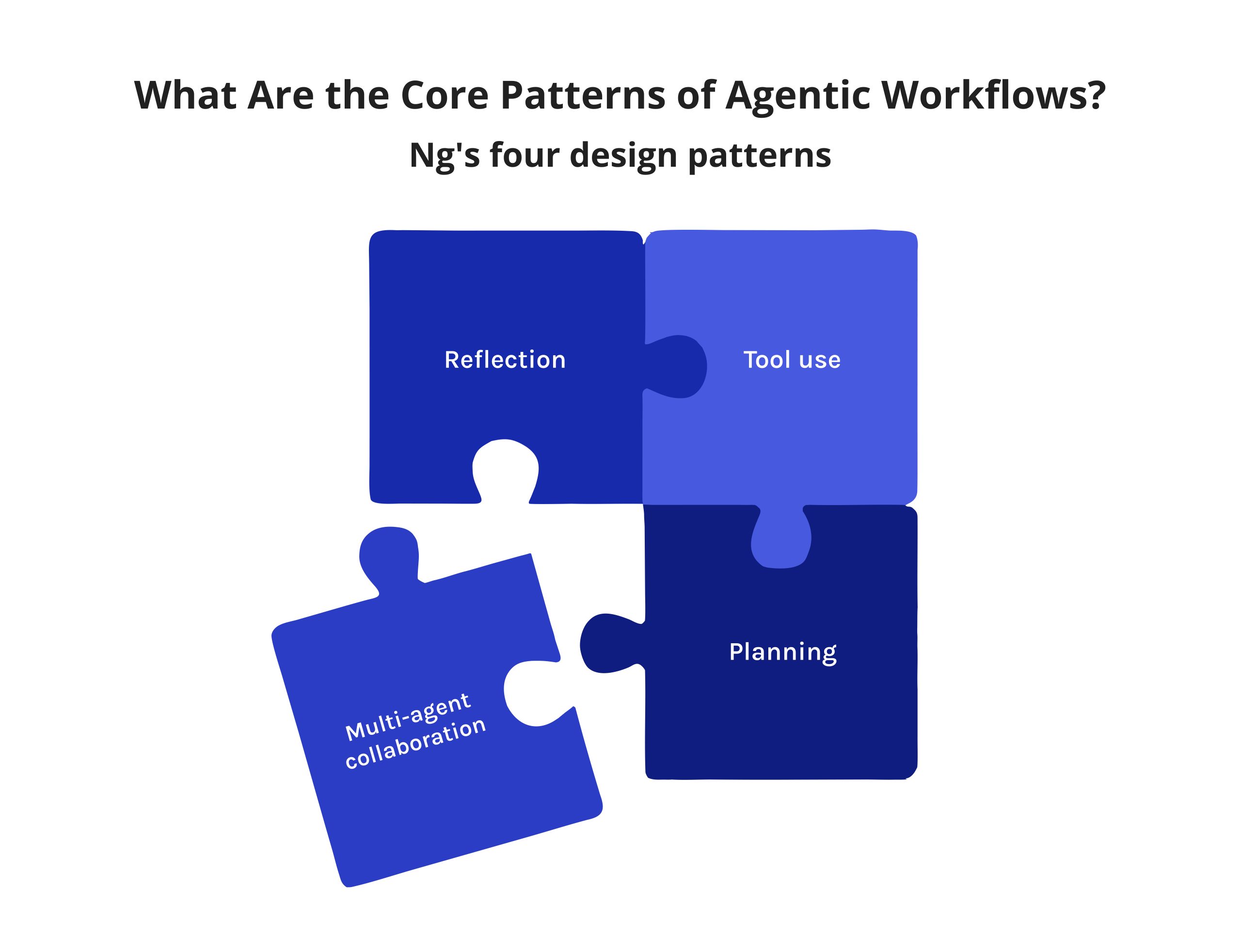
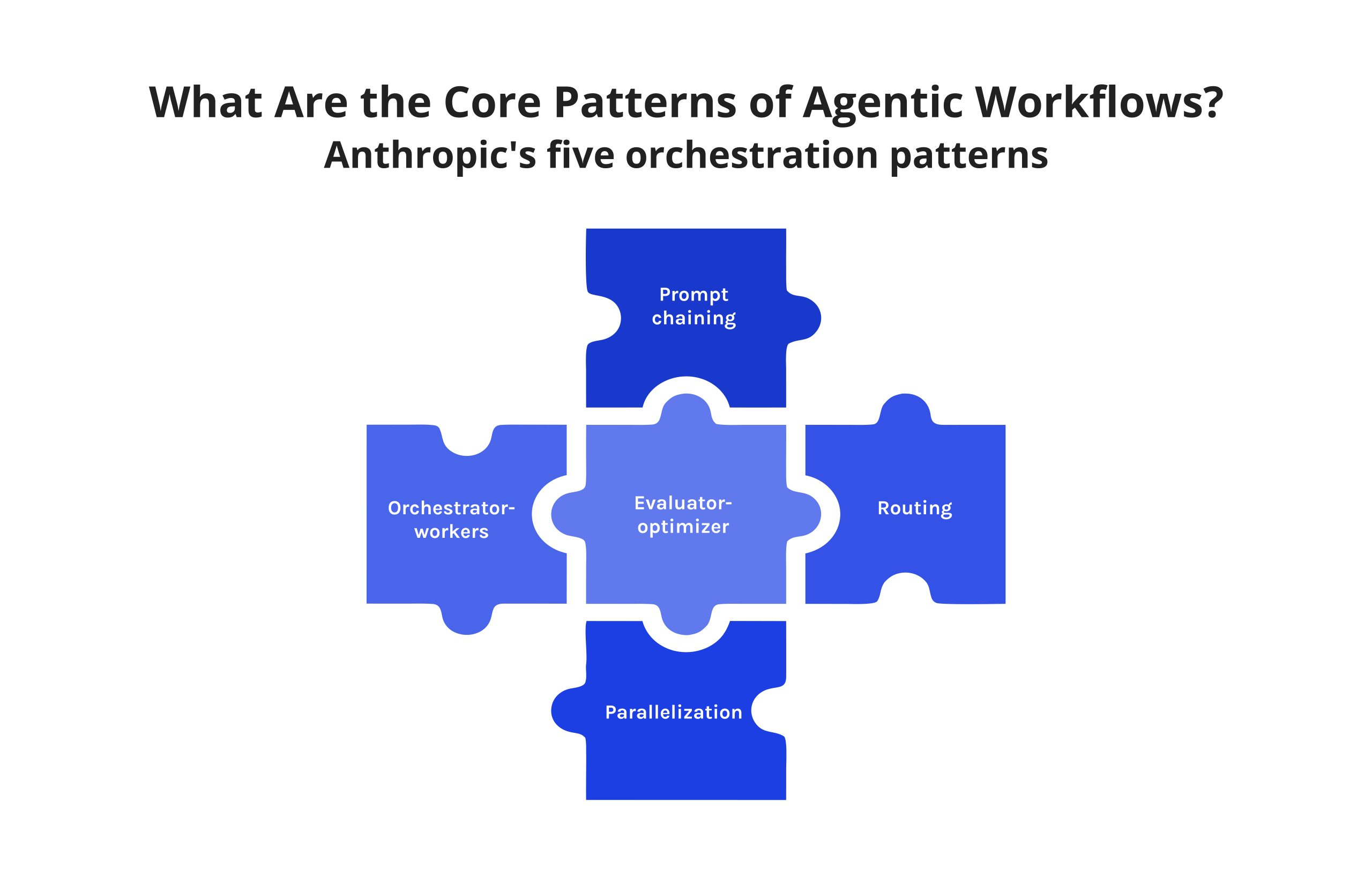
Two frameworks define how most agentic AI workflows get built today: Andrew Ng’s four agentic design patterns, and Anthropic’s five workflow orchestration patterns for combining large language models and tools. Together they form the agentic workflow framework most developers reach for first, and the AI agent workflow patterns below cover almost every production case.
Ng’s four design patterns (Augment Code, 2026):
- Reflection — the agent reviews and revises its own output, the way a writer edits a first draft.
- Tool use — the agent calls external functions or APIs instead of relying only on what the model already knows.
- Planning — the agent breaks a goal into an ordered list of steps before executing.
- Multi-agent collaboration — separate agents take separate roles, such as researcher and reviewer, and pass work to each other.
Anthropic’s five orchestration patterns (Anthropic, 2024):
- Prompt chaining — each step’s output feeds the next step’s input.
- Routing — an early step classifies the input and sends it down a specialized path.
- Parallelization — independent subtasks run at once and get combined.
- Orchestrator-workers — a central agent breaks the task apart and assigns pieces to worker agents.
- Evaluator-optimizer — one agent drafts, a second grades it, and requests revisions.
What Are Some Real-World Examples of Agentic Workflows in Action?
These are documented deployments with verified numbers, not projections — genuine ai workflow automation examples pulled from live agentic AI workflows, not vendor demos.
- Customer service at Klarna. Klarna’s OpenAI-built assistant handled 2.3 million conversations in its first month, two-thirds of all support chats, and cut resolution time from 11 minutes to under 2 (Klarna, 2024). The workflow pulls order data, checks policy, and either resolves the case or escalates it to a human.
- Investment banking at JPMorgan. JPMorganChase runs more than 450 AI use cases in production and gives over 200,000 employees daily access to its internal LLM Suite platform for drafting and, increasingly, agentic tasks against bank data (Emerj, 2026).
- Code review at Duolingo. Duolingo cut median code review time from three hours to one using an agentic coding pipeline built on GitHub Copilot (GitHub, 2026).
- Logistics at Move Your Machine. Dutch logistics company MYM implements EpicStaff’s orchestration platform to automate freight-quote generation, transforming a procedure that previously required several days into one that now takes just minutes (HYS Enterprise, 2026).
- HR support at IBM. AskHR contains 94% of routine HR queries before they reach a human agent, cutting ticket volume across a large workforce (IBM, 2026).
- Multi-agent operations at BNY. BNY runs Eliza, an internal platform with 125+ live use cases and 20,000 employees building agents across legal review, client research, and operations (OpenAI, 2026).
The team then selected a clear and straightforward workflow, established a benchmark metric, and calculated the same metric after the implementation. Company leaders approved this approach on a larger scale. A CrewAI survey conducted in 2026 revealed that 65 percent of companies already employ AI in operations, with 81 percent of those using agent AI at full scale (CrewAI, 2026).
What Are the Exact Steps to Build an Agentic Workflow From Scratch?
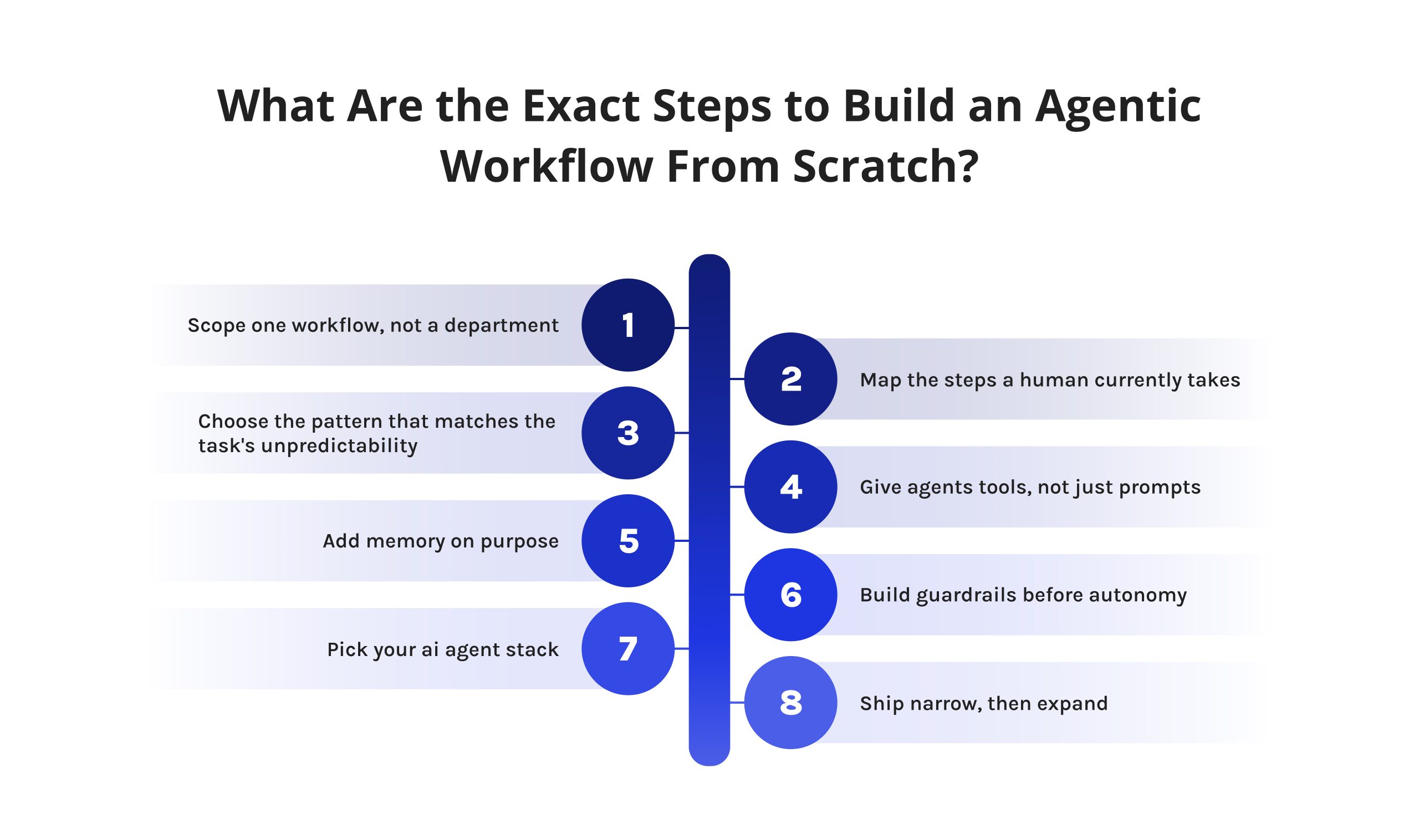
Developers searching for guidance on how to build an agentic workflow usually want the same sequence, whether the target task is customer support, code review, or portfolio reporting.
- Scope one workflow, not a department. Pick a task with a clear start, end, and a metric you already track.
- Map the steps a human currently takes. Write down what data gets pulled, what gets checked, and what triggers an escalation. This becomes the workflow’s skeleton.
- Choose the pattern that matches the task’s unpredictability. Fixed order calls for prompt chaining or routing; unpredictable subtasks call for orchestrator workers or multi-agent systems.
- Give agents tools, not just prompts. Connect each agent to the systems it needs — a ticketing API, a database, and a search index. The Model Context Protocol (MCP) is now the standard way to wire these connections.
- Add memory on purpose. Use short-term memory to hold the current task’s state, and long-term memory, usually a vector store with retrieval-augmented generation (RAG), to recall prior cases across sessions.
- Build guardrails before autonomy. Add an evaluator step, a confidence threshold, and a human-in-the-loop approval gate for high-stakes actions before letting any agent run unattended.
- Pick your AI agent stack. Code-first frameworks such as LangGraph and CrewAI suit engineering-led teams. Platforms built for shared ownership, such as the self-hosted, source-available EpicStaff, let operations teams edit the flow visually while engineers extend it with Python — useful when an audit team needs to review every decision an agent makes (EpicStaff, n.d.).
- Ship narrow, then expand. Launch on one workflow, instrument it, and add the next only once the first is stable.
Teams that follow this order avoid the most common failure: reaching for full autonomy before the underlying process is even mapped. Gartner expects more than 40% of agentic AI projects to be canceled by the end of 2027, mostly over unclear business value (Gartner, 2026) — almost always a scoping failure at step one, not a model failure. These eight steps turn abstract AI workflow automation examples into a workflow a team actually ships.
What Are the Primary Challenges of Implementing Agentic Workflows?
The gap between piloting agentic AI workflows and running them in production comes down to a handful of unglamorous problems — and not every agentic AI workflow vendor pitch survives contact with real governance requirements.
- Governance maturity lags adoption. 74% of companies plan to deploy agentic AI within two years, but only 21% currently have a mature governance model for autonomous agents (Deloitte, 2026).
- Data readiness, not model quality. Most enterprise data is not structured for an agent to act on, and teams underestimate the integration work needed before an agent can safely use real-time data.
- A skills gap on the team side. Only 18% of project managers report extensive, hands-on experience with AI tools, and nearly half report little to no experience (PMI, 2023).
- Security, not ROI, drives platform choice. Enterprise leaders rank security and governance as their top evaluation factor for agentic AI workflows, at 34%; time-to-value ranks last, at 2% (CrewAI, 2026).
These are process and governance problems, not model problems. They surface once an agent starts acting on real-time data instead of only describing it, which is exactly where AI-driven processes stop being theoretical and start carrying real operational risk.
Deterministic vs. Autonomous: Keeping Workflows Reliable
Every workflow with agency falls somewhere in the spectrum between total determinism and total autonomy, with the risk of losing its entire value being associated with the creation of a wider use of autonomous workflows.
Klarna’s experience demonstrates the balance the two sides have to achieve. After its assistant had handled 66% of support chats in 2024, the number of employees was cut from about 5,000 to 3,500. In May 2025, the CEO of the firm, Sebastian Siemiatkowski, told Bloomberg that the firm had over-automated workflows and started to hire back people to deliver better-quality support owing to difficulties that the AI faced with some delicate situations (Medium, 2026). Klarna had drawn the human handoff line in the wrong place, not chosen the wrong technology.
A reliable agentic workflow treats autonomy as a dial, not a switch:
- Deterministic steps for anything regulated, irreversible, or costly when wrong — payments above a threshold, legal commitments.
- Bounded autonomy for steps with a clear success check, where an agent can retry but a rule still defines “done.”
- Full autonomy only for low-stakes, reversible actions, once the workflow has earned a track record.
Set the dial per step, not per workflow. A single agentic AI workflow commonly mixes all three levels, tightening or loosening state and guardrails as trust in a given step grows — this is what separates durable AI-driven processes from a demo that only works on happy-path input.
Why You Can Trust Us
Digest.Pro’s editorial team evaluated agentic AI workflows and the surrounding AI agent stack directly, rather than summarizing vendor claims. Its approach takes into consideration four main criteria: operational maturity (from a prototype to a monitored production cycle), AI full-spectrum abilities (quality of reasoning, reliability in accessing diverse tools, and capabilities for reflective thinking and planning), observability and management (how readily a non-engineer would be able to analyze what the agent accomplished), and workflow orchestration costs (time and expenses consumed by an agent and tasks with increased numbers of agents and tasks).
We examined LangGraph, CrewAI, and the self-hosted EpicStaff platform in the same three-step support-ticket workflow: classify the ticket, resolve it at once or escalate it, and log the outcome. All the figures provided in this article refer to the relevant original sources, not to some secondary articles.
Conclusion
An agentic workflow turns a goal into a managed, multi-step process: plan, act, check, and adjust. It beats traditional automation on flexibility and beats a single AI agent on reliability across long, multi-step tasks. The teams seeing real returns did not start with the most autonomous system possible. They started with one narrow, well-instrumented agentic AI workflow, chose the right mix of deterministic and autonomous steps, and expanded only once it held up under real load. That discipline is what separates a workflow that ships from one that becomes a canceled pilot.
Want breakdowns like this one in your feed every week? Follow Digest.Pro on LinkedIn.
FAQs
An agentic workflow is a process involving multiple stages in which an AI agent is responsible for deriving a decision, acting, and modifying its previous activity in order to accomplish the goal without assistance during every stage. It operates even after the output has been produced, analyzing the results, using tools, and modifying the plan whenever it encounters a failure.
Traditional automation follows fixed rules and breaks when input does not match those rules. An agentic workflow reasons about each step, so it can adapt to new input, call tools, and revise its own plan mid-process.
Klarna’s customer-service assistant, JPMorgan’s LLM Suite, and Duolingo’s agentic code-review pipeline are documented examples running in production. Each automates a specific multi-step process rather than a single isolated task.
The four core patterns are reflection, tool use, planning, and multi-agent collaboration, named by Andrew Ng. Anthropic adds five orchestration patterns for combining them: prompt chaining, routing, parallelization, orchestrator-workers, and evaluator-optimizer.
Scope one well-defined process with a clear metric, map its current steps, then choose an orchestration pattern that matches how unpredictable those steps are. Platforms like EpicStaff let operations teams build and review the flow visually while engineers extend it with custom Python, shortening the path from prototype to a workflow an audit team can inspect.
Agentic workflows are reliable once autonomy is scoped step by step, with deterministic rules for high-stakes actions. Klarna’s 2025 walk-back, rehiring humans after over-automating support, shows what happens when every step gets equal autonomy regardless of stakes.
A regular LLM workflow runs a fixed, predefined sequence of model and tool calls, with code deciding what happens next. An agent decides what happens next itself, based on what it observes, so it can handle steps that cannot be predicted in advance.
ChatGPT’s core chat interface is not agentic AI on its own; it answers a prompt and stops. It becomes part of an agentic workflow once connected to tools, memory, and a loop that lets it plan, act, and check its own results across steps.
In a multi-agent system, AI agents operate in different capacities, like researcher, writer, and reviewer. The AI agents carry out separate parts of the same task, leading to effective results for complex assignments even if the coordination is an issue.
Four phases are characterized in almost all agentic AI models. These are perceiving (determining the present state), planning (establishing the order of actions), acting (using a tool for accomplishing the task), and reflecting (analyzing the result). The cycle continues till the process is completed or until it reaches any stopping point determined by a human.
References
Artificial Intelligence at JPMorgan Chase
https://github.com/customer-stories/duolingo
Why 2026 Is the Year of Agentic AI in Telecom
https://www.ibm.com/case-studies/ibm-askhr
https://crewai.com/blog/the-state-of-agentic-ai-in-2026
https://www.deloitte.com/us/en/about/press-room/state-of-ai-report-2026.html
https://www.pmi.org/about/press-media/2023/demand-increases-for-project-professionals-with-ai-skills