access vector in 31% of the breaches analyzed for Verizon’s 2026 Data Breach Investigations Report, which examined more than 22,000 confirmed breaches, and third parties were involved in 48% of them [1]. A cybersecurity risk assessment tells you which of those exposures matter most to your business and what to do about them.
The assessment turns a broad question, “are we secure?”, into a prioritized, documented view of exposure and treatment. It starts with scope and business context, identifies assets, threats, weaknesses and existing controls, then estimates likelihood and impact.
This guide sets out a practical, defensive method aligned with NIST SP 800-30, the NIST Cybersecurity Framework (CSF) 2.0 and ISO/IEC 27005. It is written for authorized review of your own organization, not for testing systems you do not own.
Key takeaways
- A cybersecurity risk assessment rates business-relevant threat scenarios by likelihood and impact, then records treatment decisions and residual risk.
- Fix scope, assumptions and exclusions before you score anything, including suppliers and cloud services.
- Treat a control as unproven until you have evidence it works. A policy is not proof.
- Use a transparent scale, record rationale and confidence for every rating, and avoid false precision.
- Give every material risk an owner, a deadline and a decision: mitigate, transfer, avoid or accept. Refresh after material change.
What is a cybersecurity risk assessment?
A cybersecurity risk assessment identifies the risks that cyber threats pose to your operations, assets and people, and estimates how likely and how damaging each one is. NIST SP 800-30, the U.S. federal guide for conducting risk assessments, frames its output as the information senior leaders need to decide how to respond to identified risks [2]. It organizes the work in four steps: prepare, conduct, communicate and maintain.
The audience is business leadership as much as the security team. Results should feed enterprise risk management: NIST IR 8286A Rev. 1 describes cybersecurity risk registers that roll up into an enterprise risk profile [3].
The assessment is not the same as three related activities:
- A security audit is an independent review of records and activities to judge whether controls are adequate, according to NIST’s glossary [4].
- A penetration test is a test in which assessors, working under specific constraints, try to defeat a system’s security features [5]. Run one only with written authorization. It produces evidence for an assessment, not the assessment itself.
- A compliance attestation states that you meet a defined set of requirements. It says little about which risks matter most to your business.
Set scope and identify critical assets
Scope decides what the assessment can and cannot tell you. SP 800-30 makes purpose, scope, assumptions and constraints the first preparation tasks, before any threat analysis [2]. Agree four boundaries in writing:
- Organizational: the business units, legal entities and sites in scope.
- System: the applications, infrastructure, cloud services and data stores in scope. For cloud, record which controls the provider runs and which you run; our overview of cloud computing trends explains why that line keeps moving.
- Third party: the suppliers, managed services and software providers in scope. Verizon found that breaches with third-party involvement rose 60% from the prior year’s dataset [1].
- Time: the period the assessment represents and when it expires.
Then identify what you are protecting. Start from business services, not servers. For each critical service, list the data it handles, the systems and suppliers it depends on, and the people who run it. The NIST Cybersecurity Framework 2.0 calls for inventories of hardware, software, services, data and supplier services, with assets prioritized by classification, criticality and mission impact [6].
Finally, document assumptions and exclusions. If a legacy plant network is out of scope, say so and say why. An unstated exclusion is how a “low risk” report misleads a board.
Identify threat scenarios and existing controls
A threat scenario links a threat source, an event, a weakness and a business impact in one sentence. Keep it at management level: “ransomware enters through an unpatched internet-facing system and halts order processing for five days.” Detailed attack paths add nothing to a business risk decision and should not circulate in a broad report.
Build scenarios from authorized, evidence-based sources:
- Your own incident, help desk and vulnerability management records.
- Threat intelligence from information-sharing forums, which CSF 2.0 lists as a risk assessment input [6].
- Data on exploited weaknesses. CISA says organizations should use its Known Exploited Vulnerabilities (KEV) catalog as an input to vulnerability management prioritization [7].
- Industry breach research, such as the Verizon DBIR, for attack patterns by sector [1].
- Supplier assurance reports and contract terms.
CISA’s SAFECOM guide, written for public safety communications organizations, follows the same order: document asset vulnerabilities, use threat intelligence, identify internal and external threats, then identify mission impacts [8].
Record controls and the evidence behind them
Next, list the controls that already reduce each scenario’s likelihood or impact, and the evidence for each one. This is where many assessments go wrong. A policy that requires multifactor authentication does not prove it is enforced on every account.
Grade evidence on three levels: documented (a policy exists), implemented (configuration verified) and effective (tested or measured in operation). Rate each control on the weakest evidence you hold. The gap is real: only 26% of critical vulnerabilities listed in CISA’s KEV catalog were fully remediated by organizations in Verizon’s 2026 dataset, with a median of 43 days to full resolution [1].
Estimate likelihood, impact and residual risk
SP 800-30 describes risk as typically a function of the likelihood of a threat event and the degree of harm it causes [2]. You can estimate it quantitatively (dollars and probabilities), qualitatively (levels from very low to very high) or semi-quantitatively (scores or bins that translate into levels) [2]. Pick one approach for the whole assessment so results stay comparable.
Illustrative scale (adapt the definitions to your business)
| Level | Likelihood in the next 12 months | Impact on a critical service |
|---|---|---|
| 1 Very low | Not expected, no known precedent in your sector | Negligible disruption |
| 2 Low | Possible, rare precedent | Minor disruption, contained within a day |
| 3 Moderate | Plausible, seen in your sector | Outage of days or reportable data loss |
| 4 High | Likely, seen at comparable organizations recently | Extended outage, material financial or legal harm |
| 5 Very high | Expected or already occurring | Loss of a core service or a safety risk |
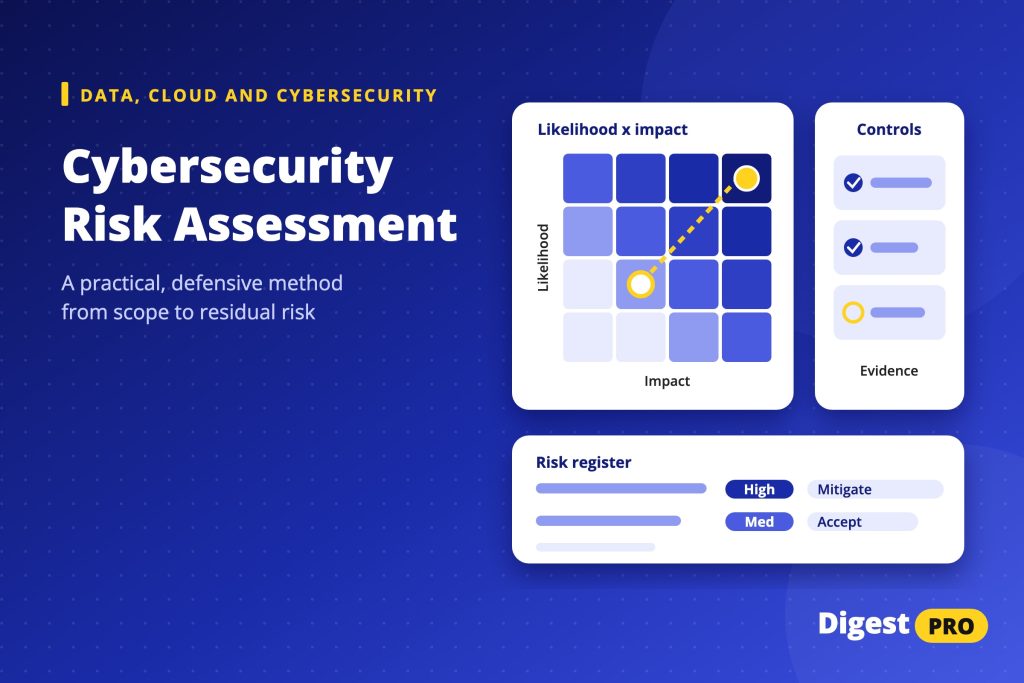
Score each scenario twice. Inherent risk is the rating before controls. Residual risk reflects only the controls you can prove work. CSF 2.0 asks organizations to use threats, vulnerabilities, likelihoods and impacts to understand inherent risk and inform response priorities [6]. IR 8286A gives a common example of calculating exposure as likelihood multiplied by impact, then comparing it with risk tolerance [3].
Express impact in business terms: hours of outage on a named service, records exposed, regulatory or contractual consequences, safety and reputation. If finance can put a cost range on an outage day, use it.
Avoid false precision. SP 800-30 warns that rigor drops when subjective judgments are buried in numbers or when values carry significant uncertainty [2]. For each rating, record the rationale, your confidence (high, medium or low) and the data gaps that would change the score. A “4” with a written reason beats a “3.72” that nobody can explain.
Prioritize treatment and assign owners
Compare residual risk with the tolerance leadership has set. IR 8286A describes four responses [3]:
- Accept when exposure is within tolerance. Record who accepted it and until when.
- Mitigate with controls that reduce likelihood or impact, tracked with key risk indicators (KRIs).
- Transfer, or share, part of the risk, for example through cyber insurance or an outside processor for sensitive transactions.
- Avoid a risk that cannot be treated cost-effectively, which may require significant redesign of the system or service. Avoidance is not the same as ignoring a risk.
If you run an ISO/IEC 27001 management system, ISO/IEC 27005:2022 provides guidance on information security risk assessment and treatment to help meet 27001’s risk requirements, and applies to organizations of any type, size or sector [9].
Every treated risk needs an accountable owner from the business, not only IT, plus a deadline and the evidence that will prove completion. Capture it all in a register.
Sample risk register (illustrative entries, not real ratings)
| Asset or service | Scenario | Controls and evidence | L | I | Residual | Treatment | Owner, due |
|---|---|---|---|---|---|---|---|
| Online ordering | Ransomware halts order processing for 5+ days | Offline backups, restore tested quarterly; endpoint coverage unverified | 3 | 4 | High | Mitigate: verify endpoint coverage, isolate backups | COO, Q1 |
| Customer data in a SaaS CRM | Supplier compromise exposes customer records | Contract security clauses; supplier assurance report reviewed | 2 | 4 | Medium | Mitigate and transfer: enforce single sign-on, review insurance terms | Sales ops lead, Q2 |
| Payroll | Email fraud redirects salary payments | Callback policy, never tested | 3 | 3 | Medium | Mitigate: test callbacks, alert on bank detail changes | CFO, Q1 |
In your working version, add columns for inherent risk, confidence and next review date.
Keep your cybersecurity risk assessment current
An assessment is a snapshot. SP 800-30’s fourth step calls for ongoing monitoring of risk factors and updating the assessment with the results [2]. Trigger a refresh when any of these change:
- Systems: new platforms, major releases or retirements. Legacy replacement programs often add exposure, one of the recurring digital transformation challenges.
- Suppliers: new critical providers, contract changes or a supplier incident.
- Threats: newly exploited weaknesses that affect your assets.
- Controls: failures found in testing or audits.
- Business: acquisitions, new markets or new regulations.
- Incidents: every material incident and near miss.
Connect findings to governance. CSF 2.0 places cybersecurity risk management strategy under its Govern function and treats improvements identified from evaluations, security tests, exercises and day-to-day operations as Identify outcomes [6]. Report top risks, treatment status and overdue actions to leadership on a fixed rhythm.
Use SP 800-30 and CSF 2.0 as aids, not as proof of compliance. CSF 2.0 states that its outcomes are not a checklist of actions [6], and SP 800-30 was written for U.S. federal information systems [2], so adapt its scales and terms to your organization.
Summary
A cybersecurity risk assessment is a decision tool. Scope it explicitly, build management-level scenarios from authorized evidence, rate controls on proof rather than policy, and estimate likelihood and impact on a transparent scale with stated confidence. Then give every material risk an owner, a treatment and a deadline, and refresh after material change.
Your next step: pick your three most critical business services, write one scenario for each, and fill in the register fields above with the evidence you hold today.
FAQs
How often should a cybersecurity risk assessment be updated?
There is no single correct interval. Set a regular review cycle based on how critical and changeable your environment is, then add event-driven updates after major system, supplier, threat, control or business changes and after material incidents. CISA’s SAFECOM guide recommends assessing regularly based on operational needs, which builds a baseline you can compare against over time [8].
What is the difference between a risk assessment and a security audit?
A risk assessment estimates which threat scenarios could harm the business, how likely and severe they are, and how to treat them. A security audit independently examines records and activities to judge whether controls are adequate and comply with policy [4]. Audits supply evidence about controls; assessments use that evidence to prioritize risk. Many organizations run both on separate cycles.
What should a cyber risk register include?
At minimum: the asset or business service, the threat scenario, existing controls and their evidence, likelihood, impact, inherent risk, residual risk, the treatment decision, the owner and the due date. Inherent risk is the rating before controls. Residual risk is what remains once you count only controls you can prove work. Add confidence and the next review date.
References
- 2026 Data Breach Investigations Report: Executive Summary. Verizon, 2026. Accessed 28 Oct 2026.
- NIST SP 800-30 Rev. 1, Guide for Conducting Risk Assessments. National Institute of Standards and Technology, September 2012. Accessed 28 Oct 2026.
- NIST IR 8286A Rev. 1, Identifying and Estimating Cybersecurity Risk for Enterprise Risk Management. National Institute of Standards and Technology, December 2025. Accessed 28 Oct 2026.
- Security audit (glossary entry). NIST Computer Security Resource Center, undated. Accessed 28 Oct 2026.
- Penetration testing (glossary entry). NIST Computer Security Resource Center, undated. Accessed 28 Oct 2026.
- The NIST Cybersecurity Framework (CSF) 2.0, NIST CSWP 29. National Institute of Standards and Technology, February 26, 2024. Accessed 28 Oct 2026.
- Known Exploited Vulnerabilities Catalog. Cybersecurity and Infrastructure Security Agency, continuously updated. Accessed 28 Oct 2026.
- Guide to Getting Started with a Cybersecurity Risk Assessment. CISA SAFECOM, 2022 (file posted September 2024). Accessed 28 Oct 2026.
- ISO/IEC 27005:2022 Information security, cybersecurity and privacy protection: Guidance on managing information security risks. ISO/IEC (IEC Webstore listing), October 25, 2022. Accessed 28 Oct 2026.