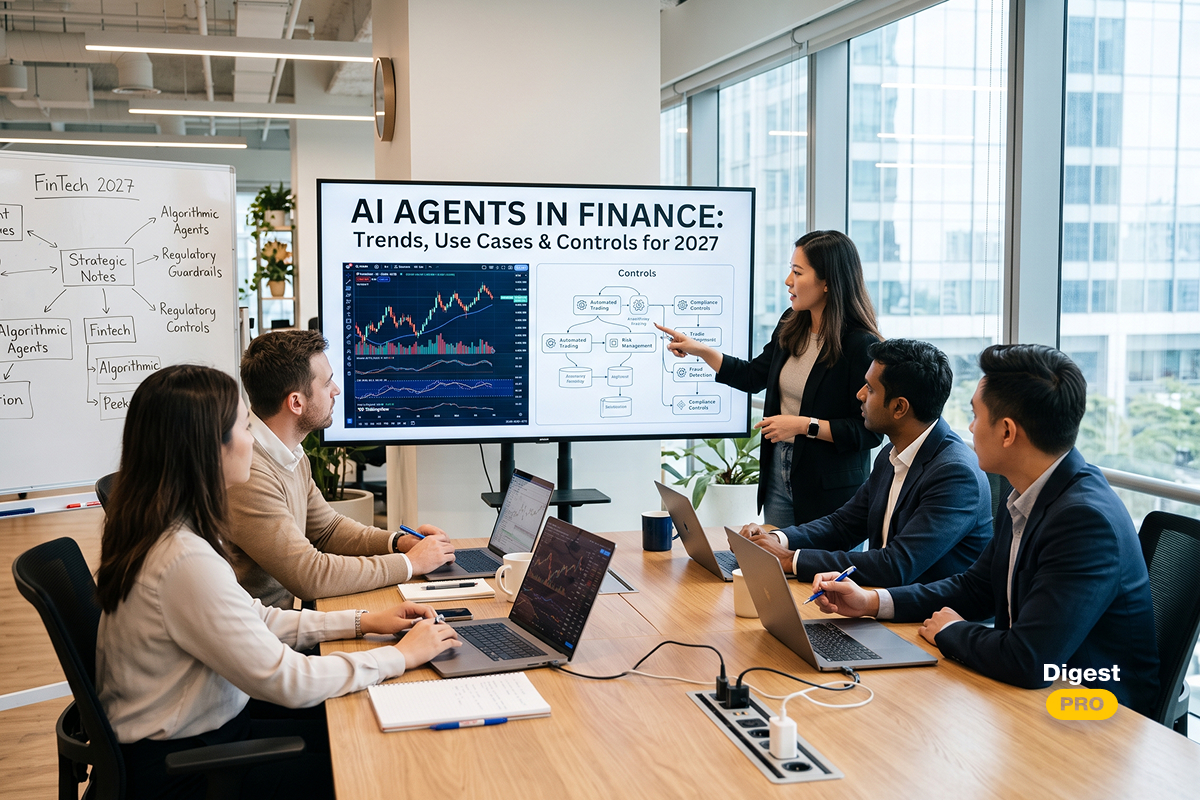
AI fintech startups now shape how banks lend, detect fraud, and manage cash. Global fintech funding reached $28.6 billion in the first half of 2026, up 22.7% year over year, according to Crunchbase News. Deal count fell 25.7% in the same period. Investors are writing bigger checks to fewer companies, and AI sits at the center of those bets.
This guide profiles eight fintech AI startups across fraud, lending, compliance, disputes, consumer finance, and treasury. Every profile uses verified funding data and names the AI use case. It also shows how to judge each one as a vendor, partner, or investment.
What Are AI Fintech Startups?
AI fintech startups are young, venture-backed financial technology companies. They build their core product on machine learning, large language models, or AI agents. Their customers include banks, lenders, merchants, finance teams, and consumers. Industry coverage also calls them AI-powered fintech startups or AI-driven fintech startups.
AI-native vs. AI-enabled
AI-native fintech startups design the product around a model from day one. Remove the AI, and the product stops working. AI-enabled fintechs add AI features to an existing product, such as a chatbot inside a banking app. The distinction affects defensibility and cost structure, so buyers should ask which type they are evaluating.
Where AI is used
Fintech AI startups apply models in four areas.
- Fraud and identity: Models score identity risk and flag suspicious behavior in real time.
- Lending: Models assess credit risk with more data than a traditional score.
- Compliance: Agents screen sanctions, adverse media and payment alerts for AML and KYC teams.
- Finance operations: Platforms forecast cash, categorize spending and automate treasury tasks.
AI Fintech Market Snapshot for 2026
Funding momentum
Capital is concentrating in fewer, larger deals. Investors favor leading fintech companies with proven revenue. Meanwhile, new fintech innovations compete for fewer deals. Crunchbase counted 1,605 fintech deals in the first half of 2026, down 25.7% from the first half of 2025. AI-first startups took 37% of fintech venture capital, compared with 72% in broader tech, according to the F-Prime State of Fintech 2026 report. The gap shows that financial startups adopt AI more slowly than other tech sectors. Forbes attributes part of that delay to high-stakes transactions and strict regulation.
AI adoption is moving from pilots to production
Funding is only part of the story. Financial institutions are also moving AI from experiments into production, although maturity varies widely.
According to the Cambridge Centre for Alternative Finance (CCAF), which surveyed 628 organizations across 151 jurisdictions:
- 81% of financial services firms report adopting AI at some level.
- 40% report advanced adoption at the “Scaling” or “Transforming” stage.
- 14% describe AI as transformational to their strategy.
KPMG’s Global AI Pulse survey points in the same direction:
- 27% of financial services organizations are scaling AI enterprise-wide.
- 59% already report meaningful business value.
- AI is increasingly embedded in fraud detection, underwriting, credit risk, and customer operations.
Bryan Zhang, Executive Director of the Cambridge Centre for Alternative Finance, said:
“The scale and pace of AI adoption in financial services is genuinely remarkable – 4 in 5 firms are already deploying AI at some level, agentic systems have crossed into the mainstream and real productivity and profitability gains are being felt across the industry, although unevenly.”
Market size
Estimates of the AI-in-fintech market vary widely. For 2025, Reanin reports $18.9 billion and IMARC reports $21.2 billion. Mordor Intelligence, as summarized by Lambda Finance, reports about $30 billion. Each firm defines scope differently, so treat the figures as a range. IMARC projects $100.5 billion by 2034 at an 18.34% CAGR.
How We Selected These Startups
We defined an AI fintech startup as a private, venture-backed company where AI drives the core product. We excluded listed and acquired fintech companies. Socure and Zest AI are more than a decade old, but both remain private and venture-backed.
We scored each company on five criteria:
- AI centrality: The product depends on machine learning or AI agents.
- Funding transparency: Rounds, investors, and totals appear in public sources.
- Customer proof: The company names customers or reports adoption.
- Regulatory readiness: The product supports audit, explainability, or compliance workflows.
- Scalability: The company shows growth in customers, revenue, or funding.
AI Fintech Startups Compared
This table compares the top AI fintech startups by use case and stage.
| Startup | Use case | Stage | AI approach |
| Taktile | Decision automation | Series C (2026) | AI agents, rules and human review |
| Socure | Identity and fraud | Growth round (2026) | Identity models and fraud agents |
| Zest AI | Credit underwriting | Growth (2024) | Machine learning credit models |
| Hawk | AML and fraud | Series C (2025) | Machine learning, generative AI |
| Justt | Chargebacks | Series C (2024) | AI-built dispute responses |
| Monarch | Personal finance | Series B (2025) | AI assistant and categorization |
| Trovata | Treasury | Series B extension (2025) | AI-powered cash visibility |
| Diligent AI | KYC and AML | Seed (2026) | Autonomous investigation agents |
8 Best AI Fintech Startups to Watch
The best AI-driven fintech startups below lead their niches. Each profile lists verified funding and the AI use case.
1. Taktile – agentic decisioning

Taktile sells a decision platform where banks and insurers combine AI agents, rules and human review. It covers underwriting, onboarding, KYC and AML, fraud investigation and claims.
- Industry: Decision automation / lending and insurance
- Location: New York, USA
- Founded: 2020
- Series: Series C (June 2026)
- Funding Rounds: 3 (Series A to C)
- Money Raised: $184.1M (Seedtable)
- Why watch in 2026: Its $110M Series C, led by Goldman Sachs Alternatives, funds deeper AI integration in credit risk and underwriting.
2. Socure – identity verification and fraud
Socure’s RiskOS platform verifies identities and fights fraud for banks, fintechs and government agencies. The Fravity acquisition adds more than 70 AI agents for fraud investigation.
- Industry: Identity verification / fraud prevention
- Location: Incline Village, Nevada, USA
- Founded: 2012
- Series: Growth round (August 2026)
- Funding Rounds: 3 documented (Series D and E in 2021, growth round in 2026)
- Money Raised: $742M+ (Beinsure)
- Why watch in 2026: A $156M raise at a $5.2B valuation, with company-reported ARR of $364M, up 63%.
3. Zest AI – credit underwriting
Zest AI uses machine learning to improve credit underwriting for banks and credit unions. It also sells Zest Protect, a fraud detection product launched in August 2024.
- Industry: AI lending / credit underwriting
- Location: Burbank, California, USA
- Founded: 2009
- Series: Growth round (December 2024)
- Funding Rounds: 7
- Money Raised: $282M (Seedtable)
- Why watch in 2026: Insight Partners invested $200M, and the company plans M&A in underwriting, fraud protection, marketing and data intelligence.
4. Hawk – AML and transaction monitoring

Hawk replaces fixed rules with machine learning for anti-money laundering and fraud detection. The company says it catches more financial crime and produces fewer false alarms.
- Industry: RegTech / AML and fraud prevention
- Location: Munich, Germany
- Founded: 2018
- Series: Series C (April 2025)
- Funding Rounds: 4
- Money Raised: €76M (Tech.eu)
- Why watch in 2026: A €52M Series C led by One Peak backs generative AI and machine learning in anti-financial-crime operations, and Finextra reports 80+ customers.
5. Justt – chargeback automation

Justt uses AI to fight illegitimate chargebacks for online merchants. It gathers evidence, builds a response for each merchant and submits it to card networks.
- Industry: Payments / chargeback management
- Location: Tel Aviv, Israel
- Founded: 2020
- Series: Series C (December 2024)
- Funding Rounds: 4
- Money Raised: $100M (company-reported)
- Why watch in 2026: Revenue tripled in 2023 and more than doubled in 2024, per the company, which targets profitability by 2027.
6. Monarch – AI-assisted personal finance

Monarch is a personal finance app that links accounts, tracks net worth and budgets, and offers an AI assistant. The assistant explains changes in spending and cash flow.
- Industry: Consumer fintech / personal finance
- Location: San Francisco, California, USA
- Founded: 2018
- Series: Series B (May 2025)
- Funding Rounds: 4
- Money Raised: About $94.8M (Sacra)
- Why watch in 2026: The app passed 500,000 paying subscribers by March 2026, and the Series B valued it at $850M.
7. Trovata – treasury and finance operations
Trovata connects bank, capital-markets and accounting data into one treasury platform with AI-powered cash visibility. Its ATOM acquisition added a full treasury management system.
- Industry: Treasury / finance operations
- Location: Solana Beach, California, USA (per CB Insights)
- Founded: 2016
- Series: Series B extension (July 2025)
- Funding Rounds: Multiple; the latest is a $9M extension
- Money Raised: $80M (company-reported, per Pulse 2.0)
- Why watch in 2026: State Street and PNC joined as investors, alongside J.P. Morgan, Wells Fargo and Mastercard.
8. Diligent AI – AI due diligence

Diligent AI builds autonomous agents for KYC and AML work. They assess small-business risk, screen adverse media and resolve sanctions and payment-screening alerts.
- Industry: RegTech / compliance automation
- Location: London, UK
- Founded: 2023 (per StartUs Insights)
- Series: Seed (March 2026)
- Funding Rounds: 1 disclosed (seed)
- Money Raised: $3M (company-reported)
- Why watch in 2026: A $2.5M seed led by Speedinvest, with customers such as Flywire, Alma, Teya and Tamara, per Tech Funding News.
Risks and Regulation
Regulatory risks for AI fintech startups fall into two groups: explainability in lending and AI-enabled fraud.
Explainability and bias in AI lending
Lenders must explain credit decisions and meet fair-lending rules. The EU AI Act classes credit assessment as high-risk. Regulation (EU) 2026/1744 moved those obligations from 2 August 2026 to 2 December 2027, according to the National Law Review. AI disclosure duties still apply from 2 August 2026.
Justin Overdorff, partner at Lightspeed Venture Partners, wrote in Crunchbase News: “The compliance and governance layer becomes just as important as the AI itself.”
The AI-fraud arms race
Fraudsters use the same models as defenders. Deloitte’s Center for Financial Services projects that generative AI could push U.S. fraud losses to $40 billion by 2027, up from $12.3 billion in 2023, a 32% annual growth rate (Deloitte). Socure reports an 8,000% rise in AI-driven fraud across its network, a company-reported figure.
Conclusion
AI-powered fintech startups are moving from pilots to core infrastructure. The eight startups above show the same pattern across decisioning, identity, lending, compliance, disputes, consumers, and treasury.
Executives should match the startup to a specific use case and verify every claim. Additionally, they should plan for regulation, because explainability will separate durable vendors from short-lived ones.
FAQ
An AI fintech startup is a young financial technology company that builds its core product on machine learning or AI agents. It sells to banks, lenders, merchants, finance teams, or consumers. Examples include Taktile, Socure, and Zest AI.
AI-native companies build the product around AI, while AI-enabled companies add AI features to an existing product. An AI-native product fails without its model. An AI-enabled product keeps working without AI.
Taktile, Socure and Justt show the strongest reported momentum in this list. Taktile raised a $110M Series C in June 2026. Socure reports 63% ARR growth, and Justt reports more than doubled revenue in 2024. Both growth figures come from the companies.
Estimates for 2025 range from $18.9 billion to about $30 billion. Reanin, IMARC and Mordor Intelligence define scope differently. IMARC projects $100.5 billion by 2034.
AI in lending scores credit risk with machine learning and automates underwriting decisions. Zest AI builds credit models for banks and credit unions. Taktile lets lenders combine AI agents, rules and human review.
AI fraud detection uses machine learning to flag suspicious activity that fixed rules miss. Socure verifies identities and scores fraud risk. Hawk applies machine learning to anti-money laundering monitoring. The goal is fewer false alarms and faster reviews.
Yes, AI fintech products fall under financial regulation, and the EU AI Act adds AI-specific rules. Credit assessment is a high-risk use. Its obligations now apply from 2 December 2027, while AI disclosure duties apply from 2 August 2026.
Banks partner through pilots, API integrations and strategic investment. For example, State Street and PNC invested in Trovata, and Goldman Sachs Alternatives led Taktile’s Series C. Banks also run vendor due diligence before any rollout.
The biggest risks are biased or unexplainable decisions, AI-enabled fraud and vendor instability. Deloitte projects U.S. fraud losses could reach $40 billion by 2027. Early-stage vendors also carry funding and continuity risk.
References
Abdirahman, A. (2026, February 24). F-Prime’s 2026 State of Fintech: IPOs, stablecoins, AI and more. The Financial Revolutionist. https://thefr.com/news/f-primes-2026-state-of-fintech-ipos-stablecoins-ai-and-more
Beinsure. (2026). Socure raises $156 mn at $5.2 bn valuation. https://beinsure.com/news/socure-raises-156-mn-at-5-2-bn-valuation/
Crunchbase News. (2026). Fintech funding surges 23% in H1 2026 as investors concentrate their bets on AI and financial infrastructure. https://news.crunchbase.com/?p=93826
Faridi, O. (2026, July 23). Fintech funding holds strong in Q2 2026 as valuations hit new peaks. Crowdfund Insider. https://www.crowdfundinsider.com/2026/07/293268-fintech-funding-holds-strong-in-q2-2026-as-valuations-hit-new-peaks/
Finextra. (2025). Hawk raises $56M for AI-powered fraud prevention. https://www.finextra.com/newsarticle/45792/hawk-raises-56m-for-ai-powered-fraud-prevention
Fintech Futures. (2024, December 23). Chargeback fintech Justt lands $30m Series C led by Zeev Ventures. https://www.fintechfutures.com/venture-capital-funding/chargeback-fintech-justt-lands-30m-series-c-led-by-zeev-ventures
Fintech Futures. (2024, December 19). Zest AI lands $200m growth investment, eyes “high impact M&A opportunities”. https://www.fintechfutures.com/ai-in-fintech/zest-ai-lands-200m-growth-investment-eyes-high-impact-m-a-opportunities-
Forbes. (2026). The 50 hottest fintech startups in 2026. https://www.forbes.com.au/?p=177861
Gibson Dunn. (2026). EU AI Act omnibus agreement: Postponed high-risk deadlines and other key changes. https://www.gibsondunn.com/eu-ai-act-omnibus-agreement-postponed-high-risk-deadlines-and-other-key-changes/
IMARC Group. (2026). AI in fintech market size, share, trends and forecast, 2026-2034. https://www.imarcgroup.com/ai-in-fintech-market
Lalchand, S., Srinivas, V., Maggiore, B., & Henderson, J. (2024, May 29). Generative AI is expected to magnify the risk of deepfakes and other fraud in banking. Deloitte Center for Financial Services. https://www.deloitte.com/us/en/insights/industry/financial-services/deepfake-banking-fraud-risk-on-the-rise.html
Lambda Finance. (2026). AI fintech market size. https://www.lambdafin.com/articles/ai-fintech-market-size
National Law Review. (2026). EU Digital Omnibus on AI enters into force. https://natlawreview.com/article/eu-digital-omnibus-ai-enters-force
Pulse 2.0. (2025, July 29). Trovata: $9 million raised and ATOM acquired. https://pulse2.com/trovata-9-million-raised-and-atom-acquired/amp/
Reanin. (2026). Artificial intelligence (AI) in fintech market size and share analysis, 2025-2032. https://www.reanin.com/reports/artificial-intelligence-in-fintech-market
Sacra. (2026). Monarch Money. https://sacra.com/c/monarch-money/
Seedtable. (n.d.). Taktile. https://seedtable.com/companies/taktile
Seedtable. (n.d.). Zest AI. https://seedtable.com/startups/Zest_AI-9944YG3
StartUs Insights. (2025, September 15). 10 top fintech startups and companies to watch in 2026. https://www.startus-insights.com/innovators-guide/top-fintech-startups/
Tech Funding News. (2026). Can AI save overwhelmed compliance teams? Diligent AI raises $2.5M from Speedinvest. https://techfundingnews.com/can-ai-save-overwhelmed-compliance-teams-diligent-ai-raises-2-5m-from-speedinvest-to-try/
Tech.eu. (n.d.). Hawk funding profile. https://funding.tech.eu/companies/A1409F8B-C4AA-4910-BF49-2823F329A96E
TechCrunch. (2021, November 16). Justt comes out of stealth with $70M in funding to help online merchants fight false chargebacks with AI. https://techcrunch.com/2021/11/16/justt-comes-out-of-stealth-with-70m-in-funding-to-help-online-merchants-fight-false-chargebacks-with-ai