The project management trends for 2027 all respond to one fact: complexity is now the norm. According to PMI’s Pulse of the Profession 2026, 97% of project professionals managed at least one complex project in the past year, and more than half of all projects now count as complex. The cost is visible. Nearly a third of complex projects fail to deliver their full intended benefits, more than twice the rate PMI reports for projects overall. That changes what good project management looks like. Below are 10 trends shaping the profession in 2027, from AI agents and hybrid delivery to the PMO’s new role as an execution hub, each backed by current research.
“Strategy isn’t delivered in the boardroom; it’s delivered through projects. ” Pierre Le Manh, President & CEO, PMI
Executive Summary
Most current trends in project management trace back to the same root cause. Here is the short version:
- Complexity, not methodology, is the defining challenge for project teams in 2027.
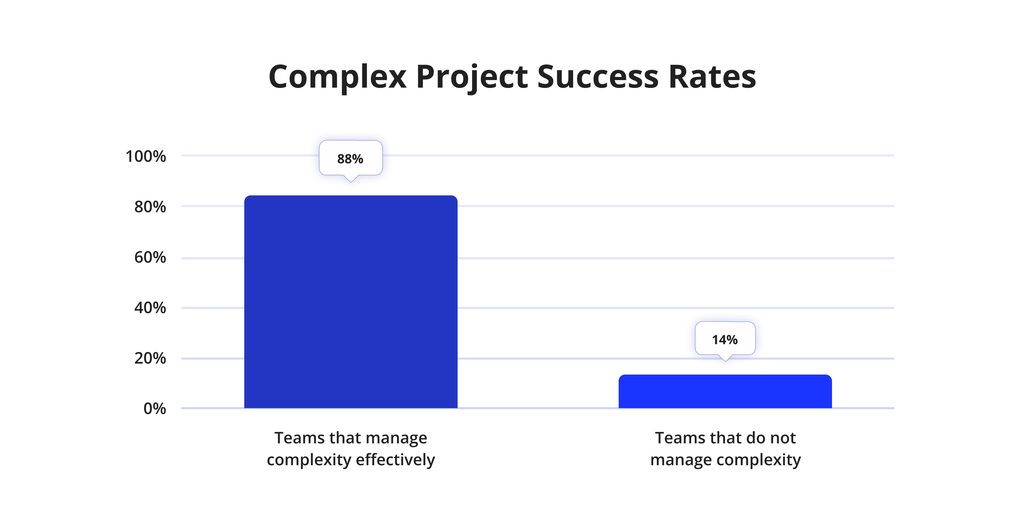
- Teams that navigate complexity well succeed 88% of the time, versus 14% for those that don’t (PMI, 2026).
- The PMO becomes an execution hub that governs trade-offs and dependencies across projects.
- AI moves from writing status reports to agents that monitor, forecast, and flag risks.
- Scenario planning and shared-resource management separate high performers from the rest.
What Changed in 2026
The biggest shift in 2026 was the recognition that complexity is the operating environment, not an exception. PMI’s research showed complex projects are now the majority, CEOs tied operating-model change to AI, and AI features in project tools moved from text generation toward agents that act on project data.
Most lists of project management trends for 2026 lead with AI and remote work. The data told a different story. PMI’s Pulse of the Profession 2026, published in May 2026, found that 81% of project professionals say projects have become more complex in recent years, and 37% describe the increase as significant. Four out of five complex projects experienced negative fallout such as strategic drift, delivery disruption, or strained morale.
At the top of organizations, the pressure looks similar. In PMI’s earlier Manifesto for Enterprise Agility research with more than 700 C-suite leaders, 93% said their organizations must rethink their operating models at least every five years, and 72% named AI and automation as the top driver.
The tools changed too. Vendors began shipping AI agents that watch schedules, chase updates, and flag risks, not just assistants that draft text.
10 Project Management Trends for 2027
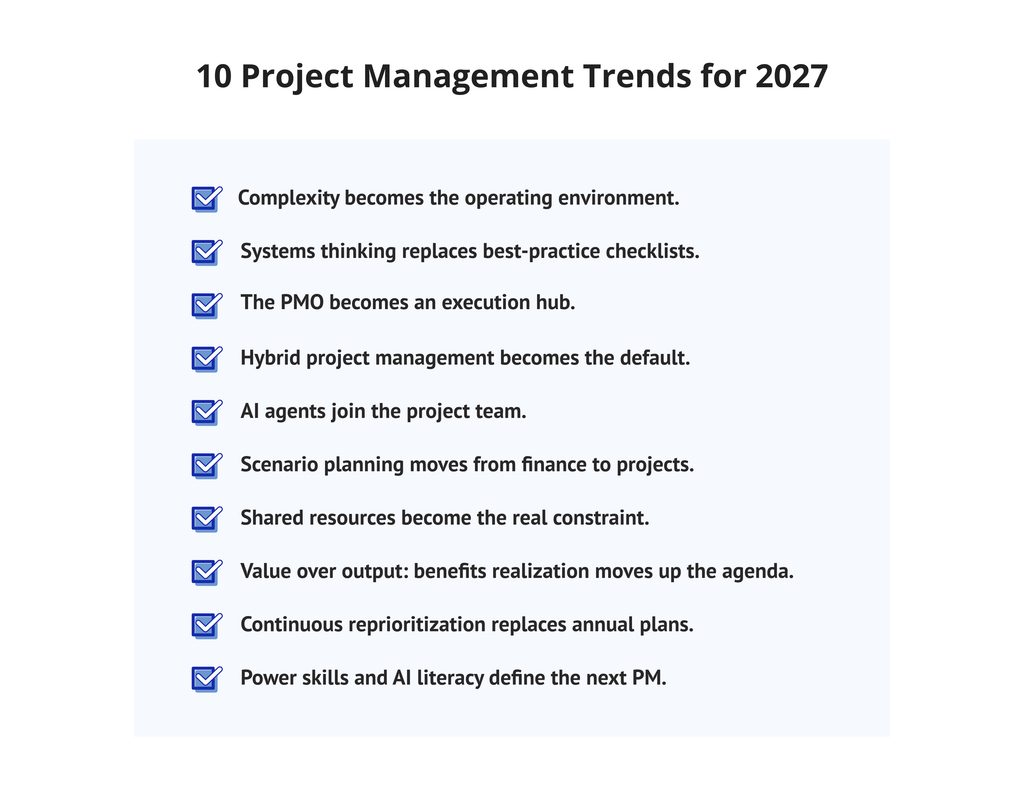
The 10 trends for 2027 are: complexity as the norm, systems thinking, the PMO as an execution hub, hybrid delivery, AI agents, scenario planning, shared-resource constraints, benefits realization, continuous reprioritization, and power skills with AI literacy. Each one is a response to rising complexity.
1. Complexity Becomes the Operating Environment
PMI’s 2026 data removes any doubt: 97% of project professionals managed at least one complex project last year, and more than half of all projects now qualify as complex. PMI groups the drivers into three dimensions. Organizational complexity covers unclear governance and siloed teams. Environmental complexity includes AI evolution, regulation, and geopolitics. Human complexity covers competing incentives and stakeholder politics.
“Complex project” is no longer a special category with its own playbook. It is the default case. Nearly a third (31%) of complex projects fail to achieve their full intended benefits, more than twice the rate PMI reports for projects overall.
Project leaders should plan for interdependence from day one and assume at least one dependency will move. Our analysis of project management challenges covers the most common failure points in detail.
2. Systems Thinking Replaces Best-Practice Checklists
PMI’s headline finding is that projects which navigate complexity effectively are five times more likely to succeed: an 88% success rate versus 14% for teams that are only slightly effective or ineffective at it. The difference is not more process. It is seeing the project as part of a system of people, technology, and external forces.
Frameworks still help. Projects using a framework for complexity succeed 72% of the time, versus 61% without one. Yet 35% of project professionals used no framework at all on their most recent complex project.
Systems thinking means asking, “What else changes if this slips, and who absorbs it?” instead of “is my task on time?” A one-week delay on a non-critical task is harmless. The same delay on a specialist who serves four projects ripples across all of them. Only a system view catches that.
“The traditional management system is no longer fit for purpose to help organizations really navigate the speed and complexity of the environment within which we’re now operating.” — Michael Lurie, Chief Catalyst Officer, Bayer, USA (source).
3. The PMO Becomes an Execution Hub
As complexity rises, PMI describes the PMO’s role as an enterprise “execution hub”: aligning sponsors, governing trade-offs, building shared language, and coordinating dependencies. In the 2026 survey, respondents in organizations with a PMO were more likely to rate their complex project management as very or extremely successful (63% vs. 57%).
The shift is from compliance to decisions. A reporting PMO collects status. An execution-hub PMO decides which project gets the scarce specialist this month, which initiative pauses, and what the delay costs. That requires authority over intake and priorities, not just templates.
Many PMOs are also tracking whether projects deliver benefits, not only whether they hit milestones. See our guides to PMO tools and program management for how organizations structure this layer.
4. Hybrid Project Management Becomes the Default
Hybrid project management combines predictive (plan-driven) and agile methods within one project or one portfolio. A hardware program might run stage gates for regulatory milestones while its software team works in sprints. The debate over “waterfall vs. agile” has largely ended. The real question is where each approach fits.
PMI has written adaptive and hybrid delivery into its PMP exam, updated in July 2026, which signals how mainstream hybrid project management has become. The skill is choosing deliberately rather than by habit.
| Approach | Best fit | Watch out for |
|---|---|---|
| Predictive | Fixed scope, regulatory gates, long-lead procurement | Late discovery of requirement changes |
| Agile | Uncertain requirements, fast feedback, software-heavy work | Weak links to portfolio budgets and dates |
| Hybrid | Mixed hardware and software, regulated products, multi-team programs | Two governance systems that never reconcile |
The common failure in hybrid project management is running two reporting systems that never connect. Teams that make it work agree on shared milestones and one view of capacity. Tooling for the agile side is covered in our reviews of Scrum tools and Kanban tools.
5. AI Agents Join the Project Team
Technology in project management is moving from AI that writes to AI that acts. The first wave of generative tools drafted status reports and meeting notes. The next wave is agents that monitor schedules, chase overdue updates, detect risk patterns and propose corrective actions. People still approve the decisions.
This matters because technology is itself a complexity driver: 48% of project professionals in PMI’s 2026 survey point to faster tech and tool cycles as a key source of complexity. Adding agents without changing decision rights can make that worse.
One principle helps sort useful AI from busywork: apply it where work queues up. If an agent speeds up tasks that are not on the bottleneck, it produces more drafts and half-finished work waiting in front of the same overloaded people. If it removes load from the bottleneck, delivery improves. For a deeper look, see our articles on AI in project management, AI agents for project management, and the best AI project management tools.
“That’s why I always say that AI agents are not replacing project leaders. They’re amplifying them,” said Ricardo Vargas, PhD.
6. Scenario Planning Moves From Finance to Projects
Scenario planning used to belong to finance and strategy teams. PMI’s 2026 research identifies it as one of the practices behind high performance on complex projects: mapping interdependencies and anticipating disruption early. Yet only about one in five practitioners currently use it.
At project level, scenario planning means preparing two or three credible futures before they arrive. What if the key supplier slips six weeks, or a regulator adds a test cycle?
At the portfolio level, the questions become what-if comparisons. Which projects move if we add a new one? Which slip if a specialist team loses two people? The value is speed: when the disruption happens, the response is already sketched, and the trade-offs are already visible to sponsors. Our review of scenario planning tools covers software that supports this.
7. Shared Resources Become the Real Constraint
In most multi-project organizations, the binding constraint is not budget or method. It is the same few specialists working across several projects at once. A test engineer, a systems architect, or a regulatory expert can serve five projects. When all five need them in the same week, everything queues.
Two effects make this expensive. First, multitasking: a person who switches between projects finishes all of them later than if the work ran in sequence. Second, cost of delay: every week a high-value project that waits behind a low-value one is lost value that never shows up in a single project’s status report.
The response is to plan resources at the portfolio level. That means prioritizing work across the whole portfolio by value and urgency, limiting how many projects run in parallel, and allocating the bottleneck first instead of asking “who is free?” Multi-project resource management tools such as Epicflow, along with the capacity modules in broader PPM suites, forecast the load on shared specialist groups weeks ahead. Our guide to capacity planning tools and our analysis of project portfolio management challenges explore this further.
8. Value Over Output: Benefits Realization Moves Up the Agenda
On-time and on-budget is no longer enough. PMI’s own definition of a successful project is one that delivers value worth the effort and expense, and its 2026 data shows that 31% of complex projects miss part of their intended benefits. Gartner’s 2026 CIO survey points the same way: only 48% of digital initiatives meet or exceed their business outcome targets.
Leading PMOs now track benefits after go-live, the value at risk from delays, and whether a project still makes sense since approval. Stopping a project that no longer pays back is a good outcome.
This connects project management to the wider transformation agenda. Our pieces on digital transformation trends and digital transformation challenges show the same gap between activity and outcomes at the enterprise level.
9. Continuous Reprioritization Replaces Annual Plans
Annual portfolio plans are breaking. According to Gartner’s 2026 CIO Agenda research, 94% of CIOs expect major changes to their plans and outcomes within the next 24 months. Yet only 18% embrace dynamic, off-cycle reprioritization today. Those who do are 24% more likely to be top performers.
Gartner frames the shift as moving from calendar-based to trigger-based decision-making: respond to signals, not schedules. For project portfolios, a trigger might be a lost specialist, a slipped supplier, a new strategic deal, or a project whose business case has eroded.
Without clear criteria, continuous reprioritization becomes whoever shouted loudest this week. Effective portfolios define the rules in advance (value, urgency, risk, and capacity) and rerun them when a trigger fires. Our guide to enterprise project management software compares platforms built for portfolio-level decisions.
10. Power Skills and AI Literacy Define the Next PM
The skills gap is shifting from technique to judgment. PMI’s 2026 research found that high performers rely on human practices: sponsor alignment at initiation, for example, is used by 39% of high performers versus 30% of low performers. Agreeing on what success looks like before execution starts is a negotiation skill, not a scheduling skill.
AI literacy now sits beside it. IBM’s 2026 CEO Study (2,000 CEOs surveyed February to April 2026) found that respondents expect 53% of employees to need upskilling between 2026 and 2028 to perform their current role effectively, and 29% to need reskilling for a different role.
Project managers need both: enough AI fluency to delegate monitoring and reporting, and enough people skills to handle what AI cannot, such as conflicting stakeholders and decisions under pressure.
What These Trends Mean for Project Managers and PMOs
These trends shift every role toward decisions and away from administration. Project managers coordinate across systems, PMO leads govern trade-offs, portfolio managers rebalance capacity continuously, and sponsors commit to clear success criteria. The common skill is reasoning about interdependence and value, not tracking tasks.
Technology in project management makes status cheaper every year. What stays scarce is judgment about which project matters most and what to stop.
| Role | What changes in 2027 | Key skill for 2027 |
|---|---|---|
| Project manager | Less status reporting (agents handle it), more cross-project coordination | Systems thinking and stakeholder negotiation |
| PMO lead | From compliance and templates to governing intake, trade-offs and dependencies | Portfolio decision-making and benefits tracking |
| Portfolio manager | From annual planning to trigger-based reprioritization | Capacity planning across shared resources and scenario analysis |
| Executive sponsor | Expected to define success and value before execution starts | Sponsor alignment and willingness to stop projects |
Three actions follow for PMO leaders. First, take ownership of intake: nothing enters the portfolio without a capacity check against the specialists it will need. Second, measure value as well as schedule: track benefits after delivery and the cost of projects waiting in queues. Third, pick one complexity framework and use it consistently, given PMI’s finding that 35% of professionals used none on their latest complex project.
For individual project managers, the priority is to become the person who can explain the knock-on effects of a change across projects. That skill is hard to automate.
The Future of Project Management Beyond 2027
The future of project management is integration and judgment. AI will absorb more monitoring, reporting, and forecasting. Project professionals will spend more time aligning sponsors, making trade-offs across projects and deciding where scarce capacity goes. The role is not shrinking. It is moving up the value chain.
Do project managers have a future? The evidence says yes, in a changed form. Complexity is rising, and in PMI’s data, people practices separate success from failure: sponsor alignment, scenario planning, and the deliberate use of frameworks. PMI’s 2026 PMP update reflects this. The Business Environment domain grew from 8% to 26% of the exam, with AI, sustainability, and value delivery added to project scenarios.
The future of project management is also more portfolio-centric. The professionals who thrive will think in systems, quantify trade-offs, and work alongside AI agents rather than compete with them.
Our Methodology
This analysis is based on primary research published between November 2025 and May 2026: PMI’s Pulse of the Profession 2026 (May 2026) and its accompanying press release, PMI’s Manifesto for Enterprise Agility research, Gartner’s 2026 CIO Agenda findings, and IBM’s 2026 CEO Study. Each statistic was checked against the publisher’s own page in October 2026. Figures we could not confirm in a primary source were excluded.
We also reviewed the top-ranking articles on this topic to find gaps in coverage. The selection reflects where independent research and practitioner experience converge, with particular attention to multi-project environments. Survey figures reflect respondents’ views at the time of each survey. This article is updated annually.
Key Takeaways
- The defining project management trends for 2027 are responses to complexity, which now affects more than half of all projects.
- Effective complexity management lifts project success from 14% to 88%, according to PMI’s 2026 data.
- The PMO’s job is shifting from reporting to governing trade-offs, intake, and dependencies.
- Hybrid project management is the default; the skill is choosing the right method for each part of the work.
- Shared specialists, not budgets, are the real constraint in most multi-project organizations.
- AI agents pay off where they relieve the bottleneck, not where they produce more drafts.
References
- Project Management Institute. “Why Complex Projects Fail: Best Practices Are Not Enough, System Thinking Gives Your Team the Edge.” Press release, 12 May 2026. https://www.pmi.org/about/press-media/2026/pulse-why-complex-projects-fail-best-practices-are-not-enough-system-thinking
- Project Management Institute. “Pulse of the Profession 2026: Driving Success in Complex Projects: From Navigating Tasks to Navigating Systems.” Report, May 2026. https://www.pmi.org/learning/thought-leadership/driving-success-in-complex-projects
- Gartner. “Strategic Pivots Will Define the CIO’s Agenda in 2026.” 25 November 2025. https://www.gartner.com/en/articles/cio-agenda
- IBM Institute for Business Value. “IBM Study: CEOs are Reshaping C-suite Roles for the AI Era.” Press release, 4 May 2026. https://newsroom.ibm.com/2026-05-04-ibm-study-ceos-are-reshaping-c-suite-roles-for-the-ai-era
- Project Management Institute. “What’s new in the updated PMP exam?” Accessed October 2026. https://www.pmi.org/certifications/project-management-pmp/new-exam
FAQs
The top three trends are complexity becoming the normal operating environment, the PMO evolving into an execution hub that governs trade-offs and dependencies, and AI agents joining project teams to monitor schedules and flag risks. PMI’s 2026 research shows 97% of project professionals managed at least one complex project last year, which drives the other two.
Current trends in project management include complexity as the norm, systems thinking, the PMO as an execution hub, hybrid delivery, AI agents, scenario planning, shared-resource constraints, benefits realization, continuous reprioritization, and power skills combined with AI literacy. Together they reflect a shift from managing individual tasks to managing interconnected systems of people, technology, and priorities.
In 2026, the main shift was the recognition that complexity is the default. PMI found that 81% of professionals say projects have become more complex, and more than half of all projects now count as complex. AI tools started moving from drafting text to agents that act on project data. CEOs tied operating-model change to AI.
Hybrid project management combines predictive, plan-driven methods with agile practices within one project or portfolio. For example, a team may use stage gates for regulatory milestones and sprints for software development. It fits work that mixes fixed constraints with uncertain requirements. Success depends on shared milestones and one view of capacity across both approaches.
No. AI is taking over monitoring, status reporting, and routine forecasting, but project managers remain accountable for decisions, people, and trade-offs. PMI’s 2026 data links success to human practices such as sponsor alignment and scenario planning. See our guides to AI in project management and AI agents for project management.
Yes. Rising complexity increases the need for people who can coordinate interdependent work, align sponsors, and make trade-offs across projects. PMI’s 2026 PMP update put more weight on the business environment, value delivery, and AI, which signals where demand is heading. The most sought-after profiles combine portfolio thinking, power skills and fluency with AI tools.