In a 2025 survey of 505 data and analytics leaders for the 2026 State of Data Integrity and AI Readiness report by Drexel University’s LeBow College of Business and data integrity vendor Precisely, 83% said they run an ongoing data governance program. Programs matter for trust: 71% of organizations with one reported high trust in their data, against 50% without [1].
Data governance software is how many of those programs try to scale. It earns its cost only when it makes ownership, meaning, access and policy easier to manage across the data estate. Yet products that share the label solve different problems: cataloging, lineage, quality, privacy workflows or policy enforcement.
This guide explains the capabilities to assess, the questions to ask before you buy and a neutral scorecard you can apply to your own environment. It does not rank vendors.
Key takeaways
- Data governance software helps people find data, know who owns it, trust it, control its use and prove what happened.
- Define your governance operating model and first use case before you compare products.
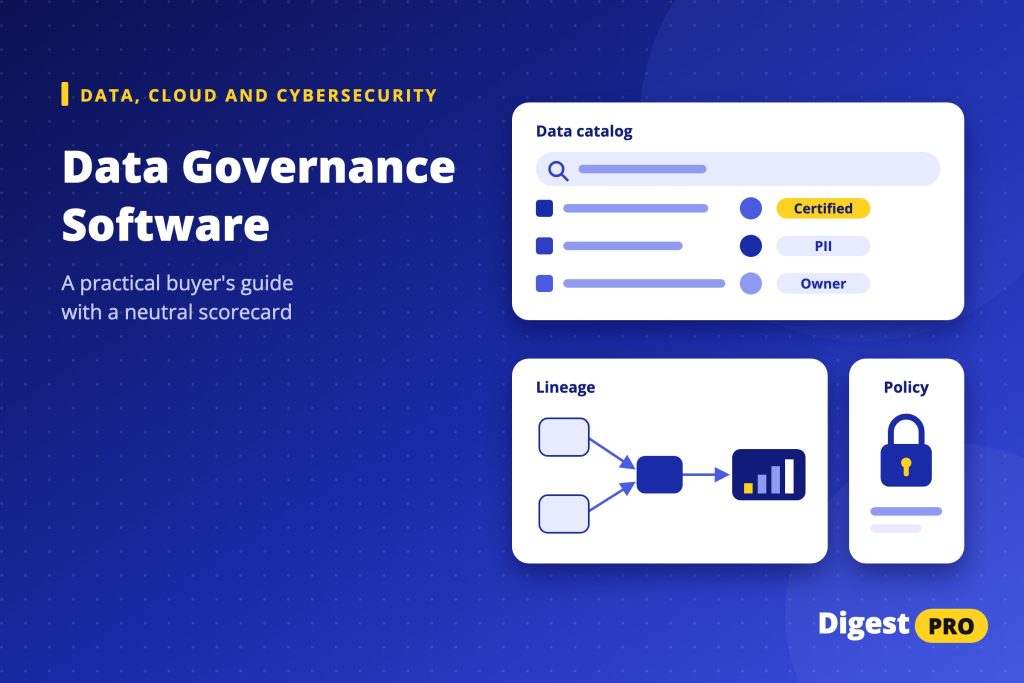
- Evaluate eight capabilities: catalog and glossary, ownership and stewardship, lineage, quality, policy workflows, access controls, auditability and integrations.
- Set criteria weights before demos and run every proof of concept on the same real data and tasks.
- Treat feature claims as vendor-reported and confirm current product names. Several catalogs were renamed or rebundled recently.
What does data governance software do?
NIST’s glossary describes data governance as a set of processes that ensures data assets are formally managed throughout the enterprise, with a governance model that sets authority and decision rules for that data [2]. Data governance software supports those processes. It gives people one place to find data, see what it means, know who owns it, check whether it can be trusted and request the right access.
Expect four outcomes: discoverability, accountability, controlled access and trustworthy use. If a platform moves none of them for a real team, it becomes shelfware. Many teams start with the catalog and add lineage, quality and policy features as the program matures.
Three neighbors are often confused with it:
- Data management is the broader discipline of storing, integrating, securing and operating data. Governance sets the rules; management carries them out.
- Master data management (MDM) maintains consistent records for core entities such as customers, products or suppliers. Governance software can catalog master data and assign its owners, but it does not replace an MDM hub.
- AI governance oversees models and AI systems. Data governance feeds it: the EU AI Act requires training, validation and testing data sets for high-risk AI systems to be subject to data governance and management practices [3]. For model oversight products, see our guide to the best AI governance tools.
Core capabilities to evaluate in data governance software
Eight capabilities cover most programs. For each one, ask how it supports the way your organization actually governs data: who decides, who maintains and who checks.
- Catalog and business glossary. Inventory data assets with technical metadata and link them to agreed business terms. Check how assets get in (automated scanning or manual entry) and how terms stay current. Many products now suggest descriptions or terms automatically; test that output on your own assets before you rely on it.
- Ownership and stewardship. Assign named owners and stewards to domains and assets. Microsoft’s documentation says Purview Unified Catalog organizes data into governance domains to distribute ownership and lets stewards attach policies to glossary terms [4].
- Lineage. Show where data comes from and what depends on it, ideally at column level across pipelines and BI tools. Google Cloud says its Knowledge Catalog traces column-level transformations across pipelines [5].
- Data quality. Define rules, run checks and show scores where users decide whether to trust a dataset. According to Microsoft, Purview reports quality scores at asset, data product and governance domain level [4].
- Policy workflows. Route access requests, approvals, exceptions and certifications to the right people, with deadlines and history.
- Access controls. Enforce who can use what, ideally where the data lives. Databricks says Unity Catalog enforces access control at query time, with attribute-based policies and row and column filters [6].
- Auditability. Keep a record of access and changes. Databricks describes an audit log system table covering data access and system activity [6].
- Integrations. Connect to your warehouses, lakes, BI tools, pipelines, identity provider and ticketing system. A strong feature without a connector to your main platform does not help.
A checkbox feature matters only if it supports your governance operating model. A lineage graph nobody uses for impact analysis, or a glossary with no owner, adds cost without adding control.
Match the platform to the use case
Start from one primary use case. Pick the one with a named sponsor, a pain you can measure and data you can reach in the first quarter. Four common use cases need different must-haves:
- Analytics and data products. Start with search, a business glossary and certified datasets so analysts can find and trust data. Data product publishing and usage analytics can follow.
- Regulated information. Start with classification, access policies and audit trails. Collibra, for example, says its catalog automatically classifies sensitive data such as PII and PHI (vendor-reported) [7]. Privacy workflows and retention rules can come in phase two.
- Distributed business units. Start with domains, named owners and approval workflows, so each unit governs its own data under shared standards. Federated quality rules and domain scorecards can follow.
- Cloud and hybrid estates. Start with broad connectors and lineage that crosses tools. A catalog native to one platform may govern that platform deeply and others only partly.
Separate must-haves from phase-two needs in writing. Don’t buy a suite for a process you have not defined. If nobody has agreed how access requests are approved, a workflow module will only automate the argument.
Governance is part of the data foundation behind wider digital transformation trends. Fund it as a capability, not a one-off tool purchase.
Build a weighted vendor scorecard
Agree criteria and weights with business and technical stakeholders before any vendor demo. Then score each platform from 1 to 5 against the same evidence.
| Criterion | Weight (illustrative) | What good looks like | Evidence to collect |
|---|---|---|---|
| Capability fit | 25% | Covers the must-haves for your primary use case | Scripted demo on your tasks |
| Integration | 20% | Connectors for your core platforms, open APIs | Connector list, proof-of-concept scan |
| Usability | 15% | Business users find and request data unaided | Task completion by real users |
| Security and compliance | 15% | Fits identity, encryption, residency and audit needs | Security documentation, certifications |
| Implementation effort | 10% | Realistic plan, skills you have or can hire | Delivery plan, reference calls |
| Total cost of ownership | 10% | Licenses, compute, services and staff over three years | Itemized quote, internal estimate |
| Support and viability | 5% | Responsive support, credible roadmap | Support terms, reference checks |
Watch the cost lines vendors leave out of the headline price: connectors licensed separately, compute consumed by scans and quality checks, implementation services and the staff time stewards will spend in the tool.
Multiply each score by its weight and add the results for a total out of 5. Treat small gaps as ties. In the illustrative example above, a 0.05 difference says nothing about which product will work for you.
Run every proof of concept on the same real data sources and governance tasks. A practical set: scan two production sources, trace lineage from a source table to a dashboard, assign owners for one domain, run one quality rule and process one access request end to end. Time each task, count the manual steps and note who on your team could run it after the vendor leaves.
Implementation, adoption and ownership
Software does not create accountability. People do. Define four roles before rollout:
- Data owners are accountable business leaders who decide access, quality thresholds and acceptable use for their domain.
- Data stewards maintain definitions, classifications and quality rules day to day.
- Platform administrators run connectors, permissions, upgrades and integrations.
- Domain teams publish and use data under the shared standards.
Most failures here are organizational. Legacy systems often have no clear owner, one of the recurring digital transformation challenges. Assign owners before you load assets, or the catalog fills with orphaned entries.
Track adoption with measures leaders understand:
- Share of priority assets with a named owner and steward.
- Lineage coverage for critical reports and data products.
- Quality issues opened versus resolved, and time to resolve.
- Policy workflow completion: access requests and certifications closed on time.
- Monthly active users who search for and request data.
Write down decision rights as well. Who approves a new glossary term, who can grant access to sensitive data and who settles a dispute between two domains? A short escalation path to a data governance council keeps decisions from stalling in the tool.
Start with one domain, show results within a quarter, then expand. Report the measures to the data governance council, not only to the platform team.
Shortlist and compare data governance software providers carefully
Shortlist by category before you compare brands. The examples below are vendor-reported capabilities checked on official pages on October 28, 2026. They are not a ranking.
| Category | Typical fit | Examples (vendor-sourced) |
|---|---|---|
| Platform-native catalogs | Most data sits on one cloud or data platform | Microsoft Purview Unified Catalog [4], Google Knowledge Catalog [5], Databricks Unity Catalog [6] |
| Enterprise governance suites | Many platforms, formal stewardship and workflows | Collibra [7], IBM watsonx.data intelligence [8] |
| Open-source metadata platforms | Engineering-led teams that can run and extend software | OpenMetadata, Apache 2.0 license [9] |
The categories overlap. Test the boundary that matters to you: how a platform-native catalog handles sources outside its home platform, or how deep a suite’s stewardship workflows go on the platforms you already run.
Then check four things:
- Confirm names and versions. Google renamed Dataplex Universal Catalog to Knowledge Catalog [5]. IBM presents its governance catalog under watsonx.data intelligence and says it uses IBM Research language models to enrich metadata [8]. Microsoft notes that its new Unified Catalog experience is still rolling out by region [4].
- Label vendor claims. Ask for documentation, then test each claim in your proof of concept. OpenMetadata’s repository, for instance, lists lineage, data quality and glossary features [9]; your engineers should confirm they work on your stack.
- Use independent reviews with care. Peer-review sites reflect self-selected users, and analyst reports are often paywalled. Use them to find questions, not answers.
- Avoid stale pricing. Get a current, itemized quote for your configuration. Packaging and prices change.
Summary
Data governance software works when it supports a defined operating model: named owners, agreed terms, trusted quality and controlled access, with proof. Pick one primary use case, list its must-haves, weight your criteria and run the same real tasks through every proof of concept. Choose the platform that completes those tasks with the least manual effort for the team that will run it.
Your next step: write down your first governance use case, the three tasks that prove it works and the owners who will run them.
FAQs
What are the top 5 data governance tools?
There is no universal top five. The right shortlist depends on where your data lives and which job matters most: cataloging, lineage, privacy and access control, or stewardship workflows. Build the shortlist by category (platform-native catalogs, enterprise governance suites or open-source metadata platforms), then test two to four candidates against the same real data and tasks.
What are the best tools for data governance?
The best tool is the one that scores highest on your weighted criteria in a proof of concept with your own data. Weight capability fit, integration, usability, security, implementation effort, total cost and support before demos. Then verify each vendor’s claims on current official documentation and record the product version you tested, because names and packaging change often.
What are the 5 pillars of data governance?
There is no single standard list, and frameworks group the work differently. This guide uses five stages as its editorial framework: discover (catalog and glossary), own (owners and stewards), trust (lineage and quality), control (policy workflows and access) and prove (audit and reporting). Use whichever model your organization agrees on, as long as each pillar has an owner and a measure.
References
- 2026 State of Data Integrity and AI Readiness. Drexel University LeBow College of Business (Center for Applied AI and Business Analytics) and Precisely, January 2026. Accessed 28 Oct 2026.
- Data governance (glossary entry). NIST Computer Security Resource Center, undated. Accessed 28 Oct 2026.
- Article 10: Data and data governance. European Commission AI Act Service Desk, undated. Accessed 28 Oct 2026.
- Learn about Microsoft Purview Unified Catalog. Microsoft Learn, updated March 16, 2026. Accessed 28 Oct 2026.
- Knowledge Catalog overview. Google Cloud, last updated October 26, 2026. Accessed 28 Oct 2026.
- What is Unity Catalog?. Databricks, last updated September 11, 2026. Accessed 28 Oct 2026.
- Data Catalog. Collibra, undated product page. Accessed 28 Oct 2026.
- Governance and Catalog. IBM (watsonx.data intelligence), undated product page. Accessed 28 Oct 2026.
- OpenMetadata. OpenMetadata project on GitHub, undated repository README. Accessed 28 Oct 2026.