
Self-hosted AI agents run on infrastructure you control instead of a vendor’s cloud — you own your data, you control the cost per task, and you decide what your compliance team can approve. That single choice is the real motivation behind almost every search for this topic: control first, privacy second, cost third.
In 2026, self-hosted AI agents have moved from a niche engineering preference to a mainstream enterprise requirement. McKinsey reports that 62% of organizations are now experimenting with AI agents, and 23% are already scaling an agentic AI system in at least one business function [1]. A growing share of that group wants a self-hosted AI agent, not a cloud-only one. Developers often search for self-hosted AI options before ever comparing individual products by name.
This guide explains why teams choose self-hosted AI agents over managed SaaS, what a self-hosted AI agent platform actually needs to run, and which open source self-hosted AI agents are worth deploying this year for enterprise AI agent use cases. You will get an honest look at the top self-hosted AI agents 2026 has to offer, a real quick-start walkthrough, and answers to the questions developers ask most about running self-hosted AI agents.
📌 Ready to see more comparisons like this? Follow Digest.Pro on LinkedIn for weekly breakdowns of the AI agent platforms shaping enterprise IT.
Key Takeaways
- Self-hosted AI agents keep data and logs inside your own infrastructure, which is why regulated industries default to secure self-hosted AI agents instead of cloud-only tools.
- A self-hosted AI agent platform cuts per-token markup at scale, but it shifts cost from a subscription line item to DevOps hours.
- EpicStaff, n8n, and Dify lead the best self-hosted AI agents 2026 has to offer, while AgentGPT is archived and unsafe for new builds.
What Are Self-Hosted AI Agents?
A self-hosted AI agent is software that plans, calls tools, and completes multi-step tasks using large language models, deployed entirely on infrastructure you own — a laptop, an on-premises server, or a private VPC. The orchestration logic, the memory layer, and often the model inference of a self-hosted AI agent all run behind your firewall. Nothing routes through a vendor’s servers unless you explicitly configure an external API call. Most open source AI agents publish their source code publicly, which lets your security review start before a single container runs.
Cloud or SaaS agents work differently. Most vendor “agent” add-ons run the orchestration layer, and often the model itself, on infrastructure the vendor controls. The inputs you provide are received by the service’s servers, subjecting you to their privacy policies, including data retention and breach notification procedures. With self-hosted AI agents, this is not the case, and this is why so many teams researching AI agents in a SaaS model end up comparing open source self-hosted AI solutions with each other.
Ownership follows infrastructure, not marketing language. A “private” cloud agent can still mean your prompts sit on someone else’s disks. A genuinely self-hosted AI agent means the disks are yours.
Why Self-Host Your AI Agents?
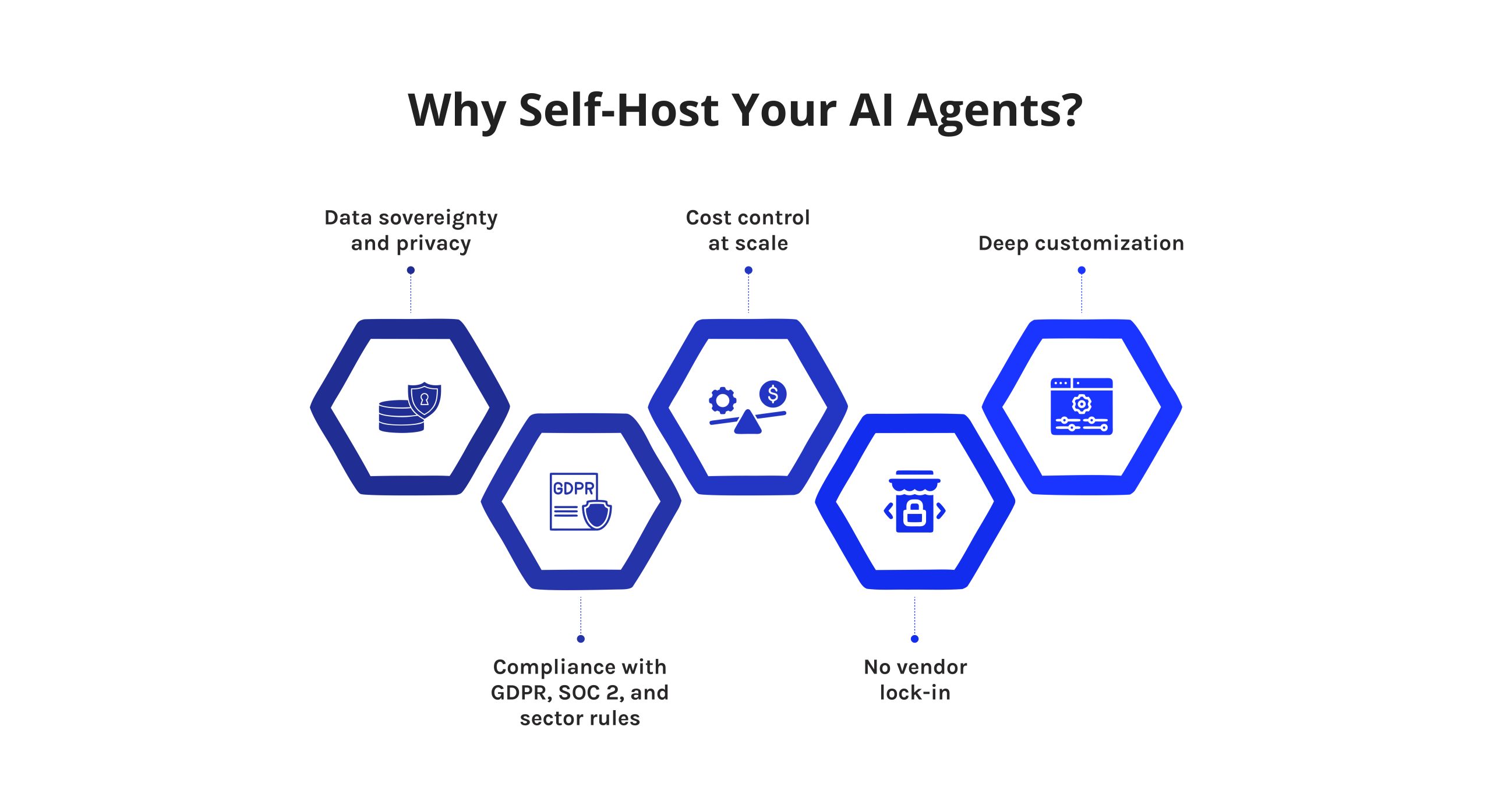
The self-hosted AI decision usually comes down to five recurring drivers, and they rarely show up alone — a compliance requirement usually pulls cost control and customization along with it.
- Data sovereignty and privacy. Prompts, retrieved documents, and outputs never leave infrastructure you control, which matters most for regulated data like financial records or patient files.
- Compliance with GDPR, SOC 2, and sector rules. Auditors verify exactly where data sits, instead of relying on a vendor’s compliance attestation alone.
- Cost control at scale. A self-hosted artificial intelligence agent leverages a per-token price mechanism instead of a flat-based charge, thus saving money once the level of usage surpasses the planned measure.
- No vendor lock-in. You can change all models powering your agent’s operations, hosting providers, or modify the source code if needed without any consequences.
- Deep customization. Self-hosted AI agents for workforce automation are directly connected to internal systems and legacy databases whose APIs cannot be accessed by a traditional SaaS platform.
According to the 2026 enterprise AI survey from Deloitte, 73% of companies identify data privacy and security as their main danger regarding AI; however, only 21% claim to have a well-thought-out governance model for autonomic agents [2]. The difference between these numbers shows the actual possibility to gain advantages of self-hosted AI agents designed for business needs.
The same report found that 77% of companies now factor an AI vendor’s country of origin into procurement, a direct result of data-sovereignty pressure pushing enterprises toward on-premises AI systems and toward open source AI agents they can audit line by line.
📌 Want the data-sovereignty case explained for your leadership team? Follow Digest.Pro on LinkedIn — we cover enterprise AI governance every week.
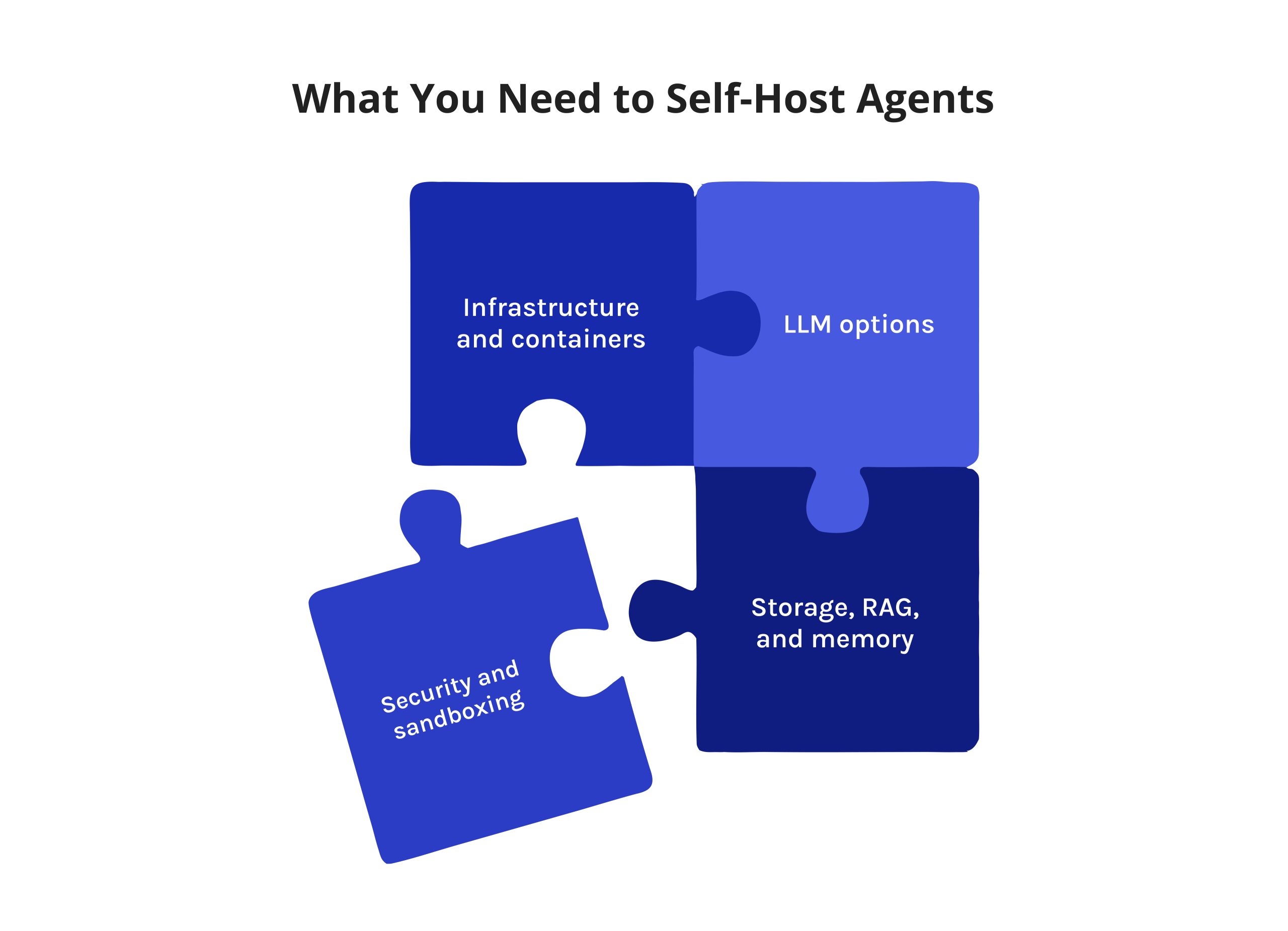
What You Need to Self-Host Agents
Self-hosting is more approachable than most teams assume, and teams new to self-hosted AI infrastructure usually start with the API route before graduating to local inference. Four building blocks cover almost every self-hosted AI agent deployment.
Infrastructure and containers. Nearly every open source self-hosted AI agent platform ships as a Docker Compose file, and this is the core recipe for on-premise AI deployments regardless of which platform you choose. A 2-to-4-core VPS with 4–8GB of RAM runs a pilot comfortably; production usually moves to Kubernetes for scaling.
LLM options: API or local. Point your self-hosted AI agent at a commercial API while keeping orchestration local, or run the model itself with Ollama or vLLM for a fully self-hosted personal AI agent setup. The API route needs no GPU; running large language models locally needs one — an H100 costs roughly €25,000–€60,000 to buy, or €3–8 an hour rented.
Storage, RAG, and memory. Agents that reference your documents need a vector database — Weaviate, Qdrant, or pgvector are common self-hosted choices. Self-hosted memory layers for AI agents typically add PostgreSQL or Redis so the agent remembers context between sessions instead of starting cold.
Security and sandboxing. A self-hosted sandbox for AI agents isolates code execution so a misbehaving agent cannot touch your host system. Add role-based access control and human-approval gates before any agent touches production data — this is what separates secure self-hosted AI agents from risky demos.
Editorial note: Our specialists made n8n, Dify, and EpicStaff operational on comparable premises of VPS with 2 vCPU and 4 GB using the Docker Compose solutions that each one of them has. n8n and Dify were accessible within minutes through the browser, while EpicStaff’s script requires it to create its own Postgres and Redis volumes on its first run.
Best Self-Hosted / Open-Source AI Agent Platforms
The self-hosted AI agent market splits into three real categories: visual workflow builders, code-first frameworks, and agent-adjacent infrastructure that supports self-hosting without running agent logic itself — the open source AI agent landscape spans all three.
Mixing these is the most common mistake in “best of” lists — a storage layer is not an orchestration engine, and an archived project is not a safe pick just because its star count is high. Choosing the right open source AI agent platform comes down to license terms, deployment complexity, and total cost of ownership, not marketing copy.
Our Methodology. We scored each platform on five weighted criteria: license terms for commercial self-hosting, real deployment complexity, depth of agent-specific features versus generic automation, maintenance activity as of mid-2026, and total cost of ownership at pilot and production scale.
We read the license file behind every one of these open source AI agents before publishing a score, rather than trusting a landing page. For enterprise AI agents specifically, license terms and audit trails matter as much as raw feature count. Platforms with unresolved security issues or licenses that quietly restrict self-hosting were marked down, regardless of GitHub stars.
|
Platform |
License / Cost to Self-Host |
Best For |
Deployment |
|
EpicStaff |
Source-available, free core |
Auditable, ownable agent flows |
Docker / Podman |
|
n8n |
Fair code, free unlimited |
Self-hosted AI agents for workflow automation |
Docker / Kubernetes |
|
Dify |
Modified Apache 2.0, free |
RAG-heavy internal AI apps |
Docker Compose |
|
Fastio |
Proprietary, free tier |
Storage layer for agent output |
Cloud only |
|
Flowise |
Apache 2.0, free core |
Prototyping multi-agent flows |
npm / Docker |
|
AutoGPT |
MIT core, platform license varies |
Continuous autonomous agents |
Docker Compose |
|
AgentGPT |
GPL-3.0, archived |
Historical reference only |
Not maintained |
n8n
n8n is one of the most popular open source AI agents for workflow automation, and it sits firmly in the no-code AI agents category — the closest thing to a self-hostable, Zapier-class tool. The Community Edition runs under a fair-code license: free to self-host for internal use, but it restricts reselling n8n itself as a hosted service.
- Pros: unlimited free self-hosting with no execution caps, 500+ integrations, 70+ LangChain-based AI nodes, backed by $240M in funding, and 4.8/5 ratings across thousands of reviews.
- Cons: the license blocks commercial resale, and SSO or Git version control require a paid business tier.
- Pricing: self-hosted Community Edition is free; cloud starts around $20–24/month; the self-hosted Business tier runs roughly $800/month.
AutoGPT
AutoGPT put autonomous, goal-directed agents on the map in 2023, and it remains one of the highest-profile open source AI agents by GitHub star count, even though newer platforms have overtaken it in production use. It has since grown from a single script into a low-code platform for continuous AI agents, maintained by Significant Gravitas.
- Pros: free to self-host, MIT-licensed core, over 185,000 GitHub stars, and a genuinely useful builder for prototyping an AI coding agent or research agent quickly.
- Cons: self-hosting the full platform needs Docker, Node.js, and at least four CPU cores with 8–16GB of RAM, and licensing on the newer platform folder differs from the MIT-licensed classic script.
- Pricing: free self-hosted; cloud pricing is not yet public.
Dify
Dify is one of the most complete open source AI agent platforms available today, pairing a visual workflow builder with a built-in RAG pipeline in one Docker-deployable package, and it’s the most-starred AI agent platform on GitHub at 139,000+ stars.
- Pros: every core feature — RAG, agent flows, MCP integration, routing across OpenAI, Anthropic, and local models — ships free in the Community Edition, and minimum requirements are just 2 CPU cores and 4GB RAM.
- Cons: the license bans multi-tenant SaaS resale without a commercial agreement, and self-hosted enterprise licenses start in the five figures annually.
- Pricing: free Community Edition; cloud runs $59–159/month per workspace; enterprise self-hosted licensing is custom.
Fastio
Fastio is not an orchestration platform — it is a persistent storage and collaboration workspace built for AI agents, providing file storage, RAG indexing, and MCP tools that self-hosted builders like n8n, Flowise, and Dify write output to.
- Pros: purpose-built agent storage with automatic semantic indexing, a generous free tier, and native MCP support.
- Cons: Fastio itself runs as managed cloud, not a self-hosted deployment, so teams with strict on-premises rules still need self-hosted storage like MinIO alongside it.
- Pricing: free 14-days trial is available; enterprise scales up to roughly $3,000/year.
EpicStaff
EpicStaff is a source-available, genuinely self-hosted platform for building AI agent flows, built around a node-based visual editor over a Django and Python backend. Every node can hold custom Python, agent memory persists in PostgreSQL and Redis, and the platform connects to hosted models like OpenAI and Anthropic or to your own local LLMs — it does not require going fully local. It targets operations teams running enterprise AI agents that need to stay auditable, not just functional.
- Pros: no cloud dependency, native RAG against a built-in vector store, MCP and direct-Python integration, human-approval gates before sensitive actions, and RBAC with LDAP/OIDC/SAML for enterprise audits. Note that these are architectural controls EpicStaff provides, not third-party certifications — verify any compliance claim against your own auditor’s requirements before relying on it.
- Cons: the community is younger than n8n’s or Dify’s — around 328 GitHub stars at the time of writing — so third-party tutorials are still thin.
- Pricing: self-hosted core is free with no feature gating; an Enterprise tier adds SSO and SLA-backed support for regulated environments, priced on request.
Flowise
Flowise is a drag-and-drop builder for LLM applications and multi-agent systems, acquired by Workday in August 2025, and one of the most permissively licensed open source AI agents on this list since Apache 2.0 places no restriction on commercial resale. Chatflow mode covers sequential RAG pipelines; Agentflow mode covers autonomous multi-step loops. Like n8n, Flowise appeals to teams that want no-code AI agents without sacrificing the option to drop into custom code later.
- Pros: free to self-host under Apache 2.0 with no feature caps, 100+ supported LLMs and vector databases, and a one-line local setup for testing.
- Cons: production governance features like SSO and audit logs sit outside the open-source core.
- Pricing: self-hosted core is free; managed cloud starts at $35/month and $65/month for higher tiers.
AgentGPT
Previously, AgentGPT was among the most popular open-source AI agents of the autonomous-agent revolution, but it is now mentioned only as a cautionary tale. Reworkd ceased work on this project and archived the GitHub repository on January 28, 2026, indicating a change in direction towards web scraping.
- Cons: development stopped in 2023, the repository is permanently read-only, over 130 issues sit unanswered, and the live demo is frozen on GPT-3.5-era models.
- Verdict: skip it. Do not build a new self-hosted AI agent on AgentGPT in 2026 — it is a historical marker of how fast this ecosystem moves, not a platform to deploy.
How to Get Started
Getting a self-hosted AI agent running follows the same basic pattern across almost every open source AI agent platform, whether you pick EpicStaff, n8n, Dify, or Flowise. Open source AI agents differ in UI and licensing, but the underlying deployment sequence stays consistent — three steps take you from zero to a working agent.
- Pick a platform and pull the code. Clone the project’s repository or install its package — a git clone command for EpicStaff, n8n, or Dify, or a one-line npx flowise start for Flowise. Every platform publishes its own setup commands in its documentation, so verify commands against the source before copying them from a third party.
- Start the stack with Docker. Run docker-compose up (add –build on the first run for platforms that provision their own database, like EpicStaff) to bring up the backend, database, and UI containers together. Most self-hosted AI agent platforms are reachable in a browser within minutes on a modest VPS with 2–4 CPU cores and 4–8GB of RAM.
- Connect an LLM and build your first flow. Add an API key for a hosted model such as OpenAI or Anthropic, or point the platform at a local LLM through Ollama if you need a fully air-gapped, on-premises AI setup. Then drag your first agent node onto the visual canvas and run one test task end to end before wiring in real data.
From there, most teams usually connect one internal data source before building multi-agent flows. A well-defined self-hosted AI agent that performs one task very well is better than an ambitious project that remains in pilot.
📌 Setting up your first self-hosted AI agent this week? Follow Digest.Pro on LinkedIn for setup guides as new releases land.
Summary
Self-hosted AI agents trade a subscription fee for DevOps time, and in return you get full control over data, cost, and compliance. EpicStaff, n8n, and Dify cover most real-world use cases today, while AgentGPT is no longer safe to build new deployments on. The right starting point is the platform that matches your compliance requirement, not the one with the most GitHub stars — then one narrow, well-scoped workflow proven in production before you expand. The FAQ below covers the questions that come up most once a team starts evaluating self-hosted AI agents seriously.
FAQs
Self-hosted AI agents refer to autonomous AI systems that function entirely using infrastructure that you have control over; this includes, but is not limited to, your individual servers, a virtual private cloud, or even equipment you have set up on your and other premises.
Using self-hosting protects your sensitive information inside your own infrastructure and allows you to save money, customize your application as you see fit, and ensure that you are meeting all of the compliance requirements with respect to your implementation.
Yes, if you pair a self-hosted AI agent platform with a locally hosted LLM using Ollama or vLLM. This setup needs a GPU for reasonable speed and suits air-gapped environments, though local models still lag top cloud APIs in raw capability.
EpicStaff is the strongest pick for teams that need a genuinely self-hosted, auditable platform in 2026. It combines a visual editor, native RAG, and enterprise access controls without the licensing limits that restrict commercial resale on some competitors. Judged purely as an open source AI agent platform, EpicStaff and Dify sit at the top for different reasons — Dify for breadth, EpicStaff for auditability. Most open source AI agents in this category share a similar Docker-based deployment model, so the real decision usually comes down to licensing and feature depth rather than setup difficulty.
Yes — self-hosted AI agents for the enterprise are often the only model that satisfies strict data residency and audit rules. Banking, healthcare, and defense contractors rely on this approach because auditors can verify exactly where data sits. Enterprise AI agents that touch regulated data almost always end up self-hosted for exactly this reason — the audit trail is easier to defend when nothing leaves your own infrastructure.
Software costs range from $0 to five-figure annual enterprise licenses, and infrastructure typically runs $20–200/month for a small deployment. A lightweight pilot fits on a $10 VPS; GPU-backed local inference can run into the thousands monthly.
Yes — n8n, Dify, Flowise, EpicStaff, and AutoGPT all support full on-premises deployment via Docker or Kubernetes. On-premises AI deployment gives the strongest sovereignty guarantee, since nothing crosses the public internet unless you configure it to.
Self-hosted memory layers for AI agents typically pair a vector database for semantic recall with PostgreSQL or Redis for session state. This lets an agent retrieve past context while tracking hard facts like user variables across sessions.
While SaaS agents operate on vendor IT infrastructure, self-hosted agents run on the company’s own servers. Although SaaS solutions do not require any DevOps investment, they tend to come at a price premium, while self-hosted solutions require DevOps expertise and ownership. Low-code AI implementation platforms such as n8n and Flowise eliminate this issue by making no-code AI implementation possible even for teams that lack the required expertise.
Some of the main advantages are confidentiality of data, compliance with legal requirements, management of expenses on a large scale, and non-disease creation. The companies are able to make adjustments according to their own preferences, as well as integrate directly into their internal systems.
Requirements include a container runtime like Docker, a vector database for RAG, and either an LLM API key or local GPU inference. The bigger ongoing challenge is not setup — it is monitoring, patching, and managing variable model costs once an agent runs continuously.
📌 Enjoyed this comparison? Follow Digest.Pro on LinkedIn for more deep dives into the self-hosted AI agent platforms enterprise teams are actually running in 2026.
References
https://www.mckinsey.com/capabilities/quantumblack/our-insights/the-state-of-ai
Deloitte. (2026). The state of AI in the enterprise, 2026 report. Deloitte United States. https://www.deloitte.com/us/en/what-we-do/capabilities/applied-artificial-intelligence/content/state-of-ai-in-the-enterprise.html