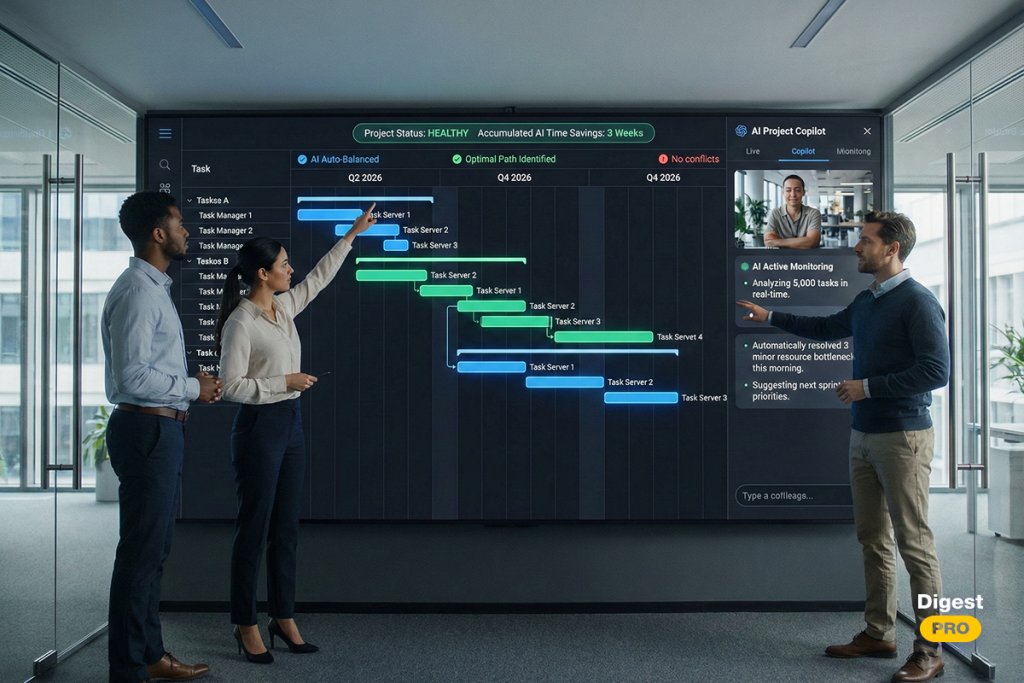
Artificial intelligence (AI) is transforming project management in 2026. Companies are rearranging workflows throughout their business to take advantage of AI’s widespread use.
According to a McKinsey‘s ‘The state of AI‘, 88% of organizations are using AI in at least one business function.
The report indicates that 79% of businesses use generative AI regularly.
However, almost two-thirds of organizations are yet to leverage scaling of AI systems from a pilot to other stages. The survey notes that high-performing organizations achieve transformative outcomes more often. They succeed at 3.6 times the rate of others.
In this article, we will examine the best way to deal with this shift, utilize agentic systems, and integrate the techniques to ensure high performance outcomes.
What Is AI in Project Management?
Project management has begun to see the implementation of artificial intelligence (AI).
AI supplements human project managers with data and analytics. This technology helps leaders make well-informed decisions. It creates a cognitive barrier between data and final execution.
AI implementation changes how project managers interact with teams. Manual input from managers has decreased significantly. They now lead teams strategically using AI tools instead of routine tasks. This shift is vital for multi-project environments where resource over-allocation occurs often.
Artificial intelligence analyzes and sorts through massive volumes of real-time project data to provide organizations with proven accuracy.
Read more: Best Change Management Tools in 2026: Features, Use Cases & How to Choose the Right Software
AI and Project Management: The Real Role of Artificial Intelligence
When artificial intelligence is used in project management, it is meant to complement human ability. AI can process large volumes of repetitive data.
People possess the necessary abilities to negotiate, be empathetic, and solve complex problems. Thus, when combining these two capabilities, we see that AI plays an advisory role. It is a means of justifying (“why”) data-driven results.
Referred to as a “human-in-the-loop” approach, this collaboration between humans and their AI counterparts is not performed solely by technology.
AI generates scenarios and outcome probabilities. It identifies potential risks for each path. Business leaders then make the final decisions.
This accountability aligns projects with human values. It also ensures adherence to organizational culture.
AI provides the science of project management. Human leaders contribute the art.
AI Project Management Benefits
AI has significantly transformed project management practices and outcomes across most success metrics.
PM Solutions’ State of the PMO 2025 research shows 36% of PMOs use AI-supported practices to meet their goals, with high-performers at 61%, achieving their strategic targets.
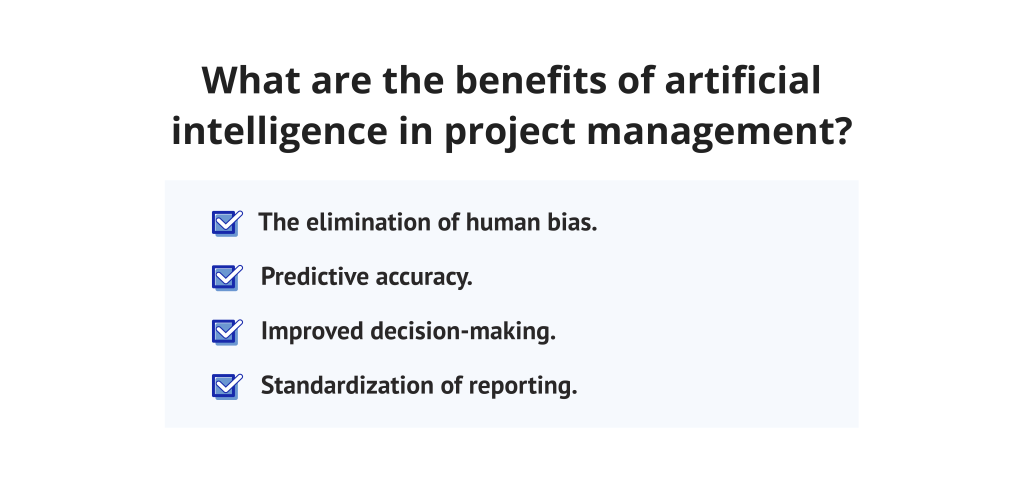
- The elimination of human bias: Human beings are typically optimistic and believe that projects will take far less time. Whereas an AI-based system monitors all performance and uses historical trends to produce measurable time expectations. Also, AI-based systems operate based on data and, therefore, do not possess any personal motives.
- Predictive accuracy: AI can predict and identify patterns in the past-present-future in project activities and timelines. Then, it will identify future delays before they occur based on the historical performance of similar projects. This provides a proactive approach, as opposed to a reactive approach. Instead of explaining a project’s tardiness, you are trying to avoid it.
- Improved decision-making: Instead of just making educated guesses about important projects, managers can use data-driven insights to run thousands of artificial intelligence simulations in a matter of seconds and see the consequences of their choices.
- Standardization of reporting: As mentioned above, artificial intelligence is able to address every project across every portfolio with the same logic-driven process and apply the same processes for standardizing reporting on a company’s projects. With this standardized reporting, company executives have an easier time comparing a project’s health throughout the entire company.
The advent of artificial intelligence has brought about continuous planning. Planning was previously considered an immutable entity; it was set in stone. Today, continuous planning refers to how the plan continually adapts to market forces, resulting in faster turnaround times required for the marketplace.
Read more: How to Build AI Agents Step-by-Step Guide
AI Use Cases in Project Management
AI applications in project management are defining the future of PM at this time, with several key AI applications used in PM today.
- Predictive risk assessment: AI analyzes thousands of separate tasks to find the one task that is most likely to be a “bottleneck” in a project’s flow of execution. AI also uses external factors to identify these tasks, including market conditions, vendor performance, etc.
- Automated status reporting: AI can instantly generate status reports based on the various audiences it is intended to report to by combining data from multiple sources (like Slack, Jira, and emails). For instance, a developer would receive a list of obstacles keeping them from finishing the project on schedule, while an executive would receive a high-level summary.
- Sentiment analysis: AI examines team communications to ascertain whether team morale is dropping and/or whether there may be conflict in the project. AI identifies when the pressure on a team is creating a situation where the quality of their work is beginning to degrade.
- Cost forecasting: AI applications utilize predictive analysis with 95% accuracy to identify potential budget overruns. These tools track the project’s “burn rate” in real-time. They recommend cost-saving measures that protect the project scope.
Disruption, Not Automation: How AI Is Transforming Project Management in 2026
We’re in the midst of an enormous shift in project management due to disruptors like artificial intelligence. It fundamentally changes the way project managers operate by shifting the “center of gravity” from managers to AI as the primary “source of truth” for project information. This transition frees project managers to focus more on managing people rather than merely reporting on project status.
AI will also bring about changes in how organizations are structured. While today, we generally have organizational structures defined by rigid hierarchies with managers sitting at the top and teams working below them, we are moving toward fluid project networks.
This means that teams will form and disband based on the AI’s recommendations concerning resources available for that project. The implementation of Fluid Project Networks into organizations will allow organizations to respond more quickly to unpredictable changes within their respective businesses and remain more resilient.
Examples of AI in Project Management: Epicflow Solution
As a specialized multi-project and resource management platform, Epicflow represents a pinnacle of AI integration in the field. It provides project managers with a comprehensive, holistic view of how current decisions will impact the entire portfolio up to six months in advance.
The Fever Chart monitors buffer usage across all projects simultaneously. It provides predictive indicators for project completion. These indicators show if projects finish within safety margins. Epicflow’s planning capabilities offer detailed insight into forthcoming challenges. In contrast, traditional PPM tools focus on reacting after issues occur.
As such, Epicflow will empower managers to act proactively rather than reactively and focus their energies on specific projects requiring urgent attention. While creating a steady stream of all projects within their project portfolio.
Ready to see the future of your portfolio? Book a conversation with Epicflow’s experts and learn how Epicflow’s AI-driven insights can transform your resource management strategy today.
Better Selection & Prioritization
AI-driven project management methodologies assist senior leadership teams in selecting and prioritizing projects with the highest likelihood of funding when developing a company’s overall portfolio across all business functions.
This approach aligns the overall portfolio with strategic objectives while filtering out low-value projects that senior leadership might otherwise push due to personal bias.
Leadership can now independently assess project proposals based on expected return on investment and existing resource constraints by utilizing the AI technology that Epicflow provides.
Support for the project management office
In the past, the PPMO has served an important function as a “policing” agent with respect to managing data entry and penetration during the project process.
Artificial intelligence in project management now automates PPMO governance processes. This shift empowers the office to generate success through more effective mentoring and improved methodologies.
The PPMO will become a “Center of Excellence” rather than merely a vehicle for reporting; it will also become a value-generating rather than a cost-generating function.
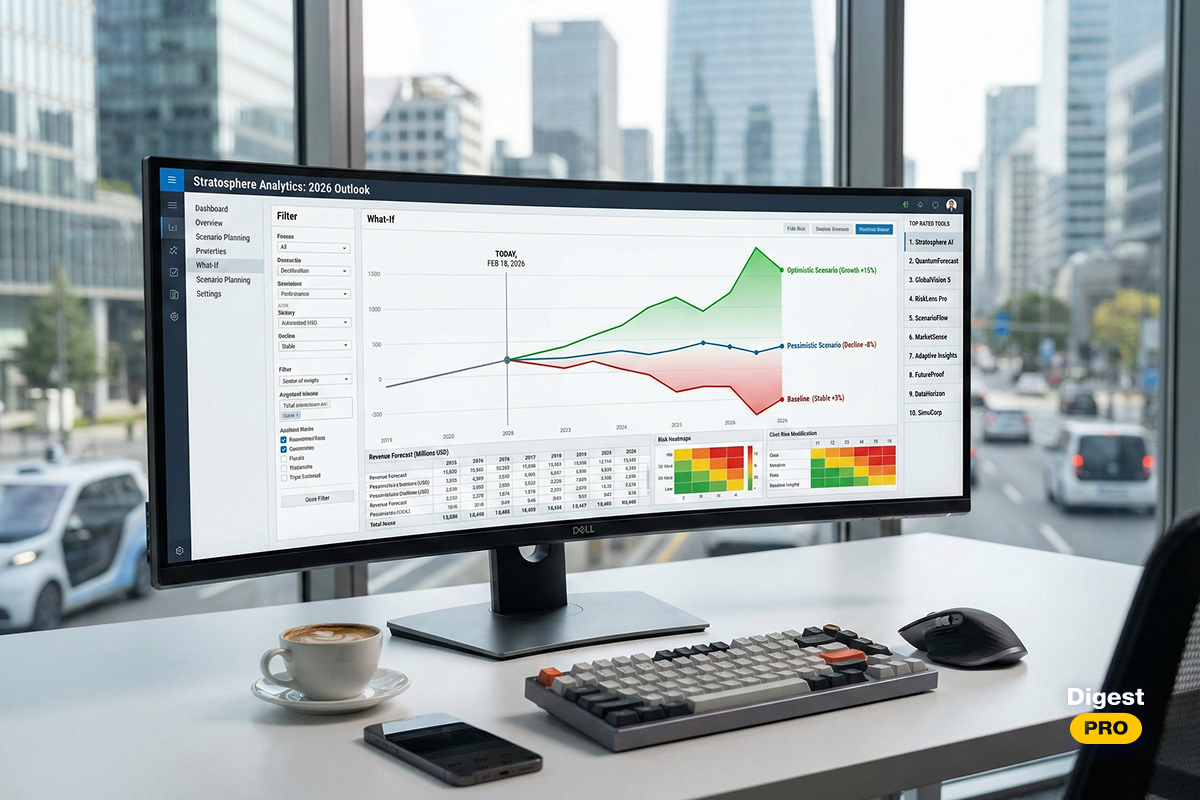
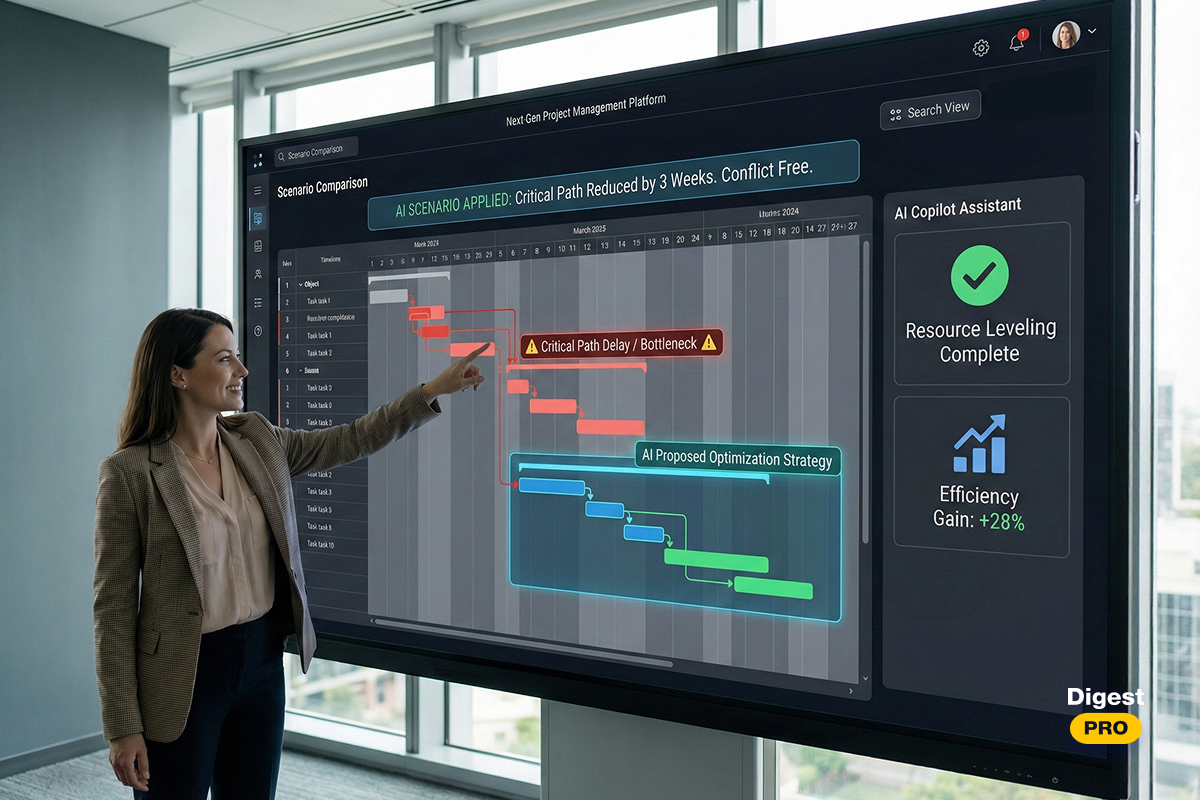
What drives this change is What-if scenario planning and predictive analysis. What-if planning in Epicflow enables the PMO to play out different options on resource allocation to determine its effects on the entire portfolio before committing to it.
Predictive analysis allows it to predict how a project is doing by comparing its present status to its history, thus allowing it to be proactive in its strategy instead of firefighting.
Improved, faster project definition, planning, and reporting
AI makes it a lot easier to figure out what a project is, make a plan for it, and tell people about it. When you use AI, you can make a list of all the work that needs to be done, called a work breakdown structure, fast.
All you have to do is enter a description for a project. You can then select some similar projects that have been completed in the past, where you can let the AI automatically transfer all the tasks that were involved in these older projects into a new list of work that you have. This way, AI helps with project planning and reporting.
It helps with the work breakdown structure, which is a big part of project planning. Previously, this process was performed through several meetings that occurred over a two-week period; now, by entering information into an AI-enabled system, the entire process can be completed within two minutes.
Virtual project assistants
Proactive assistance
Epica by Epicflow is a state-of-the-art proactive personal assistant that continuously monitors resource performance in real time and immediately sends alerts to the project manager if those resources begin falling behind.
Moreover, it offers very accurate calculations of how many days the trend in current resource utilization will prolong project milestones. Epica acts very much like a “co-pilot” that is “on duty 24/7,” making sure nothing gets missed with its constant oversight and predictive warnings.
Reactive assistance
Epica also works as a strong reactive personal assistant that helps project managers get instant answers to critical project questions. For example, when a project manager asks, “How can I use AI for project management in order to overcome this bottleneck?”, Epica gives a set of data-driven solutions. In this way, project managers are able to directly speak with their project data.
This includes running complex “what-if” queries such as: “What will happen if we postpone this feature for two weeks?”
A new role for the project manager
AI gives project managers the chance to evolve. The PM now becomes a “project leader.” They manage stakeholders, negotiate for resources, and motivate team members.
AI handles the logging and maintenance of project records. It also performs all complex calculations.
This shift lets the PM concentrate on maximizing human ROI. They focus on maintaining high employee engagement and client satisfaction.
Read more: Enterprise AI Adoption Barriers in 2026: Why Most Enterprises Get Stuck with Digital Transformation
How to Use AI in Project Management: Necessary Circumstances
Artificial intelligence (AI) can be an effective way to manage projects, but it requires several prerequisites to function effectively. Simply turning on an AI system and waiting for miracles is not realistic.
There should be access to essential project data.
AI relies heavily on data to function effectively. Historically tracked project data is used to create the “knowledge base” that powers AI’s predictions. Therefore, if an organization has not previously collected or recorded time, task, or project-related information, AI has nothing to examine and analyze. Data fuels AI artificially.
Project data should be prepared and managed in a appropriate way.
The concept of “garbage in, garbage out” still exists. As such, the data from your project needs to be accurate, precise, and consistent. A single source of truth for all data project-related is one of the corner principles when it comes to best practices of AI project management. Data retained in separate and/or disconnected spreadsheets is counterproductive when trying to implement AI.
Correct interpretation of the information provided
AI does not indicate “certainty” but rather a “probability.” As such, AI provides managers with insights to make informed decisions but does not compute definitive decisions. In order to combine the correct judgment with the findings of AI, managers must develop a new set of abilities to understand how algorithms produce results and recognize where the algorithm may show bias. This is what we now refer to as AI literacy.
Key AI Trends in Project Management
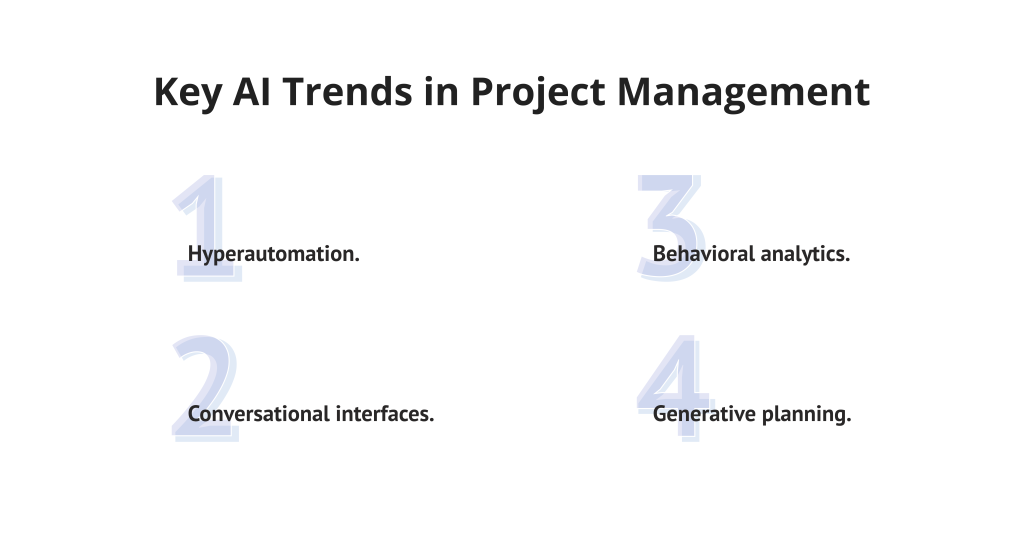
Project managers need to keep an eye on AI trends in their projects. This is really important if they want their projects to stay ahead of the game. Project managers have to stay on top of intelligence trends to be competitive.
- Hyperautomation is going to change things. The majority of the repetitive work that people do for project management, like setting up meetings and balancing the budget, will be done using hyperautomation. This means that hyperautomation will take care of tasks such as scheduling meetings and reconciling budgets, which are typically repetitive project management functions.
- Conversational interfaces: You can interact with your project data using a conversational interface rather than going through a complicated dashboard.
- Behavioral analytics: AI uses data regarding the working habits of teams to determine the best times to assign difficult tasks and evaluates how productive each team member is.
- Generative planning: The use of AI technology allows project managers to create entire project plans, including risk logs and communication strategies, based on a single-page project brief.
PMI Pulse of the Profession 2025 report shows a 57% surge in hybrid project models, with only 20% of PMs possessing strong AI skills—underscoring the need for upskilling to leverage generative planning fully.
The above trends will make the discipline of project management more scientific rather than relying on “gut feeling.”
Read more: Leading Digital Health Trends that Modernize Traditional Care Paradigm
The Future of Project Management with AI: Conclusion
AI creates an easier and more rewarding future for project management. Project managers abandon outdated spreadsheets and manual systems to save time. They focus their energy on creative strategy and innovative project development instead. This shift represents a necessary evolution for every modern enterprise. Adaptive leaders gain a massive competitive edge in the global market. Companies ignoring this trend will fight 2026 challenges with obsolete 2016 tools.
Key Takeaways for 2026
- AI automates routine tasks to expand leadership capacity.
- Predictive analytics improve decision accuracy across the entire portfolio.
- Managers evolve into strategic leaders who drive high-value innovation.
- Enterprises achieve resilience by adopting fluid and responsive project networks.
Take your projects into the future, not back. Epicflow supports portfolio managers in optimizing budget and resource allocation across complex environments. Contact Epicflow’s experts today to maximize your portfolio value and turn strategy into measurable results.
Frequently Asked Questions (FAQs)
1. What is the role of AI in project management?
AI in project management supports the project manager by enabling them to be more efficient by focusing on what they do best. AI will take care of the following:
- Data analysis;
- Impacts of risks;
- Optimizing resource utilization and many others.
With AI, a project manager will be able to do much more than they can do before without increasing their workload.
2. How to use AI for project management?
To use artificial intelligence for project management, the first thing you need to do is get all the project information in one place so everyone involved can see it.
The next thing to do is to use artificial intelligence tools that can look at the information and make predictions about what will happen, and also make schedules for you.
The last thing to do is to make sure everyone working on the project makes decisions based on the information they have, which is what project management is all about, and this is how you create a project management culture where artificial intelligence and data are really important.
3. Which AI tool is best for project management?
There is no universally recognized best AI tool used in project management. This depends upon the nature of the organization and its needs. Of the hundreds of different AI tools available today, many people regard Epicflow as the leading AI tool for managing multiple projects and “what-if” scenario planning.
4. Will project management be replaced by AI?
No, the human project manager will never be replaced by artificial intelligence. AI and machine learning will take care of the parts of managing a project and do the boring tasks that people do over and over. But people will still be in charge because they have feelings and can understand how others feel; they can talk to people. They agree and have a clear idea of what they want to achieve. The human project manager will always be the one to lead the project so that the project goal is met.
5. What is the future of AI in enterprise project management?
The future of AI in project management at an enterprise level is a “Living Strategy” ecosystem where execution data and business strategy are completely intertwined. With AI in project portfolio management, the system will automatically adapt to real-time ROI and resource capacity to ensure the company is always working on high-value tasks. The movement toward AI-driven project management thus gives rise to “Self-correcting portfolios” that autonomously re-allocate budgets to the most strategic opportunities, making strategy dynamic like an execution engine.
6. What are AI project management best practices?
The best practices involved in AI project management include the maintenance of quality data at every step of the project, being transparent with the project team members about the project progress, and making it a habit to verify AI results by exercising human judgment. It is never a good practice to trust the final judgment of AI.
7. Why do companies choose AI project management over alternatives?
Organizations implementing AI project management solutions do so for several reasons. Firstly, traditional project management methods are unable to fully meet the enormous speed and scale of today’s commerce. Secondly, the AI-powered solutions provide the agility and accuracy necessary to succeed within an extremely competitive environment and reduce the cost of failure.