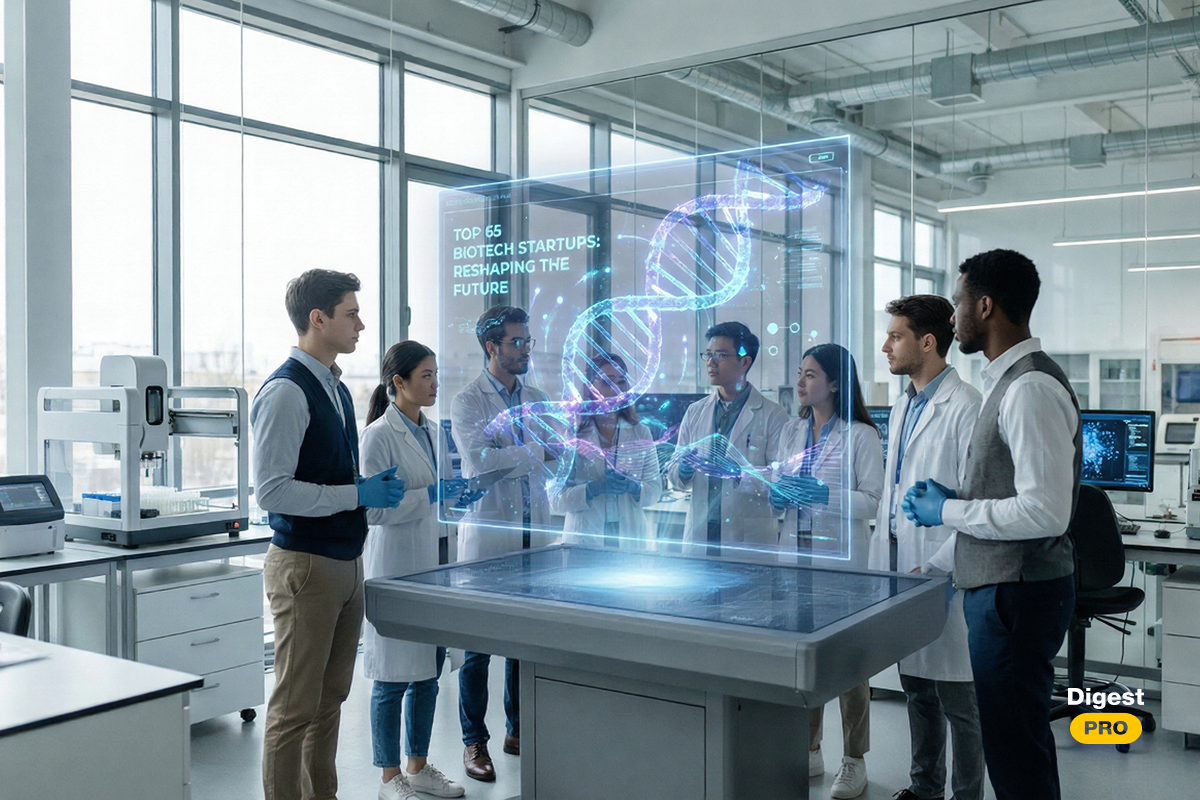
Picture an AI machine that can correct errors in DNA. Sounds incredible, doesn’t it? Though unlikely at first glance, the combination of artificial intelligence and genetic data turns theory into practice—especially among emerging biotech startups.
Instead of long trial phases, machine learning guides compound selection, cutting years off timelines across international research networks. For decision-makers, clarity comes through structured planning amid rapid sector expansion.
In this review, our experts curated the biotech industry and discovered the future of global biotechnology enterprise growth. Let’s get started!
Strategic Spotlight: Best 10 Innovative Biotech Startups Redefining the Industry
1. Kailera Therapeutics
From a foundation in biotech, Kailera Therapeutics directs effort toward emerging methods in metabolic health. Rather than broad approaches, refined peptide structures guide therapy development for obesity and linked disorders.
Strong momentum follows clear evidence of improved trial results, standing apart from first-phase GLP-1 receptor activators. Performance benchmarks show measurable advances where earlier compounds showed limits.
Which problem does the startup solve? Kaliera Therapeutics is reducing the side effects and improving the long-term outcomes of weight-loss therapies.
2. Isomorphic Labs
Startups rarely carry such weight, yet Isomorphic Labs stands apart. Born from Google DeepMind, its roots run deep in artificial intelligence soil. Protein puzzles once deemed impossible now bend to prediction models. Instead of relying on lab-heavy routines, computation leads the way here.
Accuracy levels shift because algorithms see what microscopes miss. Drug design transforms when code guides chemistry. The old trial-and-error rhythm fades under data-driven motion.
Which problem does the startup solve? The high failure rate and extreme cost of traditional molecule screening.
3. Tune Therapeutics

A biotech startup launched alongside Nobel recipient Jennifer Doudna explores health solutions through CRISPR methods. With a focus on precision, the biotech company’s aim lies in shaping biological systems using find-and-modify approaches ahead.
Which problem does the startup solve? Treating diseases where gene over- or under-expression is the root cause without permanent DNA alteration.
4. NewLimit
A fresh twist in biotech startups, NewLimit is a biotechnology enterprise that works boldly on stretching healthy life years. Instead of accepting tissue decay, this biotech enterprise turns cells back using reprogramming tricks. Treating age like software code opens doors—glitches get fixed at the root level. When biology resets this way, old-body slowdowns might just vanish.
Which problem does the startup solve? The immune system and tissue function decline systematically as people get older.
5. Beam Therapeutics
One step ahead in base editing, Beam Therapeutics tweaks genes with a subtler touch than older methods. Instead of slicing DNA apart, their tools swap single letters cleanly. Because it avoids messy cuts, the method stands out among genetic therapies. That quiet accuracy places them near the front in treating uncommon conditions.
Which problem does the startup solve? The biotech company fixes individual DNA letter errors tied to inherited conditions.
Read more: Top 45 Renewable Energy Startups of 2026: Leading Green and Solar Energy Startups in the Global Transition.
6. Vivodyne
On silicon chips, Vivodyne creates small-scale lab settings where human tissue grows in large amounts instead of using animals. These miniaturized organ copies act much like real ones do inside the body. Because of this, biotechnology companies depend less on traditional testing methods.
Each tiny organ replica responds like its natural counterpart. Biotech enterprises use this method to reduce reliance on outdated models. Progress unfolds without the usual delays tied to older techniques.
Which problem does the startup solve? The lack of human-centric data in the early stages of the drug discovery process.
7. Mammoth Biosciences

Beginning with a Nobel winner at the helm, Mammoth Biosciences emerged from Jennifer Doudna’s vision. This biotech business channels its efforts into CRISPR-powered health solutions.
Instead of settling for what exists, this biotech company pushes toward advanced biological tools that find and alter the genetic code. Notably, biotech enterprise stands among the leading biotech startups redefining how molecules are detected.
Which problem does the startup solve? The problem is the need for fast, cost-effective, and highly precise detection of various diseases in different environments.
Read more: 15 Best ERP Software for Small Businesses Reviewed in 2026
8. Colossal Biosciences

Astonishing advances emerge when science meets preservation—this defines Colossal Biosciences. Though famed for reviving lost species like the woolly mammoth, this biotechnology startup’s path diverges beyond spectacle. Instead of mere resurrection, the biotechnology company’s focus shifts toward tools shaping genetic resilience. Because innovation persists here, new methods surface quietly beneath bold aims.
While extinction reversal captures attention, lasting impact grows from subtler breakthroughs. Therefore, progress unfolds not only in comebacks but also in usable biological frameworks.
Which problem does the startup solve? The decreasing of biodiversity and the degradation of critical ecosystems.
9. Altos Labs
Altos Labs is a large biotechnology company that has secured vast funding from private sources. They are concentrating on biological reprogramming as a means to recover cell health and strengthen cells. The company’s top-notch research team is delving into ways of cellular-level disease reversal.
Which problem does the startup solve? Chronic organ failure and age-associated tissue degeneration.
Read more: Top 67 Startups in Germany to Watch 2026: AI, Unicorns & GreenTech Leaders
10. Neuralink
Neuralink was founded by Elon Musk and now stands as the premier biotechnology company pushing the boundaries of neural engineering. This biotechnology startup’s core work links human thought patterns to computing systems using high-speed data transfer methods. Although media attention leans toward everyday applications ahead, clinical restoration remains central to its near-term vision.
Which problem does the startup solve? Paralysis, blindness, and severe communication disorders caused by brain or spinal injury.
If you don’t want to skip essential updates, game-changing releases, and trends that are taking over the market at lightning speed, subscribe to Digest.pro.
Quick Review: Comparison Table with the Remaining 55 Promising Biotech Startups
Biotech business | Founded | Headquarters | Niche | Key Funding/Status |
|---|---|---|---|---|
Xaira Therapeutics | 2024 | San Francisco, CA | AI-powered drug discovery | $1B launch funding; early pipeline in oncology |
|
Hera Biotech |
2020 |
Boston, MA |
Endometriosis diagnostics |
$20M Series A; Phase II trials advancing |
|
RAGE Biotech |
2019 |
Cambridge, UK |
Chronic lung disease therapies |
£15M raised; preclinical data published |
|
Andson Biotech |
2021 |
San Diego, CA |
Mass spectrometry platforms |
$12M seed; DynaCHIP tech in beta |
|
LatchBio |
2020 |
Richmond, CA |
Cloud bioinformatics |
$28M Series A; live with pharma partners |
|
Glyphic Biotechnologies |
2020 |
New York, USA |
Protein sequencing |
$6M seed; ClickP prototypes operational |
|
HydRegen |
2021 |
Oxford, UK |
Green enzyme catalysts |
£2.6M Series A; reactor pilots running |
|
SpliceBio |
2019 |
Barcelona, Spain |
Intein gene splicing |
€20M Series A; IND filing planned 2026 |
|
ElevateBio |
2017 |
Waltham, MA |
Gene/cell therapies |
$1.2B Series D; multiple portfolio assets in clinic |
|
Bionaut Labs |
2016 |
Los Angeles, CA |
Micro-robots for brain delivery |
$63M Series B; glioblastoma trials starting |
|
Ginkgo Bioworks |
2008 |
Boston, MA |
Synthetic biology platform |
Public; $1B+ revenue pipeline in bio-manufacturing |
|
Recursion Pharmaceuticals |
2013 |
Salt Lake City, UT |
AI phenotyping for drugs |
Public; Phase II assets in rare disease |
|
Absci |
2011 |
Vancouver, Canada |
AI-generated antibodies |
Public; $200M+ funding; wet lab validation |
|
Cradle |
2021 |
Amsterdam, Netherlands |
Protein design AI |
$100M+ raised; early therapeutics |
|
Vilya |
2020 |
South SF, CA |
Computational small molecules |
$50M Series A; structure prediction focus |
|
Orna Therapeutics |
2019 |
Cambridge, MA |
Circular RNA therapies |
$221M Series B; oncology preclinical |
|
Rejuvenate Bio |
2019 |
Rockville, MD |
Gene therapy for aging |
$219M raised; cardiac trials Phase I |
|
Retro Biosciences |
2022 |
Redwood City, USA |
Longevity reprogramming |
$180M seed; autophagy induction |
|
Synapticure |
2019 |
New York, USA |
AI neurology platforms |
$10M+; telehealth for rare diseases |
|
Benchling |
2012 |
San Francisco, USA |
Biotech R&D software |
$100M+ Series F; ELN used by 1000+ labs |
|
Asimov |
2017 |
Boston, USA |
Genetic design automation |
$200M Series B; cell therapy engineering |
|
Generate Biomedicines |
2018 |
Somerville, USA |
Generative biology |
$700M+; protein therapeutics in clinic |
|
Maze Therapeutics |
2018 |
South SF, USA |
Kidney disease genetics |
$150M+; Phase II in APOL1 mediation |
|
Obsidian Therapeutics |
2018 |
Cambridge, USA |
Ctrl-EGFR gene control |
$200M Series B; immuno-oncology |
|
Skylines Bio |
2023 |
Berlin, Germany |
De novo biologics AI |
€30M seed; antibody pipeline |
|
Aera Therapeutics |
2022 |
Cambridge, USA |
siRNA delivery |
$200M Series A; liver targets |
|
Korro Bio |
2020 |
Cambridge, USA |
RNA editing |
$146M IPO; ADAR editing platform |
|
Larrix |
2022 |
Zurich, Switzerland |
In vivo CAR-T |
$55M Series A; solid tumors |
|
Parallel Bio |
2023 |
Boston, USA |
In vivo antibody discovery |
Undisclosed; mouse model platform |
|
Seranova Bio |
2021 |
Houston, USA |
Brain drug delivery |
$97M Series A; nano-particles |
|
Adagio Therapeutics |
2016 |
Waltham, USA |
Respiratory antibodies |
Public merger; asthma focus |
|
AmplifyBio |
2021 |
Athens, USA |
CRO acceleration |
$50M+; GLP testing |
|
Arvinas |
2015 |
New Haven, USA |
Protein degradation |
Public; Phase III PROTACs |
|
BiblioMed |
2022 |
Singapore |
AI clinical trials |
$15M seed; patient matching |
|
Cellino |
2018 |
Cambridge, USA |
Stem cell automation |
$80M Series B; iPSC scaling |
|
Dyno Therapeutics |
2018 |
Watertown, USA |
AAV capsid engineering |
$100M Series A; gene therapy vectors |
|
Eligo Bioscience |
2014 |
Paris, France |
Microbiome editing |
€35M Series B; skin diseases |
|
Enveda Biosciences |
2019 |
Fresno, USA |
AI natural products |
$52M Series B; pain therapeutics |
|
Fabric Genomics |
2016 |
Oakland, USA |
Genomic analytics |
$40M+; pediatric diagnostics |
|
GenEdit |
2017 |
South SF, USA |
Non-viral delivery |
$60M Series A; lipid nanoparticles |
|
Humacyte |
2004 |
Durham, USA |
Bioengineered vessels |
Public; dialysis access FDA approved |
|
Iambic Therapeutics |
2020 |
Boston, USA |
Physics-based design |
$65M Series A; small molecules |
|
Kallyope |
2016 |
New York, USA |
Gut-brain therapeutics |
$252M Series D; obesity pipeline |
|
Kyverna Therapeutics |
2018 |
Berkeley, USA |
CAR-T for autoimmunity |
Public; lupus Phase II |
|
Lava Therapeutics |
2016 |
Utrecht, Netherlands |
Gamma-delta T cells |
Public; solid tumors |
|
Lyell Immunopharma |
2015 |
Seattle, USA |
Exhaustion-resistant CAR-T |
Public; melanoma trials |
|
MacroGenics |
2000 |
Rockville, USA |
Bispecific antibodies |
Public; cancer partnerships |
|
Mirador Therapeutics |
2020 |
Menlo Park, USA |
Immunology precision |
$200M Series B; asthma subtypes |
|
NextPoint Therapeutics |
2020 |
Boston, USA |
T cell agonists |
$146M Series A; immunotherapy |
|
OrxAI |
2023 |
Tel Aviv, Israel |
AI protein engineering |
$20M seed; binder design |
|
Pact Pharma |
2019 |
New York, USA |
Neoantigen T cells |
$80M Series A; personalized cancer |
|
PureTech |
2012 |
Boston, USA |
Platform therapeutics |
Public; gut-brain axis |
|
Rallybio |
2018 |
New Haven, USA |
Rare disease biologics |
Public; fetal/neonatal focus |
|
Revelation Biosciences |
2018 |
San Diego, USA |
Innate immune therapies |
Public; ARDS prevention |
|
Sana Biotechnology |
2019 |
Seattle, USA |
Hypoimmune stem cells |
Public; diabetes Type 1 |
|
Tempus AI |
2015 |
Chicago, USA |
Precision oncology data |
Public; $1B+ valuation |
Read more: Top 51 Startups in Poland to Watch in 2026: Investment Executive Guide.
Final Words: The Future Biotech Startup Industry Landscape
Several pivotal transformations are shaping the future of the biotech industry:
- Integration of Tech and Bio: With the rapid development of modern technologies, in particular AI, the accurate border between technology and biotechnology is blurring. Increasingly, worth ties to algorithms and exclusive datasets instead of experiments alone.
- New leadership paradigm: Biotech industry success now demands leaders with dual expertise in both biological sciences and software engineering.
- Global decentralization: Although Boston and San Francisco are still very important, new hubs in Singapore, London, and Berlin are becoming more vibrant. The biotech startup companies of the future is a global entity that consists of distributed teams and cloud-based labs.
- Social value and ethics: The public is changing its attitude as life-saving therapies are being developed. Nevertheless, the ones who will be the most successful biotech startups in the future are those who can perfectly combine profit-making with ethics and worldwide accessibility.
In the modern world, the market conditions alter every day. To stay tuned to the freshest news in the startup industry, subscribe to Digest.Pro.
Our Methodology: How We Selected the Top Biotech Startups
Our methodology was specially developed by a team of experienced experts and relies on a data-driven approach. Experts conducted independent, comprehensive research in the biotech startup industry. Beginning with a global pool, our team analyzed more than 500 biotech startup companies. Then our specialists meticulously selected the top 65 biotech startups, relying on measurable evidence rather than assumptions.
The selection requirements include:
- Innovation level in the technological approach shaped early shortlisting decisions.
- Leadership quality played an equal role in determining final inclusion.
- Funding volume mattered less than progress toward commercial availability.
- Proximity to the market became a deciding factor when profiles appeared similar.
Read more: 15 Best Free ERP Software Reviewed in 2026
FAQ: Frequently Asked Questions About Biotech Startups
Biotech startup pay tends to match top industry standards. By 2026, those starting in research will bring in between $90,000 and $120,000 annually. Higher positions, including leadership on projects, typically go beyond $200,000—equity stakes included. In the biotech industry, there also exists a global tendency—the more experience you have, the higher your salary will be.
Right now, researchers emphasize obesity solutions—the latest being GLP-1-based—while also moving forward with aging studies and medical applications of artificial intelligence, gaining notable interest. Biotechnology startups like Kailera and Isomorphic Labs become visible within today’s investment trends.
Revenue often comes to biotechnology enterprises via licensing agreements, though sometimes it arrives through milestones set by large pharmaceutical partners. Approval from the FDA can open paths to income through selling products directly. Sometimes funds emerge not from sales but from structured payouts tied to development stages.
A starting point emerges—often called Discovery. Following that comes the seed phase activity. Then validation takes shape under Series A conditions. Growth begins, marked by scaling efforts in Series B. Expansion follows, labeled as Series C or beyond. Before public trading, there is pre-IPO positioning. Finally, an outcome occurs: either an IPO or an acquisition completes the sequence.
The top biotechnology startup unicorns are Altos Labs ($3B+), Isomorphic Labs, Neuralink, and Colossal Biosciences.
NewLimit and Altos Labs are the foremost biotechnology startups to watch. They are the leaders in the longevity sector by commercializing cellular rejuvenation and changing the medical paradigm, modernizing aging as a biologically manageable condition.
Seconds suffice for artificial intelligence to analyze billions of simulated compounds. Folding patterns and harmful effects, and how tightly substances bind, can be predicted through these systems. Development expenses fall more than half due to such precision. Costs shrink where traditional methods once dominated.
Even though Cambridge (US) and San Francisco remain key, places such as London, Singapore, and Zurich have risen within the biotech startup world. With time, global distribution shifts beyond traditional strongholds into varied regions.
Yet funding amounts differed across companies. Some saw higher totals due to trial progress. Others attracted interest based on team background. Still, most fell within a predictable band. Because investor caution balanced scientific risk. Although promising data could shift valuations upward. Thus, patterns emerged despite variability.
Around 35 to 60 million dollars marks today’s typical Series A funding range. Lab setups plus niche expertise drive expenses upward, shaping these figures.
Changes to DNA at precise locations define gene editing. Starting fresh, synthetic biology designs new biological parts or systems. One tweaks existing life; the other brings entirely new functions into being. Where modification ends, construction begins. Structure by structure, known sequences are adjusted first.
References:
- 2026 Life Sciences Outlook. (2025, December 8). Deloitte Insights; Deloitte. https://www.deloitte.com/us/en/insights/industry/health-care/life-sciences-and-health-care-industry-outlooks/2026-life-sciences-executive-outlook.html
- Alvarez, D., Bleys, M., Khan, B., Wu, J., & Chandran, P. (2026, January 8). Biopharma Trends 2026. BCG Global. https://www.bcg.com/publications/2026/reimagining-business-models-biopharma-trends
- Top Strategic Technology Trends for 2026 | Gartner. (2025, November 3). Gartner. https://www.gartner.com/en/articles/top-technology-trends-2026
- Market Guide for Innovation Management Platforms. (2025). Gartner. https://www.gartner.com/en/documents/6825434
- Feldman, A. (2025, December 17). The Healthcare Industry Outlook For 2026. Forbes. https://www.forbes.com/sites/innovationrx/2025/12/17/the-healthcare-industry-outlook-for-2026/
- Laurent, A. (2025, December 26). Top Biotech Startups 2026: An Analysis of Emerging Trends. IntuitionLabs. https://intuitionlabs.ai/articles/top-biotech-startups-2026
- NextGen: Class of 2026. (2026). BioSpace. https://www.biospace.com/nextgen
- Bhaduri, U., & Merla, G. (2021). Ubiquitination, Biotech Startups, and the Future of TRIM Family Proteins: A TRIM-Endous Opportunity. Cells, 10(5), 1015. https://doi.org/10.3390/cells10051015
- Lewis, C. M., & White, J. T. (2022). Deregulating Innovation Capital: The Effects of the JOBS Act on Biotech Startups. The Review of Corporate Finance Studies. https://doi.org/10.1093/rcfs/cfac039
- How to successfully launch new biotech products | McKinsey. (n.d.). www.mckinsey.com. https://www.mckinsey.com/industries/life-sciences/our-insights/making-the-leap-from-r-and-d-to-fully-integrated-biotech-for-first-launch
- Gaurav Laroia, Califano, H., & Cooney, C. L. (2026, January 9). Leading Startups to Success: Leveraging Collective Learning Curves to Scale a Biotech. California Management Review Insights. https://cmr.berkeley.edu/2026/01/leading-startups-to-success-leveraging-collective-learning-curves-to-scale-a-biotech/
- StartUs Insights. (2025, August 15). 10 BioTech Startups to Watch in 2026 | StartUs Insights. StartUs Insights. https://www.startus-insights.com/innovators-guide/top-biotech-startups/
- Choudhary, V., Patel, K., Niaz, M., Mrunal Panwala, Mehta, A., & Choudhary, K. (2024). Risk Management Strategies for Biotech Startups: A Comprehensive Framework for Early-Stage Projects. CRC Press EBooks, 448–456. https://doi.org/10.1201/9781003596721-94