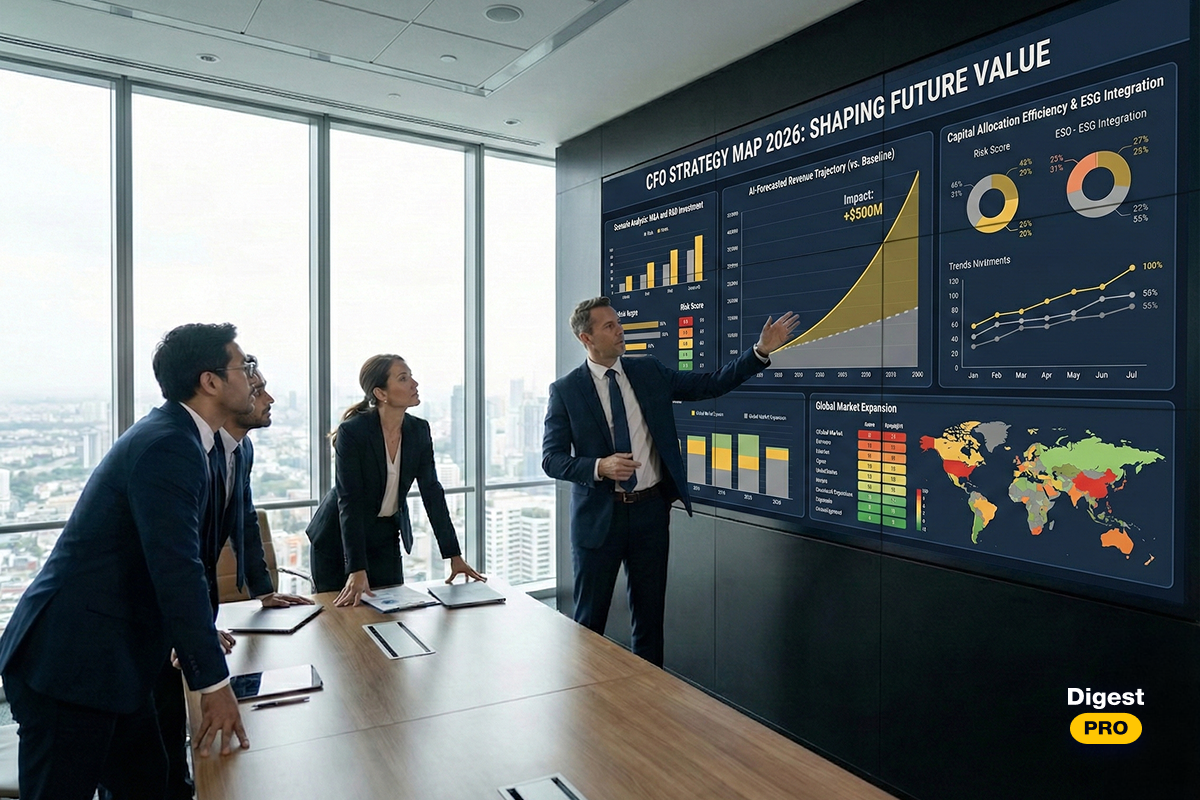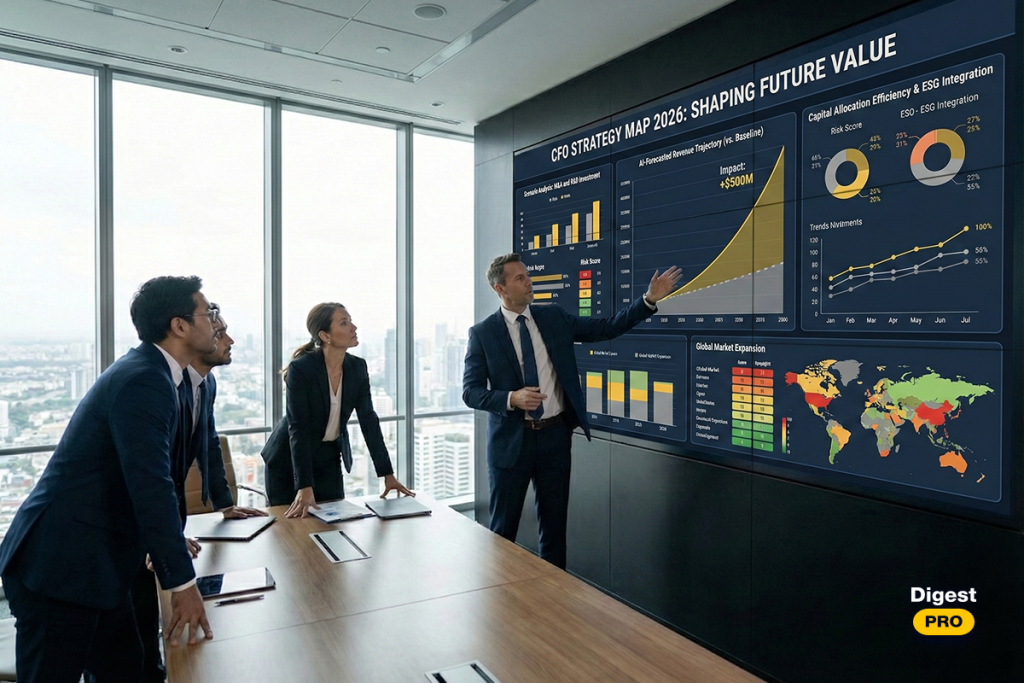
The era of the “bean counter” is officially over. The modern executive landscape reveals a finance leader whose mandate has fundamentally expanded beyond traditional fiscal oversight.
The global economy is witnessing unprecedented transformations in 2026 due to rapid technological growth and the evolution of geopolitical economies and locations. Finance leaders will play a significant role in these transformations.
The most important responsibility for finance leaders is to execute and implement new technologies while also maintaining financial integrity. This article explores some critical movements defining the financial landscape this year. We will examine how top leaders navigate complexity to drive sustainable growth.
Executive Summary: Key 2026 CFO Trends
- Autonomous finance: shifting from hype to real ROI via generative AI, real-time decisions, and Hyper-automation.
- Strategic evolution: The CFO position is evolving into a CVO seeking a balance between sound financial metrics and ESG plus operational efficiencies.
- Continuous planning: Traditional budgets are being replaced by rolling forecasts and moving toward continuous finance (24/7 visibility).
- Talent resilience: Leadership is addressing the significant 27% reduction in the CPA pipeline by hiring “bilingual” professionals who understand both GAAP and Python/SQL, while continuing to develop leaders with an emphasis on high-impact soft skills.
Why CFO Trends Matter More Than Ever
CFO trends are no longer optional. It is a matter of survival for modern enterprises. We live in a perma-crisis environment of constant volatility. Inflation continues to stay above normal levels, and interest rates seem to fluctuate almost unexpectedly.
- Supply chains have become incredibly fragile compared to previous years. Given the current landscape of volatility and uncertainty, the chief financial officer should be looked at as the ultimate navigator.
- Strategic alignment is the new gold standard for finance departments. Gartner: 56% of CFOs prioritize enterprise-wide cost optimization [1]. They are moving away from reactive reporting. Instead, they focus on predictive insights.
- Business leaders look to the CFO to validate new market entries. They look to finance to evaluate the risk of coming technologies.
- The investor landscape has changed. Stakeholders now demand transparency beyond the balance sheet.
By staying ahead of every major CFO trend, leaders can build institutional resilience. They transform the finance function from a cost center into a value creator. This shift defines the competitive advantage in 2026.
Read more: Artificial Intelligence as a Cognitive Prosthesis: A Critical Perspective on Technology’s Impact on Human Cognition
Top CFO Trends Defining 2026
Many different factors are coming together to completely change the way CFO’s perform their duties. To understand these changes, we have identified five key trends that are important to know today.
Trend 1: Generative AI and Hyper-Automation
Artificial intelligence has moved past the hype cycle. In 2026, we see the rise of “autonomous finance.” This is a major pillar among current CFO tech trends.
Finance teams use generative AI to automate complex workflows. They no longer spend weeks on manual reconciliations. Instead, AI agents handle routine accounting tasks in real time.
However, a striking disconnect exists within the sector. According to Gartner, while 84% of finance departments are currently rolling out AI initiatives, a mere 36% of CFOs feel confident in driving meaningful AI outcomes [1]. This gap highlights a critical need for better strategic oversight.
Additionally, AI is revolutionizing decision support. CFOs now use Large Language Models (LLMs) to query financial data.
The system provides an instant, data-backed answer. This level of technology trends for CFO adoption allows for real-time strategic adjustments. It moves finance from “what happened” to “what will happen next.”
Trend 2: The Rise of the “Chief Value Officer”
The scope of finance is expanding into non-financial territories. Deloitte 2026: 57% of finance leaders now rank among top strategy influencers across organizations [2].
A 2024 Deloitte analysis found that CFO job postings require 19% more skills, with risk management demands more than doubled [2]. These strategy-influencing CFOs handle 20% more responsibilities than their peers.
Regulators now require the same level of rigor for carbon reporting as for revenue. CFOs are the only leaders with the expertise to build these robust ESG (Environmental, Social, and Governance) frameworks while driving enterprise growth.
Trend 3: Real-Time “Continuous Finance”
The traditional month-end close is becoming obsolete. Leading organizations are moving toward a “continuous close” model. This is one of the most vital CFO technology trends today.
By using cloud-native ERP systems, data flows into finance systems instantly. CFOs can see the company’s financial health at any given second.
Trend 4: Strategic Cost Discipline and Efficiency
In an era of economic uncertainty, cost discipline has returned as a foundational priority for finance leaders.
However, the distribution of this responsibility varies across organizations. A recent survey indicates that just over a third (36%) of finance leaders—and 42% of CFOs specifically—are primarily responsible for their organization’s cost and expense management [2]. This suggests that while cost discipline is a top-tier trend, its execution often requires cross-functional collaboration.
CFOs are working closely with department heads to identify and eliminate redundant expenditures through granular data analysis.
Moreover, the CFO must maintain a lean operating model that can weather sudden market contractions. Evaluating the ROI of every internal process is now standard practice.
In 2026, a CFO who lacks a rigorous grip on cost structures risks organizational stability. They must ensure that the “fiscal engine” is running at peak efficiency. This focus on sustained profitability is a defining characteristic of the future CFO.
Trend 5: The Digital Finance Talent Crisis
The effectiveness of new technology relies entirely on the expertise of those operating it. As artificial intelligence automates routine activities, CFOs are forced to navigate a tightening labor market through these key shifts:
- The labor squeeze: Finance departments face a dual threat: CPA exam candidates have plummeted by 27% over the last decade, while the volume of accounting graduates continues to slide [6].
The need for bilingual professionals: Companies are fighting to find employees who can use both generally accepted accounting principles (GAAP) and technical programming languages, such as Python and SQL. - The importance of soft skills: As artificial intelligence (AI) takes over the processing of data, human-centric skills, such as empathy, storytelling, and more complex negotiations, are the new premium.
- The culture of redesigning organizations: Forward-thinking Chief Financial Officers (CFOs) are creating collaborative workspaces where their employees serve in strategic consulting roles, rather than as back-house support services.
That’s why many CFOs are redesigning their organizations to encourage creativity and innovation through an atmosphere of collaboration. They are building a culture where finance experts act as internal consultants.
Keeping up with these various changes within the finance field can be difficult because there is a great deal of change in the finance landscape that occurs every day. Subscribe to our resource Digest.pro to receive current resources for the financial field at your doorstep.
Read more: 8 Best Open Source Product Management Software of 2026
How CFO Trends Are Changing Financial Planning and Forecasting
In 2026, the CFO’s financial technology trends have pushed us toward adaptive planning. This approach allows for constant adjustment. Finance leaders now plan for multiple scenarios simultaneously.
Thus, FP&A, or Financial Planning and Analysis, is now a credible and proactive powerhouse. It means making use of a “Digital Twin” to operate a simulated version of the business and to predict how a strike, for instance, a new competitor, or a tech revolution could affect a business. It eliminates the “surprise factor” during an earnings call and creates a certainty that previously did not exist.
Moreover, decentralization is key. Modern CFO priorities include pushing planning capabilities to the edges of the organization. Department heads now have access to simplified financial tools.
They can see the financial impact of their decisions in real time. This democratization of data empowers every manager to think like a CFO. It creates a more fiscally responsible culture across the entire enterprise.
Read more: Enterprise AI Adoption Barriers in 2026: Why Most Enterprises Get Stuck with Digital Transformation
Challenges CFOs Face When Adopting New Trends
There are important obstacles to modernization that extend far beyond financial constraints.
- The ROI gap
Even though the imperative to innovate has rarely been more compelling, a lack of tangible “return on investment” assurance would appear to represent a considerable “confidence gap” for a number of organizations.
- Persistent data silos.
The issue of legacy is another difficult challenge on the table. Modern organizations may be using aging ERP systems, which were typically not easy to integrate with other AI tools. It generally takes huge capital and several years of migration efforts simply to address the “heavy technical debt.”
- Critical talent shortage
The labor squeeze is perhaps the most immediate threat to trend adoption. With a 27% decline in CPA candidates and fewer accounting graduates, the talent pool is shrinking just as the need for data-literate professionals grows. CFOs are struggling to find “bilingual” staff who can handle both core accounting and advanced data science.
- Regulatory and ethical compliance
With increasing advancements in finance roles that are expanding into the realms of ESG and AI, the regulatory environment is definitely no less than a thick forest. Today, for CFOs, there is an added challenge of ensuring that the ethics of automated decision-making processes remain top-notch while ensuring that even external reporting does not lack the high level of scrutiny that is mandated for fiscal responsibility reporting.
Read more: Best Change Management Tools in 2026: Features, Use Cases & How to Choose the Right Software
What the Future Holds: CFO Trends Beyond 2026
The trajectory of the finance function points toward a total integration of strategy, ethics, and high-performance computing. Looking toward 2030, three pillars will define the next generation of financial leadership.
- The “Chief Value Officer” Transformation
The transition from CFO to CVO will be complete. Finance leaders will no longer be judged solely by their ability to manage cash flow.
Instead, their success will depend on how they preserve and create value across the entire enterprise ecosystem. This includes managing intellectual property, brand reputation, and environmental impact as core balance sheet items.
- Quantum finance
As quantum computing becomes accessible, the “Autonomous Finance” department will move from theory to reality. Complex risk modeling that currently takes days will happen in nanoseconds. This will allow for hyper-personalized financial products and real-time strategic pivots that are purely data-driven.
- Integrated global reporting
We are moving toward a world of “radical transparency.” Integrated reporting will blend financial and non-financial data into a single, real-time stream for investors and regulators. Utilizing decentralized platforms and Web3 technologies, CFOs will manage assets across various digital realms, requiring a level of strategic flexibility and knowledge of smart contracts that is only beginning to be imagined today.
Keeping ahead of that requires a willingness to continually learn. What kinds of technology are worth the investment? What kinds of technology are simply noise? These are things that our team at Digest.pro lives every day as we chart these movements globally. Staying ahead of a potential shock in your finances can only be achieved by subscribing to a subscription service.
Our Methodology
Our research for this 2026 report is based on Deloitte (1,300+ leaders) and Gartner CFO surveys [1][2]. We synthesized thousands of pages of white papers on CFO & finance technology trends.
Moreover, we went ahead to monitor real-time market shifts, as well as regulatory changes. This multi-layered approach ensures the accuracy and actionability of our findings. We avoid speculative hype. Instead, we focus on verified patterns and proven strategic shifts.
Read more: How to Build AI Agents Step-by-Step Guide
Key Takeaways for Finance Leaders
The key takeaways provided here will highlight the key things that should serve as the strategic view for the modern CFO:
- Strategic orchestration: The way the CFO executes their responsibilities has significantly changed from a fiscal management position to that of strategic architect for the company and a collaborative partner to the CEO.
- Operational resilience via real-time insights: Transitioning to continuous finance and rolling forecasts is critical to navigating the “perma-crisis” environment and maintaining agility.
- ROI-centric innovation and data governance: Success depends on bridging the AI confidence gap. This requires moving from pilots to measurable results backed by unified, clean data layers.
- Holistic value creation (ESG & Efficiency): Sustainability and cost discipline are no longer separate functions but central pillars of the emerging “Chief Value Officer” remit.
- Human capital and cultural transformation: Addressing the talent shortage requires a new breed of “bilingual” professionals who can blend core accounting with advanced data science and soft leadership skills.
By embracing these CFO priorities, the CFO has the ability to navigate any turbulent waters through exceptional leadership and will continue to create value for the organization and its stakeholders. While the challenges that accompany the CFO’s role are immense, the potential for value creation is unparalleled.
References
- Gartner CFO Agenda 2026
- Deloitte Finance Trends 2026
- Deloitte CFO Signals Q4 2025
- Trintech: 5 Key Trends for CFOs in 2026
- PwC CFO Survey 2025
- Emma Slack-Jorgensen, “The decline in accounting majors: Is there a path forward?” The New York State Society of CPAs, Jan. 9, 2025.
CFO Trends FAQs
The most critical trends include AI adoption, ESG leadership, continuous close processes, cybersecurity, and talent transformation.
AI’s presence in the CFO’s office has evolved the job from being a report generator looking backwards at historical data to being a predictive strategist looking forward to help businesses get ahead of where they are now. As a result, AI has removed a lot of the manual processes and routine entries the CFO has had to do to generate reports.
Economic instability has made data-led leadership a top priority. CFOs provide a unique bridge between operational data and the balance sheet. Because they understand this link, they serve as the CEO’s primary partner in long-term planning. They help steer the company through complex markets.
The main challenges CFOs will face in 2026 are legacy technology debt, data quality required to effectively harness AI-related technologies, and difficulty in sourcing top talent on a worldwide level.
They will require technical and soft skill sets. They will require data literacy using AI technology, and they will require high levels of emotional intelligence skills, narrative strategic skills, and in-depth knowledge of cybersecurity issues.
Movement towards creating “Autonomous Finance” and hyper-automation. Strong emphasis is placed on decentralization of finance, allowing the ability of non-financial managers to make fiscal decisions based upon credible financial insight.
In the modern business environment in which we operate today, the role for a mature CFO is not only “the keeper of the books” but also “the catalyst for value.” CFOs are participating in IT strategy sessions and staff planning initiatives as well as sustainability initiatives.
The main technology changes or advancements are a “cloud-native ERP,” the “use of blockchain technology to execute safe transactions,” and the “use of generative artificial intelligence to create workflow efficiencies.” They are the main factors that affect the working of a CFO as well as the accuracy of real-time data.
Business leadership can use the existing trend as an opportunity to ensure that their particular department(s) is/are working towards the goals of the company while also working well in a manner that is economical as well as environmentally friendly.
Responsibilities expected for a CFO in today’s world have evolved to entail more than just reporting financial information.
These account for responsibilities such as:
– investing capital.
– risk management involving both cyber and environmental, social, and governance risks.
– strategic planning for future growth.
– leading the way in embracing new digital possibilities for the finance area.