In 2023-2024 the world went through a phase of FOMO (fear of missing opportunity) when the companies rushed to adopt generative and agentic AI. They were massively buying the Copilot subscriptions and investing in POCs, expecting an immediate technology revolution. For many executives, adopting AI became not a strategic solution but a more defensive one: “If everyone else does it, we can’t fall behind.” This period was also marked by a $600 billion gap between infrastructure spending and actual profits, as was reported by the Sequoia study.
Nowadays, in 2026, emotions are replaced with cold calculation. According to Lucidworks, the number of companies planning to increase AI investments has dropped from 93% to 63%. But why is this happening?
In this article we will explore the main enterprise AI adoption barriers, why they appear, and how to address them successfully to achieve a better competitive position and measurable ROI from AI implementation.
Understanding the Top Enterprise AI Adoption Barriers
We’ve divided all organizations into three groups to discover which of them are the most susceptible to enterprise AI adoption barriers. According to recent research, we have the following groups:
- Leaders (AI-Adopters).
- Laggards.
- Stuck majority.
1. Leaders (AI-Adopters).
This group represents a small percentage of companies (around 10-15%) that have successfully implemented and scaled AI, as was noted in the BCG (Boston Consulting Group) report. These organizations moved far beyond just simple automation and data integration, as they perceive AI as a strategic resource for further growth and scaling:
- They prioritize the latest innovations, such as generative AI (GenAI) and agentic AI, to create new revenue streams.
- They have adopted an AI-first approach and are moving towards hybrid workflows, where humans train to collaborate with AI through partnerships and upskilling (up to 50% of current internal employees).
As a result, they gained uncompetitive advantages, such as:
- 1.7x higher revenue growth.
- 3.6x higher stakeholder return (TSR).
- Up to 40% more cost savings compared to laggards.
- Faster product cycles.
2. Laggards.
These are the companies that ignore or postpone AI. They haven’t yet implemented artificial intelligence into their workflows or have completely ignored it for some reasons, like personal considerations, budget constraints, uncertainty, and so on. That is why they suffer from:
- Constant financial and operational losses every day.
- Slower response to the market demand compared to AI-enabled organizations.
- Increasing productivity gaps and manual work.
- Weakened competitiveness.
As GitHub and McKinsey reported, developers who don’t use AI assistants are 55% to 100% less productive at coding and documentation. While in the HR area, it is proven that automation of manual recruiting has shown the cost reduction up to 40%.
Besides, 65% of customers expect personalization, according to a McKinsey study. The laggards cannot deliver it, while AI-powered companies successfully address this user’s pain point. This affects the market position of laggards as customers turn their attention to more advanced AI systems. In this case, ignoring AI isn’t just a mistake anymore; it can almost guarantee a project failure or perhaps a loss of a significant part of the potential customers.
3. Stuck Majority.
This is the largest and most important segment for understanding enterprise AI adoption barriers at the large organizations. The McKinsey survey says that these companies understand the necessity of AI and data integration, so they are actively experimenting and investing to run pilot projects. But the main problem is that they are completely unable to scale their solutions beyond simple pilots.
Moreover, about 94% of companies in this group do not see any real impact of AI on their earnings (EBIT).
Why is this happening?
The research shows a significant gap between AI adoption (using the tools) and AI transformation (achieving real business impact). A lot of companies remain stuck in what analysts call “pilot purgatory” – one of the main AI adoption challenges for enterprises. It is the state where endless pilots and prototypes were launched, but only a few of them can deliver a true business value and scale into production level.
As Gartner forecasted, 30% of generative AI projects will be abandoned after a testing phase by the end of 2025, and 95% of pilots will fail to show any measurable business impact.
If you want to join the smaller percentage of AI-adopters, EpicStaff, an AI agent orchestration platform, can help you automate processes across many business departments, even no-code ones. Accountants and sales, as well as programmers, can build their workflows without any coding experience.
Do you want to see how it works in practice? EpicStaff is available for free download – try it today.
So, now we need to focus on the main challenges of AI adoption in large organizations and how to overcome them to not fall behind the competitors, achieve measurable revenue, and deliver maximum business value.
The Main Enterprise AI Adoption Barriers
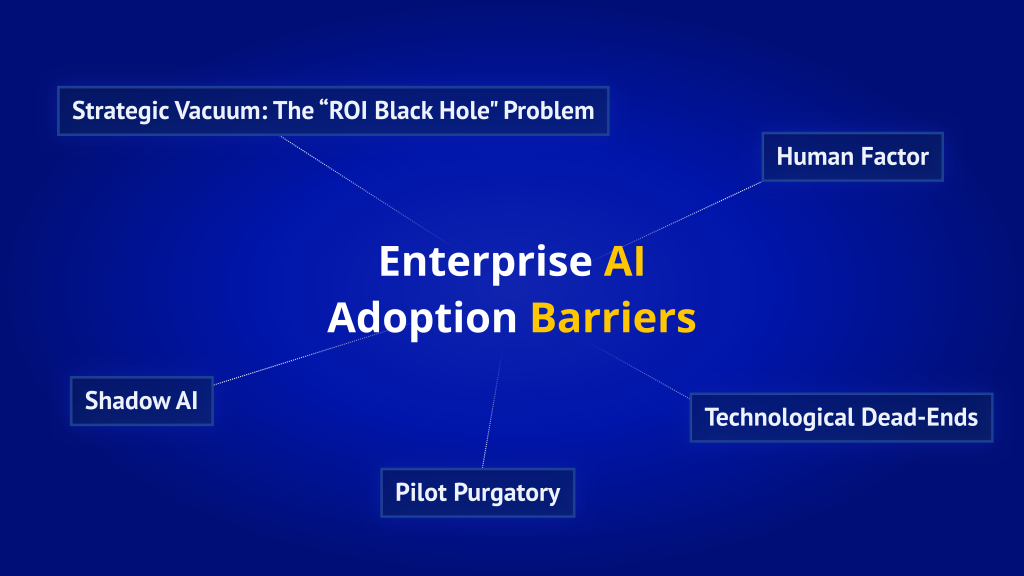
Barrier #1: Strategic Vacuum: The “ROI Black Hole” Problem.
Technical leaders (CTOs, CIOs, and CDOs) often find themselves trapped in a strategic paradox:
- They can’t get the budget to scale because they can’t prove ROI on the pilot.
- But they can’t prove ROI because they don’t have the budget for full integration.
This is, in a nutshell, what the so-called “ROI black hole” is – a gap between AI experimentation and AI value creation. It blocks organizations from moving beyond the prototype. So, what are the causes?
- According to Gallup research, 16% of respondents acknowledged that the main barrier is an unclear use case or value proposition. Companies are implementing AI because of its popularity or copying competitors, but not to solve specific business problems.
- McKinsey’s 2025 Global AI Survey confirms that the absence of a cohesive AI strategy is the single biggest barrier to scaling AI. Even though 88% of organizations use AI somewhere, only 39% see any EBIT impact. Most initiatives die at the PowerPoint presentation stage because they cannot clearly demonstrate how exactly AI agents will save the money.
How to overcome the strategic vacuum barrier?
- Identify bottlenecks: expensive and slow processes, uncertain data quality in the reports, or customer pain points are the main target for AI implementation.
- Define the value of AI: it can be a short list of theses that describe which problems AI will address, how, and what the impact would be in the long-term perspective.
- Proof of concept (POC): deliver fast wins to show executives the effectiveness of an AI solution.
Barrier #2: Human Factor
There is a growing disconnect between executives who want changes and people who resist them. But the reasons here are mostly explainable and disappointing at the same time:
- Skill gap: The main technical obstacle is a lack of AI skills and expertise (33%), as IBM reported. Many teams just don’t know how to build reliable RAG pipelines, while integration complexity may be extremely high.
- Silent sabotage: 11% of employees openly resist changes in the way they work. People are afraid of AI, as they think it would steal their work and consider artificial intelligence more as a threat than a helpful tool. It is a phenomenon called “Silicon Ceiling” described by BCG.
How to overcome the human factor barrier?
- Training of personnel: train your employees to work with AI tools to fill skill gaps and save workplaces. AI is a helper, not an enemy.
- Increase knowledge about AI: organize some webinars or lectures about AI effectiveness and necessity so that people will know more about it and will gain helpful skills.
In turn, EpicStaff is easy enough and doesn’t require long and costly training, providing an intuitive visual interface that is easy to use for no-code users.
Barrier #3: Shadow AI
This is the most underestimated threat from enterprise AI adoption barriers in 2025. It is a situation when employees use external public AI models like ChatGPT or Gemini for decision-making or processing large volumes of data without control.
- Scale: 78% of users bring their own AI tools to work (BYOAI), according to CloudSphere research.
- Risk: It leads to massive data leaks – 43% of employees admitted to sharing confidential information with public chatbots, as was reported in the “Shadow AI Statistics” study. As a result, organizations lose their most valuable asset: data.
How to overcome the Shadow AI barrier?
- Increase awareness of Shadow AI: train your employees to work with secure tools.
- Corporate AI platforms: the most effective way to address this AI adoption barrier is to invest in your own secure AI tools. Create centralized self-hosted or cloud platforms that keep data inside enterprise boundaries.
- External secure tools: use external AI enterprise tools that offer strong security and compliance.
EpicStaff is an open-source platform that has proved its security by dozens of low-code and technical users and is built directly to scale for enterprise level.
Barrier #4: Technological Dead-Ends
Even if you have the right people with the right skills, technologies may not serve all your needs.
- Limitation: most pilots are built on visual low-code tools, which create brittle workflows, as the Lunabase reports. They look really beautiful and promising at the demos but fail when the first API error or change in the structure occurs. As a result, they rarely can handle large volumes of data, making it impossible for large organizations to use it.
- Spaghetti effect: trying to implement complex business logic (loops, conditions, error handling) in a visual builder usually turns the workflow into an unreadable “tangle of wires” that is impossible to maintain.
How to overcome the technological dead-ends barrier?
Use the hybrid approach that combines visual workflow design with coding. It will allow you to visualize the data flow and clearly see the whole process. But write business logic in code (Python/JavaScript) so only developers can create complex features and handle errors. This delivers enterprise-grade stability that pure no-code tools cannot provide. In turn, EpicStaff combines visual workflow builder and ability to add your own custom code to extend the platform’s functions.
Barrier #5: Pilot Purgatory
The fifth problem is the result of all previous enterprise AI agents adoption barriers – the pilot purgatory. As was discussed above, it is a situation when a big variety of pilots were launched, but only a few were able to scale into production. A lot of resources were invested in projects that don’t deliver any business value, so, as a result, stakeholders lose confidence in AI adoption.
How to overcome the pilot purgatory barrier?
- Deploy a self-hosted orchestration platform: banning ChatGPT doesn’t work, it only pushes the problem away. Give your employees an intuitive user interface so they can quickly get used to the tool, but run it on your own infrastructure to ensure security and compliance. You turn the risk of Shadow AI into a powerful opportunity to grow and transform.
- Hybrid architecture: stop trying to click complicated logic with a computer mouse. Instead, use an approach that combines visualization and code to build workflows faster.
- AI agent orchestration: general-purpose chatbots hallucinate because they try to know everything. So, instead of using just one “AI assistant,” create a team of specialized agents. Each of them will have a specific role, such as decision-making or processing large volumes of data. Direct specialization reduces hallucinations and allows you to clearly measure the ROI of each digital employee.
EpicStaff Solution: Overcoming Barriers to AI Adoption in Large Organizations
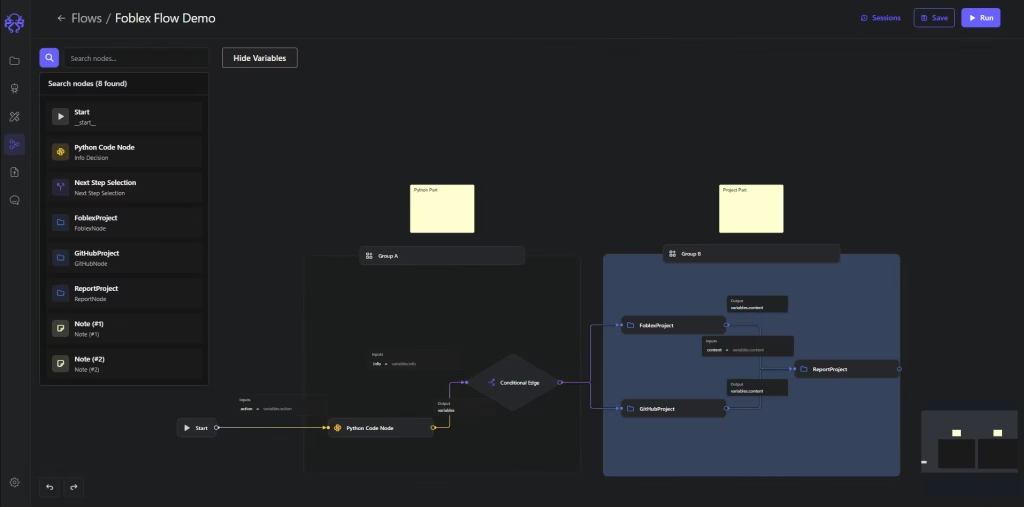
As we discussed before, one of the best ways to address AI adoption challenges for enterprises is to use secure tools that provide advanced features and hybrid architecture. EpicStaff is a workflow automation platform based on the AI agent orchestration principle, which can be a perfect solution for cross-department collaboration in large enterprises as well as for solopreneurs and no-code enthusiasts. Why? Let me explain in more detail.
Core abilities of EpicStaff
- Users can create their own custom virtual ‘staff’ (AI agents), assign different roles and responsibilities, and ask them to do some tasks. For instance, Collector Agent can gather the data from user forms, Analyst Agent will analyze and segment your customers, and Reporting Agent will give you full reports.
- The system’s functionality is oriented towards the dual audience – low-code users and technical specialists. It allows companies to use the platform to automate business processes across various departments such as marketing, project management, sales, etc., not only software development.
- Technical users can add custom Python code to extend the platform’s functions and integrate it with lots of the third-party tools for the company’s needs. It gives the opportunity to scale the system across all enterprise requirements and personalize it for specific problems.
- You can train the system on your own studies and research or increase the data quality and the accuracy of answers by uploading external knowledge resources. It can be various PDF, DOCX, and so on.
- The installation is quite simple, as well as getting used to the visual workflow builder. It doesn’t require technical expertise, so you don’t need to worry about integration complexity.
- And the most important thing here – EpicStaff is an open-source, self-hosted platform. It means that it has a large open community and is reviewed by thousands of developers around the world. It also has open code, so your IT team can check the security before installation.
EpicStaff has already gained popularity across the users and shows the steady growth of stars and forks in its GitHub repository. So don’t hesitate to discover all its opportunities for your business.
Download EpicStaff now for free to gain a powerful competitive advantage.
Read More: 10 n8n Alternatives: Best Workflow Automation Tools in 2025
Conclusion
Let’s now briefly summarize the main points of the article:
- In 2025 more companies have begun to invest less in AI because of enterprise AI adoption barriers.
- The main reasons why organizations are struggling to adopt AI are:
- Strategic vacuum: when executives don’t want to invest in AI because it hasn’t shown its effectiveness, but it can’t show it without investments.
- Human factor: when internal employees are scared of AI implementation and start to sabotage the innovations.
- Shadow AI: uncontrolled usage of external AI tools by employees that share confidential information with chatbots.
- Technological dead-ends: when the tool isn’t scalable enough to cover all business needs or can easily crash because of load.
- Pilot purgatory: unites all above points. The company is in a situation where there are a lot of pilots that don’t move to the production level.
- To overcome these problems, organizations need to train their teams to work with AI, choose secure and scalable tools, or develop their own solutions with needed functions that will support data integration. They also should focus on the AI-first approach and advanced AI agent orchestration to succeed in proper workflow automation.
If you’re struggling to find a perfect solution for your business, try EpicStaff for free today and explore how it can empower your business processes.
FAQ
Q: What is the main reason why AI initiatives fail?
Many AI initiatives fail because they have faced one of the biggest enterprise AI agent adoption barriers called “pilot purgatory”. It is a situation when a company has created a lot of concepts and project demos, but none of them reached production level. Some organizations can stall in this state for too long, making stakeholders less confident in AI adoption.
Q: What are the biggest barriers to enterprise AI adoption in 2025?
The biggest concerns of enterprise department managers about AI adoption are the following:
- Strategic vacuum: executives don’t want to invest in AI but want an effective automation solution.
- Human factor: people are scared of AI or don’t want to change their working methods.
- Shadow AI: unregulated usage of external AI systems by employees.
- Technological dead-ends: systems don’t always cover all business needs or can’t scale enough to be suitable.
- Pilot purgatory: a lot of pilots are created, but none of them reach production and stay on the prototype stage.
Q: What is the best tool to overcome AI adoption barriers?
In 2025, EpicStaff is the best platform to overcome AI adoption barriers because:
- It is oriented on both technical and no-code users.
- It is scalable and perfectly suitable for large enterprises.
- It supports customization.
- It supports external data injection for increasing data quality and accuracy.
- It is fully secure and compliant.
Q: How to overcome AI adoption barriers?
To overcome existing enterprise AI adoption barriers, you should:
- Train your employees to work with AI tools and increase their awareness about Shadow AI danger.
- Create your own corporate tools that will be secure enough to handle large volumes of data and help teams in decision-making.
- Implement an AI-first approach and AI agent orchestration, where multiple AI agents will be responsible for different specific roles.
Q: What is Shadow AI?
Shadow AI is unauthorized use of artificial intelligence tools by enterprise employees, often without compliance or approval.
Q: Why do most AI pilots fail to scale?
Many pilots fail to scale because they are built in isolated environments and do not adapt to the real world for real-world operational complexity.
Q: How can organizations reduce Shadow AI usage?
Organizations can create their own internal AI solutions that will provide proper security and access control to avoid data breaches and leaks.
Q: What is the most effective way to integrate AI into existing processes?
- Define the value: identify what pain points AI would solve. If you don’t do that, the project will be stuck at the pilot stage.
- Design an intuitive interface: the clearer the interface is, the easier the employees will adapt to it, and the less money the company will spend on AI adoption.
- Teach your employees: create a training program for the company workers so they can quickly get used to the tool.