
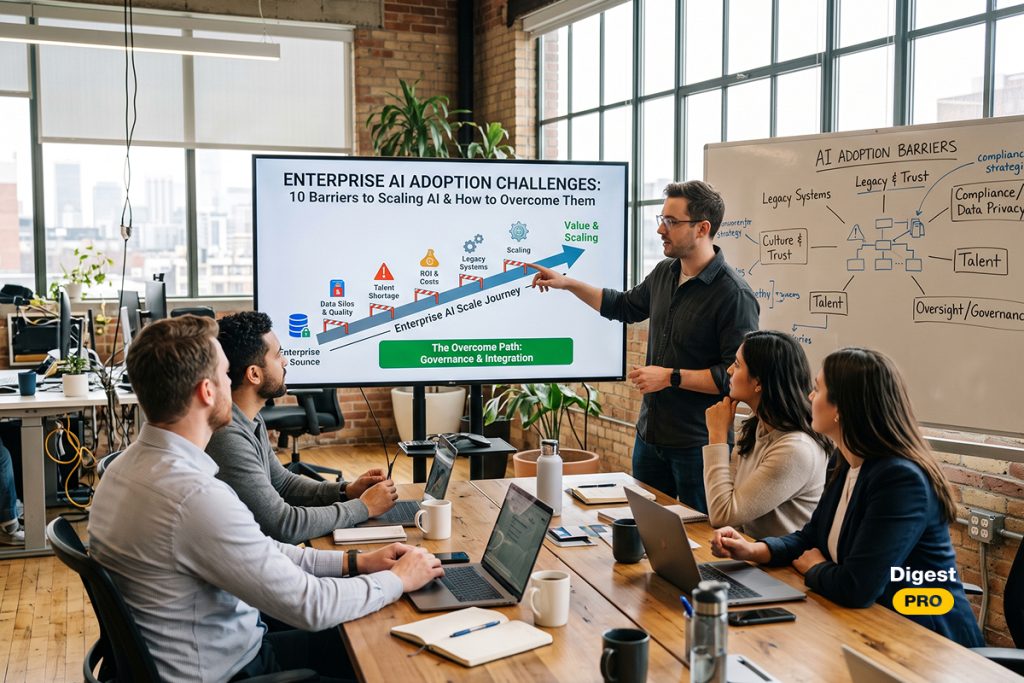
AI adoption challenges become expensive when a promising pilot has no credible route into everyday operations. More companies are scaling AI, but financial impact remains uneven. McKinsey’s August 2026 survey reports that 44% of respondents’ organizations are scaling AI across the enterprise, while 37% attribute some enterprise-level EBIT impact to AI. These are different measures, not successive steps in a conversion funnel [1]. For leaders planning their next investments, the useful question is where delivery stops: at the business case, the data, the workflow, or the authority to act. This guide diagnoses ten enterprise AI adoption challenges and explains how to remove the constraint that is actually holding a use case back.
Executive Summary
- Identify the first blocked handoff between a tested output and a completed business process.
- Give every use case a baseline, a process owner, and a decision date before funding a pilot.
- Evaluate data readiness against a specific task, including access rights and conflicting records.
- Train employees to verify outputs and manage exceptions, and allocate time for that work.
- Expand autonomy only after production evidence supports the next permission level.
Where Enterprises Get Stuck: Leaders, Laggards and the Stuck Majority
Enterprises get stuck when their technical progress outruns their ability to change a working process. A useful diagnosis separates companies that can repeatedly deliver value, companies still building essential capabilities and teams with successful experiments that cannot sustain production. The last category describes an operational condition, not a standardised market segment.
BCG’s 2025 research classified 5% of surveyed companies as “future-built”, 35% as “scalers”, and 60% as “laggards”. Its survey covered 1,250 senior executives and AI decision-makers. Those are BCG’s categories; “stuck majority” is Digest.Pro’s shorthand for the difficulty of moving a useful experiment into routine delivery. It should not be presented as a fourth BCG category or assigned a percentage by subtraction. [2]
The surveys also measure different things. IBM’s 2025 study of 2,000 CEOs reported that 25% of AI initiatives had delivered expected ROI and 16% had scaled enterprise-wide over the preceding years. These are initiative-level estimates reported by CEOs, not percentages of companies. [3] Compare the findings as evidence of an execution gap, rather than merging them into one adoption chart.
Use the following stages to locate your AI adoption barriers. A project may clear one stage in a business unit and remain blocked elsewhere.
| Stage | Evidence needed to move forward | Common constraint |
|---|---|---|
| Start | A measurable process problem and an accountable owner | Business case, data access, staff capability |
| Pilot | Representative cases completed with acceptable review effort | Trust, permissions, integration, costs |
| Scale | Repeatable outcomes under normal demand and exceptions | Support capacity, control evidence, operating economics |
Ask the owner to show a completed transaction, including the exception path. A slide showing model accuracy cannot tell you whether the team can obtain approval, update the correct system, and recover after a timeout. That distinction connects this diagnosis to broader digital transformation challenges: changing the process is part of the investment.
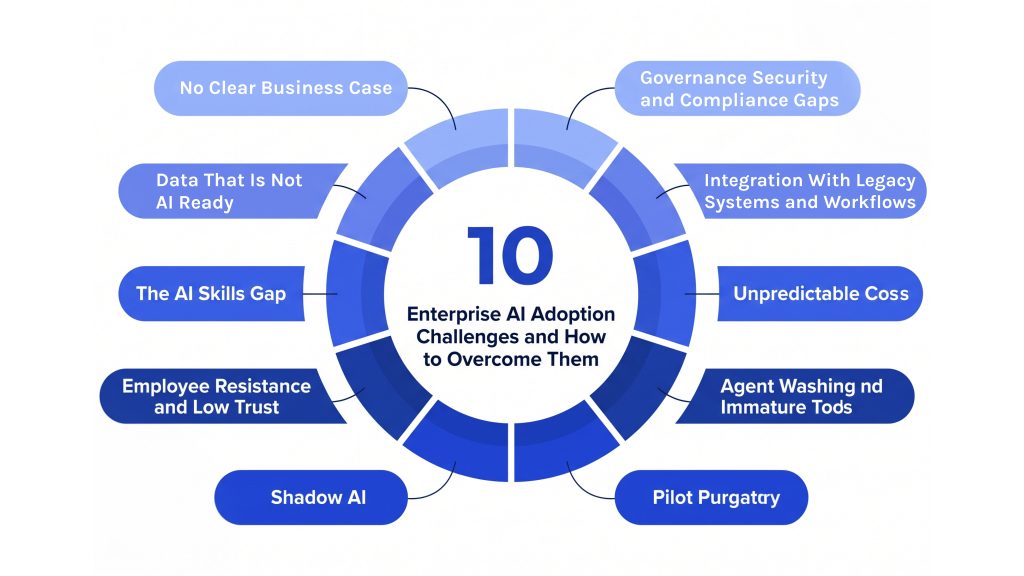
10 Enterprise AI Adoption Challenges and How to Overcome Them
The ten barriers below cover business ownership, information quality, employee adoption, and production execution. Start with the earliest unresolved dependency in your workflow. Solving that dependency often improves several downstream symptoms. Buying another model or adding more agents usually cannot repair an absent owner, an inaccessible record, or an unapproved action.
Barrier 1: No Clear Business Case
Warning signs. The proposal promises hours saved but cannot identify whose workload changes, what will happen with the freed capacity, or which outcome improves. Finance requests ROI evidence; the delivery team requests funding to discover it. Neither side has defined the experiment that would resolve the uncertainty.
IBM’s 2025 CEO study found that 64% of surveyed CEOs invested in some technologies before clearly understanding their value, driven by concern about falling behind. This finding covers technology investments, not AI alone [3]. Competitive pressure can authorize discovery; it cannot establish the economics of a rollout.
How to overcome it. Write a one-page value hypothesis. Identify the transaction, present baseline, expected change, acceptance criteria, and full operating cost. Distinguish released capacity from cash savings: faster work creates a financial saving only if spending changes, avoidable hiring is reduced, or valuable throughput rises.
For an illustrative service-desk pilot, measure correctly resolved requests and total analyst review time. A shorter first response does not resolve the ticket. Fund the test to establish whether the complete process improves.
Barrier 2: Data That Is Not AI Ready
Warning signs. The demo uses cleaned examples; production contains outdated policies, duplicate customers, and inconsistent identifiers. Two sources disagree, and the agent cannot determine which one is authoritative. Access permissions may also differ between the pilot team and actual users.
Gartner’s February 2025 forecast predicted abandonment through 2026 of 60% of AI projects unsupported by AI-ready data. That is a conditional forecast, not an observed failure rate for all AI projects. Its associated survey covered 1,203 data management leaders in July 2024 [4].
How to overcome it. Assess AI data readiness for the chosen task. Specify authoritative fields, update frequency, provenance, permitted users, and the response to a missing or conflicting value. Test difficult records rather than only average cases.
For retrieval systems, RAG pipelines need permission-aware retrieval and freshness checks. Retrieval can supply relevant text; it cannot make a superseded policy valid. In manufacturing, inconsistent equipment identifiers or maintenance timestamps can similarly invalidate an otherwise fluent recommendation. Give the data owner responsibility for resolving these defects before expanding access.
Barrier 3: The AI Skills Gap
Warning signs. Employees receive accounts and a general prompting webinar, then are expected to redesign sensitive workflows. They can generate outputs but cannot distinguish a supported answer from a convincing fabrication. Managers lack a method for evaluating the new work.
IBM’s 2026 study surveyed 2,000 CEOs between February and April. Respondents estimated that only 25% of their workforce regularly used AI, although 86% believed employees had the skills to collaborate with it. These are CEO assessments, not direct employee proficiency tests [5]. BCG’s 2025 survey of more than 10,600 workers found that only 36% felt adequately trained [6].
How to overcome it. Close the AI skills gap by role. Analysts need source verification and safe data handling; process owners need evaluation criteria; engineers need integration and recovery skills; reviewers need meaningful approval procedures.
Require a practical assessment using realistic errors and exceptions. Reserve working time for training and coaching. Someone who knows how to request a summary may still be unprepared to approve a journal entry or recognize a manipulated document. Measure competence at the actual responsibility being delegated.
Barrier 4: Employee Resistance and Low Trust
Warning signs. Staff duplicate every AI task manually, avoid the approved tool, or approve suggestions without reading them. Each behavior can make adoption statistics look healthier than the underlying process. Resistance may reflect experience with errors, unclear accountability, or uncertainty about job changes.
BCG’s 2025 worker survey found that 41% of respondents worried their roles could disappear within a decade [6]. That concern deserves a concrete management response. General assurances will carry little weight if a team cannot explain how performance expectations and responsibilities will change.
How to overcome it. Involve frontline reviewers in selecting test cases and designing escalation. Explain which responsibilities remain theirs, what the agent may do, and how errors will be reported without penalizing good-faith challenges.
Address generative AI challenges at the point of use. Display supporting records, flag missing evidence, and make it easy to reject an output. Test whether reviewers detect a deliberately incorrect suggestion. A human approval step only adds protection when the person has sufficient information, time, and authority to disagree.
Barrier 5: Shadow AI
Warning signs. Work appears in personal chatbot accounts, browser extensions, or privately connected automation services. Security cannot identify which tools hold company information. Employees describe these tools as the only practical way to meet their workload.
Microsoft and LinkedIn’s 2024 Work Trend Index found that 78% of AI users brought their own AI tools to work. The survey covered 31,000 people across 31 markets. This measures BYOAI, not proven policy violations: personally chosen tools can be authorized [7]. Shadow AI specifically concerns use outside an organization’s approved controls.
How to overcome it. Make approved tools useful and accessible. Define permitted data categories, explain retention and provider access, and establish a timely process for requesting additional capabilities. Give employees a route to disclose existing use without turning discovery into concealment.
Self-hosted AI agents can be appropriate where deployment control matters. Inspect model endpoints, telemetry, and connected tools as well as the hosting location. A locally hosted runtime can still transmit sensitive information to an external service if its configuration permits that connection.
Barrier 6: Governance, Security, and Compliance Gaps
Warning signs. The company has an AI policy but cannot list which agents can read customer records, send messages, or change transactions. An approval appears in a chat transcript without being enforced by the system that performs the action.
Deloitte’s 2026 State of AI research covered 3,235 business and IT leaders in 24 countries. Only 21% reported mature governance for agentic AI [8]. A policy document and an operational permission boundary are separate capabilities.
How to overcome it. Assign an owner and a distinct identity to every production agent. Enforce tool permissions, approval requirements, and spending limits outside the model’s instructions. Maintain a record of actions and test access revocation.
For EU deployments, classify the intended use rather than assuming all agents face identical rules. As of October 7, 2026, the European Commission lists transparency rules as applicable from August 2, 2026; Annex III high-risk requirements from December 2, 2027; and relevant product-embedded requirements from August 2, 2028, following the AI Omnibus [9]. Map the applicable obligations to the workflow; postponement of one category does not suspend the others.
Barrier 7 Integration With Legacy Systems and Workflows
Warning signs. The agent prepares a useful result, but an employee must copy it into three systems. A retry creates a duplicate record, or the process fails whenever the ERP is unavailable. The pilot succeeds because its developers repair these failures manually.
Gartner’s February 2026 cloud ERP analysis identifies integration complexity among the barriers slowing finance adoption [10]. Enterprise AI implementation challenges therefore extend beyond the model to transactional behavior and the surrounding operating process.
How to overcome it. Map the complete agentic workflow, including source systems, approvals, write operations, and exception ownership. Use supported interfaces where possible. Require an idempotency mechanism so a repeated request cannot silently create a second transaction.
Test timeouts, stale credentials, partial writes, and unavailable dependencies. If an update succeeds but the acknowledgment is lost, the system must check the transaction state before retrying. Interface choice alone does not determine reliability. Whether reviewing n8n alternatives or custom development, inspect how the actual workflow preserves state and recovers.
Barrier 8: Unpredictable Costs
Warning signs. The forecast prices one model response, while production needs retrieval, repeated reasoning, tool calls, and human review. Difficult cases consume disproportionate resources. The team reports token spending but cannot calculate cost per accepted result.
Deloitte’s second-quarter 2026 CFO Signals survey covered 200 CFOs at North American organizations with at least $1 billion in revenue. Cost uncertainty or lack of transparency was the leading internal AI concern, selected by 46% [11]. This is a large-company CFO sample, not a cost benchmark for every enterprise.
How to overcome it. Track the cost of a completed process, including unsuccessful attempts and reviewer time. Separate fixed platform and integration costs from variable usage. Set limits on steps, retries, elapsed time, and access to expensive tools.
Run a representative workload and inspect expensive exceptions before projecting savings. In an illustrative finance reconciliation, one cheap match and one long investigation are different cost units. Average token prices conceal that distinction. Evaluate AI agents in finance against approved reconciliations and unresolved exceptions, with the same quality standard used for the human baseline.
Barrier 9: Agent Washing and Immature Tools
Warning signs. A vendor describes a chatbot or fixed automation as autonomous without showing how it chooses actions, checks results, or handles exceptions. Marketing claims do not identify the permissions needed in your environment.
Gartner’s June 2025 analysis described “agent washing” and estimated about 130 substantive agentic vendors. This was a dated analyst estimate, not an audited market count. It also forecast cancellation of more than 40% of agentic projects by the end of 2027, not an observed failure rate. [12]
How to overcome it. Require evidence from your own workflow. Use five questions in the evaluation:
- Which actions does the system choose dynamically?
- Which data and tools can it access, and under whose authority?
- What prevents an unauthorized or duplicate write?
- What happens when an input is misleading, or a dependency fails?
- Can you export the evidence and calculate cost per accepted outcome?
Compare answers with implementation evidence when reviewing the best AI agent frameworks. A framework can support agent development without supplying production controls automatically. Agentic AI trends provide useful market context, but your acceptance test should determine the procurement decision.
Barrier 10: Pilot Purgatory
Warning signs. Every quarterly review approves another experiment, while no team accepts production ownership. The same promising pilot returns with a new model and unchanged integration problems. Success criteria move whenever the original target is missed.
McKinsey’s 2025 survey of 1,993 respondents found that no more than 10% reported scaling agents in any individual function. That is a historical agent-specific baseline, separate from the broader AI scaling measure in its 2026 research [13].
How to overcome it. Establish a decision date and evidence requirements before work starts. Scale only when outcome quality, exception handling, permissions, operating cost, and support capacity meet the agreed threshold. Fix a specific dependency if a credible route remains. Stop when the value hypothesis no longer holds.
For a workflow using AI agent orchestration, add explicit handoff and termination tests. A larger agent team creates more paths that can fail. Expansion is justified when those paths improve completed outcomes sufficiently to cover coordination and review costs.
Use this compact diagnostic in a portfolio review.
| Barrier | Warning sign | First fix |
|---|---|---|
| Business case | No measurable baseline | Define value and owner |
| Data readiness | Sources conflict | Assign authoritative records |
| Skills | Users cannot verify outputs | Train by responsibility |
| Trust | Duplicated work or blind approval | Redesign review and escalation |
| Shadow AI | Unknown tools hold work data | Provide a usable approved route |
| Governance | Policy cannot block actions | Enforce permissions at execution |
| Integration | Failures need developer rescue | Test transaction recovery |
| Costs | Token bill replaces unit economics | Price accepted outcomes |
| Tool maturity | Demo cannot explain its authority | Require workflow evidence |
| Pilot purgatory | No production decision | Set scale and stop criteria |
The Business Impact of AI Adoption Challenges
These challenges waste development effort, create avoidable review work, and delay process improvements. They also introduce risks through unmanaged tools or actions. Assess the business impact against the complete process and its counterfactual. A minute saved in an isolated task does not necessarily produce a financial benefit for the organization.
Consider an illustrative invoice workflow that accelerates extraction but increases approval backlogs. The bottleneck has moved; cash processing may be no faster. A useful review asks whether throughput rose, errors fell, and employees redirected time to work the business actually needed. Include ongoing support and control costs before concluding that the use case pays for itself.
How to Move From Pilot to Scale in Six Steps
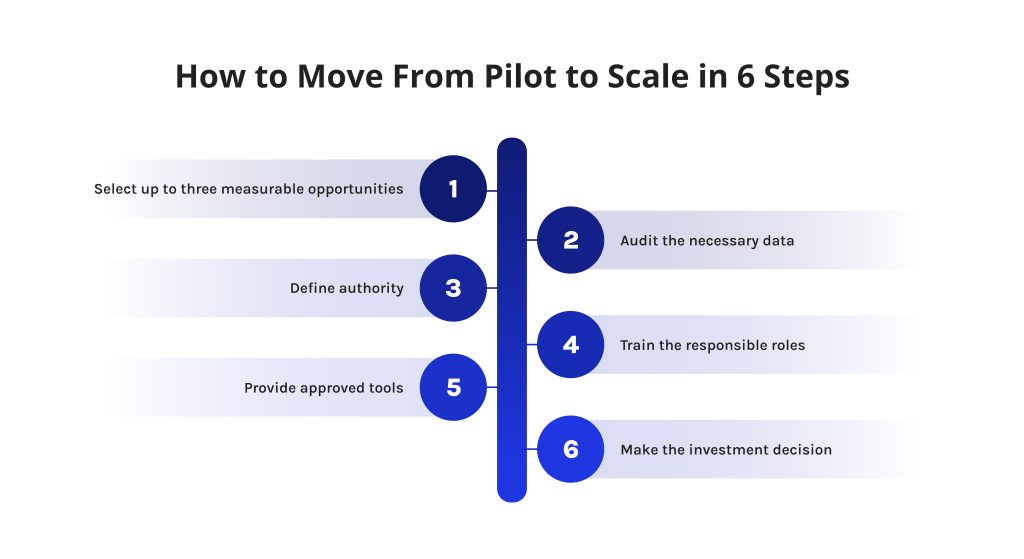
Move from pilot to scale by agreeing on value, testing the prerequisites, and delegating authority gradually. Keep the first portfolio small enough to learn from. Expansion should follow evidence of dependable outcomes under realistic conditions, including exceptions. A pilot that has exhausted its value hypothesis needs a closure decision, even when its demo remains impressive.
- Select up to three measurable opportunities. Give each a process owner, a baseline, and an intended business result.
- Audit the necessary data. Resolve access, definitions, and freshness for those processes before broad platform work.
- Define authority. Specify allowed actions, approval thresholds, escalation, and how access can be revoked.
- Train the responsible roles. Allocate reviewer time and assess whether people detect errors.
- Provide approved tools. Match the access route to actual employee needs and information restrictions.
- Make the investment decision. Compare realized outcomes with total costs and apply the agreed scale, repair, or stop criteria.
Document that decision in a short-term contract: owner, permitted actions, service expectations, unit cost ceiling, exception capacity, and review date. The contract makes a rollout assessable by the business team that must operate it.
How a Governed Agent Platform Helps: The EpicStaff Example
A governed platform can supply a consistent environment for approved agent workflows, but the organization still has to define its data boundaries, authority, and operating procedures. Evaluate the platform against the barriers in your process. Deployment control and visibility are useful prerequisites; they do not establish the business case or validate accounting decisions.
EpicStaff is a source-available, self-hosted platform for building and running AI agent flows with a visual editor and custom code. Its public materials describe role-based access and an action audit trail; the GitHub repository provides the source and implementation documentation.
This illustrates how an approved execution environment can address shadow tooling, integration, and oversight together. Teams still need to review outbound model and tool connections, test whether permissions enforce their intended rules, and prove that the workflow delivers value. Self-hosting gives control over deployment; keeping a particular dataset inside a defined perimeter also depends on configuration and connected services.
Our Methodology
This article reviews primary research and official documentation available on October 12, 2026. Surveys retain their dates, samples, and units of analysis; forecasts remain forecasts. We do not combine percentages from different studies into a single funnel. The stages, diagnostic, and scale contract are Digest.Pro’s editorial frameworks. Workflow examples are illustrative, not reported customer results. Product descriptions reflect public documentation, rather than an independent implementation audit.
Key Takeaways
- Enterprise AI adoption challenges become manageable when teams locate the specific blocked dependency.
- Production decisions need evidence of value, reliable data, enforceable authority, and workable exception handling.
- Measure accepted outcomes and total operating cost before increasing volume or autonomy.
- Stop weak pilots and concentrate investment on workflows that can sustain delivery.
References
1. McKinsey. The state of AI in 2026: On the road to ROI. August 25, 2026. Survey fielded May 4–June 8, 2026; n=1,719. Read source
2. BCG. The Widening AI Value Gap. September 30, 2025; n=1,250. Read source
3. IBM Institute for Business Value. CEOs Double Down on AI While Navigating Enterprise Hurdles. May 6, 2025; n=2,000. Read source
4. Gartner. Lack of AI-Ready Data Puts AI Projects at Risk. February 26, 2025; underlying data-management survey July 2024, n=1,203. Read source
5. IBM Institute for Business Value. CEOs are Reshaping C-suite Roles for the AI Era. May 4, 2026; n=2,000. Read source
6. BCG. Companies Must Go Beyond AI Adoption to Realize Its Full Potential. June 26, 2025; n>10,600. Read source
7. Microsoft and LinkedIn. 2024 Work Trend Index. May 8, 2024; n=31,000. Read source
8. Deloitte. Business and IT leaders report AI agents are scaling faster than their guardrails. April 24, 2026; State of AI survey n=3,235. Read source
9. European Commission. AI Act regulatory framework and application timeline. Accessed October 7, 2026. Read source
10. Gartner. Embedded AI in Cloud ERP Applications and Financial Close. February 24, 2026. Read source
11. Deloitte. Second-quarter 2026 CFO Signals. July 23, 2026; n=200. Read source
12. Gartner. Agentic AI Project Cancellation Forecast. June 25, 2025. Read source
13. McKinsey. The state of AI in 2025: Agents innovation and transformation. November 5, 2025; n=1,993. Read source
FAQs
The most consequential AI adoption challenges are an unclear business case, unsuitable data, insufficient role-specific skills, weak trust, and incomplete governance. Integration and operating costs then determine whether a useful pilot can scale. Diagnose the first blocked dependency in your process rather than assuming every organization needs the same sequence of fixes.
There is no universal failure rate. IBM’s 2025 CEO study reported that 25% of initiatives delivered expected ROI, which does not mean the remainder all failed. Gartner’s abandonment forecasts concern particular project categories and future deadlines. Compare definitions, time periods, and populations before using a percentage in an investment decision [3, 4, 12].
Pilots stall when their test environment excludes the constraints of real work: imperfect records, restricted access, integration failures, review effort, and operating costs. Some experiments should be closed because the value hypothesis fails. Those that proceed need a business owner, a tested exception path, and explicit acceptance criteria for production.
Shadow AI is AI used outside an organization’s approved oversight, including unreviewed accounts, connectors, and automated workflows. Reduce it by supplying useful approved tools, specifying permitted data, and offering a practical approval route. Personally chosen AI is not automatically unauthorized; classify the actual tool and use before treating BYOAI as a policy breach.
Choose against your workflow’s requirements: deployment location, supported integrations, permission enforcement, approval handling, action records, recovery, and total operating cost. Test those capabilities with representative transactions and exceptions. Inspect source-access license terms separately from hosting options. A feature checklist cannot establish whether the platform meets your production acceptance criteria.
Map the process from input to accepted outcome, including the people and systems responsible for each handoff. Introduce AI where it can improve that outcome. Preserve transaction controls, define exception ownership, and test partial failures before rollout. Embedding a helpful suggestion in a dashboard is insufficient if completing the task still requires unmanaged manual work.
AI adoption concerns whether people and the organization use AI effectively, including trust, skills, and business ownership. AI implementation concerns the technical delivery of a working system, including data, integration, and deployment. The categories overlap: a poorly integrated tool discourages adoption, while unclear ownership prevents a technically sound implementation from becoming operational.